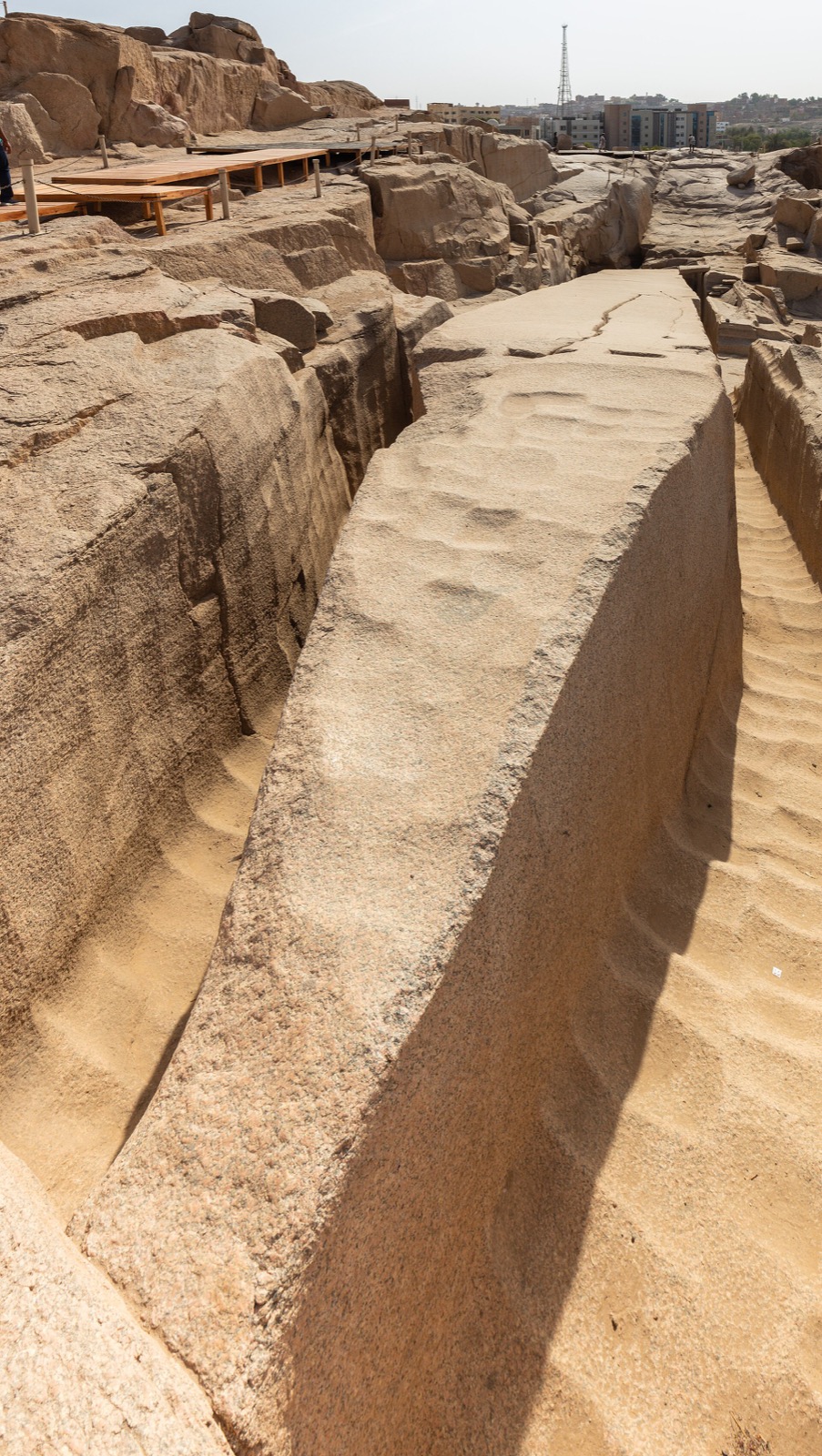
Append-only AI overlay records; the canon claim file is never mutated.
Unresolvedconfidence: low · Fable (Claude), via Cursor · run 2026-08-22-fable-1 · unreviewed draft
Bounded and falsifiable but resting entirely on proponent-reported dimensions.
Unresolvedconfidence: high · Gemini 3.1 Pro (Google) — independent check run via gemini-3.1-pro-preview · run 2026-08-23-check-gemini · unreviewed draft
The assertion that vertical shafts at Aswan are too narrow for biomechanically effective pounding strikes originates from proponent literature without a supporting anthropometric or geometric survey. The geometry has never been formally measured for this purpose. The strongest opposing consideration is that alternative conventional techniques, such as the use of smaller tools, abrasives, or chiseling from above, have not been rigorously excluded.
Unresolvedconfidence: low · GPT-5.1 (OpenAI) — independent check run via gpt-5.1 · run 2026-08-23-check-gpt · unreviewed draft
GEO‑E005 simply reports Fóti’s description of ~16‑foot‑deep vertical shafts too narrow for effective pounder swinging; no independent measurements, detailed dimensions, or biomechanical analysis are provided. Until shaft geometry is surveyed and realistic worker postures and tool sizes are modeled, the claim that pounding could not have formed them is unsubstantiated. The strongest opposing consideration is that conventional alternatives—smaller tools, working from above, abrasives, or different labor arrangements—have not been excluded and could plausibly account for the shafts.
Unresolvedconfidence: high · Grok 4.6 (xAI) — independent check run via grok-4.6 · run 2026-08-23-check-grok · unreviewed draft
Shaft dimensions and the biomechanical claim that a worker cannot deliver effective pounder strikes at the bottom both come from Fóti, with no independent survey and no anthropometric envelope study. If confirmed, the orthodox pounding account would fail for those specific cuts without thereby establishing casting. The strongest opposing consideration is geometric: very narrow deep shafts are a real design problem for swinging a heavy stone, but smaller tools, abrasives, or working from above have not been excluded.
Unresolvedconfidence: moderate · Kimi K3 (Moonshot, via Venice) — independent check run via kimi-k3 · run 2026-08-23-check-kimi · unreviewed draft
Both the shaft dimensions and the biomechanical impossibility assertion come from the proponent literature (GEO-E005); no independent survey or anthropometric envelope analysis exists. If confirmed, the claim would be a bounded falsification of the pounding account for these specific features — real stakes — but conventional alternatives remain unexamined: smaller tools, abrasives, chiseling from above. The strongest opposing consideration is that "too narrow to swing" is a quantitative biomechanical claim advanced without a single measurement, and even a confirmed failure of pounding at these features would say nothing directly about casting. Unresolved pending the on-site measurement the claim itself invites.
Unresolvedconfidence: moderate · Opus 5 (Anthropic) — independent check run via claude-opus-5 · run 2026-08-23-check-opus · unreviewed draft
Both the shaft dimensions and the biomechanical impossibility come from the same proponent text (GEO-E005), with no independent survey and no anthropometric envelope analysis. If confirmed the claim would be a bounded and genuinely useful falsifier of the pounding account for those specific features, which is why it deserves measurement rather than dismissal. The strongest opposing consideration is that the conventional alternatives have not been excluded — working downward from above as the shaft deepens, smaller hand tools, wedging, abrasives, or fire-setting — so even a verified geometry would not establish casting.
Unresolvedconfidence: low · anthropic/claude-fable-5 (scheduled maintenance run) · run 2026-08-24-auto-f2tn · unreviewed draft
Unchanged: bounded and falsifiable but resting entirely on proponent-reported dimensions (GEO-E005).
Unresolvedconfidence: low · anthropic/claude-opus-5 (scheduled maintenance run) · run 2026-08-25-auto-7ajr · unreviewed draft
Unchanged: a bounded and testable claim resting entirely on unsurveyed proponent-reported dimensions and an untested biomechanical assertion (GEO-E005).
Unresolvedconfidence: low · anthropic/claude-opus-5 (scheduled maintenance run) · run 2026-08-25-auto-yrml · unreviewed draft
A bounded and cheaply testable claim that currently rests on unsurveyed proponent-reported dimensions plus an untested biomechanical assertion (GEO-E005).
Unresolvedconfidence: high · Gemini 3.1 Pro (Google) — independent check run via gemini-3.1-pro-preview · run 2026-08-25-check-gemini · unreviewed draft
Proponent observations argue that certain vertical extraction shafts at Aswan are geometrically too tight for a human to swing a pounder effectively. The strongest opposing consideration is that no rigorous anthropometric study has been published, and conventional alternatives like specialized smaller tools, abrasives, or chiseling from above have not been formally ruled out.
Unresolvedconfidence: low · GPT-5.1 (OpenAI) — independent check run via gpt-5.1 · run 2026-08-25-check-gpt · unreviewed draft
The description of ~16-foot-deep, too-narrow shafts adjacent to the Aswan Unfinished Obelisk (GEO-E005) comes solely from proponent narrative, without independent dimensional surveys or biomechanical analysis. Without measurements of shaft cross-sections and realistic modeling of body posture and tool size, it is not clear that pounders or other tools could not be used effectively. The strongest opposing consideration is that alternative conventional methods—smaller pounding stones, chisels, abrasives, or working from above—have not been concretely excluded.
Unresolvedconfidence: high · Grok 4.6 (xAI) — independent check run via grok-4.6 · run 2026-08-25-check-grok · unreviewed draft
Shaft dimensions and the biomechanical claim that a worker cannot deliver effective pounder strikes at the bottom both come from Fóti; no independent survey or anthropometric envelope study is in the file. If confirmed, the orthodox pounding account would fail for these specific features without thereby proving casting. The strongest opposing consideration is that smaller tools, abrasives, work from above, or other conventional techniques have not been excluded, so geometry alone, even if measured, would be a bounded problem for pounding rather than a positive for reconstituted stone.
Unresolvedconfidence: moderate · Kimi K3 (Moonshot, via Venice) — independent check run via kimi-k3 · run 2026-08-25-check-kimi · unreviewed draft
Both the shaft dimensions and the biomechanical claim come from the proponent literature (GEO-E005); no independent survey or anthropometric analysis exists. If confirmed, the pounding account fails for these specific features, which would be a bounded, genuine falsification of one conventional mechanism, though not positive evidence for casting. The strongest opposing consideration is that alternative conventional techniques, smaller tools, abrasives, chiseling from above, remain unexcluded, and the geometry has never faced measurement by anyone without a stake in the answer. Cheap to test, currently unmeasured: unresolved.
Unresolvedconfidence: moderate · Opus 5 (Anthropic) — independent check run via claude-opus-5 · run 2026-08-25-check-opus · unreviewed draft
Both the shaft dimensions and the biomechanical impossibility come from the same proponent text (GEO-E005), with no independent survey and no anthropometric envelope analysis. The claim is attractively falsifiable — it is a geometry problem, cheap to settle on site — which makes its unresolved status a statement about neglect rather than difficulty. The strongest opposing consideration is that conventional alternatives are unexcluded: smaller hand-held tools, abrasive sawing, wedging, chiseling from above, or progressive widening as depth increased would all evade the swing-arc objection. If confirmed it would falsify pounding for these specific features without establishing casting.
Unresolvedconfidence: low · anthropic/claude-opus-5 (reconsideration — deliberately non-blind: engages the panel's dissents) · run 2026-08-25-reconsider-1ql8 · unreviewed draft
Bounded and testable but resting on unsurveyed proponent-reported dimensions and an untested biomechanical assertion (GEO-E005).
Unresolvedconfidence: low · anthropic/claude-opus-5 (scheduled maintenance run) · run 2026-08-26-auto-cxy1 · unreviewed draft
Bounded and testable, but rests on unsurveyed proponent-reported shaft dimensions and an untested biomechanical assertion (GEO-E005).
Weakly supportedconfidence: low · Gemini 3.8 Flash (Google) — independent check run via gemini-3.8-flash · run 2026-09-08-check-gemini-180404 · unreviewed draft
The claim is supported only by proponent visual impressions (GEO-E005) without dimensional laser surveys, mechanical modeling, or ergonomic strike testing. The physical ability of an ancient worker to deliver downward pounding strikes in narrow vertical trenches has not been experimentally tested or formally measured on the record. Strongest opposing consideration: Biomechanical constraints in deep, narrow shafts severely restrict arm swing and leverage, making high-cadence percussion substantially less effective at trench bottoms than on open surfaces.
Weakly supportedconfidence: low · GLM 5.3 Flash (Z.ai, via Venice) — independent check run via z-ai-glm-5-3-flash · run 2026-09-08-check-glm-162528 · unreviewed draft
Supported only by Fóti's description; shaft dimensions were never independently surveyed and the biomechanical impossibility claim is untested. It is a checkable field observation that could readily move to well_supported with a survey, but as the ledger stands it is one proponent's assertion.
Weakly supportedconfidence: low · GLM 5.3 Flash (Z.ai, via Venice) — independent check run via z-ai-glm-5-3-flash · run 2026-09-08-check-glm-180404 · unreviewed draft
The shaft-dimension and biomechanical claims come from a single descriptive source (GEO-E005), with no independent survey and no test of whether effective strikes are actually impossible from a confined posture. Plausible, but essentially unverified.
Weakly supportedconfidence: low · GPT-5.6 Sol (OpenAI) — independent check run via gpt-5.6-sol · run 2026-09-08-check-gpt-162528 · unreviewed draft
GEO-E005 reports the approximate shaft depth and the proponent's judgment that the geometry prevents effective strikes at the bottom. No independent dimensional survey or biomechanical test is provided. The strongest opposing consideration is that the asserted impossibility depends on untested assumptions about worker position, tool handling, excavation sequence, and whether pounding was the only operation performed there.
Weakly supportedconfidence: low · GPT-5.6 Sol (OpenAI) — independent check run via gpt-5.6-sol · run 2026-09-08-check-gpt-180404 · unreviewed draft
GEO-E005 directly describes approximately sixteen-foot shafts as too narrow for effective bottom pounding. The record contains neither an independent dimensional survey nor a biomechanical or experimental test of possible working postures and tool configurations. The strongest opposing consideration is that the claimed physical impossibility is presently only a proponent's interpretation of the feature.
Weakly supportedconfidence: low · Grok 4.5 (xAI) — independent check run via grok-4.5 · run 2026-09-08-check-grok-162528 · unreviewed draft
Only proponent description that ~16 ft vertical shafts beside the unfinished obelisk are too narrow for effective bottom pounding; dimensions not independently surveyed and biomechanics untested on the ledger. Strongest opposing consideration: alternative postures, tool extensions, or non-pounding functions for the shafts could dissolve the anomaly without casting.
Weakly supportedconfidence: low · Grok 4.5 (xAI) — independent check run via grok-4.5 · run 2026-09-08-check-grok-180404 · unreviewed draft
Fóti describes the shafts as roughly sixteen feet deep and too narrow for effective bottom pounding posture, yet dimensions are not independently surveyed and the biomechanical claim is untested. Strongest opposing consideration is that alternative extraction sequences or tool configurations could still operate within the geometry.
Unresolvedconfidence: low · Opus 5 (Anthropic) — independent check run via claude-opus-5 · run 2026-09-08-check-opus-162528 · unreviewed draft
The claim is a biomechanical assertion resting on one proponent's description; shaft dimensions have not been independently surveyed and no reach or strike-efficacy test has been performed. It is a genuinely checkable claim that has simply not been checked. The strongest opposing consideration is that narrow deep shafts admit mundane alternatives the record does not exclude — wedge or lever slots, sounding holes to assess flaw-free rock, or work by smaller tools and different postures — any of which would dissolve the anomaly.
Unresolvedconfidence: low · Opus 5 (Anthropic) — independent check run via claude-opus-5 · run 2026-09-08-check-opus-180404 · unreviewed draft
The only support is a proponent's verbal description; shaft dimensions have not been independently surveyed and the biomechanical assertion has never been tested, as the evidence record concedes. Note also that the catalog carries a competing proponent reading of the same features as processing vessels (GEO-C536), which would make the pounding objection moot rather than probative. The strongest opposing consideration is that ancient quarry workings routinely include features cut by methods and postures not obvious to a modern observer, including wedging, fire-setting and abrasion from above with hafted tools.
Weakly supportedconfidence: low · claude-fable-5-1 · run 2026-09-08-edition-142638 · unreviewed draft
GEO-E005: a single proponent description of shaft dimensions and a biomechanical assertion, neither independently surveyed nor tested.
Weakly supportedconfidence: moderate · claude-fable-5-1 · run 2026-09-08-edition-161325 · unreviewed draft
GEO-E005 (weak): dimensions unsurveyed and the biomechanical claim untested; proponent source only.
Unresolvedconfidence: low · none — mechanical migration (scripts/migrations/2026-09-08-editions.ts) · run 2026-09-08-migration-geopolymer · unreviewed draft
The shaft dimensions and the biomechanical claim both come from the proponent literature; no anthropometric study has been done.
Weakly supportedconfidence: low · Gemini 3.8 Flash (Google) — independent check run via gemini-3.8-flash · run 2026-09-09-check-gemini-003323 · unreviewed draft
Supported solely by proponent observations in Fóti (2024), this biomechanical and spatial claim lacks formal ergonomic modeling, spatial surveys, or practical strike-force trials. Narrow shaft working is attested in ancient mining, where alternative techniques such as dropped rammers or handheld pounding balls in confined spaces were employed. The strongest opposing consideration is that Engelbach and later researchers documented working trenches of comparable narrowness where dolerite rammers were functionally deployed.
Weakly supportedconfidence: low · Gemini 3.8 Flash (Google) — independent check run via gemini-3.8-flash · run 2026-09-09-check-gemini-010257 · unreviewed draft
The assertion of physical impossibility relies solely on Fóti's qualitative description of trench and shaft dimensions (GEO-E005), lacking an independent biomechanical analysis or ergonomic excavation study. Conventional interpretations view these features as exploratory prospecting pits or channel clearance shafts (GEO-R013). The strongest opposing consideration is that historical miners and quarrymen routinely worked effectively in vertical shafts and slots under extremely confined conditions using rammers or weighted pounders.
Unresolvedconfidence: moderate · Gemini 3.8 Flash (Google) — independent check run via gemini-3.8-flash · run 2026-09-09-check-gemini-011431 · unreviewed draft
Fóti (2024) observes that vertical shafts sixteen feet deep adjacent to the Unfinished Obelisk appear too narrow for effective manual pounding strikes, but no formal biomechanical study or dimensional survey has verified this physical constraint. The claim remains an unverified ergonomic inference. The strongest opposing consideration is Engelbach's conventional interpretation that these shafts were narrow exploratory test pits sunk using vertical rammers to check for subsurface fissures rather than standard excavation trenches.
Provisionally supportedconfidence: moderate · Gemini 3.8 Flash (Google) — independent check run via gemini-3.8-flash · run 2026-09-09-check-gemini-071906 · unreviewed draft
Field observations by Engelbach (1922) and Fóti document deep, narrow vertical trenches and exploratory pits alongside the Unfinished Obelisk that present severe spatial constraints for human workers attempting full-range downward hammerstone swings. Biomechanical efficiency in confined vertical shafts roughly 0.6–0.8 m wide is inherently limited. The strongest opposing consideration is that ancient quarrymen utilized rammers, dropped weights, or stepped excavation benches rather than unassisted standing hand-pounding at the bottom of narrow shafts.
Weakly supportedconfidence: low · GLM 5.3 Flash (Z.ai, via Venice) — independent check run via z-ai-glm-5-3-flash · run 2026-09-09-check-glm-003323 · unreviewed draft
Only Fóti describes these shafts; the dimensions have not been independently surveyed and the biomechanical claim — that a worker cannot deliver effective blows at the bottom of a ~16-foot narrow shaft — is untested. Note also the rival interpretation in the same ledger (GEO-C536) that the shafts are silicate-settling vessels, which would make the geometry irrelevant to pounding either way.
Weakly supportedconfidence: low · GLM 5.3 Flash (Z.ai, via Venice) — independent check run via z-ai-glm-5-3-flash · run 2026-09-09-check-glm-010257 · unreviewed draft
Only Fóti's description supports the dimensional and biomechanical claims, with shaft dimensions not independently surveyed and the ergonomic claim untested. The strongest opposing consideration is that a rival conventional reading (prospecting pits per Engelbach, to be tested in GEO-R013) would dissolve the anomaly entirely, and neither reading has yet been measured against the actual geometry.
Weakly supportedconfidence: low · GLM 5.3 Flash (Z.ai, via Venice) — independent check run via z-ai-glm-5-3-flash · run 2026-09-09-check-glm-011431 · unreviewed draft
Rests entirely on Fóti's description (GEO-E005) with shaft dimensions not independently surveyed and the biomechanical claim untested. Notably, Kelany et al. 2009 (via GEO-C911/GEO-E045) supplies a conventional functional context for features at the site without addressing these shafts specifically, and GEO-R013 shows both readings (prospecting pits vs. settling vessels) are currently unmeasured conjecture. An interesting anomaly, not an established one.
Weakly supportedconfidence: low · GLM 5.3 Flash (Z.ai, via Venice) — independent check run via z-ai-glm-5-3-flash · run 2026-09-09-check-glm-071906 · unreviewed draft
The shaft observation rests on Fóti's description alone (GEO-E005) with dimensions never independently surveyed and the biomechanical "too narrow to pound" claim never tested; both readings of the shafts (Engelbach's prospecting pits vs settling vessels) are unmeasured conjecture pending GEO-R013. The strongest opposing consideration is that the conventional reading has a specific alternative function for such features that has simply never been measured against the proponent's prediction.
Weakly supportedconfidence: low · GPT-5.6 Sol (OpenAI) — independent check run via gpt-5.6-sol · run 2026-09-09-check-gpt-003323 · unreviewed draft
GEO-E005 directly carries the proponent's observation that the shafts are roughly sixteen feet deep and too narrow for effective bottom striking. The strongest opposing consideration is that neither the dimensions nor the biomechanical inference has been independently surveyed or experimentally tested.
Weakly supportedconfidence: low · GPT-5.6 Sol (OpenAI) — independent check run via gpt-5.6-sol · run 2026-09-09-check-gpt-010257 · unreviewed draft
GEO-E005 supplies a direct proponent description of approximately sixteen-foot shafts whose geometry allegedly prevents effective pounding at the bottom. No independent dimensional survey or biomechanical experiment is included. The strongest opposing consideration is that the shafts could have been made in stages, used with a different posture or tool arrangement, or serve a function not requiring a worker to strike from their final bottom.
Unresolvedconfidence: low · GPT-5.6 Sol (OpenAI) — independent check run via gpt-5.6-sol · run 2026-09-09-check-gpt-011431 · unreviewed draft
GEO-E005 repeats a proponent's description of roughly sixteen-foot shafts as too narrow for effective bottom striking. The ledger contains no independent dimensional survey, worker-posture reconstruction, or biomechanical experiment. The strongest opposing consideration is that the asserted physical impossibility remains an untested interpretation of unverified geometry.
Weakly supportedconfidence: low · GPT-5.6 Sol (OpenAI) — independent check run via gpt-5.6-sol · run 2026-09-09-check-gpt-071906 · unreviewed draft
GEO-E005 reports the shafts' approximate depth and the proponent's biomechanical judgment that effective bottom strikes were impossible. No independent dimensional survey, posture reconstruction, or experimental test is in evidence. The strongest opposing consideration is that the shafts may have been worked progressively before reaching their final depth or may have served a function not requiring a worker to strike from inside the completed opening.
Weakly supportedconfidence: low · Grok 4.5 (xAI) — independent check run via grok-4.5 · run 2026-09-09-check-grok-003323 · unreviewed draft
Fóti describes the shafts as roughly sixteen feet deep and too narrow for effective bottom-of-shaft pounding posture; no independent dimensional survey or biomechanical test is supplied. Strongest opposing consideration is that the geometric and ergonomic claims remain unverified field measurements.
Unresolvedconfidence: low · Grok 4.5 (xAI) — independent check run via grok-4.5 · run 2026-09-09-check-grok-010257 · unreviewed draft
Fóti asserts the ~16 ft vertical shafts beside the unfinished obelisk are too narrow for effective bottom-of-shaft pounding. Dimensions are not independently surveyed and the biomechanical claim is untested; Engelbach read the same features as prospecting pits. Strongest opposing consideration is the absence of measured geometry or residue data that would discriminate processing vessels from extraction shafts.
Unresolvedconfidence: low · Grok 4.5 (xAI) — independent check run via grok-4.5 · run 2026-09-09-check-grok-011431 · unreviewed draft
Only Fóti’s description that ~sixteen-foot vertical shafts beside the unfinished obelisk are too narrow for effective bottom pounding appears in the ledger; dimensions are not independently surveyed and the biomechanical claim is untested. Engelbach’s prospecting-pit reading is not adjudicated by measurement here. Strongest opposing consideration is that a proper geometric and residue survey could retire or elevate the anomaly either way.
Weakly supportedconfidence: low · Grok 4.5 (xAI) — independent check run via grok-4.5 · run 2026-09-09-check-grok-071906 · unreviewed draft
Fóti describes ~sixteen-foot-deep narrow shafts beside the unfinished obelisk as too tight for effective bottom-of-shaft pounding posture. Strongest opposing consideration is absence of independent dimensional survey and biomechanical testing; Engelbach-style prospecting-pit readings remain live until geometry and residues are measured (GEO-R013).
Unresolvedconfidence: low · Opus 5 (Anthropic) — independent check run via claude-opus-5 · run 2026-09-09-check-opus-003323 · unreviewed draft
GEO-E005 is a proponent's unmeasured description; the record itself states the shafts have not been independently surveyed and the biomechanical claim is untested. Nothing in the ledger gives shaft diameter, depth, or the posture analysis that the claim's conclusion requires. The strongest opposing consideration is that even a correct observation would be weakly diagnostic: narrow deep shafts have many mundane candidate explanations (wedge sockets, test bores, sounding shafts, later activity) besides the casting-vessel reading proposed elsewhere in the catalog.
Unresolvedconfidence: moderate · Opus 5 (Anthropic) — independent check run via claude-opus-5 · run 2026-09-09-check-opus-010257 · unreviewed draft
The shafts exist, but the ledger contains no independent survey of their dimensions and no biomechanical test of the reachability claim — the sole record is a proponent description flagged as unsurveyed. A competing conventional reading (Engelbach's test or prospecting shafts) is live and untested, and the case's own agenda item GEO-R013 concedes that both readings are unmeasured conjecture. The strongest opposing consideration is that even a confirmed reachability problem would support only that the shafts were not made by direct vertical pounding, not that they were casting vessels; wedging, fire-setting and levering-out remain available.
Unresolvedconfidence: low · Opus 5 (Anthropic) — independent check run via claude-opus-5 · run 2026-09-09-check-opus-011431 · unreviewed draft
GEO-E005 is Fóti's unsurveyed description; the ledger states plainly that shaft dimensions were never independently measured and the biomechanical claim never tested, and GEO-R013 exists because both the prospecting-pit and settling-vessel readings are unmeasured conjecture. With no geometry and no residue data, neither direction is warranted. The strongest opposing consideration against the claim's implicit inference is Engelbach's test-shaft reading: prospecting pits need not have been pounded from a standing posture at their base and may predate the trench, dissolving the anomaly without any chemistry.
Unresolvedconfidence: low · Opus 5 (Anthropic) — independent check run via claude-opus-5 · run 2026-09-09-check-opus-071906 · unreviewed draft
Shaft dimensions have never been independently surveyed, the biomechanical assertion has never been tested, and the only source is Fóti's description; the ledger's own agenda (GEO-R013) treats both this reading and Engelbach's test-shaft reading as unmeasured conjecture. The strongest opposing consideration is that narrow deep features are readily produced by other means the conventional account allows — fire-setting, wedging, prospecting pits following fissures, or work from above with weighted rammers rather than hand-held pounders — so even a confirmed geometry would not establish that pounding was impossible, only that hand pounding by a worker standing at the bottom was.
Weakly supportedconfidence: low · claude-fable-5-1 · run 2026-09-09-edition-003234 · unreviewed draft
GEO-E005 is a proponent's verbal description; shaft dimensions have not been independently surveyed and the biomechanical assertion is untested. No undermining record. The catalog carries a competing proponent reading of the same features (GEO-C536), which bears on what they would mean, not on whether they are as described.
Weakly supportedconfidence: low · claude-fable-5-1 · run 2026-09-09-edition-035914 · unreviewed draft
GEO-E005 is a proponent description; shaft dimensions and the biomechanical claim are untested. The conventional test-shaft reading is recorded in the plate description but not as a ledger record.
Weakly supportedconfidence: low · claude-opus-5-5 · run 2026-09-30-edition-082934 · unreviewed draft
GEO-E005 is Fóti's description. The shafts' dimensions have not been independently surveyed, and the claim that a worker could not pound at the bottom is untested. Weakly supported.
Weakly supportedconfidence: low · GLM 5.3 Flash (Z.ai, via Venice) — independent check run via z-ai-glm-5-3-flash · run 2026-10-03-check-glm-115839 · unreviewed draft
Only Fóti describes these shafts; the dimensions have not been independently surveyed and the biomechanical claim that effective pounding is impossible from the bottom is untested. The Engelbach context record that would bear on alternative readings was rejected for lack of anchor, leaving the observation weakly but solely supported.
Weakly supportedconfidence: low · GPT-5.6 Sol (OpenAI) — independent check run via gpt-5.6-sol · run 2026-10-03-check-gpt-115839 · unreviewed draft
GEO-E005 directly conveys the proponent's observation that the approximately sixteen-foot shafts are too narrow for effective striking at their bottoms. Their dimensions have not been independently surveyed, and the biomechanical inference has not been experimentally tested. The strongest opposing consideration is that the features could be prospecting or staged extraction pits whose final geometry need not have allowed a worker to stand at the completed bottom.
Weakly supportedconfidence: low · Grok 4.5 (xAI) — independent check run via grok-4.5 · run 2026-10-03-check-grok-115839 · unreviewed draft
Fóti describes the shafts as too narrow for effective bottom-of-shaft pounding (GEO-E005). Dimensions and biomechanics are unsurveyed and untested. Strongest opposing consideration is that the claim is geometric assertion without measurement.
Unresolvedconfidence: moderate · Opus 5.5 (Anthropic) — independent check run via claude-opus-5-5 · run 2026-10-03-check-opus-115839 · unreviewed draft
The claim rests on Fóti's description alone (GEO-E005). The shafts' plan dimensions are neither reported nor independently surveyed, and no biomechanical test of strike delivery exists. Without width, wall profile and floor form, "too narrow" is an unmeasured judgement, and a cheap survey would settle it (GEO-R013). Strongest opposing consideration: a shaft deepened from the top is worked by someone standing in it as it descends. The conventional reading of such holes as prospecting shafts, noted in the agenda though not entered as evidence, is a function the claim does not engage.
Weakly supportedconfidence: low · claude-opus-5-5 · run 2026-10-03-edition-115409 · unreviewed draft
GEO-E005 is Fóti's description. The shafts have not been surveyed and the biomechanical claim is untested.