ContradictedThe Great Pyramid's casing and backing blocks
Weakly supportedPumapunku andesite and sandstone
Provisionally supportedIngredients and feasibility
ContradictedThe pyramid salt
MixedCan quarry matching see a binder?
MixedAswan quarrying and tools
why this research priority
The decisive tests are cheap: a records request for the Pumapunku fragment, a desk read, a field walk and a blinded re-analysis. But the tested branch came out contradicted, so a reversal is unlikely.
AI-generated editorial artwork
What is claimed
At least one major megalithic monument contains man-made cast stone: blocks made by binding processed mineral inputs rather than carved from natural rock. The two instances tested are the Great Pyramid's casing and backing blocks and the andesite and red sandstone of Pumapunku in Bolivia.
Where the disagreement lives
The live dispute is at Pumapunku: would one team's organic and glassy findings, in a loose andesite fragment and a sandstone slab, survive independent testing against natural rock? In Egypt every independent study reads the stone as natural.
▸ read the rest▾ less
Two questions remain there: whether tests built for an alkali recipe also exclude a lime–silica cement, and whether the disputed samples were the right objects. The pyramid's salt no longer decides anything, because both accounts predict it.
What would settle it
An independent laboratory should test a documented Pumapunku andesite fragment against natural Khapia andesite, with criteria fixed in advance; that would settle the open branch.
▸ read the rest▾ less
Alongside it: establish where the analysed fragment came from, date its organic matter, read the Iwawe excavation report, and survey Cerro Khapia for quarry faces or natural sand. For Egypt: blinded NMR of casing stone against a broad suite of natural limestone, and a magnetic survey of many blocks against natural bedrock.
this edition · 3 October 2026
No verdict moved in this edition.
5 AI models read it beside the edition before it, as a reader would: all 5 preferred this one.
an AI-generated assessment · not reviewed by a human
The thesis (GEO-C022) is existential and stays unresolved: one instance is contradicted and the other has never been independently tested. Egypt (GEO-C020) is contradicted. GEO-E018, GEO-E019 and GEO-E021 read pyramid stone as natural limestone. GEO-E020's genuine geopolymer control shows an alkali binder is visible when present and absent from casing stone, and that GEO-E012's Si-rich spheres occur in natural Tura stone.
▸ the full reasoning▾ less
GEO-E017's calcium-silicate reading survives outside GEO-E020's alkali test, but no record has looked for that binder and found it. The salt no longer supports GEO-C020 (GEO-E033). The medieval report (GEO-C003) is uncited (GEO-E029) and absent from al-Suyūṭī (GEO-E027). The modern halite (GEO-C907, GEO-E030) also effloresces on the carved Sphinx (GEO-E031) and is reported native to Giza limestone (GEO-E032, on GEO-C506). Undocumented 1990s cleaning removes any surface baseline (GEO-E034, on GEO-C594). Pumapunku (GEO-C021) is weakly supported. GEO-E006 and GEO-E007 are positive but come from one team. The andesite was a loose surface find (GEO-E057), compared with no natural rock (GEO-E060). The interior occurrence (GEO-E058, on GEO-C004) makes surface dirt an incomplete explanation. The only negative, GEO-E008, is a sandstone provenance study that cannot exclude same-quarry aggregate. The methods critique (GEO-C030) holds for XRF and ICP-MS (GEO-E024) but not against binder-aware petrography (GEO-E020). The Aswan records bear on pounding, not casting. The evidence record whose removal would most change the case verdict is GEO-E020. Without its positive control, the Egyptian branch would drift toward mixed, GEO-C030 would stand unanswered, and the case would move toward mixed.
the steelman — the strongest argument this judgment does not answer
The negative Egyptian literature tested Davidovits' alkali recipe and stopped there. GEO-E020's control was an alkali geopolymer, and its author concedes a binder near 5 wt% might not register in bulk chemistry.
▸ read the rest▾ less
GEO-E017 reads a Bent Pyramid casing stone by solid-state NMR as Tura grains in an amorphous calcium-silicate gel, and has drawn no published rebuttal. GEO-E022 shows lime and diatomaceous earth form such a gel at room temperature. GEO-E012's Si–Ca–Mg ratios, absent from six nearby candidate quarries, have not been reproduced in natural stone by any record here. At Pumapunku the proponents anticipated the contamination objection and cut into the fragment. GEO-E058 reports the same carbon- and nitrogen-bearing matter beneath plagioclase crystals, which proponents read as excluding surface dirt. The sandstone result (GEO-E006) comes from a documented architectural slab, not loose debris. No independent laboratory has re-examined either stone. The only negative, GEO-E008, predates modern analysis and concerns provenance, which GEO-C030's narrow point shows cannot see a binder. A proponent can say without error that the answer to the Andean result is absent, not negative.
5 AI models from different vendors each judged the evidence without seeing this judgment or one another. A model concurs when its verdict is within one step of the one above.
▸Gemini 3.8 Flash (Google)Contradictedjudged an earlier versionThe megalithic casting hypothesis posits that major monumental stones, notably Old Kingdom Egyptian pyramid blocks and Tiwanaku/Pumapunku andesite/sandstone megaliths, were cast in place from chemically reconstituted mineral slurries (geopolymers or calcium silicate hydrates) rather than quarried, carved, and transported.
The megalithic casting hypothesis posits that major monumental stones, notably Old Kingdom Egyptian pyramid blocks and Tiwanaku/Pumapunku andesite/sandstone megaliths, were cast in place from chemically reconstituted mineral slurries (geopolymers or calcium silicate hydrates) rather than quarried, carved, and transported. While chemical feasibility of low-temperature mineral reconstitution is established under modern conditions and plausible ancient pyrotechnology precursors existed (GEO-C010, GEO-C012), direct empirical evaluations of the archaeological stones overwhelmingly contradict the claim that monumental blocks were manufactured artificially.
Proponents rely heavily on isolated analytical anomalies, such as microstructural constituents identified by Barsoum et al. (2006) and MacKenzie et al. (2011), alongside petrographic/SEM observations of organic phases at Pumapunku (Davidovits et al. 2019). However, rigorous petrographic examinations of pyramid casing and core stones across multiple independent labs (Folk & Campbell 1992; Harrell & Penrod 1993; Freestone & Middleton 2007) consistently reveal pervasive natural sedimentary and tectonic microstructures—including intact fragile fossils, clams, burrows, sedimentary bedding, and tectonic calcite-filled fractures cross-cutting intact rock—that cannot form within a crushed and slurry-cast aggregate. Critically, Jana's (2007) comparative petrography utilizing a true geopolymeric limestone positive control demonstrated that synthetic binders exhibit distinct elemental signatures (Na, K, Al enrichment) and matrix morphology entirely absent from monument casing stones, while showing that putative synthetic markers (e.g., opal-CT lepispheres) are normal natural constituents of Eocene marine limestone.
In the Andean theater, the claim rests on unverified fragments of loose debris collected outside protected precincts (PP1), lacking geological control comparisons against Cerro Khapia outcrops (GEO-C004, GEO-C913). Alternative explanations—such as natural volcanic glass, natural sedimentary halite, and post-construction salt deliquescence or undocumented modern restoration materials (GEO-C594, Sessa et al. 2026)—account for the observed chemical traces far more parsimoniously. The overarching casting attribution (GEO-C022) is therefore contradicted by the primary petrographic record.
its steelman
The presence of carbon- and nitrogen-bearing amorphous matter beneath intact plagioclase crystals in the interior subsample PP1C of Pumapunku andesite, and the multinuclear MAS NMR detection of an amorphous calcium-silicate-hydrate (C-S-H) cementing phase in Snefru's Bent Pyramid casing stones that does not match local quarry comparators, remain unreplicated by independent blinded studies evaluating specific non-zeolitic binder chemistries.
run 2026-09-09-check-gemini-071906 · 2026-09-09 · Contradicted · an AI seat, blind to the judgment · not human reviewed · per-claim verdicts on each claim page
▸GPT-5.6 Sol (OpenAI)Weakly supportedconcursThe evidence gives the featured hypothesis genuine but weak empirical support, while weighing substantially against its best-developed Great Pyramid application.
The evidence gives the featured hypothesis genuine but weak empirical support, while weighing substantially against its best-developed Great Pyramid application. For the Great Pyramid, GEO-E012 reports unusual microconstituents interpreted as rapid precipitation from a basic solution, and related NMR work reports a possible calcium-silicate binder in a Bent Pyramid casing stone. Those observations keep artificial limestone scientifically discussable. Their force is nevertheless reduced by contested or narrow sample provenance, limited natural comparators, and several direct examinations finding ordinary sedimentary limestone. GEO-E018 reports bedding, fossils, burrows, fractures, tool marks, and no aggregate-cement fabric across numerous observed blocks. GEO-E019 and GEO-E021 report natural limestone in particular specimens, while GEO-E020 uniquely compares casing stone with both natural limestone and a known Davidovits geopolymer positive control and finds the expected alkali-aluminosilicate binder signature only in the positive control. These records warrant contradiction of GEO-C020 as presently stated, although they cannot logically exclude every unsampled block or the revised C-S-H chemistry.
Pumapunku supplies the strongest remaining route to the broad existence claim. The proponent team reports carbon- and nitrogen-bearing amorphous matter beneath plagioclase crystals in an interior cut from PP1, which is harder to dismiss as superficial dirt than the surface observations. Against that, PP1 was selected by appearance from loose debris outside the protected monument area, no identified architectural block was sampled, no geological andesite control was examined, and the material was not molecularly identified or dated. The two published papers and fuller report are one team and one sample line, not replication. The Pumapunku attribution is therefore weakly supported rather than established.
The mechanism evidence establishes ingredients more securely than ancient manufacture. Egyptian natron availability is established, and achieving approximately 850 °C is plausible largely from general pyrotechnological background, but a large-block ancient-feasible recipe lacks independent replication and characterization. Likewise, the proposed Andean acid-and-guano process is asserted rather than demonstrated with ancient inputs and durability data. The narrow core of GEO-C030 is sound: trace-element provenance alone cannot distinguish a natural block from a composite made from geochemically identical quarry material. Its broader formulation is not sound because XRD and binder-aware petrography can test phases and microstructure; provenance blindness does not neutralize GEO-E018–GEO-E021.
Steelmanning the hypothesis, its proponents can point to two nontrivial observations: Barsoum's reported microconstituents and the interior carbon/nitrogen-bearing matter in PP1. Steelmanning the conventional account, direct petrography repeatedly finds natural textures, while the principal Andean result lacks secure architectural provenance and a natural control. The case is thus weakly supported, not unresolved, because affirmative measurements exist, but not mixed because the attribution-level support is consistently less diagnostic and less replicated than the counterevidence. The single most influential record is GEO-E020: removing it would eliminate the only positive-control comparison and materially weaken confidence against Great Pyramid casting. The case verdict nevertheless survives without it because GEO-E018, GEO-E019, and GEO-E021 remain direct negative petrographic evidence, while the Andean branch remains independently limited by provenance and controls.
its steelman
This assessment does not explain the Bent Pyramid casing-stone NMR result: the spectra were interpreted as Tura limestone grains cemented by an amorphous calcium-silicate gel formed through human intervention, whereas the strongest positive-control rebuttal tested an alkali-aluminosilicate geopolymer rather than aged C-S-H. No blinded replication on provenance-secure casing stone against a broad stratified natural-limestone suite appears in the ledger.
run 2026-10-03-check-gpt-115839 · 2026-10-03 · Weakly supported · an AI seat, blind to the judgment · not human reviewed · per-claim verdicts on each claim page
▸Grok 4.5 (xAI)UnresolvedconcursThe featured hypothesis (GEO-C022) asserts that at least one major megalithic monument contains cast reconstituted stone rather than solely carved natural rock.
The featured hypothesis (GEO-C022) asserts that at least one major megalithic monument contains cast reconstituted stone rather than solely carved natural rock. Evidence records supply two primary candidate sites—Great Pyramid limestone (GEO-C020) and Pumapunku/Tiwanaku andesite-sandstone (GEO-C021)—plus mechanism, methodology, tool-mark, and historical observations. On the Egyptian side the sole non-proponent laboratory positive is Barsoum et al. 2006 (GEO-E012) reporting Si-Ca-Mg microconstituents, hydrated phases unknown in nature, and rapid-precipitation textures in some samples; MacKenzie et al. 2011 (GEO-E017) later read a Bent Pyramid casing as Tura grains in artificial C–S–H gel. These are real observations, yet they are opposed by multiple independent petrographic and multi-technique studies (Folk & Campbell GEO-E018, Harrell & Penrod GEO-E019, Jana GEO-E020 with positive geopolymer control, Freestone & Middleton GEO-E021) that recover ordinary sedimentary bedding, burrows, tectonic fractures confined to blocks, opal-CT lepispheres identical to natural limestone, and no alkali-aluminosilicate or aggregate-cement fabric. Jana’s side-by-side control demonstrates that a genuine casting binder is detectable when present; its absence in casing stones therefore carries weight. Sample-provenance disputes (Supreme Council statements, Lauer-sample identity) further dilute Barsoum. Salt observations (GEO-C003, GEO-C506) collapse under Sessa et al. 2026: halite is native to Giza nummulitic limestone and appears as efflorescence at the carved-bedrock Sphinx and other Egyptian sites; the Al-Ma’mun salt-layer report remains an uncited secondary claim absent from al-Suyūṭī’s compilation. Tool-mark rates (GEO-C001) are low but single-study; tourist scoop failures and shaft geometry (GEO-C002, GEO-C006) are anecdotal. Natron sources and temperatures (GEO-C011, GEO-C010) are established or plausible, and laboratory reconstitution is feasible (GEO-E013, GEO-E022), yet feasibility is not occurrence. On the Andean side Davidovits team SEM/EDS reports organic/amorphous matter inside andesite (GEO-E006/E007/E058) and microstructural features read as geopolymer; an interior subsample reduces simple surface-contamination concerns. However the key andesite fragment PP1 was selected by appearance from loose debris outside the protected area (GEO-E057/C913), no geological Khapia comparator was ever run (GEO-E060), nitrogen quantification is admitted impossible by EDS (GEO-E059), and 1971 quarry attribution plus the methods point that metallic fingerprints cannot distinguish cast-from-aggregate (GEO-C030) leave the result unanchored. Restoration-history gaps (GEO-C594/E034) further qualify every surface claim. Cross-cutting, quarry-matching methods are indeed blind to H/C/O (GEO-C030 supported), yet binder-aware petrography is not. No record supplies a provenance-secure, independently replicated binder signature that survives positive-control comparison. The hypothesis therefore remains open: mechanism and ingredient availability are not refuted, tool-mark logistics remain awkward under pure pounding, and the Andean organics are unexplained if natural, yet every concrete attribution is either contradicted by stronger petrography, undermined by sample insecurity, or reduced to anecdote. The decisive settling study—blinded, controlled petrography or NMR on documented monument stone versus matched natural parents and aged binder controls—has not been performed. Verdict is unresolved rather than weakly_supported because the positive threads do not clear the threshold of reliable occurrence, and rather than contradicted because the counters, while strong for examined Egyptian samples, do not exhaust all blocks or the Andean corpus.
its steelman
Barsoum 2006 microstructures (Si-rich phases and hydrated chemistries absent from the six local natural limestones compared) plus the interior carbon-nitrogen amorphous matter reported under plagioclase in Pumapunku andesite PP1C remain concrete laboratory observations that no counter-study has reproduced on the identical specimens or fully explained as ordinary diagenesis; a proponent can rightly demand why those specific anomalies appear if every block is unmodified quarry stone.
run 2026-10-03-check-grok-115839 · 2026-10-03 · Unresolved · an AI seat, blind to the judgment · not human reviewed · per-claim verdicts on each claim page
▸GLM 5.3 Flash (Z.ai, via Venice)UnresolvedconcursThe case divides cleanly by site, and neither side can close it with the records on this ledger.
The case divides cleanly by site, and neither side can close it with the records on this ledger. For the Great Pyramid, the strongest pro-casting dataset (Barsoum 2006, GEO-E012) reports real SEM/TEM microconstituents, but it is hedged by its own authors, rests on samples whose provenance Egypt's SCA disputed, and has been directly answered by the only study in the entire exchange with a positive control: Jana 2007 (GEO-E020) analyzed a genuine Davidovits geopolymeric limestone alongside casing stones and showed that a real casting signature (Na+K/Al-rich binder, smooth matrix, spherical voids) is detectable when present, and absent from the pyramid stones. Folk & Campbell, Harrell & Penrod, and Freestone & Middleton independently report natural sedimentary textures, tool marks, and no binder. For the alkali-aluminosilicate recipe as applied to Khufu limestone, the verdict is contradicted, not merely contested. Two escape routes keep the case alive: the revised C–S–H binder (MacKenzie 2011) lies outside Jana's test and has never been replicated or control-tested, and the Andean branch rests on one loose, provenance-insecure fragment (GEO-E057) whose interior C/N-bearing amorphous matter (GEO-E058) has never been compared against a single geological Khapia andesite control (GEO-E060), with the promised 14C date never published. The salt line, once a pillar, has collapsed: Sessa et al. 2026 documents halite at the Sphinx and other carved Egyptian limestone sites and reports Klemm & Klemm's reading of halite as native to Giza strata, and the al-Ma'mun salt report traces only to an uncited proponent webpage. The methods critique (GEO-C030) is chemically correct for trace-element provenance but cannot extend to binder-aware petrography. Steelmanning the opposition: conventional archaeology explains every quantitative anomaly offered here with at least one live alternative (skilled crews vs. Marčiš's rate, local pounder industry vs. exotic import, sedimentary halite vs. casting salt), and no decisive binder-aware study on provenance-secure samples exists for either the Bent Pyramid NMR result or Pumapunku andesite — so the honest verdict is unresolved, with the pyramid-geopolymer sub-claim specifically contradicted and the hypothesis as a whole neither established nor refuted.
its steelman
The PP1C subsample's carbon- and nitrogen-bearing amorphous matter lies beneath plagioclase crystals inside a Pumapunku andesite fragment — an occurrence no record in this ledger explains under the carved account, because the proponents' own 2019 study admits no geological andesite was ever compared and the announced radiocarbon dating of that interior organic matter was never published or located. A proponent can rightly say: the single cheapest decisive test (14C on the interior organic matter, or any natural Khapia control thin section) has never been run by either side, so the strongest surviving observation in the case is unrefuted, not refuted — and the same holds for the Bent Pyramid NMR silica resonances, which no published study has tested against a stratified natural Tura/Dahshur limestone suite.
run 2026-10-03-check-glm-115839 · 2026-10-03 · Unresolved · an AI seat, blind to the judgment · not human reviewed · per-claim verdicts on each claim page
▸Opus 5.5 (Anthropic)Weakly supportedconcursThe featured hypothesis comes down to one existential claim, GEO-C022: at least one major megalithic monument contains cast stone.
The featured hypothesis comes down to one existential claim, GEO-C022: at least one major megalithic monument contains cast stone. The ledger carries it through two attribution branches. One is Great Pyramid limestone (GEO-C020). The other is Pumapunku andesite and sandstone (GEO-C021). A third record is filed under the Great Pyramid but actually concerns Snefru's Bent Pyramid (GEO-E017).
The mechanism rung can at most show that casting was possible, and even there the record is thin. The natron sources are real (GEO-C011), and the temperatures are plausible on background knowledge (GEO-C010). But no block made from demonstrably ancient inputs has been independently analysed (GEO-C012), and the Andean chemistry is asserted rather than shown (GEO-C580). The verdict is therefore decided at the attribution rung.
The Great Pyramid branch is the only one tested against natural baselines and a positive control, and it fails. Barsoum 2006 (GEO-E012) is genuine non-proponent laboratory support, but it has four weaknesses: its samples' origin is disputed; its natural baseline was six quarries; its authors concede nature could have produced every feature; and Jana (GEO-E020) found the highlighted Si-rich spheres in natural Tura limestone. Jana also showed that a real geopolymer's binder carries Na+K and Al enrichment that no casing stone shares. Freestone & Middleton (GEO-E021) and Folk & Campbell (GEO-E018) add textural and sedimentary evidence that does not depend on binder chemistry.
The salt line collapses on inspection. The al-Maʾmūn report has no traceable source (GEO-C003). Halite is reported native to the Giza strata and effloresces on the carved Sphinx (GEO-C506, GEO-C906). The chamber surfaces were restored without records (GEO-C594). GEO-C030 is right in its narrow form, but it neutralises provenance evidence (GEO-E008, GEO-E009), not petrography.
What survives is thin: one Bent Pyramid casing stone read by NMR against two quarry comparators; the originating team's andesite fragment, with no natural control and only an appearance-based link to the monument (GEO-C913); and the same team's sandstone slab sample. These are unrebutted measurements, so the verdict is weakly_supported rather than unresolved. They are unreplicated, minimally controlled and partly provenance-insecure, so it is not provisionally_supported. No negative record reaches them, so it is not contradicted. The tests that would move this verdict are specified and unrun: a provenance-secure fragment against a Khapia control (GEO-R016), blinded NMR with aged C–S–H controls (GEO-R017), and a broad-suite sandstone re-analysis (GEO-R019).
Steelman against: every proponent anomaly here that has been re-examined against a natural baseline or positive control has dissolved. Barsoum's spheres turned out to be natural opal-CT, the Lauer phosphorus a surface coating, and the salt sedimentary halite. The survivors share the same defect of thin or absent baselines, so this track record argues for discounting them toward nothing. The Aswan lines bear on how granite was worked, not on casting. GEO-C001's slow rate argues only against pounding alone, GEO-C002's null result is expected at that rate, GEO-C006 is unmeasured, and Kelany's local tool quarries cut against GEO-C511.
Steelman for: no study has tested for the revised C–S–H binder with a positive control. The interior carbon- and nitrogen-bearing matter beneath plagioclase (GEO-C918) is not explained by surface dirt. And a provenance match cannot see a same-quarry aggregate.
Some verdicts lean on background knowledge rather than records: instrument physics for GEO-C030, Egyptian pyrotechnology for GEO-C010, and the ordinariness of glassy and secondary organic phases in weathered volcanic rock for GEO-C021. The claim entries say so.
Sensitivity: GEO-E017 is the record whose removal would most change this verdict. It is the only positive on monument stone that involves laboratories beyond the Davidovits group, uses any natural comparison set, and falls outside every negative study's scope. Without it the verdict survives, but only nominally: it would rest entirely on the originating team's uncontrolled Pumapunku work and sit on the boundary with unresolved. GEO-E020 is the record on which the Great Pyramid branch's contradicted verdict most depends.
its steelman
MacKenzie et al. 2011 (GEO-E017) used ²⁹Si, ²⁷Al and ⁴³Ca MAS NMR on an outer casing stone from Snefru's Bent Pyramid. They found it differs from two local quarry limestones in a way they read as Tura grains bound by an amorphous calcium-silicate-hydrate gel. Nothing in this ledger answers it. Every negative petrographic study here predates it and examined other stones. The one study with a positive control (Jana, GEO-E020) searched only for the alkali-aluminosilicate signature of a Davidovits geopolymer, binder Na+K and Al enrichment. A lime–diatomite C–S–H binder, chemically feasible per GEO-E022, would not carry that signature. Barsoum's hydrated Ca–Mg phases "not known to hydrate in nature" (GEO-E012) are not matched in natural stone by any record either. A proponent can rightly say the binder the hypothesis now proposes has never been sought by a study designed to find it absent. The specified test has not been run: blinded NMR of provenance-secure casing stone against a broad stratified Tura/Dahshur/Giza natural suite, with aged C–S–H positive controls (GEO-R017).
run 2026-10-03-check-opus-115839 · 2026-10-03 · Weakly supported · an AI seat, blind to the judgment · not human reviewed · per-claim verdicts on each claim page
Not shown here: one model's check of the case as it stands, written and not published. The record says why.
Claim by claim, against this judgment (each seat's latest verdicts, 1 of 5 given on an earlier version of the case): 5 of 23 exact, 16 within one step, 2 split. Split — where review should start: GEO-C030 · GEO-C012 · GEO-C913 · GEO-C918.
contestedThe panel splits on claims the case rests on (GEO-C030, GEO-C012). The disagreement is shown here, not resolved by hiding it.
5 accounts, side by side · the edition of 2026-10-03
1Megaliths were quarried, carved with stone and copper tools and fire-setting, hauled and dressed in place — the carved-and-transported orthodoxy
2Some Great Pyramid casing and backing blocks are limestone re-agglomerated in an alkali-aluminosilicate geopolymer binder (Davidovits)
3Some pyramid casing stone is Tura limestone grains set in an artificial lime–silica (C–S–H) cement, a mortar chemistry rather than a geopolymer (Barsoum, MacKenzie)
4Hard stone was etched, processed or bound with waterglass made from natron and charcoal heat, the Aswan pounders and shafts being processing tools (Fóti)
5Pumapunku andesite and sandstone were cast from natural Khapia volcanic sand and crushed sandstone in an organo-mineral binder of plant acids and seabird guano (Davidovits)
the article · a marked sentence opens the exact claim behind it
about 12 minutes
Were some of the world's great stone monuments poured rather than carved? On this account they were mixed from crushed or gathered rock and a mineral binder, and set in place like concrete. The idea has been tested properly in one place and hardly at all in another. At the Great Pyramid, every independent microscope study reads the stone as natural limestone. The one study that also examined a genuine artificial stone found none of its signatures in the monument. There, the claim that some blocks are castC020 is contradicted. At Pumapunku in Bolivia, one team reports organic matter inside the andesite that it says natural rock should not hold, and nobody else has looked. So whether at least one great monument contains cast stoneC022 remains open — and most of the tests that would close it are cheap.
▸ claims behind this paragraph (2)▾ claims behind this paragraph
plate I · photograph — duotone applied in display; original unmodified
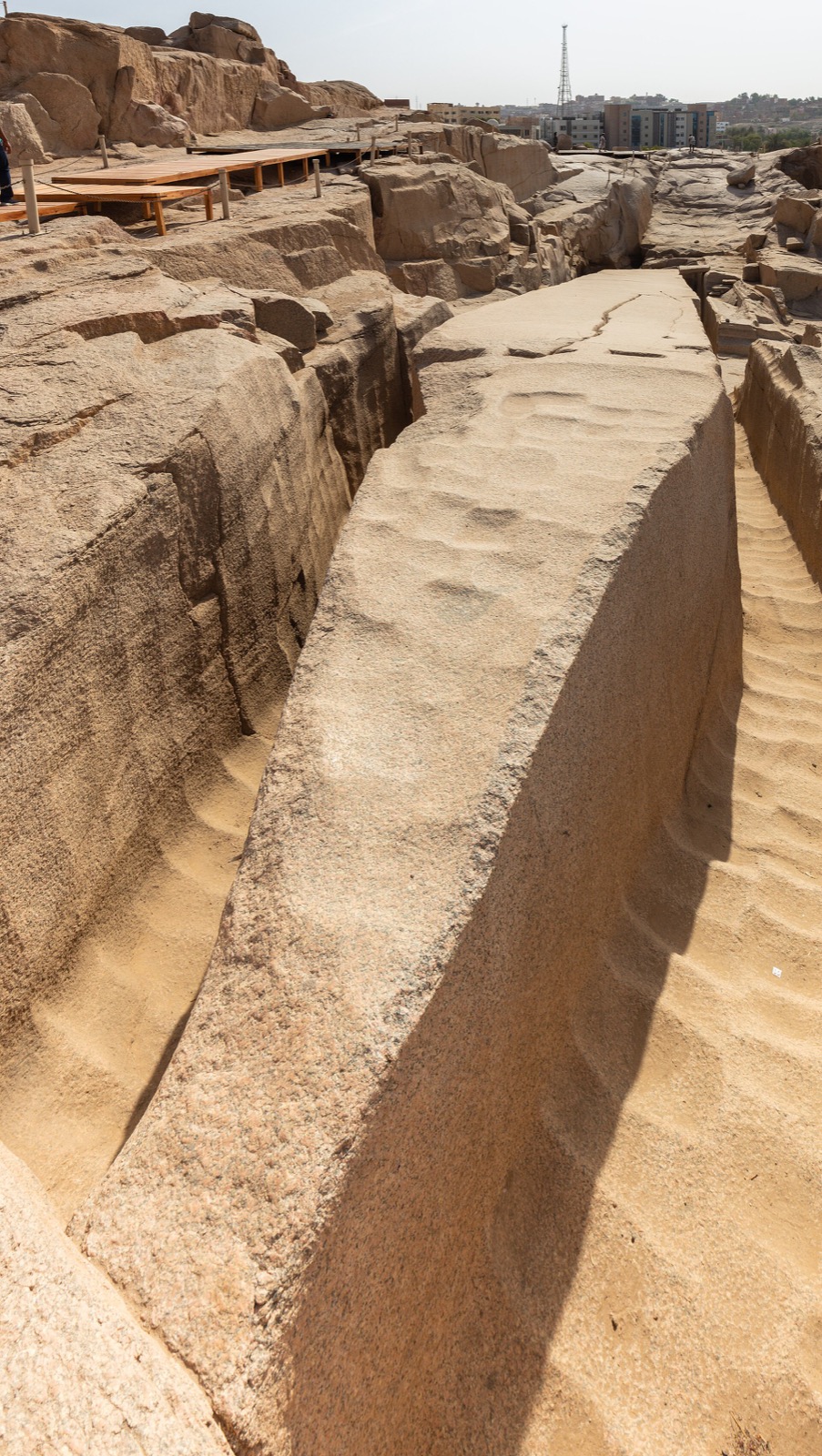
The Unfinished Obelisk in its quarry trench at Aswan, Egypt. The scalloped "scoop marks" visible along the trench walls are the features whose production by dolerite pounders is contested (GEO-C001, GEO-C002). Engelbach (1922) read the deep holes beside the trench as test-shafts sunk before the trench was cut (GEO-C702) and recorded burnt brick and burnt granite chips from fire-setting of the upper rock; the 2002 excavation of the quarry found charcoal, ash and burnt brick in quantity (GEO-C703).
At Aswan, beside the largest abandoned obelisk in Egypt, visitors are invited to strike a granite block with one of the rounded dolerite stones ancient workers are thought to have used. According to the proponent literature, no visitor has ever reproduced one of the smooth scooped depressions that line the quarry wallsC002. Nobody has counted the attempts or examined the block, so the anecdote proves little. But it points at the real question. Nobody serious doubts that Egyptians built the pyramids and Andeans built Tiwanaku. The question is how the hardest stone was worked, and whether some of it was made instead. Casting needs no lost civilisation, only forgotten chemistry, which is why it can be tested.
▸ claims behind this paragraph (1)▾ claims behind this paragraph
In the orthodox account, stone was quarried, carved with stone and copper tools and fire, hauled, and dressed in place. The French chemist Joseph Davidovits proposes two instances of casting. Pyramid casing and backing blocks are limestone re-bound in an alkali 'geopolymer' cement. Pumapunku's andesite was cast from natural volcanic sand with a binder of plant acids and seabird guano. A revision by Michel Barsoum and colleagues at Drexel University makes the pyramid binder a lime-and-silica cement, the chemistry of a mortar. And the researcher Marcell Fóti proposes a natron route: stone etched or bound with waterglass made from natron and heat, with the Aswan pounders and shafts serving as processing tools. Each account predicts something different inside the stone.
The case for carving
The orthodox account is strong. Unfinished monuments still lie attached to bedrock; the Aswan obelisk was abandoned when its granite cracked. Tools survive in quantity. Geochemistry matches monument stone to quarries. At Stonehenge, fifty of fifty-two sarsens share one chemical profile, and one of them matches the West Woods area about 25 km away. The account's gaps are quantitative. In a few places it needs more time, more hands or better technique than anyone has yet shown, and those places are where this case lives.
The firmest point is feasibility: limestone can be re-formed into large, hard, natural-looking blocks with ancient materialsC012. Davidovits' institute reports multi-ton demonstration blocks, never independently analysed. Separately, lime and diatomaceous earth form a calcium-silicate cement at room temperature. That feasibility is why the case is a question and not a fantasy. It shows only that the thing could be done. It is no evidence that anyone did it.
▸ claims behind this paragraph (1)▾ claims behind this paragraph
plate V · photograph — duotone applied in display; original unmodified
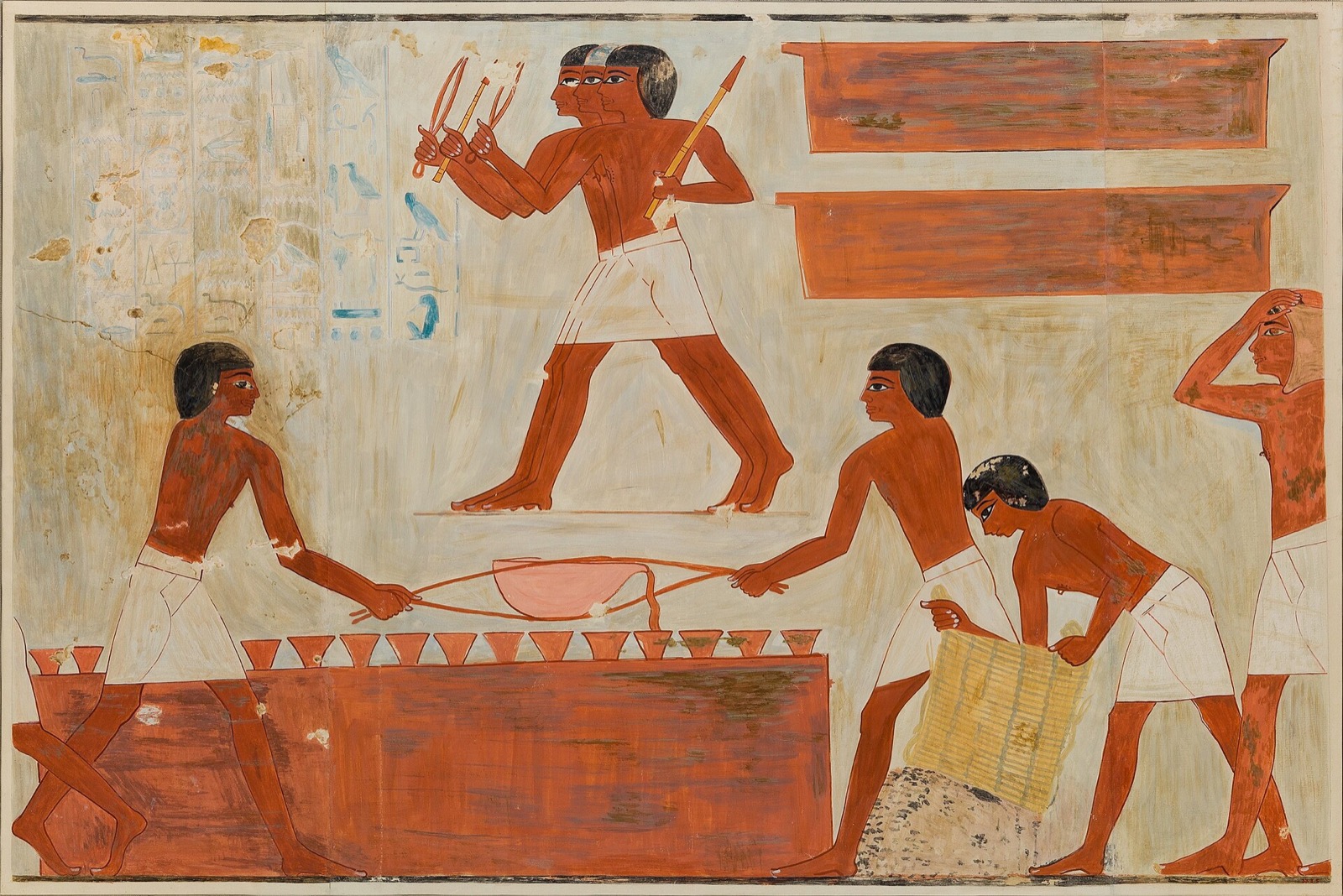
"Casting Metal," facsimile of the 18th-Dynasty mural in the Tomb of Rekhmire (MET 33.8.5). Conventionally read as bronze casting; Fóti's contested reinterpretation (GEO-C005) argues the depicted operation fits mineral processing.
Facsimile painter: Nina M. Davies (1881–1965) · facsimile ca. 1926–1927; original ca. 1479–1425 BC · source · CC0
In the Tomb of Rekhmire, an 18th-Dynasty mural shows rows of crucibles tended by workers with poles. Egyptology reads it as metal casting; Fóti argues the scale and apparatus fit mineral or waterglass processing betterC005. Egyptologists have not engaged the argument. It would be settled by asking what residues each reading predicts and looking for them.
▸ claims behind this paragraph (1)▾ claims behind this paragraph
The proponents' favourite historical detail comes from the ninth century. When Caliph al-Maʾmūn's men broke into the Great Pyramid, they found the chamber walls coated with saltC003: a centimetre and a half of it, in the Geopolymer Institute's telling. Salt is odd in dry quarried limestone and expected in stone that set wet with natron.
▸ claims behind this paragraph (1)▾ claims behind this paragraph
The principal Arabic accounts were gathered by al-Suyūṭī in the fifteenth century and translated in 1939. They tell the story of the breach twice and in detail: fire and vinegar, a wall twenty cubits thick, a granite basin holding 'nothing but worn out pieces of rope'. They never mention salt. The web page carrying the salt report names no medieval author. It also dates the entry to 820, where the translator puts the caliph's arrival in Egypt in 832. Other medieval authors remain unread, and one passage in them would revive the story. The accounts read so far do not contain it.
The surfaces are unreliable witnesses in any case. The case catalogues a broader warning, that almost no megalithic site has a complete published restoration historyC594. So far it is documented here only at Giza, but there it bites. Inside the pyramid, cleaning and patching in 1995–97 went undocumented, and salt barely visible in 2022 had spread widely two years later. One cheap test remains: does unworked Giza bedrock grow halite?
▸ claims behind this paragraph (1)▾ claims behind this paragraph
plate III · photograph — duotone applied in display; original unmodified
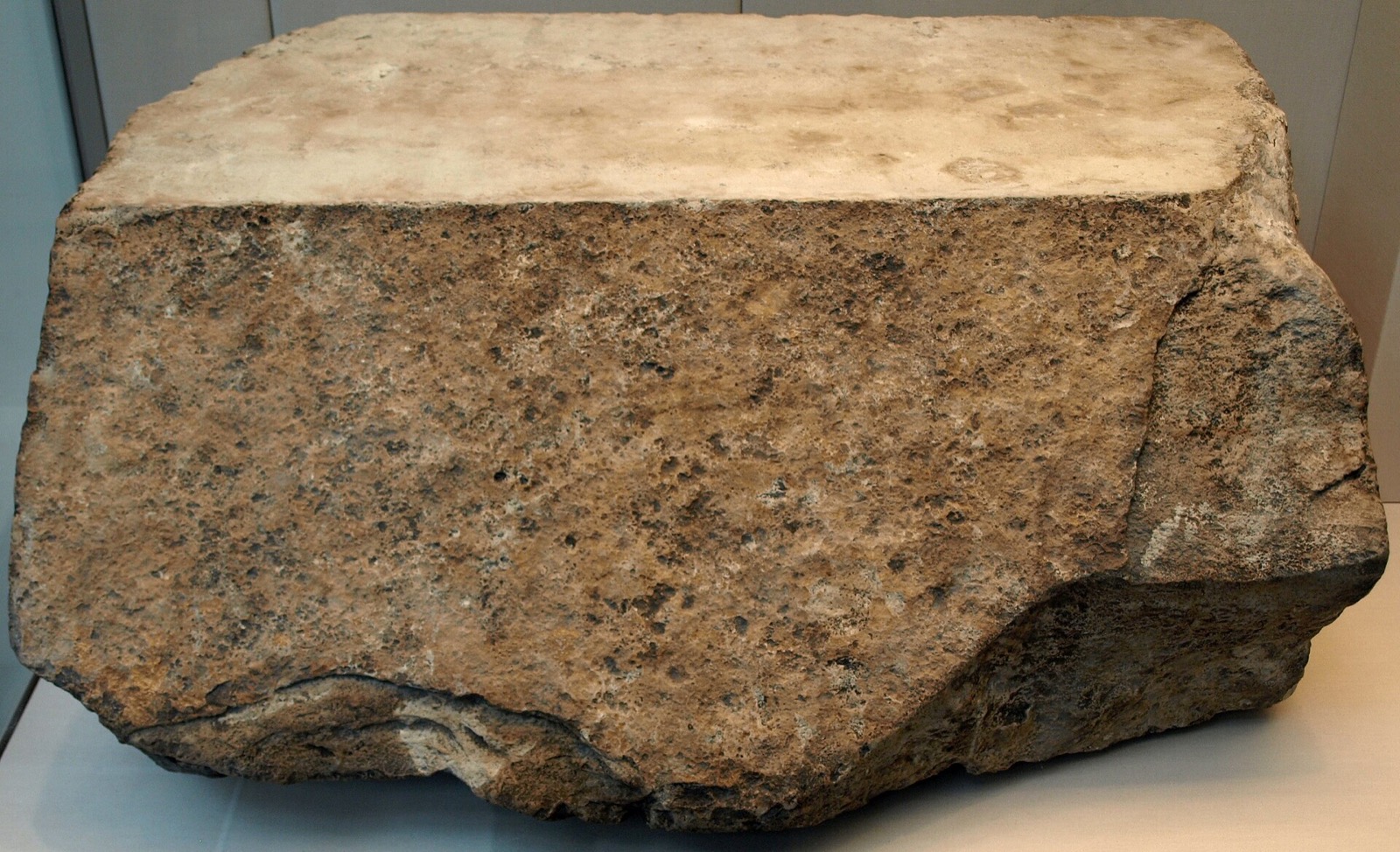
Casing stone from the Great Pyramid of Khufu (British Museum, EA 1187). Casing blocks are the pyramid components most often nominated as cast in the Davidovits line of argument (GEO-C020).
The pyramid claim covers casing, top and backing blocks, not the core. Two laboratory results favour it. In 2006 the Drexel group reported phases combining silicon, calcium and magnesium 'in ratios that do not exist in any of the potential limestone sources'. It conceded that nature 'could have — however unlikely' produced them. In 2011 an overlapping team examined a casing stone from the Bent Pyramid, an earlier pyramid at Dahshur. It used nuclear magnetic resonance, which reads how silicon, aluminium and calcium atoms are bonded. It read the stone as Tura limestone grains in a calcium-silicate gel 'formed by human intervention'.
Against them stand four examinations under the petrographic microscope, the geologist's basic tool, all finding natural limestone. Folk and Campbell saw bedding, burrows, fragile worm tubes and fractures confined to single blocks — things geology makes and moulds do not. Harrell and Penrod found the proponents' showcase 'Lauer sample' to be local limestone with no zeolite cement. Freestone and Middleton examined a British Museum casing fragment, and the cristobalite once called synthetic proved to be an ordinary sedimentary mineral. Jana examined casing stones beside natural Tura limestone and beside a genuine artificial geopolymer made by Davidovits. That last sample is the key. It showed what a binder looks like when it really is there, and the pyramid stone looked nothing like it. The 2006 silicon-rich spheres turned up in the natural stone too. The geopolymer's binder, rich in sodium, potassium and aluminium, appeared in no casing stone.
On that record the pyramid claim is contradicted. Two objections remain. Davidovits disputes that his critics had the authentic Lauer sample, and Egypt's antiquities authority says the 2006 samples were taken without permission. And Jana's negative applies to the alkali recipe. Nobody has looked for the 2011 calcium-silicate cement, which at a few per cent might hide from bulk chemistry. That is an objection to the verdict, not evidence for casting.
Pumapunku: the open question
plate IV · photograph — duotone applied in display; original unmodified
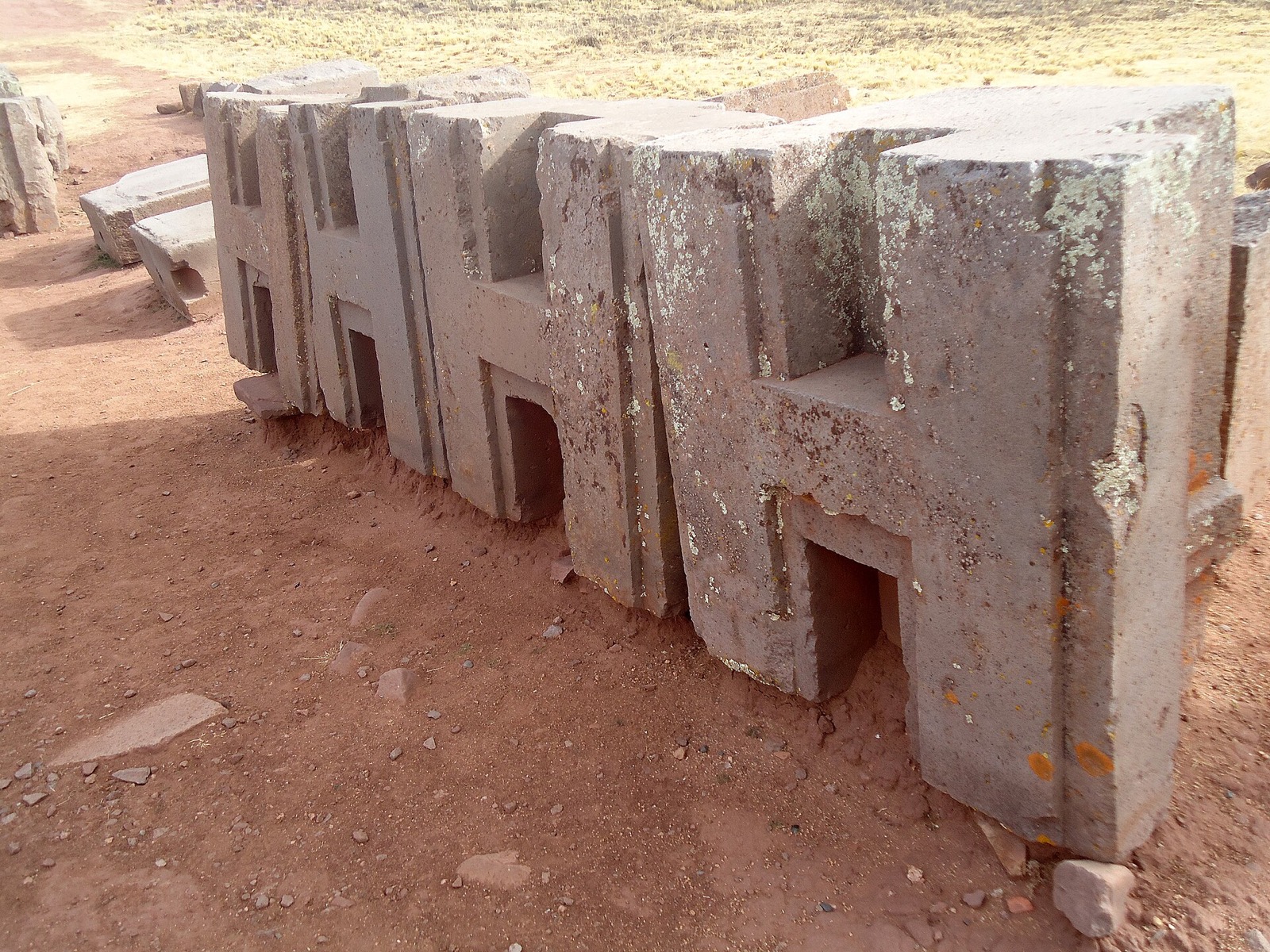
Andesite H-blocks at Puma Punku, Tiwanaku, Bolivia — the class of stone whose published SEM and petrographic analyses are the case's only laboratory evidence from a disputed monument (GEO-C004, GEO-C021). The analysed andesite sample (PP1) was not taken from a pictured block: the analysts state it was selected from loose fragments lying outside the protected monument area (GEO-C801).
The authors make three admissions. First, nitrogen could not be measured properly, and they cannot tell leftover guano from binder. That leaves the proposed chemistry of plant acids and a guano hardenerC580 asserted: its reported laboratory replication comes without data and used modern chemicals. Second, they compared the monument andesite with no natural andesite at all. Third, amorphous pockets in Tiwanaku andesite were noted in 1892 by travellers with no stake in the matter. That shows the feature recurs, but not whether it is organic or volcanic glass.
▸ claims behind this paragraph (1)▾ claims behind this paragraph
Popular accounts often cite the bubbles on the H-blocks' faces and their crisp inside corners. The bubbles have never been measured against the natural gas holes andesite contains. The archaeologist quoted on the corners, Jean-Pierre Protzen, said the builders' tools were unexplained, not that the stone was cast.
A radiocarbon date on the organic matter was promised in 2019 and has not been found. A date near AD 600 would count for casting; a modern one would point to contamination. At Giza, features read as artificial under the electron microscope turned up in natural stone once someone checked. Nobody has run that check here.
plate II · photograph — duotone applied in display; original unmodified
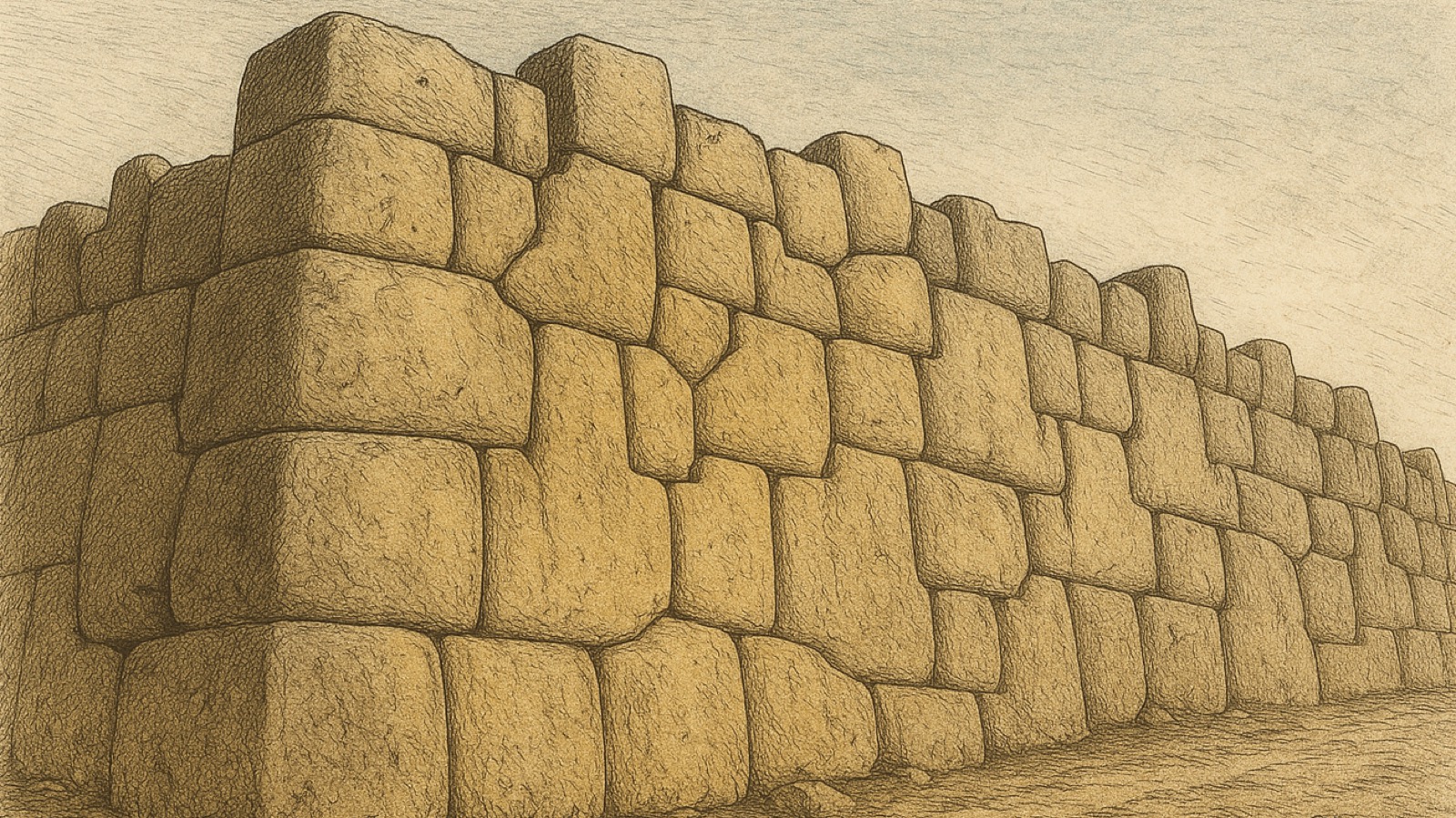
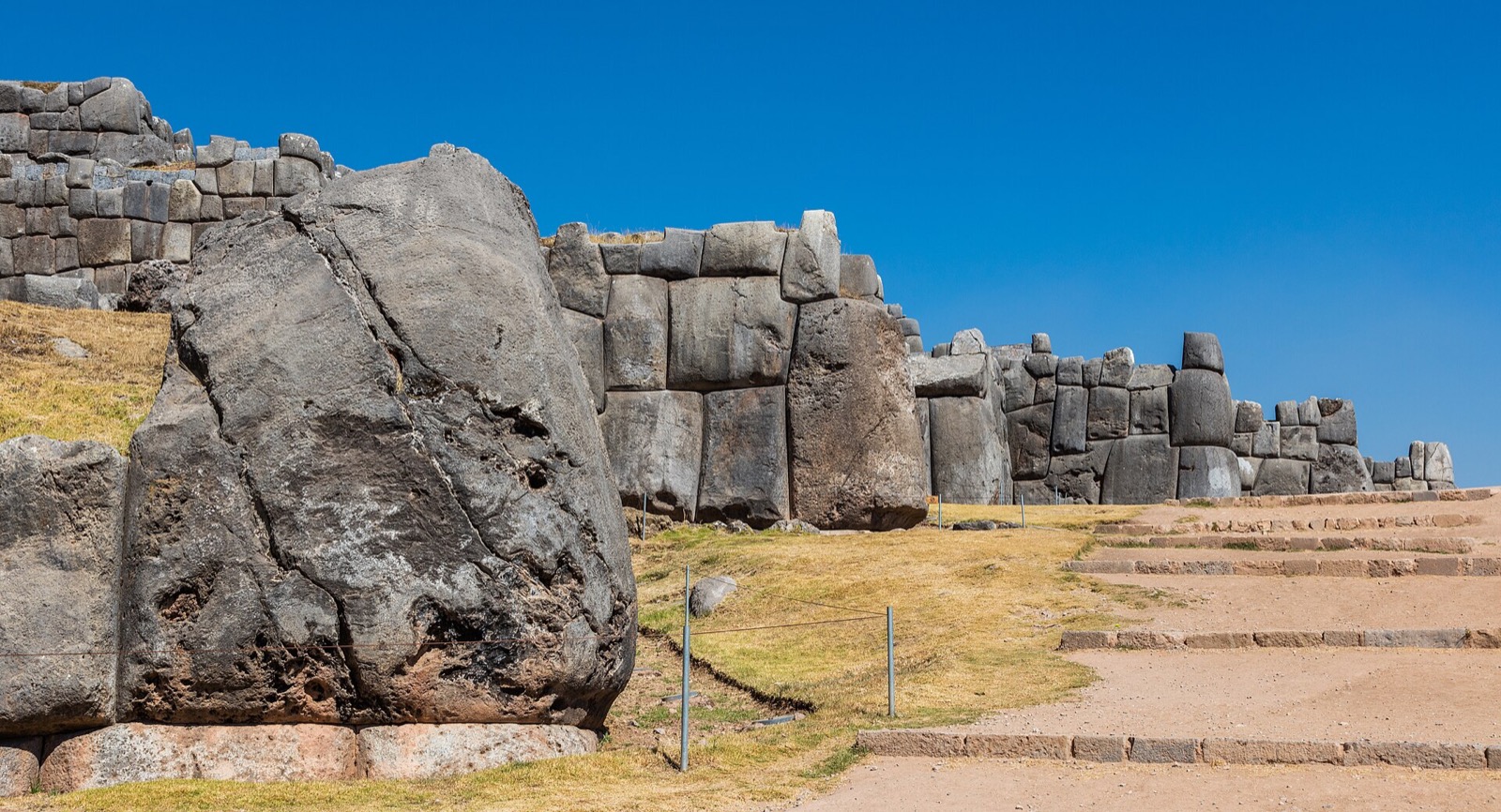
Polygonal cyclopean masonry at Sacsayhuamán, Cusco, Peru — the class of tight-jointed megalithic construction whose production method the case examines. Shown as context; no specific claim asserts this wall was cast.
The casting side's broadest reply to provenance work is that standard quarry-matching methods cannot see hydrogen, carbon or oxygen, and so cannot tell carved quarry stone from stone cast with aggregate from that quarryC030. For X-ray fluorescence and mass spectrometry that is correct. Crushed rock keeps its metal fingerprint, so a quarry match is not proof of carving. But the reply reaches less far than claimed. It lists X-ray diffraction as blind, yet diffraction reads crystalline phases and is how critics looked for zeolite cement. It lists nuclear magnetic resonance as blind to silicon, which is exactly what the pro-casting 2011 study measured. Above all, it does not touch direct microscopy. Cast stone needs a binder, binders leave signatures, and the Egyptian comparison with a real geopolymer shows those signatures are visible when present.
▸ claims behind this paragraph (1)▾ claims behind this paragraph
The strongest case for casting that this record does not answer runs as follows. The negative Egyptian studies were built around the alkali recipe, and the calcium-silicate cement has never been looked for. The one monument whose stone reads as artificial has been examined only by its proponents, and they found the organic matter inside the stone, under its crystals.
The strongest case against is equally plain. Every time anyone outside the proponent camp has examined monument stone, it has read as natural, down to fossil worm tubes. The Andean fragment that reads otherwise was picked up off the ground by its looks and never compared with the rock it supposedly differs from.
Toward casting: - a documented refit of the analysed andesite fragment to a catalogued block, or an independent laboratory finding the same interior matter in a catalogued fragment, tested against natural Khapia andesite; - a radiocarbon date near AD 600 on that matter; - a blinded test finding a calcium-silicate cement in securely sourced casing stone that a broad suite of natural limestone lacks; - a magnetic survey of many pyramid blocks, measured against natural Giza limestone, in which the blocks share one field direction. Stone that hardened where it sits would record Earth's field the same way in every block, while blocks cut elsewhere and laid in any orientation would disagree with each other; - Khapia without quarry faces, and the Iwawe deposit a natural sand store of the building period.
Toward carving: - the fragment's origin staying undocumented while its features turn up in ordinary Khapia andesite; - a modern radiocarbon date; - the sandstone's unusual matrix reproduced in natural regional sandstone; - a targeted search for the cement in casing stone finding nothing; - halite growing on unworked Giza bedrock; - quarry faces on Khapia, with the Iwawe deposit turning out to be chips from shaping blocks.
Where it stands
The headline claim is existential: it needs only one monument, so it cannot be settled by averaging. Egypt, tested with methods that can see a binder, came out against. Pumapunku has been examined by one team, on a fragment of uncertain standing. An existential claim is neither refuted by one failed instance nor supported by an untested one, and the decisive test has so far been run at the wrong site. Much of what would close the question is cheap. Ask where the andesite fragment came from, and test one with a catalogue number instead. Read the Iwawe excavation report. Walk Khapia's outcrops. The scoop marks at Aswan, meanwhile, still wait for someone to measure them properly.
the argument ladder
evidence for a lower rung does not automatically climb
Attribution
Was it actually done? The claims the thesis stands or falls on.
The strongest records on each side, structurally symmetric. Every record separates what the source states from what we infer. Browse the full ledger (47 records) →
strongest supporting
▲Supports· strongGEO-E010
Documented natron sources and their medieval decline
what the source states
Wadi el Natrun and al-Barnuj are identified as the primary ancient Egyptian natron sources for the vitreous-materials industry, with a documented decline and replacement by plant ash in the 7th–9th centuries AD.
what we infer
Establishes ingredient availability at scale and a documented supply discontinuity — the kind of discontinuity a lost-craft narrative needs, though the paper itself makes no claim about stone.
limitations
The paper concerns glass and faience; it says nothing about stone-making.
Proponents' 2020 Pumapunku model: natural Khapia andesite sand stored at Iwawe (Stratum V), piedras cansadas not used
what the source states
The abstract states that to make geopolymer andesite around AD 600–700 the builders could have transported an andesite stony material with the consistency of sand from the Cerro Khapia volcano, adding an organo-mineral binder from local biomass; that "They did not use the many quadrangular volcanic blocks", the famous piedras cansadas lying on both sides of Lake Titicaca; that they exploited a natural volcanic andesite sand from Cerro Khapia, "transported and stored it at the shore village of Iwawe", Stratum (V) in the excavation by Isbell & Burkholder (2002); and that they did not need to crush andesite rock, the sand resembling the Roman pozzolana called carbunculus.
what we infer
Editor's inference: this is the primary statement of the model GEO-C903 describes, so it supports that descriptive claim directly. It also fixes two checkable objects: the Iwawe Stratum V deposit (GEO-R009) and the abandoned quadrangular blocks. Both parties now place the andesite's origin at Khapia/Ccapia, which is why quarry geochemistry alone cannot separate them (GEO-C030 in its narrow form).
limitations
Abstract only; the PDF (DOI 10.13140/RG.2.2.10021.93929/2) returned HTTP 403 and was not read.
Proponent-authored, self-published journal (Journal on Geopolymer Science Applied to Archaeology).
Photogrammetric measurement of experimental granite quarrying with a dolerite pounder recorded a material removal rate of 216 cm³ per hour at 85 strikes per minute; the authors conclude the results speak against dolerite pounders as the sole quarrying method.
what we infer
At face value the rate implies dramatically extended timelines for the Unfinished Obelisk under the orthodox account, or the use of supplemental techniques.
limitations
Single study, single team, single granite and tool configuration.
Skilled ancient crews with maintained tools may outperform the experimental protocol.
Field and laboratory petrography: pyramid blocks show natural sedimentary and tectonic features (Folk & Campbell)
what the source states
Pyramid and temple blocks show sedimentary bedding, burrows, sharp cross-sections of clams and fragile worm tubes, ripple lamination, optical and SEM-scale properties of normal microporous limestone, and calcite-filled tectonic fractures confined to individual blocks; quarrymen's tool marks are evident; and no zeolitic "geopolymer" phase was observed by light microscopy or detected by XRD, DTA, SEM, EDXA, or chemical analysis in the sample examined, nor any aggregate-cement fabric (findings set out in Concrete International 13(8), 1991, and the Journal of Geological Education 40(1), 1992).
what we infer
Macro-scale sedimentary and structural features observed across many blocks in situ are hard to reconcile with casting and give this record broader scope than any single-sample study. It predates Barsoum 2006, so it does not address the specific 2006 SEM/TEM microconstituents.
limitations
Laboratory analysis rested on few samples; the in-situ observations are broader but not systematic sampling.
Contested at the time: Morris's rebuttal in the same journal volume (J. Geol. Educ. 40: 35–46) and the Concrete International letters cycle (Feb 1992) — the pro-casting responses are part of the record.
Proponent response to this line of criticism: the methods critique (GEO-C030, GEO-E024) — it does not touch the direct petrography here, but qualifies any step from quarry attribution to an anti-casting conclusion.
The Lauer sample examined: natural Mokattam limestone, no zeolite cement (Harrell & Penrod)
what the source states
Detailed petrographic and chemical analyses of the Lauer sample — the pyramid-interior specimen proponents cite as a prime example of limestone aggregate in synthetic zeolite cement — conclude it is a natural limestone quarried locally in the Eocene Mokattam Formation, with "no evidence of the special textures and zeolite cement that must exist if the sample is concrete."
what we infer
This targets the pro-casting side's own showcase specimen, which raises its diagnostic weight — conditional entirely on the sample-identity dispute below being resolved in its favor.
limitations
GENUINE FACTUAL DISPUTE — sample authenticity: Davidovits contends the piece analyzed in this line of work was not the authentic Lauer sample (wrong thickness, missing calcium-phosphate coating). This is a disagreement about which physical object was analyzed, not about interpretation. Complication cutting the other way: Jana's follow-up on a Harrell-supplied piece (GEO-E020) did find and map the phosphate coating.
One sample; rebutted by Morris (J. Geol. Educ. 41: 364–369).
Proponent response to this line of criticism: the methods critique (GEO-C030, GEO-E024). It bears on this record's quarry-attribution step (assigning the sample to the Mokattam Formation), though the core negative finding — no zeolite cement — is petrographic, not provenance-based.
Comparative petrography with a geopolymer positive control finds no casting signature in casing stones (Jana)
what the source states
Side-by-side examination of Great Pyramid casing stones, natural Tura limestone, and a genuine Davidovits-made geopolymeric limestone found: (1) the Si-rich spherical microconstituents highlighted by Barsoum (opal-CT lepispheres, Si≫Ca>Mg>Al) occur in both casing stones and natural limestone; (2) the real geopolymeric limestone shows marked Na+K and Al enrichment in its binder that no casing-stone sample shows; (3) phosphorus in the Lauer sample maps as contamination from a calcium-phosphate surface coating penetrating ~5 mm, with the interior phosphate-free; (4) casing stones and Tura stone share a particulate texture with intergranular pores, unlike the geopolymer's smooth matrix with spherical air voids. Jana concedes a binder at ~5 wt% might not register in bulk chemistry, which is why binder-phase SEM-EDS was used.
what we infer
The only study in the exchange with a positive control, directly measuring what a casting signature should look like — which is also why it bears on GEO-C030: it demonstrates that binder signatures are detectable when present, so provenance-blindness arguments do not extend to binder-aware petrography. Its decisive negative applies to the alkali-aluminosilicate recipe; the revised C–S-H binder of GEO-E017 is outside its test.
limitations
GENUINE FACTUAL DISPUTE — sample authenticity: Davidovits contends Jana's 'Lauer sample' piece was not authentic (wrong thickness, missing phosphate coating). In tension with that specific contention, Jana's figures 12–15 report finding and mapping the phosphate coating on the Harrell-supplied piece. Unresolved; conclusions about the Lauer sample are conditional on it.
Conference proceedings, not journal peer review.
The alkali-based negative does not test the calcium-silicate binder proposed in GEO-E017.
Proponent response to this line of criticism: the methods critique (GEO-C030, GEO-E024) — though this study is the strongest counter to it, since its positive control demonstrates binder-aware petrography can see what quarry-matching chemistry cannot.
steelmanned — the account the featured hypothesis must beat
The stone was quarried, carved and hauled with attested means: locally quarried dolerite pounders, copper tools, fire-setting, sledges and organised crews. Half-cut monuments in quarries, tool-production quarries and provenance matches such as Stonehenge's Stone 58 to West Woods support this. Pyramid stone shows bedding, fossils and fractures confined to single blocks, which moulds do not make. A real geopolymer control shows what a binder looks like when present. The pyramid's salt is halite, also found on the carved Sphinx and reported native to Giza limestone. Slow measured pounding rates mean more labour or supplementary methods, not manufacture. At Pumapunku the sandstone came from identified quarries and the andesite from Cerro Khapia. Amorphous pockets were noted in 1892 and may be volcanic glass. Organic matter in a loose fragment lying in the open is contamination or infiltration.
What would change our mind
The case does not end in a verdict; it ends in the studies that would move it, in the order this edition judges they would move it most. A result in either direction counts.
Establish what andesite sample PP1 is from, and whether a documented monument fragment can be tested instead
Request from the Geopolymer Institute and Bolivian authorities the 2017 collection permits, field photographs, coordinates and export documents for PP1/PP2/PP5, remaining fragments and thin-section numbers, and attempt a physical or petrographic refit of PP1 to a catalogued Pumapunku block. In parallel, identify a small detached andesite fragment with an object number and conservation history (site store or museum) for independent SEM/EDS and organic analysis against a Khapia andesite control. Also search for any published or unpublished 14C result on the andesite organic matter announced in 2019.
expected information gain
Converts the andesite result from an observation about a loose surface find into evidence about (or not about) the monument. A documented refit or a provenance-secure fragment reproducing the interior organic matter would materially strengthen GEO-C004; failure to document PP1's origin caps its weight; a 14C date near AD 600 or a modern date would each be decisive for contamination versus ancient binder.
Check the Iwawe Stratum V deposit and the piedras cansadas against the excavators' own descriptions
Desk work. Read Isbell & Burkholder 2002 on the Iwawe excavation and record exactly how Stratum V is described — andesite sand, gravel, dressing flakes, or something else — and its dating relative to Pumapunku construction (c. AD 600–700). In parallel, obtain Janusek et al. 2013 ('Building Taypikala', doi:10.1007/978-1-4614-5200-3_4) and record what it documents about roughly carved andesite blocks at Iwawe and the Ccapia foothills, and whether andesite quarry faces on Ccapia have been documented in any fieldwork since 2013. Then compare with the proponent model.
expected information gain
The proponents' 2020 model and the orthodox account agree on a Ccapia/Khapia origin for the andesite, so provenance geochemistry cannot separate them (GEO-C030). What separates them is a lakeshore deposit and some abandoned blocks. If Stratum V is a natural sand-consistency andesite store, the proponent model gains a non-trivial prediction; if it is dressing debris or unrelated fill, the model's aggregate source is unsupported. If carved ashlars are documented in transit, wholesale casting of andesite (GEO-C021) is undermined regardless of the SEM findings. Either outcome moves GEO-C021 without any new sampling of the monuments.
Survey Cerro Khapia (Ccapia) for andesite extraction faces versus natural sand deposits
Both the orthodox provenance work and the proponents' 2020 model place the Pumapunku/Tiwanaku andesite's origin on Cerro Khapia; they differ on what was taken from it — dressed blocks from quarry faces, or a natural volcanic sand needing no crushing (GEO-E035). A field survey of the mountain's andesite outcrops for extraction signatures (working faces, wedge or pounder scars, dressing debris, abandoned blocks matched in size to monument ashlars) versus loose scoria/sand deposits, with grain-size and petrographic comparison of any sand against the Iwawe Stratum V material (GEO-R009), would settle which material left the mountain. Pairs with a literature check of any post-2013 fieldwork documenting Khapia quarries.
expected information gain
Documented quarry faces with dressing debris and en-route ashlars would show carved andesite leaving Khapia and remove the proponents' aggregate-source story; a mountain with no extraction surfaces but a natural sand matching Iwawe Stratum V would remove the orthodox account's quarry and leave the proponents' model live. Either result is legible without touching a monument stone.
Compositional test of Iwawe Stratum V against Khapia andesite, regional tephra, monument andesite and experimental dressing debris
Locate surviving Stratum V samples and field records from the 2000–2002 Iwawe excavations (Isbell & Burkholder) or obtain new whole-fraction samples, and compare — with grain-size distribution, particle morphology, thin-section petrography, glass chemistry and major/trace elements prespecified — against (a) Cerro Khapia andesite outcrops and any unconsolidated volcaniclastic deposits there, (b) Pumapunku monument andesite, (c) regional tephra including Cerro Quemado, and (d) debris produced experimentally by dressing Khapia andesite with hammerstones. This is the laboratory extension of the desk check GEO-R009.
expected information gain
Discriminates the three live readings of the one physical deposit on which the proponents' raw-material argument rests: airfall tephra (closes the Iwawe argument), dressing debris (documents conventional block-working at the port and undermines GEO-C021), or natural Khapia sand stockpiled at AD 600 with no extraction faces (the outcome the casting model predicts). Either way it replaces argument-by-analogy with measurement.
▸ 15 more studies on the agenda▾ the rest of the agenda
GEO-R019Small grant · Lab
Independent re-analysis of Pumapunku sandstone (PP4 or equivalent) against a broad Kimsachata/Kallamarka suite, testing the natural-albite alternative
Re-examine PP4 or a new sample from the same documented location on slab No. 2 by thin section, SEM/EDS and XRD alongside a substantially larger suite of regional red sandstone including multiple Kallamarka beds, with criteria for the 'fluidal ferro-sialate matrix' and for authigenic versus alkali-induced albite specified in advance and samples blind-labelled.
expected information gain
The sandstone result has the better archaeological provenance of the two Pumapunku papers but rests on one thin section and three comparison sites, with a natural alternative the authors concede. Reproducing the matrix in natural Kimsachata sandstone closes the sandstone half of GEO-C021; failing to, across a broad suite, would be the first replicated Andean anomaly.
Blinded multinuclear NMR of Bent Pyramid and other casing stone against a stratified Tura/Dahshur/Giza limestone suite with aged C-S-H controls
Repeat 29Si/27Al/43Ca MAS NMR on provenance-secure casing samples alongside a suite of natural limestone from multiple stratigraphic positions in the Tura, Dahshur and Giza quarries, blind-labelled, on replicate instruments, with synthetic C-S-H gels aged under dry heat and carbonation as positive controls, and with Q1/Q2 detection criteria (−79 and −84 ppm) fixed in advance. Report whether any natural sample shows the −84 ppm shoulder and dominant −111 ppm silica resonance seen in the Bent Pyramid sample.
expected information gain
Tests the one surviving positive Egyptian result against the alternative its own authors leave open — natural quarry variability — and supplies the positive control (aged C-S-H) that GEO-E020's alkali geopolymer control did not. A shoulder reproduced in natural Tura stone retires the result; a shoulder absent from a broad natural suite but present in casing stone, with a Q1 explanation, would be the first binder-specific positive on pyramid stone.
Blinded paleomagnetic survey of pyramid core blocks with a natural-limestone remanence baseline
The report describes a 2012 Europhysics News pilot (Túnyi & El-hemaly, doi:10.1051/epn/2012604; not retrievable here) that reported three of seven sampled block locations at Khufu and Khafre sharing a common N–S paleodirection and read the result as a possible mixture of natural and artificial blocks. A properly designed follow-up would: sample many blocks under a blinded protocol; measure the detrital remanence strength and stability of Mokattam quarry limestone as a baseline; treat block orientation explicitly, since bedding-horizontal placement preserves natural inclination and randomises only declination; and pre-register the criterion for 'set in place' versus 'quarried and rotated'. Non-destructive or micro-core sampling at already-damaged block faces would limit intervention.
expected information gain
Paleomagnetism is a method class absent from GEO-C589 and independent of the binder chemistry debate: a block that set in place should carry a remanence aligned with the present field regardless of recipe, while a quarried and rotated block should not. A null result with adequate power on core blocks would be the first direct in-situ physical test against GEO-C020 that does not depend on contested sample provenance; a positive at scale would force a mixed model. The 2012 pilot must first be read and its assumptions audited (blocked, see dispositions).
Re-examine quarry-attribution studies under cast-stone-aware methodology
A methods paper: for each major published provenance attribution, ask whether its analytical techniques could in principle distinguish carved quarry stone from stone cast with aggregate from the same quarry — and which additional measurements (hydration state, binder phases, microstructure) would discriminate.
expected information gain
Decides how much the strongest conventional evidence class actually constrains the casting hypothesis — the methodological backbone of the whole agenda.
Establish whether halite is native to unworked Giza/Mokattam bedrock and quarry faces
Open Klemm & Klemm 2010 (cited by the report via Sessa et al. 2026, not yet read) for what it says about halite within the stratigraphic layers of the Giza nummulitic limestone, and any published efflorescence surveys of unworked Mokattam quarry faces or Giza bedrock exposures. If the literature is thin, a small field task: non-destructive surface sampling (swab or scrape of natural efflorescence) at protected unworked bedrock and quarry-face locations on the plateau and at Tura/Mokattam, analysed by XRD for halite alongside a Queen's Chamber efflorescence reference. Record restoration/cleaning history of the chambers alongside (GEO-C594).
expected information gain
GEO-C506 asserts that comparable natural limestone does not exhibit the pyramids' surface NaCl, but the ledger has no comparator; the proponents' comparator (European cathedrals) is the wrong lithology. If unworked Giza/Mokattam limestone effloresces halite, the salt discriminator collapses and GEO-C003's evidential interest with it; if it does not, the salt becomes a genuine anomaly worth bulk-chlorine testing under GEO-C590's logic.
Read Protzen & Nair 2013 (The Stones of Tiahuanaco) experiments chapter for stone type, tools, durations and features reproduced
Obtain the UCLA Cotsen monograph (open-access record at escholarship.org/uc/item/2192r04f; the page returned no text here) and record from the stone-tool experiment chapter the lithology worked, tools, time, tolerances achieved, which exterior and interior angles were reproduced, and where the authors state the method remains unresolved; also record their treatment of the piedras cansadas and transport (Chapter 6, pp. 180–181 as cited by the proponents).
expected information gain
Supplies the conventional experimental counterweight the Andean branch currently lacks: if hammerstone work reproduces the sharp interior angles the proponents call impossible, GEO-E062's argument fails; if the authors themselves report the finish unresolved, that is recorded as an honest gap rather than assumed either way.
Compile documented restoration and conservation interventions (modern mortar, consolidants, reassembly) at Giza, Tiwanaku/Pumapunku, Cusco, and Easter Island, so surface-chemistry anomalies can be checked against modern contamination before being read as ancient signatures.
expected information gain
A confound-killer: protects every surface-based claim in the case from its most likely mundane explanation.
Field-test UV fluorescence and efflorescence as cast-stone diagnostics
Test whether inexpensive, non-destructive UV fluorescence photography of surface efflorescence can discriminate cast from natural stone against prespecified criteria, using geologically matched natural controls at multiple megalithic sites. Framed neutrally: the question is whether the method discriminates at all, not whether any prior finding is validated.
expected information gain
If the diagnostic works on known-cast versus natural test panels, it becomes a scalable field screen for every disputed site; if it fails, a popular class of surface arguments loses standing.
Trace the Al-Ma'mun salt-layer report to primary Arabic sources
Locate and evaluate the Arabic accounts (Al-Maqrīzī, Ibn Khaldūn, Al-Idrīsī and related compilations) behind the report that Al-Ma'mun's party found salt-coated chamber walls in 820 AD. Pure archival work, falsifiable in either direction: a credible primary source makes the salt argument's anchor real; absence or embellishment removes it.
expected information gain
High for cost: either result decisively moves GEO-C003, and it is the cheapest project on the agenda.
Replicate and extend the Marčiš pounding-rate measurement
Independent replication of the 2023 photogrammetric quarrying-rate study with sensitivity analysis on technique, tool mass, drop height, and granite type; extension to scoop-mark sites beyond Aswan.
expected information gain
Confirms or dissolves the catalog's most mainstream-legible quantitative anomaly; a substantially higher replicated rate would restore the orthodox timeline.
Survey the Aswan trench shafts against Engelbach's test-shaft reading
Measure the deep holes C and D and the squarish holes along the Unfinished Obelisk trench (Engelbach 1922, Plate I): depth, plan dimensions, wall profile, floor form, and their stratigraphic relation to the trench walls (do the holes predate the trench, as Engelbach's reading requires — traceable up the side of the obelisk?). Record any residues (ash, vitreous material, alkali salts) by non-destructive spot XRF or swab, and test the two readings' predictions: prospecting pits should show pounded floors, irregular walls and fissure-following courses; settling vessels (GEO-C536) should show water-tight walls, decant lips or channels, and silicate residues. Compare with the pounder-wear deposit Engelbach buried under the west retaining wall if the SCA permits.
expected information gain
Both readings are currently unmeasured conjecture. Geometry and residues would settle whether the shafts are extraction-prospecting features (retiring GEO-C006's anomaly and GEO-C536) or bear processing signatures no conventional account explains.
Read Bonani et al. 2001 in full for per-sample contexts
Obtain Radiocarbon 43(3):1297–1320 and tabulate, for every Khufu, Khafre and Menkaure sample, the material (charcoal, wood, reed, straw) and the recorded context (mortar between core blocks, casing mortar, fill, surface find, settlement deposit). Check the AERA summary's implication that dated charcoal came from mortar contexts, and record the Khufu date distribution with its old-wood interpretation.
expected information gain
If the paper documents in-masonry mortar samples, GEO-C576's 'wood on the ground rather than in masonry' clause is struck and the claim narrows to the carbonate-dating gap; if sampling was largely surface or fill, the clause stands. Either result is decisive for that clause at desk cost.
Build a worldwide catalog of claimed cast-stone production signatures
Systematic, criteria-first catalog of claimed production-site and product signatures (scoop marks, nubs, flow features, mold seams) across sites worldwide — including the null side: where the signatures should appear under the casting hypothesis but don't.
expected information gain
Converts scattered anomaly anecdotes into a testable distribution; the "where are the scoop marks not?" question cuts both ways.
Joint Egyptology and history-of-technology re-examination of the 'casting a metal door' mural and its inscriptions: does the conventional bronze reading fully account for the depicted scale and apparatus, and what would each reading predict about residues or tools in the archaeological record?
expected information gain
Either strengthens the conventional reading with modern rigor or surfaces the first period depiction consistent with mineral casting.
Controlled multi-month outdoor fire-pit cycles (ash accumulation, wetting, compaction) with periodic material testing, to check whether the proposed accidental-discovery pathway produces structurally stone-like material at all.
expected information gain
Cheap test of the discovery-pathway story; failure would not refute casting but would remove its most intuitive origin narrative.
Trust comes partly from showing changed minds. Each entry is an edition that changed a verdict, with the word before and the word after — a reversal included.
Weakly supported→moved from Weakly supported to Unresolved:UnresolvedEngelbach's 1922 report, to which the pounding-stone account of Aswan granite quarrying is commonly traced, states as its experimental basis a… since refused
Aletheia records every change to a case: what changed, why, and who made it — including the AI's role. The latest:
Answer to the panel's objections on #452: 2 record(s) named by a seat re-read by the second reader with the objection in view (2026-10-03-answer-megalithic-casting-114931): answer…
Candidate edition edition-2026-09-16-023713: one conclusion sentence calibrated before publication — from "on the present record, the stone of the Great Pyramid reads as quarried, and the…
Candidate edition edition-2026-09-16-023713: rationale annotated before publication with the measured word count (5,150 → 5,209, one per cent longer, not 'at or slightly below') and the…