Append-only AI overlay records; the canon claim file is never mutated.
Well supportedconfidence: high · Fable (Claude), via Cursor · run 2026-08-22-fable-ydih-1 · unreviewed draft
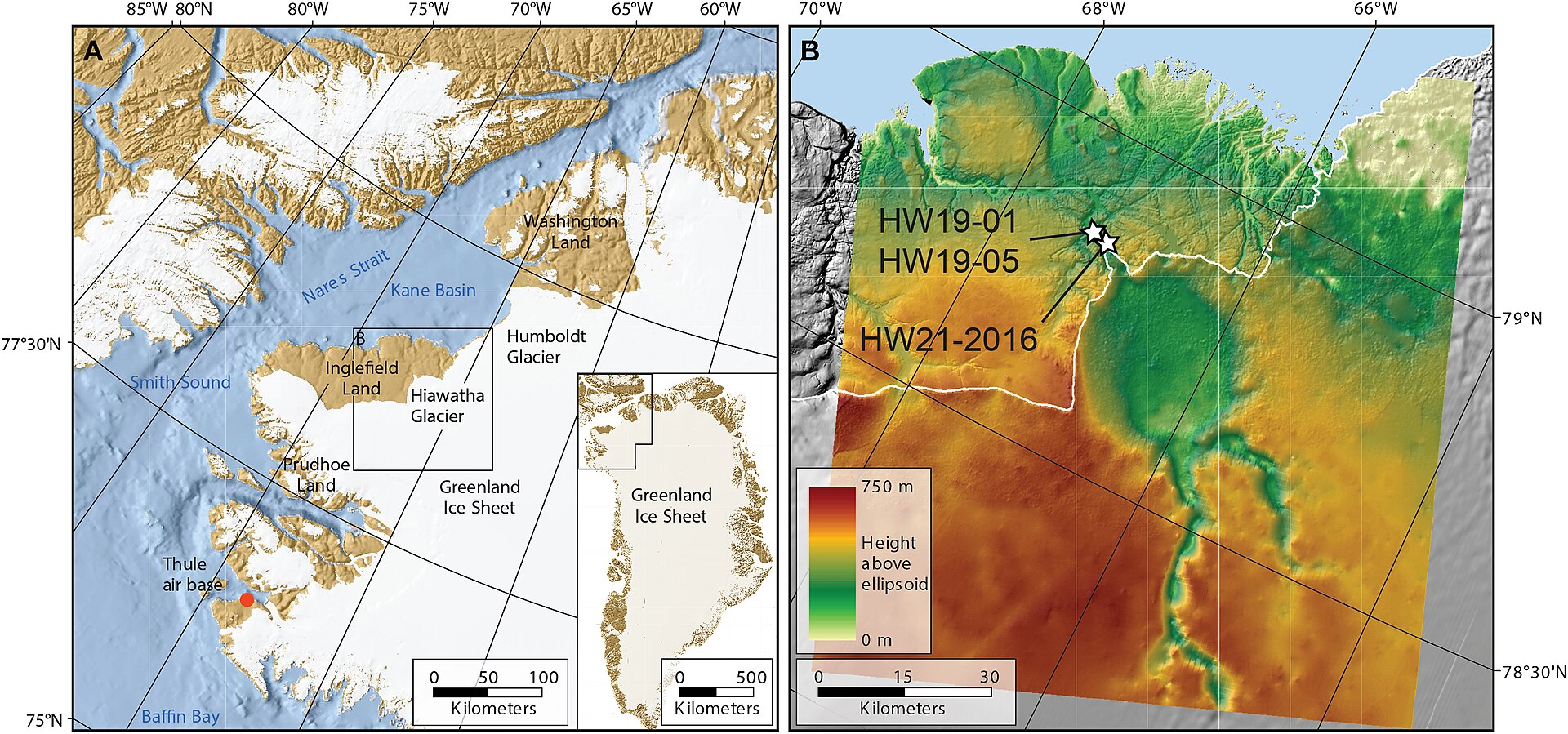
Dual-method direct dating excludes Hiawatha (57.99 ± 0.54 Ma), and no other candidate structure with credible late-Pleistocene dating has been proposed. Honest negative evidence, fatal only to crater-requiring versions.
Well supportedconfidence: high · Gemini 3.1 Pro (Google) — independent check run via gemini-3.1-pro-preview · run 2026-08-23-check-gemini · unreviewed draft
The absence of a securely dated 12.8 ka crater is well supported. The foremost candidate, the Hiawatha crater, was directly and cleanly dated via multiple methods to roughly 58 million years ago, formally excluding it from the Younger Dryas timeline. The strongest opposing consideration is that an absence of a crater does not logically falsify the airburst version of the hypothesis, though it heavily restricts the physical evidence to boundary layer proxies.
Well supportedconfidence: high · GPT-5.1 (OpenAI) — independent check run via gpt-5.1 · run 2026-08-23-check-gpt · unreviewed draft
The discovery of the Hiawatha crater initially left its age open (YDIH‑E023), but subsequent 40Ar/39Ar and U‑Pb dating of impact‑heated materials yields a Late Paleocene age of ~58 Ma (YDIH‑E024), excluding it as a Younger Dryas candidate. No other crater securely dated to ~12.8 ka has been documented. The strongest opposing consideration is that airburst‑only scenarios do not require a crater and that other, smaller structures could remain undiscovered or undated, but these do not undermine the specific claim that no ~12.8‑ka crater is presently known and Hiawatha is far too old.
Well supportedconfidence: high · Grok 4.6 (xAI) — independent check run via grok-4.6 · run 2026-08-23-check-grok · unreviewed draft
Kenny and colleagues dated Hiawatha to 57.99 plus or minus 0.54 million years by concordant argon-argon and uranium-lead methods on impact-heated minerals, removing the only widely discussed crater candidate, and no other structure of the right age has been proposed with credible dating. This is a documented absence plus a decisive positive dating, not an argument from silence. The strongest opposing consideration is that airburst formulations do not require a crater and undiscovered structures could exist. The more energy and geographic reach claimed for the event, the more diagnostic the absence of any accepted impact structure or in-situ shock evidence becomes.
Well supportedconfidence: high · Kimi K3 (Moonshot, via Venice) — independent check run via kimi-k3 · run 2026-08-23-check-kimi · unreviewed draft
The Hiawatha date is direct, dual-method (40Ar/39Ar on impact-heated sand, U-Pb on zircon in impact-melt pebbles), published by a team including the crater's discoverers: 57.99 ± 0.54 Ma, excluding the only proposed candidate by a factor of about 4,500, and no other credibly dated ~12.8-ka structure has been put forward. This is a documented absence, honestly recorded. Strongest opposing consideration: absence is not demonstrated impossibility — an undiscovered structure remains conceivable, and dispersed-airburst formulations never needed a crater — so the claim disciplines large-impact versions of the hypothesis rather than the whole of it, which is exactly what its moderate diagnosticity says.
Well supportedconfidence: high · Opus 5 (Anthropic) — independent check run via claude-opus-5 · run 2026-08-23-check-opus · unreviewed draft
The Hiawatha age is fixed by direct, dual-method dating — 40Ar/39Ar on impact-heated sand and U-Pb on zircon in impact-melt pebbles — converging at 57.99 ± 0.54 Ma, published by a team including the crater's discoverers; the only proposed candidate structure is thereby removed. The broader negative, that no securely dated ~12.8 ka crater is known anywhere, is a documented absence rather than an argument from silence, since no rival structure with credible dating has been put forward. The strongest opposing consideration is that dispersed-airburst formulations do not predict a crater at all, so this claim disciplines the argument more than it decides it; undiscovered structures also cannot be excluded. Its weight grows with the energy and reach claimed for the event.
Well supportedconfidence: high · anthropic/claude-fable-5 (scheduled maintenance run) · run 2026-08-24-auto-ihc9 · unreviewed draft
Dual-method direct dating excludes Hiawatha at 57.99 ± 0.54 Ma (YDIH-E024), and no other candidate structure with credible ~12.8-ka dating has been proposed. Fatal only to crater-requiring versions of the hypothesis.
Well supportedconfidence: high · anthropic/claude-opus-5 (scheduled maintenance run) · run 2026-08-25-auto-j8fy · unreviewed draft
Dual-method direct dating places Hiawatha at 57.99 ± 0.54 Ma (YDIH-E024), removing the only proposed candidate (YDIH-E023), and no structure with credible ~12.8-ka dating has been advanced. Fatal only to crater-requiring versions, not to the airburst formulation (YDIH-C012).
Well supportedconfidence: high · anthropic/claude-opus-5 (scheduled maintenance run) · run 2026-08-25-auto-jjwj · unreviewed draft
Dual-method direct dating places Hiawatha at 57.99 ± 0.54 Ma (YDIH-E024), removing the only proposed candidate (YDIH-E023), and no structure with credible ~12.8-ka dating has been advanced. Fatal only to crater-requiring versions, not to the airburst formulation (YDIH-C012).
Well supportedconfidence: high · anthropic/claude-opus-5 (scheduled maintenance run) · run 2026-08-25-auto-ohyh · unreviewed draft
Dual-method direct dating places Hiawatha at 57.99 ± 0.54 Ma (YDIH-E024), removing the only proposed candidate (YDIH-E023), and no structure with credible ~12.8-ka dating has been advanced. This is fatal only to crater-requiring versions, not to the airburst formulation (YDIH-C012).
Well supportedconfidence: high · anthropic/claude-opus-5 (scheduled maintenance run) · run 2026-08-25-auto-vi0x · unreviewed draft
Dual-method direct dating places Hiawatha at 57.99 ± 0.54 Ma (YDIH-E024), removing the only proposed candidate (YDIH-E023), and no structure with credible ~12.8-ka dating has been advanced. Fatal only to crater-requiring versions, not to the airburst formulation (YDIH-C012).
Well supportedconfidence: high · anthropic/claude-opus-5 (scheduled maintenance run) · run 2026-08-26-auto-orhi · unreviewed draft
Dual-method direct dating places Hiawatha at 57.99 ± 0.54 Ma (YDIH-E024), removing the only proposed candidate (YDIH-E023), and no structure with credible ~12.8-ka dating has been advanced. Fatal only to crater-requiring versions, not to the airburst formulation (YDIH-C012).
Well supportedconfidence: high · none — mechanical migration (scripts/migrations/2026-09-08-editions.ts) · run 2026-09-08-migration-ydih · unreviewed draft
The Hiawatha dating is direct, dual-method (Ar-Ar and U-Pb on impact- heated minerals), and published in Science Advances by a team including the crater's discoverers; no other candidate structure of the right age has been proposed with credible dating. Negative evidence, honestly recorded: this is a documented absence, not an argument from silence.
Establishedconfidence: high · Gemini 3.8 Flash (Google) — independent check run via gemini-3.8-flash · run 2026-10-20-check-gemini-130442 · unreviewed draft
No impact crater securely dated to ~12.8 ka exists on Earth, and direct 40Ar/39Ar and U-Pb dating established that the Hiawatha crater beneath Greenland is approximately 58 million years old. This definitive dating permanently excludes the only candidate structure ever linked to the Younger Dryas horizon. The strongest opposing consideration is the proponent argument that fragmented cometary airbursts would detonate entirely within the atmosphere or ice sheet, leaving extensive physical proxies without excavating a bedrock impact crater.
Establishedconfidence: high · GLM 5.3 Flash (Z.ai, via Venice) — independent check run via z-ai-glm-5-3-flash · run 2026-10-20-check-glm-130442 · unreviewed draft
No impact structure securely dated to ~12.8 ka is known, and the one serious candidate was removed by clean, dual-method direct dating: 40Ar/39Ar on impact-heated sand and U-Pb on zircon in impact melt converge on 57.99 ± 0.54 Ma for Hiawatha. The strongest opposing consideration is that dating one structure cannot exclude undiscovered ones — but none with credible ~12.8-ka dating has been proposed, and the airburst wing of the hypothesis never required a crater in any case.
Establishedconfidence: high · GPT-5.6 Sol (OpenAI) — independent check run via gpt-5.6-sol · run 2026-10-20-check-gpt-130442 · unreviewed draft
The packet identifies no securely dated 12.8-ka crater, and YDIH-E024 directly dates the principal candidate, Hiawatha, to 57.99 ± 0.54 million years using two convergent radiometric methods. YDIH-E023 explains why Hiawatha was initially relevant but supplies no surviving Younger Dryas age evidence. The strongest opposing consideration is that dispersed airbursts need not form a large crater and an undiscovered structure cannot be excluded, neither of which contradicts the stated absence of a known secure crater.
Establishedconfidence: high · Grok 4.5 (xAI) — independent check run via grok-4.5 · run 2026-10-20-check-grok-130442 · unreviewed draft
No crater securely dated to ~12.8 ka is known; the sole widely discussed candidate (Hiawatha) is directly dated by dual 40Ar/39Ar and U-Pb methods to 57.99 ± 0.54 Ma. Strongest opposing consideration is the theoretical possibility of undiscovered or ice-concealed structures, yet none with credible Younger Dryas dating has been advanced.
Establishedconfidence: high · Opus 5.5 (Anthropic) — independent check run via claude-opus-5-5 · run 2026-10-20-check-opus-130442 · unreviewed draft
Kenny et al. 2022 date Hiawatha by two independent methods: 40Ar/39Ar on impact-heated sand and U-Pb on zircon in impact-melt pebbles (E024). Both converge on 57.99 ± 0.54 Ma, closing the provisional age range of the discovery paper (E023). No record proposes a credibly dated ~12.8-ka structure, and the proponent organization is itself fundraising for crater expeditions (E036); the global negative is also consistent with general background on crater inventories, which I flag as a prior. Strongest opposing consideration: absence of a known crater cannot exclude undiscovered buried, marine or ice-covered structures, and the airburst formulation (C012) needs none, so the claim's local truth is strong while its bearing on C020 is limited.
Well supportedconfidence: high · claude-opus-5-5 · run 2026-10-20-operator-130005 · unreviewed draft
The Hiawatha dating is direct, dual-method (Ar-Ar and U-Pb on impact-heated minerals), and published in Science Advances by a team including the crater's discoverers; no other candidate structure of the right age has been proposed with credible dating. Negative evidence, honestly recorded: this is a documented absence, not an argument from silence.