Cases / Calico Early Man Site
Refuted
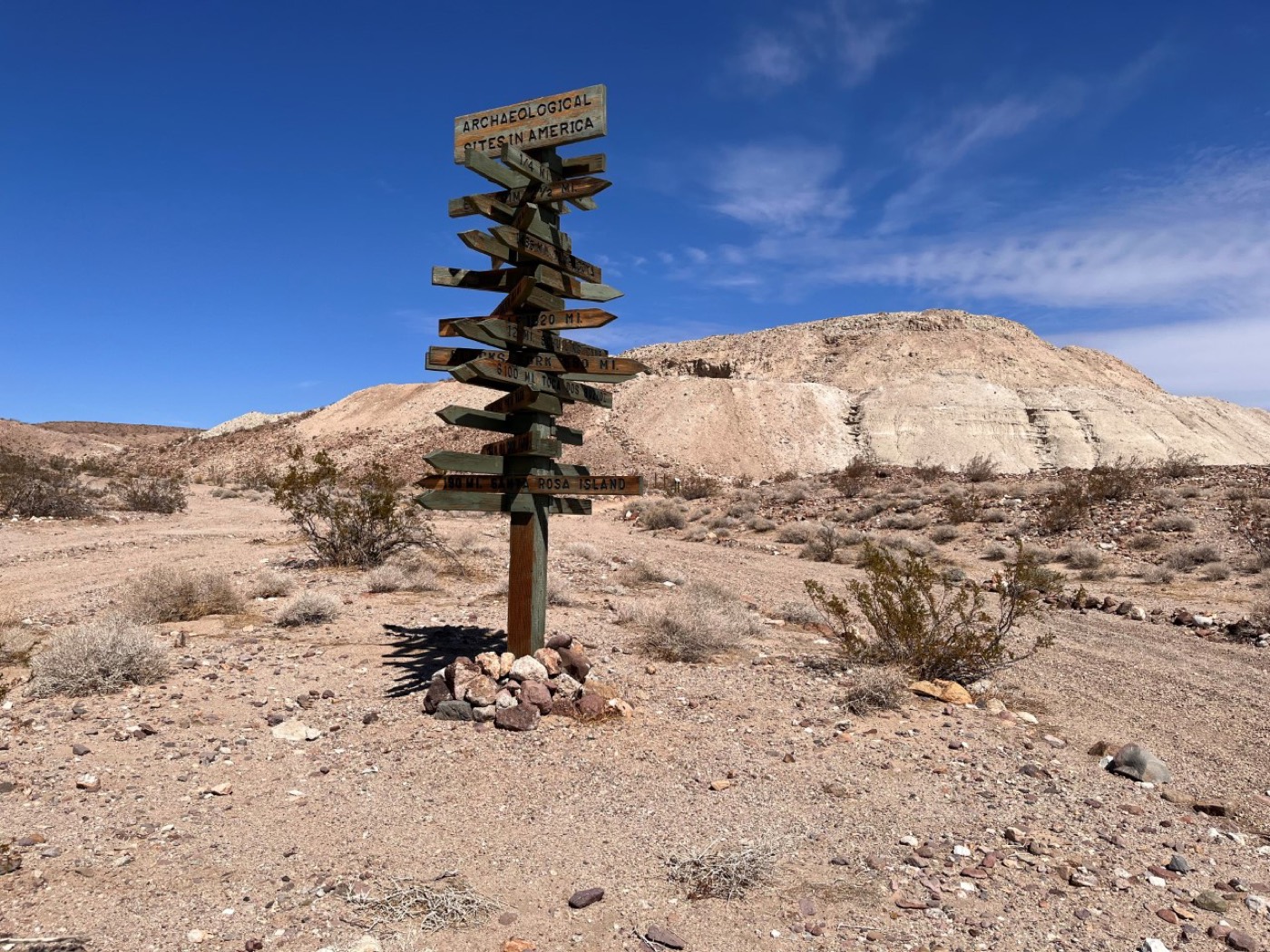
Calico Early Man Site
Flaked chert and chalcedony dug from deep alluvial-fan deposits in the Calico Hills were presented as human-made tools, putting people in the Americas tens of thousands of years before Clovis. Proponents now argue the tools are over 200,000 years old.

Claimed age
100,000-500,000 yr (1970); >200,000 yr since 1981224k yrs
Claimed
1968Louis S. B. Leakey, Ruth DeEtte Simpson
Verdict
Refuted · 19735 years after the claim
Leap
17×× the accepted limit then
Evidence then
3.5 / 8
Sources
1613 opened and checked
Record
Medium confidenceReviewed
What happened
- 1964Excavation begins on 1 November under Louis Leakey and Ruth DeEtte Simpson, funded by the National Geographic Society.
- 1968Leakey, Simpson and Clements publish a two-page preliminary report in Science.
- 1969UCLA lab finds carbonate cement in the artifact levels beyond radiocarbon range (>34,000 yr); fan estimated at 30,000–120,000 yr.
- 1970An international conference in San Bernardino draws specialists from around the world but leaves the question open.
- 1973Haynes argues in Science that natural processes in the fan could have produced all the specimens.
- 1979Duvall and Venner's statistical analysis concludes the lithics were formed naturally.
- 1981U-series dating of carbonate cement puts the basal artifact-bearing deposits at about 200,000 years.
- 1982Payen applies the Barnes edge-angle test and finds no significant difference from uncontrolled (natural) fracture.
- 1984TL/ESR measurements find no sign that the 'hearth' cobbles were heated.
- 1987Patterson and colleagues publish flake-attribute data that they argue show human manufacture.
- 2011Cosmogenic 10Be dating gives a minimum age of about 197,000 years for the Yermo deposits.
- 2024Budinger restates the case that the site holds tools more than 200,000 years old.
Objections 0 of 6 proved wrong
- The flaked stones could be natural: tectonic stress, weathering, rock-on-rock blows in streams and mudflows, pressure on buried cobbles, and repeated erosion and redeposition in the fan.Held up — Reviews accept a natural origin (S11); proponents reply that no one has shown this fracturing actually happened at the site.
- The claimed age would require pre-Neanderthal humans in the Americas during the Middle Pleistocene.Held up — Still stands: no hominin fossils at Calico and no accepted evidence of people in the Americas nearly this old. Proponents call this an age bias (S10).
- Excavators picked out, from masses of naturally broken chert, the pieces that happened to look like tools; 'artifacts' grade smoothly into non-artifacts.Unresolved — Proponents say Leakey applied consistent criteria; a later curator discarded over half of ~70,000 pieces as lacking data or 'just rocks' (S14).
- Only two control pits (1967) sampled the fan outside the master pits, too few to show whether similar broken stones occur throughout it.Unresolved — Proponents report far lower fracture densities outside the master pits, but no systematic comparison has been published.
- Edge and flake-scar angles of the Calico pieces match natural fracture rather than known human flaking.Unresolved — Reviews treat these tests as strong evidence (S11); proponents say they ignore bipolar flaking and misuse statistics. No modern re-test.
- The ring of cobbles called a hearth has not been shown to have held a fire.Held up — TL/ESR found no difference between cobble interiors and exteriors, despite an earlier magnetic study suggesting heating.
Evidence at the time within ~5 years of the claim
- Unambiguous evidenceNo — Flaked chert in a high-energy alluvial fan; critics argued from the start that such pieces can break naturally, and the 1970 conference did not settle it.
- Documented contextPartly — Excavated in measured levels from cemented Yermo fan deposits, but an alluvial fan is a transported context that cannot by itself show human activity.
- Independent dating methodsPartly — Only a geomorphic estimate (>30,000, <120,000 yr) and an infinite radiocarbon result on carbonate cement (>34,000 yr); no numeric date until U-series in 1981.
- More than one labNo — The only laboratory dates (radiocarbon on carbonate cement and roots) came from UCLA.
- Professional recoveryYes — Directed by L. S. B. Leakey and R. D. Simpson (San Bernardino County Museum) with USC geologist T. Clements.
- Peer-reviewed reportPartly — Only a two-page preliminary report in Science (1968); the fuller account appeared in a 1972 museum-association conference volume.
- Open to criticsYes — Finds were stored at the San Bernardino County Museum; site and specimens were shown to visiting specialists, including at a 1970 international conference.
- Independent teamsNo — Evidence came from the Leakey–Simpson project and specialists it recruited (e.g. UCLA radiocarbon); no independent group confirmed artifacts within five years.
- Outside stakeNo — No documented commercial, religious or nationalist motive; Leakey's scientific reputation was heavily invested in the site.
What settled it Expert review, Geology, Morphology
No single test. Haynes (1973) argued natural fracturing in the fan could produce the specimens; edge-angle studies (1979, 1982) and a 1984 TL/ESR test finding no heating in the 'hearth' reinforced the natural reading.
What would change this record
A blind comparison of archived master-pit specimens with a systematic sample of broken chert from the same Yermo deposits, finding human-only traits (knapping refits, use-wear, patterned reduction) absent from the natural sample; or hominin remains in the deposits.
Notes
- Status. Most archaeologists regard the specimens as geofacts broken by natural processes in the fan, and the 'hearth' failed a heating test. A small group (Friends of Calico; Budinger 2024) still argues they are tools over 200,000 years old.
- Accepted view then. People reached the Americas late in the last glaciation; Clovis (~11,500 radiocarbon yr BP) was the oldest accepted culture.
- Now understood. Natural geofacts in fan deposits ~200 ka or older
- Dating basis. 1970 international conference: proponents discussed 100,000-500,000 yr for the fan deposits (S12). From 1981, proponents cite U-series ~200,000 yr; current proponents claim >200,000 yr (S6, S15).
- Correction. Brief calls Leakey a 'backer'; formally co-director with Simpson and Clements, 1964-1972 (S3, S15), and secured NGS funding, but Simpson ran on-site fieldwork while Leakey was 'a regular visitor' (S14).
- Correction. Common accounts say the tools were dated to 200,000 years. The dates are on carbonate cement and fan surfaces, so they date the deposits, not any human act; Budinger (S15) agrees U-series dates groundwater events.
- Correction. Dating the deposits did not show the stones were natural; the ~200,000-yr ages mainly made a human origin harder to accept. Fracture and edge-angle studies addressed origin directly.
- Haynes (1973, quoted in S12) found natural processes 'adequate to explain' the finds but was not 'convinced that all of the specimens are geofacts'. The verdict rests on that, edge-angle tests and the great age, not proof that each piece is natural. Proponents report far higher fracture densities in the master pits (S12). S11 says Leakey cited ~200,000-yr U-series ages before 1972; S14 dates that work to c. 1979–81 (unresolved). Dates (method not named) on 15 artifacts (S14) are unpublished: UNVERIFIED. Site closed since 2016; BLM planned in 2021 to fill most pits. year_claimed = first report (digging began 1964). limit_bp: 11,500 14C BP via IntCal20 (S16).
People and evidence
- Proponents. Louis S. B. Leakey, Ruth DeEtte Simpson, Thomas Clements, Fred E. Budinger Jr., Leland W. Patterson, Christopher Hardaker
- Critics. C. Vance Haynes Jr., J. G. Duvall & W. T. Venner, Louis A. Payen, R. E. Taylor, Mary D. Leakey
- Evidence types. lithics, features, stratigraphy, geology, radiocarbon, u series, tl, esr, paleomagnetism · 3 independent lines
- Record confidence. medium — Dating and critique details verified from abstracts and open sources; the 1968 report and Haynes 1973 were paywalled and are known only through quotations.
Sources · 16 · 13 opened and checked · DOIs matched against Crossref
- S1Haynes, C. Vance (1964). Fluted projectile points: their age and dispersion. Science 145(3639): 1408–1413.Abstract read (via OpenAlex): Clovis points appear abruptly about 11,500 radiocarbon years ago. Used for orthodoxy_at_claim.
- S2Leakey, L. S. B., Simpson, Ruth De Ette, Clements, Thomas (1968). Archaeological excavations in the Calico Mountains, California: preliminary report. Science 160(3831): 1022–1023.Paywalled; metadata confirmed via Crossref, content not read. The claimed age is taken from S3, not from this report.
- S3Berger, Rainer, Libby, W. F. (1969). UCLA radiocarbon dates IX. Radiocarbon 11(1): 194–209.Read the Calico Hills series: carbonate cement at 400–480 cm has no measurable 14C (>34,000 yr); cites Butzer & Hansen's fan estimate of >30,000 and <120,000 yr.
- S4Haynes, Vance (1973). The Calico site: artifacts or geofacts? Science 181(4097): 305–310.Paywalled; not read. Its arguments are taken from direct quotations in S12 and summaries in S11 and S15.
- S5Duvall, James G., Venner, William T. (1979). A statistical analysis of the lithics from the Calico site (SBCM 1500A), California. Journal of Field Archaeology 6(4): 455–462.Abstract read: statistical analysis indicates the lithics were not made by people but created naturally.
- S6Bischoff, James L., Shlemon, Roy J., Ku, T. L., Simpson, Ruth D., Rosenbauer, Robert J., Budinger, Fred E., Jr. (1981). Uranium-series and soil-geomorphic dating of the Calico archaeological site, California. Geology 9(12): 576–582.Abstract read: fan-surface soil about 80,000–125,000 yr old; U-Th on carbonate cementing basal clasts indicates about 200,000 yr.
- S7Payen, Louis A. (1982). Artifacts or geofacts at Calico: application of the Barnes test. In Ericson, J. E., Taylor, R. E., Berger, R. (eds.), Peopling of the New World, pp. 193–201. Ballena Press Anthropological Papers 23, Los Altos, California.Volume confirmed in Open Library; chapter not read. Its result is known from a quotation in S15 and a description in S12.
- S8Bischoff, James L., Ikeya, Motoji, Budinger, Fred E. (1984). A TL/ESR study of the hearth feature at the Calico archaeological site, California. American Antiquity 49(4): 764–774.Abstract read: inner and outer parts of hearth cobbles show no TL/ESR difference; all saturated, implying no heating for at least 400,000 yr.
- S9Patterson, Leland W., Hoffman, Louis V., Higginbotham, Rose Marie, Simpson, Ruth D. (1987). Analysis of lithic flakes at the Calico site, California. Journal of Field Archaeology 14(1): 91–106.Abstract read: flake attributes compared with experimental knapping of local stone support the view that the collection contains man-made specimens.
- S10Shlemon, Roy J., Budinger, Fred E., Jr. (1990). The archaeological geology of the Calico site, Mojave Desert, California. In Archaeological Geology of North America, Geological Society of America Centennial Special Volume 4, pp. 301–313.Opening text read via OpenAlex: debate centres on authenticity and age; proponents say acceptance would be easier if deposits were 20,000–30,000 yr old.
- S11Taylor, R. E. (2009). Six decades of radiocarbon dating in New World archaeology. Radiocarbon 51(1): 173–212.Read: Haynes 1973 questioned and Payen 1982 rejected the artifacts; TL/ESR ruled out fire in the 'hearth'; notes Friends of Calico still advocate the site.
- S12Hardaker, Christopher (2009). Calico redux: artifacts or geofacts? Proceedings of the Society for California Archaeology 22 (18 pp.).Read: proponent review of over 70,000 specimens; reports 100,000-500,000 yr discussed at the 1970 conference; quotes Haynes 1973; argues fracture densities and bipolar flaking favour artifacts.
- S13Owen, Lewis A., Davis, Teresa, Caffee, Marc W., Budinger, Fred, Nash, David (2011). Surface ages and rates of erosion at the Calico Archaeological Site in the Mojave Desert, Southern California. Geomorphology 125(1): 40–50.Abstract read (Purdue repository): 10Be boulder ages 27–198 ka; the oldest, 197 ± 20 ka, is a minimum age for the Yermo deposits.
- S14Curwen, Thomas (2021, 14 July). Column One: A riddle in the California desert, and one man's fight to solve it and save himself. Los Angeles Times.Read: digging began 1 Nov 1964; 1970 conference; site closed since 2016 vandalism; reports an unpublished date (method not named) on the oldest of 15 artifacts, ~11,000 yr.
- S15Budinger, Fred E., Jr. (2024). Legacy of Calico Early Man Archaeological Project. Proceedings of the Society for California Archaeology 37: 110–127.Read (file linked from the SCA proceedings index): proponent synthesis claiming tools >200 ka; reports a U-series date of ~205 ka on a rind over flake scars.
- S16Reimer, Paula J., Austin, William E. N., Bard, Edouard, et al. (2020). The IntCal20 Northern Hemisphere radiocarbon age calibration curve (0–55 cal kBP). Radiocarbon 62(4): 725–757.Curve file from intcal.org used only to convert 11,500 radiocarbon yr BP to about 13,350 cal BP for limit_bp.
Drafted researcher agent (claude-opus-5-5) · 2026-09-23Skeptic revise · 2026-09-23Stage revisedOpen issues Declined: reclassify objections[1] (age/'prior') outcome from 'held' to 'unresolved'. No test settled it independently; outcome_note already notes this. Left as-is; flagged for analyst review.; Declined: reword objections[3].outcome_note to 'no independent, peer-reviewed comparison' (S12's control-pit tabulation is a proponent count, not peer-reviewed). Minor wording nuance, out of this revision's named scope.; Declined: objections[5].raised_by wrongly credits testers (Bischoff/Ikeya/Budinger) with raising the hearth objection. Fixing needs paywalled S4 to find who first questioned it; not read this pass.; Declined: recode features_at_claim.multiple_labs/professional_recovery as 'partial' (Berger-Bucha magnetic study; volunteer diggers per S14). Needs re-reading S11/S14 in full; deferred.; Declined: add ~135 ka and ~14.4 ka TL dates (S12, S15) and Schuiling 1972 / Taylor & Payen 1979 as new sources on stratigraphic mixing. Requires acquiring and verifying new sources; out of scope here.; Declined: downgrade S6/S10/S13 verification from 'checked' to 'exists' and record read URLs. Would need re-fetching abstracts; flagged for a future pass, not fixed now.; D19 re-rating 2026-09-23: unchanged — refuted fits: two edge-angle tests (1979, 1982) matched natural fracture and the 'hearth' showed no heating (1984); notes caution this is not proof for every piece, so 'unsupported' was weighed.Raw record · Suggest a correction