Cases / Cerutti Mastodon site
Open
Cerutti Mastodon site
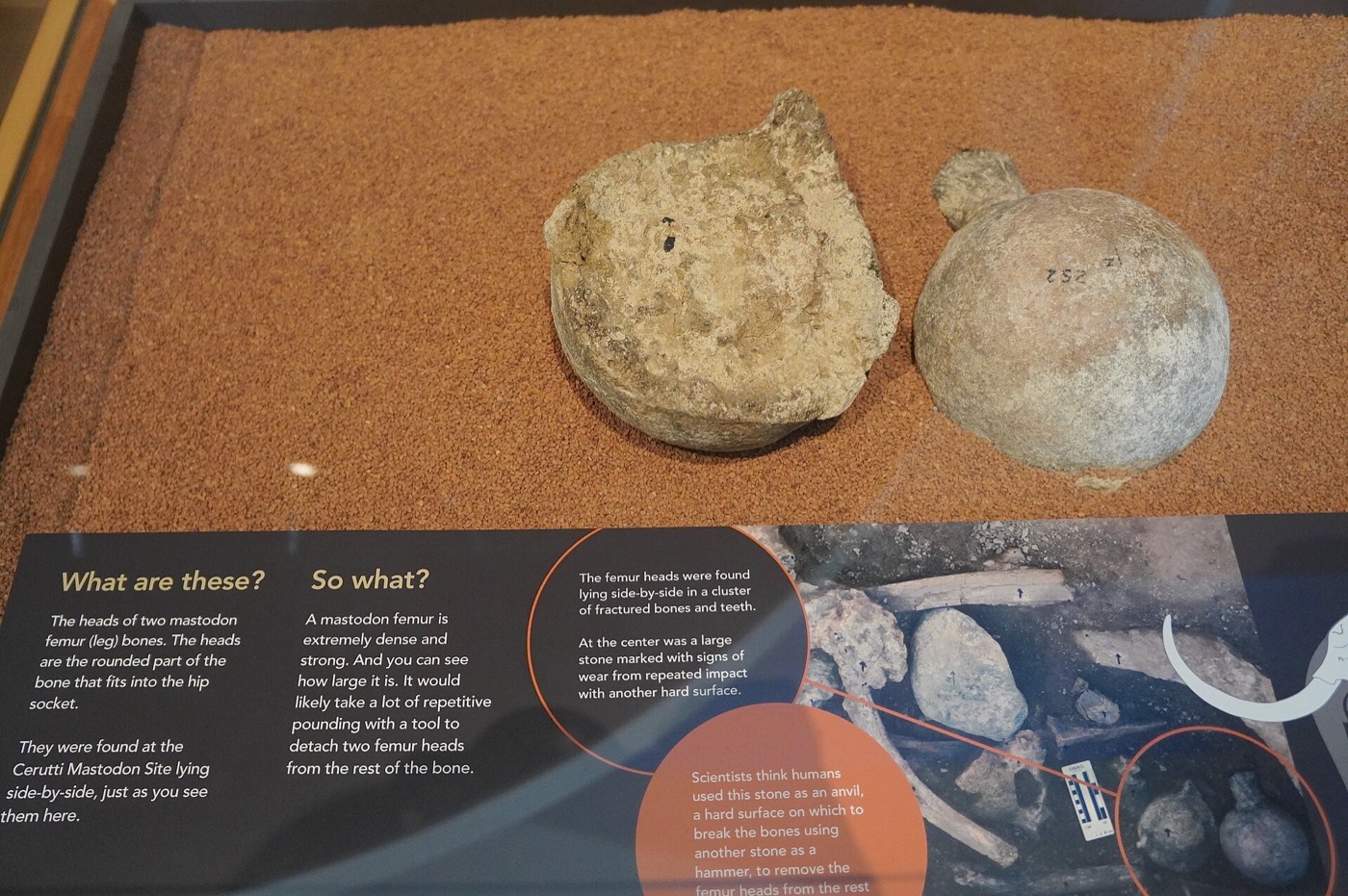
Holen and colleagues argued that an unidentified Homo species broke a mastodon's limb bones and molars with stone hammers on stone anvils about 130,000 years ago, for marrow or tool material. That is over 100,000 years before the oldest accepted American sites.

Claimed age
~130,700 ± 9,400 years ago (U-series)130k yrs
Claimed
2017Steven R. Holen, Thomas A. Deméré
Verdict
Open9 years and counting
Leap
8.7×× the accepted limit then
Evidence then
4.5 / 8
Sources
2019 opened and checked
Record
Medium confidenceReviewed
What happened
- 1992Museum paleontologists monitoring freeway work find the mastodon in November and excavate it over about five months.
- 2008Archaeologist Steven Holen first examines the specimens.
- 2009A second radiocarbon attempt finds no collagen; OSL (UIC 2008, Nebraska 2011) gives 73.3±4.1 ka and 99±12 ka; most 2011 aliquots saturated.
- 2015USGS uranium-series work on the bones (2012–2015) yields 130.7 ± 9.4 ka.
- 2017Holen et al. publish the claim in Nature.
- 2017Critiques by Haynes and by Braje and nine co-authors appear in PaleoAmerica; the authors reply.
- 2018Ferraro et al. contest the site in Nature, favoring geological and taphonomic causes; the authors reply.
- 2018Gruhn examines the collection and reports soil carbonate on break surfaces, implying ancient breakage.
- 2019Ferrell attributes the damage to freeway construction; Sutton et al. favor a natural deposit disturbed by mastodons.
- 2019Magnani et al. fault the design of the breakage experiments in an Antiquity debate.
- 2020Bordes et al., with two original authors, report bone micro-residue on the worn faces of two cobbles.
- 2026Haynes and Krasinski review 12 proboscidean bone-breaking experiments and call for more rigorous design.
Objections 0 of 7 proved wrong
- Heavy construction or excavation machinery during the 1992–93 salvage, not people, may have broken the bones.Unresolved — Proponents (2018 reply) and Gruhn report thick old carbonate on most breaks; Sutton et al. favour ancient breakage. Ferrell used plans and photos, not the bones. No thin sections published.
- The assemblage may be a natural deposit disturbed by other mastodons soon after death (e.g. by trampling), with no human involvement.Unresolved — Proponents cite low-energy burial, notches, cone flakes and refits against natural breakage. Haynes et al. (2021) found similar notches and curved outlines also arise naturally; the CM bones themselves are untested.
- Common geological and taphonomic processes explain the site better; the cobbles need not be tools.Unresolved — Holen et al. (2018) find no trace of the alluvial fan Ferraro et al. propose. Bordes et al. (2020, same team) found bone residue on the worn faces of two cobbles, not their other faces.
- No knapped stone tools or hominin bones were found, so nothing at the site is unambiguously human-made.Unresolved — Proponents reply that knapped tools are not required at bone-processing sites. No unambiguous artifact is reported in the later work reviewed here.
- The 230Th/U bone age may be unreliable: bone takes up uranium after burial, and no strictly local uranium source was sampled.Unresolved — No independent re-dating yet. Proponents cite regular uranium profiles in three bones; finite OSL ages (73.3±4.1 ka; 99±12 ka) fell well short of 130 ka, and radiocarbon failed.
- A 130,000-year-old site implies an unknown hominin in the Americas, with no fossil, archaeological or genomic trace in northeast Asia or the Americas.Unresolved — Holen et al. (2018) reply that critics misuse 'extraordinary claims require extraordinary evidence'. A prior alone cannot settle the site.
- The breakage experiments were few, qualitative and uncontrolled, and did not test natural alternatives.Unresolved — Holen, Fullagar and Holen replied (2019). A 2026 review, led by a principal CM critic, found the 12 experiments methodologically inconsistent, most with little or no quantitative data.
Evidence at the time within ~5 years of the claim
- Unambiguous evidenceNo — Broken bone and battered cobbles only: no knapped tools or hominin remains found. Natural and machine breakage were argued from the start.
- Documented contextPartly — Grid-mapped excavation with sediment and soil study, but found during freeway construction, which destroyed an unknown, probably significant part of the bonebed.
- Independent dating methodsNo — U-series alone gave ~130 ka. OSL gave finite ages well short of that (73.3±4.1 ka, CM bed; 99±12 ka, Bed C) and most 2011 aliquots saturated; radiocarbon failed for lack of collagen.
- More than one labPartly — The ~130 ka bone age comes from one lab (USGS); no second lab confirmed it. OSL ran at UIC and Nebraska, neither matching ~130 ka; two radiocarbon labs found no collagen.
- Professional recoveryYes — Excavated over about five months from November 1992 by San Diego Natural History Museum paleontologists.
- Peer-reviewed reportYes — Full report with extensive supplementary data in Nature, 2017.
- Open to criticsYes — Holen et al. released videos and 3D models, acknowledged by Magnani et al. (2019); Gruhn (2018) and Sutton et al. (2019) independently examined the collection.
- Independent teamsPartly — No independent dating or excavation. Outside researchers made brief re-examinations: Gruhn (2018), supportive on break age; Sutton et al. (2019), critical.
- Outside stakeNo — No commercial, religious or nationalist motive documented; the authors declared no competing financial interests.
What would settle it for a field partner
- Thin-section the carbonate crusts on CM fracture surfaces, and U-series date them where feasible, to see whether the crusts grew over the breaks.Low costWould show: Crusts grown over break faces would rule out machine breakage for those bones; fresh breaks cutting through crusts would support it.
- Blind, quantitative comparison of CM notches, cone flakes and fracture outlines with controlled sets: hammerstone-on-anvil, trampling, sediment loading and heavy-equipment loading of proboscidean bone.Medium costWould show: Whether the CM breakage matches human percussion better than natural or machine breakage.
- Repeat the bone U-series at a second laboratory, and date archived Bed E sediment by feldspar post-IR IRSL, which saturates at higher doses than quartz OSL.Medium costWould show: Whether the ~130 ka age holds by independent methods, or the bed is younger.
- Independent blind use-wear and residue study of all CM cobbles, with control cobbles and sediment from outside the bone clusters.Medium costWould show: Whether bone residue and impact wear are confined to the claimed tool surfaces, as Bordes et al. (2020) report for two cobbles.
What would change this record
Refuted if the key impact-notched or refitting fractures cut through old crusts, or if controlled natural or machine breakage reproduces the CM notches, flakes and wear. Closer to vindicated if independent labs confirm the age and a similar-age site yields unambiguous artifacts.
Notes
- Status. Not widely accepted: critics favor natural or construction breakage and doubt the age, while the authors hold that people broke the bones. Gruhn (2018) ruled out machine breakage and called the site an unresolved anomaly.
- Accepted view then. Population expansion into the Americas occurred after ~16,000 years ago; the earliest securely dated sites are under ~15,000 years old.
- Dating basis. 230Th/U on cortical bone of three mastodon bones, diffusion–adsorption–decay model (USGS); 2σ range. Not radiocarbon; ka taken as calendar years before present.
- Correction. Not a skeleton: fragmentary, disarticulated remains of one mastodon. Construction destroyed an unknown, probably significant part of the bonebed before excavation (S2).
- Correction. Found in November 1992 by museum paleontologists monitoring freeway work and excavated over about five months. The claim was first published in 2017, 24 years later (S18, S1).
- Correction. The ~130 ka age rests on one method, U-series on bone (130.7 ± 9.4 ka, 2σ). Radiocarbon failed for lack of collagen, and OSL gave only finite ages of 73.3±4.1 ka and 99±12 ka, well short of 130 ka (S2).
- Correction. Responses were not all critical: Boëda et al. (2017) called the find potentially transformational, and Gruhn (2018) rejected machine breakage after examining the bones (S20, S10).
- Correction. Critiques also appeared in Nature (Ferraro et al. 2018) and Antiquity (Magnani et al. 2019), not only in PaleoAmerica.
- Named for museum paleontologist Richard Cerutti, who found it. The OSL analyst (S. Forman) later co-authored the Ferraro et al. critique. The authors suggest a vertically buried tusk may have been placed by people (S2). Haynes et al. (2021) (S15) show percussion-like fractures also arise naturally on non-green or non-anthropogenic bone, though the CM bones themselves were untested; its lead author is a principal CM critic. independent_methods_count counts bone fractures, cobble wear, refits, sedimentology and U-series as separate evidence lines, not agreeing dating methods. Finite OSL ages (73.3±4.1–99±12 ka) are far older than accepted sites, so a younger bed would not remove the anomaly.
People and evidence
- Proponents. Steven R. Holen, Thomas A. Deméré, Daniel C. Fisher, Richard Fullagar, James B. Paces, Kathleen A. Holen
- Critics. Gary Haynes, Todd J. Braje and nine co-authors, Joseph V. Ferraro and colleagues, Patrick M. Ferrell, Mark Q. Sutton and colleagues, Matthew Magnani and colleagues
- Evidence types. u series, osl, stratigraphy, geology, fauna, lithics, chemistry · 5 independent lines
- Record confidence. medium — Supplementary data, Magnani et al. and the Haynes et al. (2021) abstract read in full; most critiques and replies read only as abstracts (paywalled). S19 and S21 could not be read.
Sources · 20 · 19 opened and checked · DOIs matched against Crossref
- S1Holen, S.R., Deméré, T.A., Fisher, D.C., Fullagar, R., Paces, J.B., Jefferson, G.T., Beeton, J.M., Cerutti, R.A., Rountrey, A.N., Vescera, L. & Holen, K.A. (2017). A 130,000-year-old archaeological site in southern California, USA. Nature 544(7651): 479–483.Abstract, Extended Data legends and declarations read; main text paywalled.
- S2Holen, S.R. et al. (2017). Supplementary Information for 'A 130,000-year-old archaeological site in southern California, USA'. Nature 544: 479–483.Read: setting, sediments, construction losses, taphonomy, radiocarbon, OSL and U-series sections, incl. exact OSL figures (73.3±4.1 ka; 99±12 ka; saturated 2011 aliquots).
- S3Haynes, G. (2017). The Cerutti Mastodon. PaleoAmerica 3(3): 196–199.Abstract read (OpenAlex; matches the publisher listing); full text paywalled.
- S4Braje, T.J., Dillehay, T.D., Erlandson, J.M., Fitzpatrick, S.M., Grayson, D.K., Holliday, V.T., Kelly, R.L., Klein, R.G., Meltzer, D.J. & Rick, T.C. (2017). Were hominins in California ∼130,000 years ago? PaleoAmerica 3(3): 200–202.Abstract read via OpenAlex; full text paywalled.
- S5Holen, S.R., Deméré, T.A., Fisher, D.C., Fullagar, R., Paces, J.B., Jefferson, G.T., Beeton, J.M., Rountrey, A.N. & Holen, K.A. (2018). Broken bones and hammerstones at the Cerutti Mastodon site: a reply to Haynes. PaleoAmerica 4(1): 8–11.Abstract read via OpenAlex (online November 2017); full text paywalled.
- S6Holen, S.R., Deméré, T.A., Fisher, D.C., Fullagar, R., Paces, J.B., Jefferson, G.T., Beeton, J.M., Rountrey, A.N. & Holen, K.A. (2018). Disparate perspectives on evidence from the Cerutti Mastodon site: a reply to Braje et al. PaleoAmerica 4(1): 12–15.Abstract read via OpenAlex; full text paywalled.
- S7Ferraro, J.V., Binetti, K.M., Wiest, L.A., Esker, D., Baker, L.E. & Forman, S.L. (2018). Contesting early archaeology in California. Nature 554(7691): E1–E2.Opening summary, references and author contributions read; full text paywalled.
- S8Holen, S.R., Deméré, T.A., Fisher, D.C., Fullagar, R., Paces, J.B., Jefferson, G.T., Beeton, J.M., Cerutti, R.A., Rountrey, A.N., Vescera, L. & Holen, K.A. (2018). Holen et al. reply. Nature 554(7691): E3.Opening summary read (rejects the proposed alluvial-fan source); full text paywalled.
- S9Haynes, G. (2018). Reply to Holen et al. regarding the Cerutti Mastodon. PaleoAmerica 4(2): 99–100.Abstract read via OpenAlex; full text paywalled.
- S10Gruhn, R. (2018). Observations concerning the Cerutti Mastodon site. PaleoAmerica 4(2): 101–102.Abstract read via OpenAlex. Independent examination of the collection; rules out machine breakage but calls the site an unresolved anomaly, not evidence of human agency.
- S11Ferrell, P.M. (2019). The Cerutti Mastodon site reinterpreted with reference to freeway construction plans and methods. PaleoAmerica 5(1): 1–7.Abstract read (OpenAlex and Semantic Scholar agree); full text paywalled.
- S12Sutton, M.Q., Parkinson, J. & Rosen, M.D. (2019). Observations regarding the Cerutti Mastodon. PaleoAmerica 5(1): 8–15.Abstract read (OpenAlex and Semantic Scholar agree); full text paywalled.
- S13Magnani, M., Grindle, D., Loomis, S., Kim, A.M., Egbers, V., Clindaniel, J., Hartford, A., Johnson, E., Weber, S. & Campbell, W. (2019). Evaluating claims for an early peopling of the Americas: experimental design and the Cerutti Mastodon site. Antiquity 93(369): 789–795.Read in full (free PDF from the publisher).
- S14Bordes, L., Hayes, E., Fullagar, R. & Deméré, T. (2020). Raman and optical microscopy of bone micro-residues on cobbles from the Cerutti mastodon site. Journal of Archaeological Science: Reports 34: 102656.Abstract read via Semantic Scholar. Fullagar and Deméré co-wrote the 2017 paper, so this is not independent.
- S15Haynes, G., Krasinski, K. & Wojtal, P. (2021). A study of fractured proboscidean bones in recent and fossil assemblages. Journal of Archaeological Method and Theory 28(3): 956–1025.Abstract read on the Springer page: notched edges, smooth fracture surfaces and curvilinear outlines also form on non-green or non-anthropogenically broken bone. Lead author is a principal CM critic.
- S16Haynes, G. & Krasinski, K.E. (2026). Experimental fracturing and knapping of proboscidean long bones: observed outcomes and interpretive challenges. Journal of Archaeological Science: Reports 74: 105888.Abstract read from the SSRN preprint record (10.2139/ssrn.6293278); reference list includes Holen et al. 2017. Lead author is a principal CM critic. Full text paywalled.
- S17Potter, B.A., Baichtal, J.F., Beaudoin, A.B., Fehren-Schmitz, L., Haynes, C.V., Holliday, V.T., Holmes, C.E., Ives, J.W., Kelly, R.L., Llamas, B., Malhi, R.S., Miller, D.S., Reich, D., Reuther, J.D., Schiffels, S. & Surovell, T.A. (2018). Current evidence allows multiple models for the peopling of the Americas. Science Advances 4(8): eaat5473.Open access; abstract read. Cited only for the accepted chronology near the time of the claim; it does not discuss Cerutti.
- S18San Diego Natural History Museum (n.d., c. 2018). The Cerutti Mastodon Site: One Year Later. The Nat's Science & Research Blog.Account by the proponents' museum: discovery date, excavation, Holen's first look in 2008. Undated; year inferred from title.
- S19Holen, K., Fullagar, R. & Holen, S.R. (2019). Archaeological site interpretation using experimental quantitative and qualitative data: a response to Magnani et al. (2019). Antiquity 93(369): 798–801.Metadata confirmed via Crossref; no abstract available and content not read.
- S20Boëda, E., Griggo, C. & Lahaye, C. (2017). The Cerutti Mastodon site: archaeological or paleontological? PaleoAmerica 3(3): 193–195.Abstract read (OpenAlex/lookup): calls the find 'possibly altered by humans' and 'potentially transformational'; calls for a search for comparable sites.
Drafted researcher agent (Claude Opus 5.5) · 2026-09-23Skeptic revise · 2026-09-23Stage revisedOpen issues Kept features_at_claim.multiple_labs as 'partial' rather than 'no' (skeptic offered either): OSL and radiocarbon did run at additional labs even though none confirmed the ~130 ka U-series age; the note now says so explicitly.; Did not add Eren & Bebber (2019), a minor suggestion: sources is capped at 20 and already full; Crossref confirms the citation but no abstract is indexed, so it would add little over existing S13/S19 coverage of the same debate.; D19 re-rating 2026-09-23: unchanged — open fits: human percussion vs natural or machine breakage, and the ~130 ka U-series age, are actively argued with evidence on both sides (2017-2026).Raw record · Suggest a correction