Cases / Göbekli Tepe
Vindicated
Göbekli Tepe
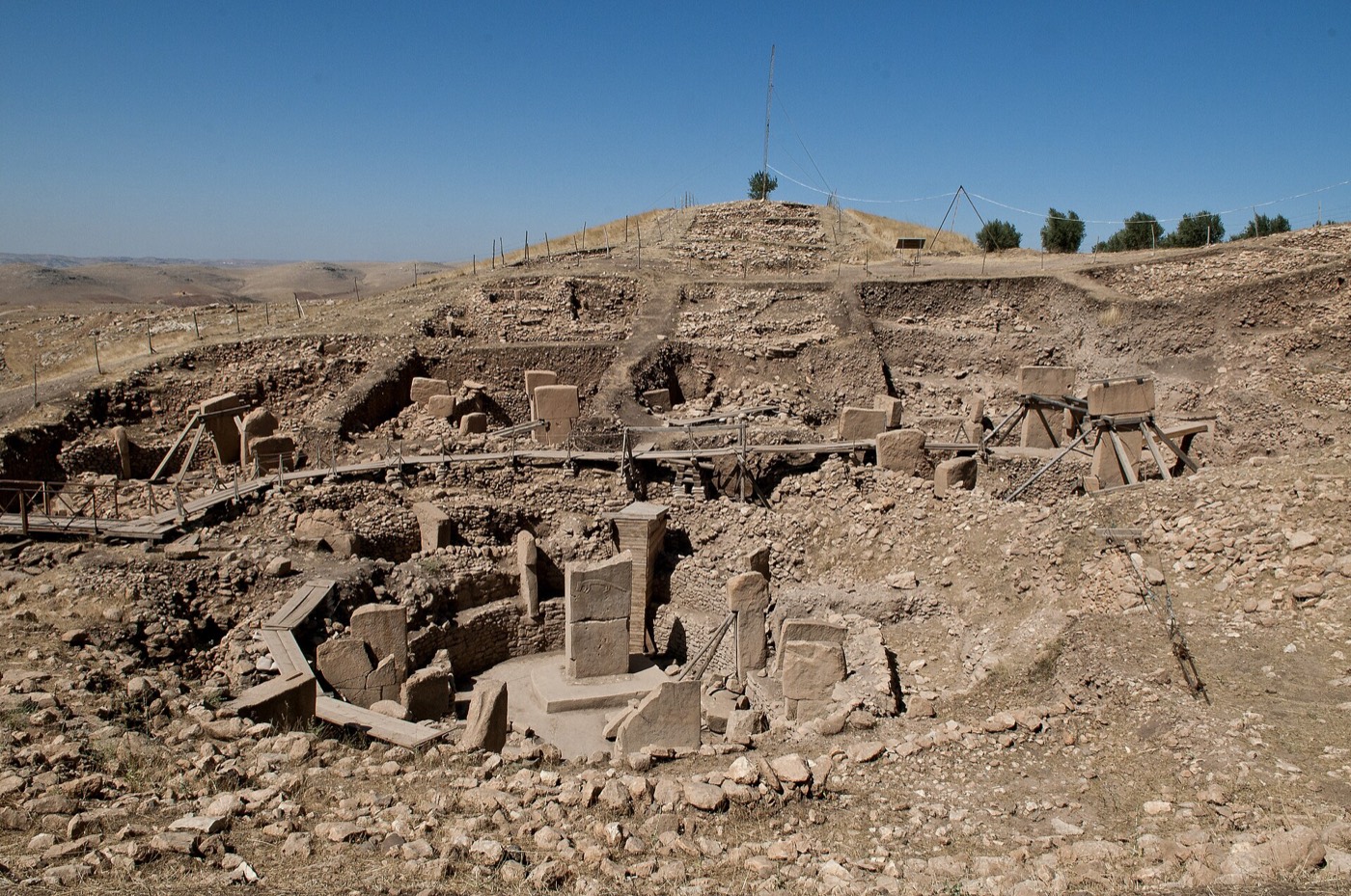
Klaus Schmidt found monumental Pre-Pottery Neolithic stone enclosures at Göbekli Tepe, built by pre-agricultural hunter-gatherers from the late 10th millennium BCE. His further reading of the site as purely ritual 'temples' with no residents is tracked as a separate candidate.

Claimed age
~9600-8200 cal BC11k yrs
Claimed
1995Klaus Schmidt, Oliver Dietrich
Verdict
Vindicated · 20005 years after the claim
Leap
—not a dating claim
Evidence then
4 / 8
Sources
96 opened and checked
Record
Medium confidenceReviewed
What happened
- 19631963 Istanbul-Chicago survey (Benedict, in Cambel & Braidwood) records flint-strewn knolls with small cemeteries at the site; significance not recognized.
- 1995Schmidt, recognizing the slabs as prehistoric megaliths, begins excavation under the DAI and Şanlıurfa Museum; the first T-shaped pillars are uncovered.
- 1998First radiocarbon dates from the site are obtained.
- 2000Schmidt publishes a preliminary report on the 1995-1999 excavations, describing monumental T-pillar enclosures and an unusual 'religious' character.
- 2011Edward Banning publishes 'So Fair a House,' arguing the enclosures may be domestic buildings rich in symbolic content rather than exclusively temples.
- 2012Dietrich, Heun, Notroff, Schmidt and Zarnkow synthesize evidence, proposing feasting and possible beer brewing (oxalate spot tests; stated as not yet certain).
- 2014Klaus Schmidt dies; DAI research at the site is subsequently coordinated by Lee Clare, who directs renewed excavation and reassessment.
- 2017Gresky, Haelm and Clare report modified human skull fragments, evidence for a Neolithic 'skull cult'; no formal burials found at the site.
- 2019Dietrich L. et al. report over 7,000 grinding/pounding tools and phytolith evidence for large-scale cereal processing at the site.
- 2020Clare's DAI review and Kinzel & Clare's synthesis describe a revised, 8-phase chronology and call for revising the popular 'world's first temple' framing.
Objections 1 of 4 proved wrong
- Before Göbekli Tepe, monumental or ceremonial construction was thought to require a farming economic base to support the necessary labor and surplus.Proved wrong — Neither domesticated plants nor animals are documented at Göbekli Tepe's Layer III (S3); hunter-gatherers organized monumental construction before agriculture. Now standard in the literature.
- Large-scale coordinated monumental building was also thought to require a sedentary, resident population, not seasonally mobile foragers.Unresolved — Domestic-type structures with hearths were later found beside the enclosures (S7), implying some on-site residency, but these are not yet radiocarbon-dated against the enclosures' main use.
- The evidence for calling the enclosures exclusively 'temples', with no domestic buildings anywhere on site, is equivocal.Held up — Post-2014 excavation (S7) found domestic-type round-oval structures with a hearth sequence beside the enclosures; DAI calls revising the 'temple' framing 'unavoidable'. Whether the enclosures are houses is untested.
- The large enclosures' fill was first read as deliberate, ritually-motivated backfilling when each fell out of use; if so, dates and finds recovered from fill would not represent primary construction or use.Held up — S7: fill is redeposition from slope slides off adjacent knolls, containing mixed PPNA/PPNB material; explains heterogeneous fill dates. Finds like S9's skull fragments cannot be dated to a single phase.
Evidence at the time within ~5 years of the claim
- Unambiguous evidenceYes — Multi-ton carved T-shaped pillars in walled circles are unambiguous artificial construction. The 'purely ritual, no residents' reading was an interpretation of that evidence, later revised (S7).
- Documented contextYes — Excavated in place from 1995 by a trained DAI/Şanlıurfa Museum team under Schmidt, with stratigraphic layers (III under II under I) documented from the outset.
- Independent dating methodsNo — Lithic typology suggested a PPN date before excavation, but typology is itself cross-dated by radiocarbon elsewhere, not independent here. Radiocarbon was the only method applied at the site.
- More than one labNo — Reported radiocarbon codes (e.g. KIA-44149, KIA-44701) all carry the Kiel AMS laboratory prefix; no independent replication by a second dating laboratory was found in the sources reviewed.
- Professional recoveryYes — Excavated under permit by Klaus Schmidt (German Archaeological Institute) jointly with the Şanlıurfa Museum from 1995.
- Peer-reviewed reportYes — Schmidt's preliminary report on the 1995-1999 excavations appeared in the peer-reviewed journal Paleorient in 2000.
- Open to criticsUnknown — No independent (non-DAI) study of the material within about five years of the 1995 claim was found; the first outside critique (Banning) did not appear until 2011.
- Independent teamsNo — One coordinated DAI-Şanlıurfa Museum project; no second team added evidence within five years. Comparable T-pillars at Nevalı Çori (Hauptmann) are corroborating context, not independent evidence.
- Outside stakeNo — Academic, institutionally funded excavation (DAI/Şanlıurfa Museum); no commercial, religious or nationalist motive documented. The popular 'world's first temple' framing outran the evidence (S7).
What would settle it for a field partner
- Complete micromorphological/use-wear study of excavated Layer II rectangular buildings to determine what fraction show domestic markers (hearths, storage, bedding) versus only symbolic/ritual features.Medium costWould show: Whether domestic occupation was site-wide and continuous or limited to specific structures or phases, resolving how much of the complex functioned as ordinary housing.
- AMS-date organic material (phytoliths, faunal collagen) from primary floor deposits inside the large decorated enclosures themselves, rather than fill or mortar, at a second laboratory outside Kiel.Medium costWould show: Whether the enclosures' primary-use dates reproduce independently of the project's usual dating laboratory, and match the accepted ~9600 cal BC start.
- AMS-date short-lived material (e.g. hearth charcoal) from the domestic-context hearth sequence reported in S7 and compare against the enclosures' wall-mortar dates (e.g. KIA-44149, S6).Low costWould show: Whether the domestic structures are contemporary with the enclosures' main use (mixed ritual-domestic site) or postdate them (supporting a purely-ritual Layer III).
What settled it New excavation
Radiocarbon dates from 1998 and Schmidt's 2000 peer-reviewed report placed the enclosures in the PPNA, and no re-dating has challenged this. Layer III has yielded no domesticated plants or animals (Dietrich et al. 2012), so the builders were hunter-gatherers.
What would change this record
Independent re-dating placing the enclosures after regional adoption of domesticated cereals or livestock, or domesticates found in primary Layer III contexts, would overturn 'monumental building before farming'.
Notes
- Status. Core claim vindicated: the ~9600-8200 cal BC age and building by pre-farming hunter-gatherers are widely accepted; no re-dating challenges them. Schmidt's 'temple, no residents' reading did not hold (S7) and is split out.
- Accepted view then. Standard models held that a farming economic base was needed to support large-scale monumental construction; hunter-gatherers were not expected to build it.
- Now understood. ~9600-8000 cal BC
- Dating basis. AMS radiocarbon on collagen, charcoal and lime mortar, mostly run at Kiel. E.g. mortar KIA-44149: 9984+/-42 BP = 9745-9314 cal BC; latest PPN activity 8860+/-60 BP = 8240-7780 cal BC.
- Refined since. Function reinterpreted: 2015-19 excavation found domestic-type buildings with hearths and rainwater harvesting beside the enclosures; the DAI calls revising the 'temple' framing unavoidable (Clare 2020).
- Refined since. Chronology refined to an 8-phase sequence: Layer III circular-oval enclosures (PPNA, from ~9500 cal BC) lie under Layer II rectangular buildings (PPNB, to ~8000 cal BC) (Clare 2020).
- Refined since. Enclosure fill, first read as deliberate ritual backfilling, is redeposited slope-slide debris mixing PPNA and PPNB material (Clare 2020), which explains the scatter of fill dates.
- Refined since. Over 7,000 grinding and pounding tools and phytolith evidence show large-scale cereal processing on site (Dietrich L. et al. 2019), supporting mixed use of the site.
- Refined since. Modified human skull fragments point to a Neolithic 'skull cult' (Gresky et al. 2017); a burial (DR1) found later revised the 2017 view that burials were absent (Clare 2020).
- Correction. Commonly repeated detail that Benedict mistook pillar tops for grave markers is UNVERIFIED: S1's quotation of Benedict (1980: 179, 181) describes flint-strewn knolls with small cemeteries, not a grave-marker misreading.
- Correction. The exact 1994 recognition date (before 1995 excavation) is UNVERIFIED in sources reviewed; this record codes 1995, when excavation and public reporting began, as year_claimed (S1).
- Correction. The brief's 'domestic or roofed buildings' framing holds: Banning (2011, S4) proposed the enclosures could be houses; post-2014 fieldwork (S7) instead found separate domestic structures beside the decorated enclosures.
- This record separates two parts of the 1995 claim: (1) pre-agricultural hunter-gatherers built monumental enclosures c. 9600-8200 cal BC; (2) the complex was purely ritual, with no residents. Part (1) is vindicated; part (2) failed. Post-2014 excavation (S7) found domestic structures with hearths near the enclosures and a burial (DR1); S9's 2017 'burials absent' account predates this. S7 also found the fill is redeposited slope debris mixing PPNA/PPNB material, not deliberate backfill, explaining early dates' heterogeneity. 'May have helped drive the shift to agriculture' is untested and dropped from claim. No source suggests hoax or contamination; debate is about function, not age.
People and evidence
- Proponents. Klaus Schmidt, Oliver Dietrich, Jens Notroff
- Critics. Edward B. Banning
- Evidence types. radiocarbon, stratigraphy, lithics, artifacts, architecture, art, human remains, plant remains, fauna · 4 independent lines
- Record confidence. medium — Age and pre-farming context are solidly sourced from open literature. features_at_claim covers the monumental/age claim; the 'purely ritual' reading, now split out, is covered by objections.
Sources · 9 · 6 opened and checked · DOIs matched against Crossref
- S1Schmidt, K. (2000). Göbekli Tepe, Southeastern Turkey. A Preliminary Report on the 1995-1999 Excavations. Paleorient 26(1): 45-54.Full text open on Persée (p.45): describes the PPN mound's megalithic architecture, sculpture and 'religious function'; quotes Benedict (1980: 179, 181) on the 1963 survey.
- S2Benedict, P. (1980). Survey Work in Southeastern Anatolia. In H. Cambel & R.J. Braidwood (eds.), Prehistoric Research in Southeastern Anatolia, pp. 150-191 (Göbekli Tepe: pp. 179, 181-182). Istanbul University.Existence confirmed via S1's quotation (pp.179, 181): flint-strewn knolls with small cemeteries. The grave-marker/Aceramic detail is not shown there and is UNVERIFIED; not used for a key field.
- S3Dietrich, O., Heun, M., Notroff, J., Schmidt, K., Zarnkow, M. (2012). The role of cult and feasting in the emergence of Neolithic communities. New evidence from Göbekli Tepe, south-eastern Turkey. Antiquity 86(333): 674-695.Full text read: Layer III (PPNA enclosures), Layer II (PPNB); 'neither domesticated plants nor animals are known', so builders were hunter-gatherers; T-pillars also at Nevalı Çori.
- S4Banning, E.B. (2011). So Fair a House: Göbekli Tepe and the Identification of Temples in the Pre-Pottery Neolithic of the Near East. Current Anthropology 52(5): 619-660.Abstract read via OpenAlex: evidence for exclusively cultic/temple buildings is equivocal, possibly resting on ethnocentric sacred/profane distinctions; buildings may be houses rich in symbolism.
- S5Dietrich, O., Notroff, J. (2015). A sanctuary, or so fair a house? In defense of an archaeology of cult at Pre-Pottery Neolithic Göbekli Tepe. In N. Laneri (ed.), Defining the Sacred: Approaches to the Archaeology of Religion in the Near East, pp. 75-89. Oxbow Books.DOI and citation confirmed via Crossref; JSTOR chapter paywalled, content not read directly. Cited only as the excavators' published reply to Banning (2011).
- S6Dietrich, L., Meister, J., Dietrich, O., Notroff, J., Kiep, J., Heeb, J., Beuger, A., Schutt, B. (2019). Cereal processing at Early Neolithic Göbekli Tepe, southeastern Turkey. PLOS ONE 14(5): e0215214.Full text read: >7000 grinding/pounding tools, phytoliths show cereal processing. Dates: KIA-44149 mortar 9984+/-42 BP = 9745-9314 cal BC; final PPN activity 8860+/-60 BP = 8240-7780 cal BC.
- S7Clare, L. (2020). Göbekli Tepe, Turkey. A brief summary of research at a new World Heritage Site (2015-2019). e-Forschungsberichte des DAI 2020(2): 81-88.Full text (DAI PDF): domestic structures, hearths, rainwater harvesting (2015-19); fill is slope-slide redeposition (mixed PPNA/PPNB), not ritual backfill; burial DR1 mapped; undated by AMS.
- S8Kinzel, M., Clare, L. (2020). Monumental - compared to what? A perspective from Göbekli Tepe. In A.B. Gebauer, L. Sorensen, A. Teather, A.C. Valera (eds.), Monumentalising Life in the Neolithic: Narratives of Change and Continuity, pp. 29-48. Oxford: Oxbow.DOI and citation confirmed via Crossref; JSTOR access blocked full text; not independently read. Not relied on for the phase count; accepted_age now cites S7 instead.
- S9Gresky, J., Haelm, J., Clare, L. (2017). Modified human crania from Göbekli Tepe provide evidence for a new form of Neolithic skull cult. Science Advances 3(6): e1700564.Abstract read: three partly preserved skulls show artificial modifications unknown elsewhere in the period; burials are otherwise absent; interpreted as a new form of skull cult.
Drafted researcher agent (claude-sonnet-5) · 2026-09-23Skeptic revise · 2026-09-23Stage revisedOpen issues multiple_labs and decisive_tests' 'second lab outside Kiel' premise rest on unverified 1998 dates (Kromer & Schmidt, Neo-Lithics 3/98); not independently located this round, left as in the draft.; S5 (Dietrich & Notroff 2015) and S8 (Kinzel & Clare 2020) remain paywalled beyond confirmed metadata; not relied on for key fields.; Whether an expectation of sedentism (e.g. Natufian villages) already existed pre-1995, versus being newly established here, is untested against a source like Bar-Yosef 1998; objections[1] left 'unresolved' rather than resolved either way.; D19 re-rating 2026-09-23: partial → vindicated — monumental building before farming is accepted; the 'temple, no residents' reading is split out as a candidate. year_resolved 2000 (first dated peer-reviewed report) is a judgment call.Raw record · Suggest a correction