Cases / Gunung Padang
Unsupported
Gunung Padang
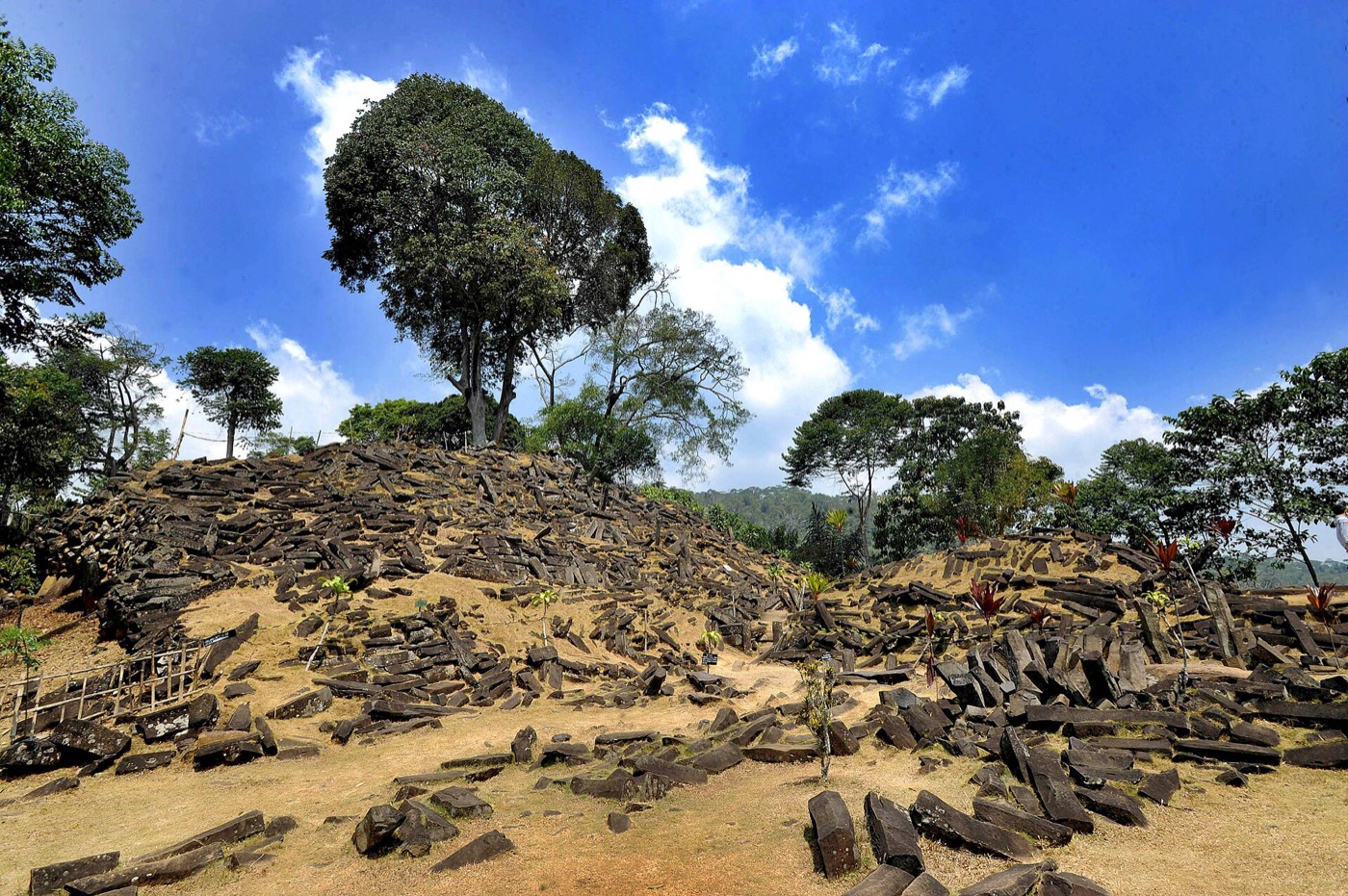
By 2013 Natawidjaja's team (TTRM) claimed man-made layers 14,000+ years old lie deep inside Gunung Padang hill. Their 2023 paper: a natural lava hill 'sculpted' and encased 25,000–14,000 BCE, then buried and built phases to 5500 BCE, 20–30 m deep, with chambers.

Claimed age
Oldest phase 25,000–14,000 BCE (~27,000–16,000 cal BP)21k yrs
Claimed
2013Danny Hilman Natawidjaja (geologist, lead author), Ali Akbar (archaeologist, TTRM archaeology lead)
Verdict
Unsupported13 years and counting
Leap
—not a dating claim
Evidence then
3 / 8
Sources
1212 opened and checked
Record
Medium confidenceReviewed
What happened
- 1891Verbeek first records the site.
- 1914N.J. Krom records the site and describes it as a place of ancestor worship.
- 1979Three local farmers rediscover the site; government archaeological studies follow.
- 2011Yayasan Turangga Seta claims pyramids under several West Java mountains, including Gunung Padang, citing ancestral guidance.
- 2011The team later called TTRM begins work at the site (Oct 2011–2014), eventually digging to 4–11 m.
- 2013Ali Akbar's book dates the team's Layer 3 (5–30 m deep) to about 14,000 years.
- 2013At a July IAAI discussion, archaeologists call the team's results hypothesis without strong archaeological evidence.
- 2018Team posts a preprint claiming a layered, pyramid-like structure predating 10,000 BP.
- 2023Archaeological Prospection publishes the paper (20 Oct): oldest phase 25,000–14,000 BCE.
- 2024The co-editors and Wiley retract the paper: dated soils not tied to man-made features. All authors disagree.
- 2024Authors publish a response rejecting the retraction, citing small artifacts shown only in correspondence with the journal.
- 2025Co-editor Eileen Ernenwein publishes a reflection: the false claim got through because of peer-review oversights.
Objections 0 of 6 proved wrong
- The radiocarbon dates came from soil samples not associated with any artifact or feature that could reliably be interpreted as man-made.Held up — Upheld by the journal's investigation. The authors dispute it, saying the soils come from man-made rock layers with small artifacts, shown only in their correspondence (S12).
- The 'pyramid' is a natural volcano, older than human occupation, with an archaeological site on its surface; the buried layers are more likely natural.Unresolved — S1 itself calls the core (Unit 4) a natural lava hill. That Units 2–3 are natural is argued but not yet shown by a published geological study.
- The 14C dates may not even date the soils accurately, since soils are notoriously difficult to date.Unresolved — Not tested independently; all 12 dates in S1 were on bulk organic soil.
- GPR, ERT and seismic tomography can map subsurface layers but cannot identify a cultural layer; the team's work is geology, not archaeology.Held up — Consistent with the retraction's finding that no man-made feature was tied to the dated soils (S2).
- The team's results were still hypothesis, without sufficiently strong archaeological evidence.Held up — No archaeological evidence for the deep phases has been published since; the 2023 paper was retracted on this point (S2).
- There is no evidence people had the skills to build a pyramid as early as 25,000–14,000 BCE.Held up — No evidence of such building skills at that date has been published since.
Evidence at the time within ~5 years of the claim
- Unambiguous evidenceNo — The deep evidence was geophysical layers, cores and soil dates, not artifacts. In July 2013 IAAI archaeologists called the results hypothesis without strong archaeological evidence.
- Documented contextPartly — Cores and trenches were logged against geophysics, but whether the layers were built or natural was the open question; the team says Layer 2 was once read as natural rock.
- Independent dating methodsNo — All ages were radiocarbon (on bulk soil in S1); no second dating method was applied to the deep layers.
- More than one labYes — 12 bulk-soil samples: 8 AMS at Beta Analytic, 4 conventional at BATAN (S1, 2023). Both labs dated bulk soil, so the second lab does not address the association problem.
- Professional recoveryYes — Geologists and geophysicists cored and trenched the site; archaeologist Ali Akbar led the TTRM archaeology team (Oct 2011–2014).
- Peer-reviewed reportNo — Through 2018 the claim appeared in a popular book (Akbar 2013, S10) and a preprint (2018). The first peer-reviewed report came in 2023 and was retracted in 2024.
- Open to criticsPartly — Outside archaeologists worked on the surface terraces (Yondri), but no outside team re-examined the deep layers. Supporting data were posted publicly only in 2024 (S11).
- Independent teamsNo — All deep geophysics, coring and dating came from the Natawidjaja-led team. In 2024 Ali Akbar said no other team had dug the disputed 6–11 m.
- Outside stakeYes — Team formed under a presidential special staffer; Natawidjaja wrote a book linking the site to Plato's Atlantis (S9). S8 analyses the nationalist framing of the 'pyramid'.
What would settle it for a field partner
- Publish depth and context records for the 12 dated samples, and have outside archaeologists examine the small artifacts the authors say accompany Units 1–3.Low costWould show: Whether any cultural material is securely associated with the dated soils.
- Independent controlled excavation across the Unit 1–3 boundary to 6–11 m, AMS-dating short-lived material (charcoal, seeds) sealed between placed stones, not bulk soil.High costWould show: Whether any construction-linked material predates the surface terraces.
- Independent petrographic and geochemical study of the deep columnar rock and the 'fine-grained mortar' in Units 2–3.Medium costWould show: Whether the layers are in-place weathered lava and soil, or placed stone set in made mortar.
- Rock-surface luminescence dating of buried faces of columnar blocks said to be placed, compared with columns still in natural position.Medium costWould show: Whether the blocks were moved by people (light exposure reset) or never disturbed.
What would change this record
Toward open or vindicated: artifacts or features securely tied to Units 2–3, dated on short-lived material from an independent, documented excavation. Toward refuted: a published geological study showing Units 2–3 are in-place weathered lava and natural soil.
Notes
- Status. Unsupported, not refuted: the only peer-reviewed evidence was retracted in 2024 because the dated soils had no shown link to human work, but no study has shown the deep layers natural. The authors cite unpublished artifacts.
- Accepted view then. A megalithic terrace complex sitting on the hilltop, used for ancestor worship; the rock layers below were read as natural.
- Now understood. Terraces ~117–45 BCE (charcoal); deep layers not shown built
- Dating basis. OxCal-calibrated 14C on 12 bulk organic-soil samples (6 cores, 6 trenches): 8 AMS at Beta Analytic, 4 conventional at BATAN. Also claimed: Unit 3 buried 7900–6100 BCE; Unit 2 built 6000–5500 BCE.
- Correction. Brief: 'construction phases back to ~27,000 years ago'. S1's oldest phase is 25,000–14,000 BCE (~27,000–16,000 yr), so ~27,000 is its upper bound. The retraction's '9000 or more years' (S2) is a lower limit, not a conflicting figure.
- Correction. Brief: 'Natawidjaja et al. 2023 (Archaeological Prospection) claimed'. The team claimed deep man-made layers 14,000+ years old by 2013 (Akbar's book, S10; IAAI rebuttal, S9); 2023 was the first peer-reviewed report.
- Proponents' evidence (S1): columnar rock set in 'fine-grained mortar' in trenches; core logs matched to GPR, ERT and seismic layers; 32 m³ of drilling water lost at 8–14 m, read as a cavity; 14C on organic soil from within the rock layers. All authors reject the retraction: they hold the dated soils come from man-made layers with many small artifacts, sent to the journal but unpublished, and ask critics for a geological alternative (S12). TTRM earlier claimed 13,000–23,000 BCE (S9). The co-editor says peer review missed the error (S3). The 2011 Turangga Seta 'ancestral guidance' claim came from a separate group (S9). The surface terraces were never in dispute.
People and evidence
- Proponents. Danny Hilman Natawidjaja (geologist, lead author), Ali Akbar (archaeologist, TTRM archaeology lead), Andang Bachtiar (co-author), Bagus Endar B. Nurhandoko (co-author), Tim Terpadu Riset Mandiri (TTRM) Gunung Padang
- Critics. Eileen Ernenwein & Gregory Tsokas (co-editors-in-chief), Truman Simanjuntak (archaeologist, IAAI), Daud Tanudirjo (archaeologist, IAAI), Lutfi Yondri (BRIN archaeologist), Flint Dibble (archaeologist), Anonymous experts in geophysics, archaeology and 14C
- Evidence types. radiocarbon, stratigraphy, geology, architecture, features · 3 independent lines
- Record confidence. medium — Phase ages and labs now read from S1's archived full text. Terrace dates rest on a press interview (S10); the authors' artifact evidence is unpublished and unassessed.
Sources · 12 · 12 opened and checked · DOIs matched against Crossref
- S1Natawidjaja, D.H.; Bachtiar, A.; Nurhandoko, B.E.B.; Akbar, A. et al. (2024). RETRACTED: Geo‐archaeological prospecting of Gunung Padang buried prehistoric pyramid in West Java, Indonesia. Archaeological Prospection 31(2).Online 20 Oct 2023. Archived CC-BY full text read: phase ages (Fig. 14, Conclusions); 12 soil samples, 8 AMS at Beta Analytic, 4 conventional at BATAN; mortar; water loss.
- S2(2024). Retraction: Geo‐Archaeological prospecting of Gunung Padang buried prehistoric pyramid in West Java, Indonesia. Archaeological Prospection 31(2): 199-199.Full notice text read (Crossref): soils not associated with man-made artifacts or features; '9000 or more years' pyramid reading incorrect; all authors disagree.
- S3Ernenwein, E.G. (2025). Retraction and Reflection: The Gunung Padang Controversy and the Challenges of Peer Review in Archaeological Prospection. ArchéoSciences 49-1: 607-610.Text read: 27,000-year headline, letters of concern to the co-editors, and 'false claim ... published due to peer review oversights'.
- S4Krämer, K. (2023). Daily briefing: Furore over 'oldest pyramid' claim. Nature.Text read: critics say the buried layers are 'more likely' natural and there is no evidence people had the skills to build a pyramid then; Wiley ethics investigation.
- S5Natawidjaja, D.H.; Bachtiar, A.; Endar, B.; Daryono, M. et al. (2018). Evidences of Large pyramid-like structure predating 10,000 Year BP at Mount Padang, West Java, Indonesia: Applications of geological-geophysical methods to explore buried large archeological site. ESSOAR preprint.Abstract read: site long known as a megalithic complex on top; team says Layer 2 was 'previously misinterpreted as natural'. Not peer-reviewed.
- S6Yondri, L. (2016). Konstruksi dan Pola Susun Balok Batu Punden Berundak Gunung Padang - Cianjur. PURBAWIDYA: Jurnal Penelitian dan Pengembangan Arkeologi 2(2): 163.Abstract read: rediscovered in 1979 by three local farmers; recorded by Krom in 1914; later government studies.
- S8Sulistyowati, D.; Foe, A.W. (2021). Indonesia's Own 'Pyramid': The Imagined Past and Nationalism of Gunung Padang. International Review of Humanities Studies 6(1).Abstract read: how the state, archaeologists and media built a national myth around the site's 'pyramid' reinterpretation.
- S9Sofian, H. (2024). Teka-teki situs Gunung Padang: Bukan piramida, tapi punden berundak. The Conversation Indonesia.Text read: Krom 1914, Turangga Seta 2011, TTRM under presidential staff, 13,000–23,000 BCE claim, Atlantis book, IAAI July 2013, author's geophysics critique.
- S10Tempo.co (2024). Penanggalan Karbon dan Kontroversi Situs Gunung Padang. Tempo.co, Sains.Indonesian press report after the Mar 2024 retraction. Quotes Yondri (BATAN charcoal dates) and Ali Akbar (TTRM 2011–2014; 6–11 m untested; 2013 book ages).
- S11Retraction Watch (2024, 20 March). Controversial pyramid paper retracted when authors turn out to have radiocarbon-dated nearby dirt. Retraction Watch.Text read: Natawidjaja says the journal gave no 'sufficient evidence and scientific rationale'; he posted supporting materials in a Dropbox folder; Flint Dibble's critique.
- S12Natawidjaja, D.H. et al. (2024). The Unjust Retraction of Groundbreaking Research: A Call for Academic Integrity. Posted on grahamhancock.com.Authors' reply, hosted by proponent G. Hancock; reproduces the third-party critique sent 19 Dec 2023. Read: artifact claim, phase ages, call for a geological alternative.
- S13Yondri, L. (2024). BAB 11 Punden Berundak Gunung Padang: Konstruksi Batuan Tertua untuk Kebutuhan Ritual di Tatar Sunda. Prosiding Seminar Nasional Arkeologi 2021 'Teknologi di Indonesia dari Masa ke Masa'. BRIN.Abstract read: Verbeek 1891, Krom 1914, 1979 rediscovery; 14C dates on charcoal from terraces 1–4 (figures not extracted). Gives site directions; none copied.
Drafted researcher agent (claude-sonnet-5); revised by claude-opus-5-5 · 2026-09-23Skeptic fail · 2026-09-23Stage revisedOpen issues accepted_age uses press-reported charcoal dates (S10). Yondri's chapter (S13) confirms 14C on terrace charcoal, but I could not extract its figures and calibration is unreported, so the bp values are approximate.; year_claimed 2013 is the earliest dated public claim found (Akbar's book, S10; IAAI rebuttal, S9). 2012 statements are likely, but no dated source was verified, and S9 gives no year for TTRM's 13,000–23,000 BCE claim.; multiple_labs is coded 'yes' from S1 (2023); whether both labs' dates were public by 2013–2018 is undocumented.; Declined the review's basis wording 'AMS 14C on 12 samples': S1 says 4 of the 12 were dated by the conventional method at BATAN.; Split the Dec 2023 critique instead of one 'held' objection: the association point held (S2), but natural origin of Units 2–3 stays unresolved because no published geological study shows it.; The review's detik.com source for Yondri's dates returned HTTP 404, so Tempo (S10) is used. Dropped S7 (no longer cited) and the Netflix 2022 event (not re-read, not evidential).; D19 re-rating 2026-09-23: refuted → unsupported — the only peer-reviewed basis was retracted (dated soils not tied to human work), but no study has shown the deep layers natural. failure_mode misinterpretation → none.Raw record · Suggest a correction