Cases / Kensington Runestone
Refuted
Kensington Runestone
Olof Öhman reported finding a rune-inscribed stone on his farm near Kensington, Minnesota, in 1898. Its text, dated 1362, tells of 30 Norwegians and Swedes out of Vinland who lost ten men, read by proponents as proof of Norse explorers deep inland.
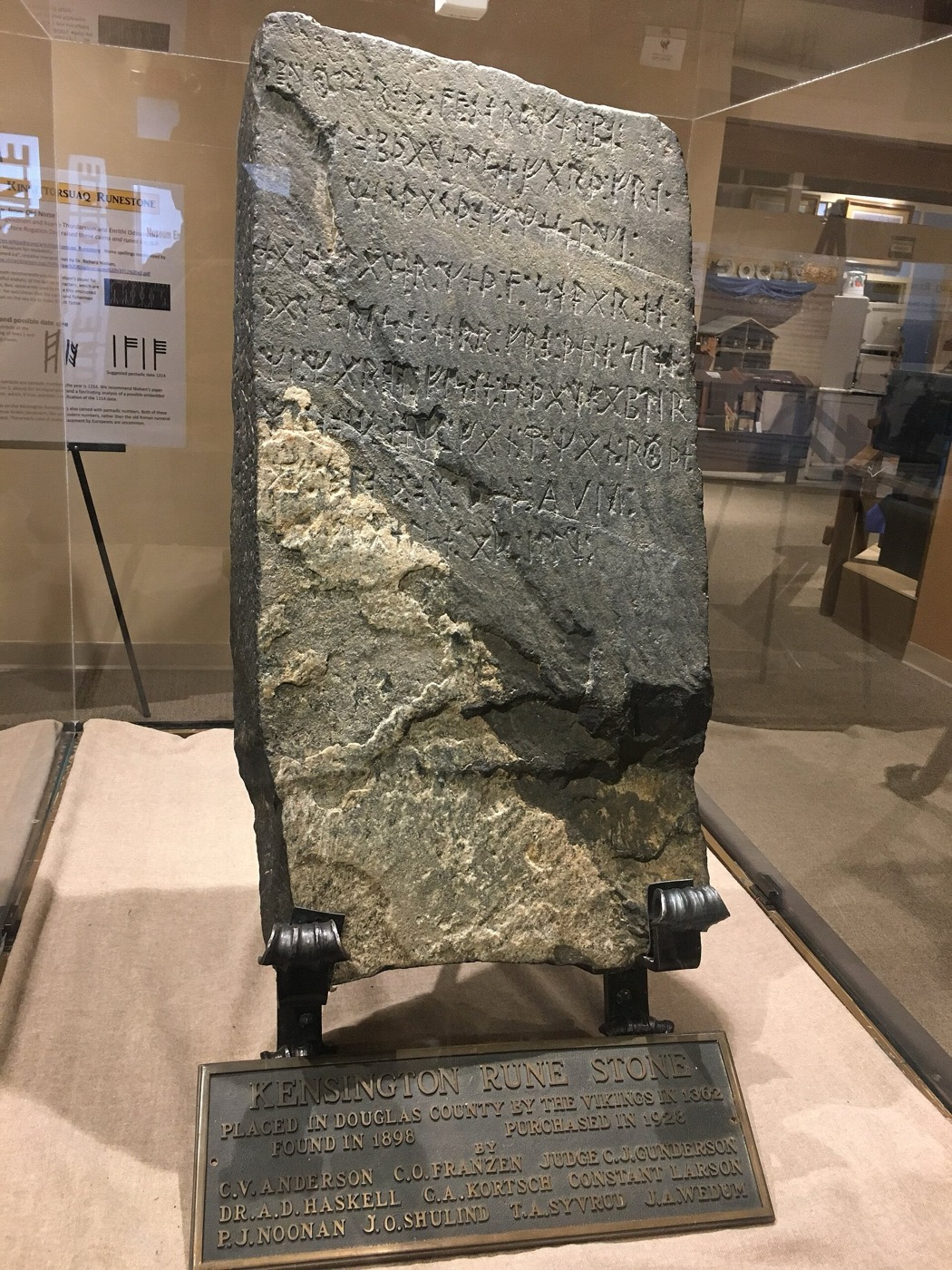

Claimed age
AD 1362 (date carved in the text)590 yrs
Claimed
1898Hjalmar Holand, Newton H. Winchell
Verdict
Refuted · 18991 years after the claim
Leap
—not a dating claim
Evidence then
2.5 / 8
Sources
144 opened and checked
Record
Medium confidenceReviewed
What happened
- 1898Olof Öhman reports finding the stone on his farm, partly under a young tree whose roots gripped it; his son Edward, aged ten, is present.
- 1899O. J. Breda (Minneapolis, from a drawing) and G. O. Curme (Chicago) both judge the inscription not medieval; the stone returns to Öhman.
- 1907Öhman sells the stone (or, per Flom, a share in it) to Hjalmar Holand, who writes about it from 1908 until his death in 1963.
- 1910MHS Museum Committee gives a favorable opinion (21 Apr), if a Scandinavian specialist agrees; member-geologist N. H. Winchell presents much of its report.
- 1910George T. Flom tells the Illinois State Historical Society the text is a modern dialect in modern runes, building on Helge Gjessing's critique.
- 1958Erik Wahlgren publishes The Kensington Stone: A Mystery Solved, a book-length rejection of a medieval origin.
- 1968Theodore C. Blegen publishes The Kensington Rune Stone: New Light on an Old Riddle, which Williams (2012) groups with Wahlgren's critique.
- 1994Linguist Robert A. Hall Jr. publishes The Kensington Rune-Stone: Authentic and Important, defending a 14th-century origin.
- 2004Rune-rows dated 1883 (Carl Emil Larsson) and 1885 (his brother Edward, a Dalarna tailor) are found in the Umeå dialect archive.
- 2006Richard Nielsen and geologist Scott F. Wolter publish The Kensington Rune Stone: Compelling New Evidence, a book-length case for authenticity.
- 2012Henrik Williams (Uppsala) finds the weight of evidence favors a 19th-century origin but calls that case 'not complete'.
- 2015David M. Krueger's Myths of the Rune Stone traces how faith in the stone shaped local Nordic identity after experts undermined it.
Objections 0 of 7 proved wrong
- Thirty explorers could not plausibly have reached western Minnesota from Vinland on the Atlantic coast, and covering that distance in fourteen days would have been impossible.Unresolved — No trace of a Norse inland route has been found, but Williams (2012) says 'nothing has been proven either way'; the medieval claim fell on the text, not the route.
- Plural subjects take singular verb forms (vi var, vi kom), where 14th-century Swedish had -um endings (vi varom, vi komom); the text reads as a modern dialect.Held up — Williams (2012): the weight of evidence still favors a 19th-century origin, though several forms once called impossible proved possible in Old Swedish.
- The text is written 'in modern runic characters'; runes were used in Dalarna long after the Middle Ages, so a 19th-century carver could have known them.Held up — Rune-rows of 1883 and 1885 from Dalarna (Larsson papers, found 2004) are closely related to the stone's runes, though n, o, p, r and t differ (Williams 2012).
- Runes cut in the soft calcite part are as clear as those in the harder graywacke; long weathering would have blurred them.Unresolved — Winchell (MHS 1910) judged the weathering old, as Wolter's books (2006, 2009) do; none of this is peer-reviewed or replicated (Williams 2012).
- No independent witness saw the stone in place, and accounts of the enclosing tree's size and age varied from one telling to the next.Unresolved — Williams (2012): no corroborating witness or tangible evidence exists, but there is also 'no evidence to disprove the account'.
- The inscription's number system and historical setting do not fit the 14th century, so the stone is not authentic.Unresolved — Flom (1910) judged Gjessing's case sound; no later source read for this record re-tests the numerals.
- Öhman owned a grammar with a runic alphabet, given him by a defrocked minister, Fogelblad, pointing to a local maker.Unresolved — Williams (2012) finds three medieval-looking words of the text in Rosander's Swedish encyclopedia, which Öhman owned, yet no evidence that he carved it; a reported confession fails scrutiny.
Evidence at the time within ~5 years of the claim
- Unambiguous evidenceYes — Clearly a deliberate carving; the dispute was over its age and author, not whether people made it.
- Documented contextNo — No corroborating witness or tangible evidence fixes where or how it was found; only the finders' statements exist.
- Independent dating methodsNo — No dating method was applied; its age rested on the carved date and on readings of its runes and language.
- More than one labNo — No laboratory work. The only 1899 examinations were Breda's reading of a drawing and Curme's inspection in Chicago.
- Professional recoveryNo — The farmer found it partly under a young tree whose roots gripped it; no trained excavator saw it in place.
- Peer-reviewed reportNo — No report by ~1903: after the 1899 verdicts the stone 'was not therefore submitted to a detailed examination' and became a door-step.
- Open to criticsYes — Öhman let it go to Chicago for inspection in 1899; it then lay at his granary as a door-step. No refusal of access is recorded.
- Independent teamsPartly — Breda (Minneapolis) and Curme (Chicago) assessed it separately in 1899 and both rejected a medieval date; no second group backed the claim.
- Outside stakeUnknown — No stake is documented for 1898-1903. Holand's financial interest (a purchase, or a share per Flom) began in 1907.
What settled it Expert review
The text itself: Breda and Curme (1899) and later specialists judged its language and runes not medieval. In 2004, rune-rows from Dalarna dated 1883 and 1885 turned up that are closely related to its runes, though n, o, p, r and t differ (Williams 2012).
What would change this record
Overturned by a peer-reviewed, replicated weathering study showing the grooves need centuries of exposure, by 14th-century examples of the stone's rune and verb forms, or by securely dated medieval Norse material from the find area.
Notes
- Status. Specialists have judged the text not medieval since 1899, despite a conditional 1910 MHS endorsement. Williams (2012) agrees on the weight of evidence but calls the 19th-century case incomplete; weathering claims of age lack peer review.
- Accepted view then. Norse voyages to Vinland were known only from sagas and annals, the last recorded long before 1362; nothing placed Norse explorers in the interior.
- Now understood. 19th century AD, before 1898; carver unknown
- Dating basis. The date written in the inscription itself; no independent dating method applies.
- Correction. A reported deathbed confession by a neighbour who claimed to have helped Öhman 'does not stand up to scrutiny' (Williams 2012, S9); no evidence shows Öhman carved the stone.
- Correction. Crossref's chapter record (10.5749/9781452945422-005) dates Krueger's Myths of the Rune Stone to 2010; the book is 2015 (10.5749/9781452974729).
- Carver and motive are unknown: Williams (2012) finds no evidence Öhman made it, so 'hoax' is the best-fitting code, and a 19th-century carving made without intent to deceive is not ruled out. Wolter's geological case (S13, S14) continues Winchell's 1910 view that the weathering is old; it is in books, not peer-reviewed journals, and its data (e.g. mica weathering in the grooves) are UNVERIFIED here. Thalbitzer (1951) also backed authenticity (S9). Hagen's 1950 Speculum study (S2) was not read. 'stratigraphy' here means only the tree-root testimony. The MHS report records hearsay (Gunder Johnson) that Öhman drew runes on a board around 1883.
People and evidence
- Proponents. Hjalmar Holand, Newton H. Winchell, William Thalbitzer, Robert A. Hall Jr., Richard Nielsen, Scott F. Wolter
- Critics. Olaus J. Breda, George O. Curme, George T. Flom, Erik Wahlgren, Theodore C. Blegen, Henrik Williams
- Evidence types. inscription, stratigraphy, geology · 3 independent lines
- Record confidence. medium — S1, S9 and S12 were read for every passage used. Wahlgren, Blegen, Hagen, Hall and the Wolter books were not read; their stances come from titles and S9.
Sources · 14 · 4 opened and checked · DOIs matched against Crossref
- S1Flom, G. T. (1910). The Kensington Rune-Stone: An Address (delivered before the Illinois State Historical Society, Springfield, Illinois, 6 May 1910).Full OCR text grepped: find account, Breda footnote, door-step, Holand's 'share', verb-form and rune arguments, calcite freshness, Gjessing, Fogelblad grammar.
- S2Hagen, S. N. (1950). The Kensington Runic Inscription. Speculum 25(3): 321-356.Crossref-confirmed; paywalled and not read. Its stance was not confirmed, so it supports no field.
- S3Wahlgren, E. (1958). The Kensington Stone: A Mystery Solved. Madison: University of Wisconsin Press.Library record confirmed (archive.org, lending-restricted); not read. Williams (2012, S9) places it in the stone's 'down period'.
- S4Blegen, T. C. (1968). The Kensington Rune Stone: New Light on an Old Riddle. St. Paul: Minnesota Historical Society.Confirmed via a 1969 review (Scott, Journal of American History 56(1), doi:10.2307/1902068); not read. Williams (S9) groups it with Wahlgren.
- S5Michlovic, M. G. (1990). Folk Archaeology in Anthropological Perspective. Current Anthropology 31(1): 103-107.Crossref-confirmed; paywalled, not read. Supports no field.
- S6Kehoe, A. B. (2006). The Kensington Runestone: Approaching a Research Question Holistically. Anthropology of Consciousness 17(2): 106-108.Crossref lists a 3-page item by Kehoe with the title of her 2005 book; not read. Supports no field.
- S7Feder, K. (2006). The Kensington Runestone: Approaching a Research Question Holistically [book review]. Ethnohistory 53(4): 769-770.Crossref-confirmed review of Kehoe's 2005 book; paywalled, not read. Supports no field.
- S8Hall, R. A., Jr. (1994). The Kensington Rune-Stone: Authentic and Important. Lake Bluff, IL: Jupiter Press. 136 pp.Metadata from Glosecki's review, Language 1998 (doi:10.2307/417935); not read. Williams (S9) names Hall as a supporter of authenticity.
- S9Williams, H. (2012). The Kensington Runestone: Fact and Fiction. The Swedish-American Historical Quarterly (now Swedish-American Studies) 63(1): 3-22.Open-access PDF grepped: Breda/Curme 1899, 1907 sale, 'facts' 1-4, Larsson papers, caveats on the 19th-century case, Rosander, supporters Hall, Thalbitzer, Wolter.
- S10Krueger, D. M. (2015). Myths of the Rune Stone: Viking Martyrs and the Birthplace of America. Minneapolis: University of Minnesota Press.Abstract read. Crossref's chapter record 10.5749/9781452945422-005 misdates the book to 2010.
- S11Quaife, M. M. (1934). The Myth of the Kensington Rune Stone: The Norse Discovery of Minnesota 1362. The New England Quarterly 7(4): 613ff.Crossref-confirmed (start page 613 only); paywalled, not read. Supports no field.
- S12Minnesota Historical Society Museum Committee (1910). The Kensington Rune Stone: Preliminary Report to the Minnesota Historical Society by its Museum Committee. St. Paul: Minnesota Historical Society (Volkszeitung Co., December 1910).OCR text grepped: resolution of 21 Apr 1910 (chair E. C. Mitchell; members incl. N. H. Winchell), Winchell's reading of the report, weathering estimates, Gunder Johnson.
- S13Nielsen, R. & Wolter, S. F. (2006). The Kensington Rune Stone: Compelling New Evidence. Chanhassen, MN.Not peer-reviewed; not read. Details from Williams 2012 (fn 18), who presents it as the outcome of Nielsen's rune and language work and new geological study.
- S14Wolter, S. F. (2009). The Hooked X: Key to the Secret History of North America. St. Cloud, MN.Not peer-reviewed; not read. Details from Williams 2012 (fn 5), who cites it for Wolter's support of authenticity as a 'forensic' geologist.
Drafted researcher agent (claude-sonnet-5); revised by claude-opus-5-5 · 2026-09-23Skeptic revise · 2026-09-23Stage revisedOpen issues Winchell did not chair the MHS committee: its 1910 report names E. C. Mitchell as chairman. Winchell was the member-geologist who judged the weathering old and read much of the report (S12, S9); the record says so.; year_resolved set to 1899, when Breda and Curme rejected the stone; specialists never reversed. The MHS 1910 opinion was conditional, and Williams puts the broad academic verdict around 1950; status_note flags the 1910 endorsement.; Kept 'stratigraphy' as the nearest schema term for the tree-root find-context argument; it rests on testimony only (S9), as documented_context = no records. independent_methods_count = 3: text, find context, weathering.; Sköld (2003), DAUM-Katta 13, not added: its host was unreachable, so it is known only from Williams fn 36. Williams dates the Larsson find to 2004 yet cites this 2003 issue; the record follows Williams.; Hagen (1950, S2) dropped from key_proponents and the timeline: his stance could not be confirmed (paywalled) and Williams does not list him. Öhman dropped as finder, not advocate, to fit six names.; The find-context and numerals objections are coded 'unresolved', not 'held': Williams says the find account was never proven false, and no source read re-tests the numerals.; Not yet checked: Reassessing Alleged Runic Forgeries (De Gruyter, 2024; chapter doi:10.1515/9783111450889-005) may hold a newer Kensington assessment.; D19 re-rating 2026-09-23: unchanged — refuted fits: linguistic and runic evidence (modern verb forms; 1883/1885 Dalarna rune-rows) positively points to a 19th-century text; Williams (2012) calls that case strong but incomplete.Raw record · Suggest a correction