Cases / Meadowcroft Rockshelter
Open
Meadowcroft Rockshelter
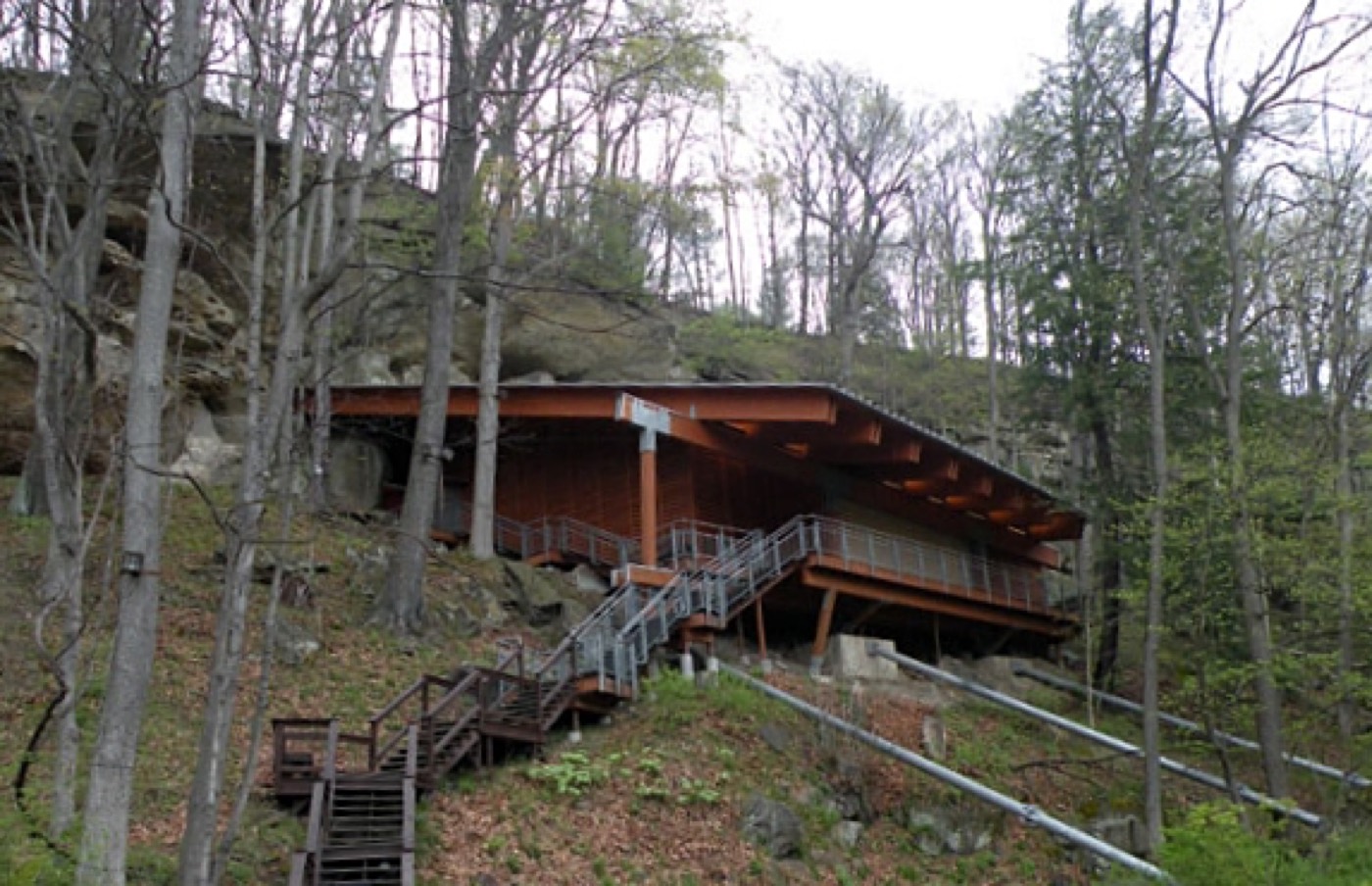
James Adovasio's team argued that 11 well-defined strata at Meadowcroft Rockshelter record intermittent human occupation spanning at least 16,000 and perhaps 19,000 radiocarbon years -- long before Clovis.

Claimed age
16,000-19,000 14C yr BP (uncalibrated)—
Claimed
1977James M. Adovasio, Jack Donahue
Verdict
Open49 years and counting
Leap
—limit not sourced
Evidence then
3.5 / 8
Sources
1714 opened and checked
Record
Medium confidenceReviewed
What happened
- 1977Adovasio and colleagues publish a progress report calling Meadowcroft 'a 16,000 year chronicle'.
- 1978American Antiquity overview: the 11 strata span 'at least 16,000 years and perhaps 19,000 years' of occupation.
- 1980Haynes asks whether contamination is a problem for the site's early charcoal dates.
- 1980Mead argues the Stratum IIa fauna and flora are discordant with other local full-glacial fossils.
- 1980The excavators reply to Haynes and Mead that the dates fit the fauna, flora, artifacts and geology.
- 1987Tankersley, Munson & Smith show coal can contaminate radiocarbon samples and that standard lab procedures cannot remove it.
- 1990The excavators assess Oxford AMS dates and hold that people were present by 14,000-14,500 years ago.
- 1992Tankersley & Munson reiterate the coal-contamination concern; the excavators reject it for lack of evidence.
- 1999Goldberg & Arpin's micromorphology finds no evidence of groundwater contamination of the early levels.
- 2022Hart & Adovasio AMS-date maize from strata IV-XI to historic times (likely after AD 1800), showing intrusion in later strata.
- 2022Potter et al. regard all purported sites older than 16,000 cal yr BP as equivocal.
- 2025Madsen et al. (independent authors) count Meadowcroft among 10 sites underpinning pre-Clovis ('American Upper Paleolithic') technology.
Objections 0 of 5 proved wrong
- Charcoal dates from the lowest strata may be too old because of particulate or non-particulate contamination by older carbon.Unresolved — Excavators rejected it using Oxford AMS dates (S5); S6 found no groundwater contamination. No source read reports a direct test for coal particles.
- Fauna and flora from dated Stratum IIa are discordant with other local Wisconsinan-age (full-glacial) fossils, casting doubt on the dates.Unresolved — Excavators replied that the dates are 'not discordant' with the associated fauna and flora (S12). No independent re-analysis was found.
- Early and perhaps some later dates may be contaminated by coal or dissolved coal by-products; the critics recommended specific tests to detect this.Unresolved — Excavators replied there is 'no evidence whatsoever' of contamination (S13). No source read reports the recommended tests being done.
- Critics questioned the site's stratigraphy, on which the association of the earliest dates and artifacts depends (specific arguments not read here).Unresolved — An independent 2025 study reports the dates in stratigraphic order (S14), but historic maize intruded into strata IV-XI (S9). No independent re-study of the lowest strata found.
- Critics questioned the 'character' of the earliest artifact assemblage (specific arguments not read here).Unresolved — An independent 2025 study treats the lower Stratum IIa tools (26 tools, 298 debitage) as a coherent early blade-and-biface industry (S14); not yet a consensus.
Evidence at the time within ~5 years of the claim
- Unambiguous evidencePartly — S1 reports occupation throughout the sequence, but critics questioned the 'character' of the earliest artifact assemblage (S7).
- Documented contextYes — 11 well-defined strata in a deeply stratified site (S1); critics nonetheless questioned the stratigraphy (S7).
- Independent dating methodsNo — Radiocarbon was the only dating method reported (50+ dates, S5); no second method appears in any source read.
- More than one labUnknown — No source read names the lab(s) behind the 1970s dates; the only second-lab (Oxford AMS) dates cited came by 1990 (S5).
- Professional recoveryYes — Systematic excavation reported by professional archaeologists and specialists led by J.M. Adovasio (S1).
- Peer-reviewed reportYes — Full overview in American Antiquity in 1978 (S1), a year after the first report (S16).
- Open to criticsUnknown — No source read shows whether critics could examine samples or the site within about five years of the claim.
- Independent teamsNo — Within 1977-1982 the data came from the excavators (S1); critics' 1980 papers commented on those data (S3).
- Outside stakeNo — Academic research; no commercial, religious or nationalist motive found in the sources read.
What would settle it for a field partner
- Single-fragment AMS dates on botanically identified charcoal from lower Stratum IIa features, run at an independent lab, with reflectance checks for coal on the same samples.Medium costWould show: Whether the oldest dates hold once coal particles, which standard lab pretreatment cannot remove (S17), are excluded.
- Screen archived charcoal and sediment from the deepest strata for coal particles by reflectance and paleobotanical analysis, compared with local coal seams.Low costWould show: Direct evidence for or against coal contamination of the oldest dated samples.
- AMS-date any bone, antler or other non-charcoal organic material from the earliest strata.Medium costWould show: An independent material class to cross-check the charcoal-based chronology of the oldest levels.
- Desk study: compile all published Meadowcroft dates by stratum and lab number, calibrate them with IntCal20, and flag outliers and reversals.Low costWould show: Calendar ages for the claimed and accepted occupations, and whether the basal dates are internally consistent.
What would change this record
Toward 'refuted' only if all lower Stratum IIa dates prove contaminated (e.g., coal in dated charcoal) or intrusive. Toward 'vindicated' if single-fragment AMS dates on identified charcoal at an independent lab replicate the basal dates.
Notes
- Status. Open: an independent 2025 synthesis counts Meadowcroft among core pre-Clovis sites (S14), but the coal-contamination test critics asked for was never reported, and Potter et al. (2022) deem all pre-16 ka sites equivocal (S15).
- Accepted view then. Clovis-first: no accepted human presence in the Americas before Clovis (11,000-11,500 14C yr BP in S11; calendar limit 13,050 cal BP from S15)
- Now understood. Pre-Clovis by ~12,000-14,500 14C yr BP; older unconfirmed
- Dating basis. S1 (1978): the 11 strata 'span at least 16,000 years and perhaps 19,000 years.' Radiocarbon years (calibration did not then reach this range); not calibrated here. S16 (1977) already claimed 16,000.
- Correction. Brief says critics 'questioned the absence of Ice Age fauna.' The documented source of the fauna/flora objection is Mead (1980), unnamed in the brief, who calls them 'discordant' (S3); whether Haynes (1980) also made it is unverified.
- Two lines counted: radiocarbon dates; artifacts and features in stratified context (AMS is the same method; S6 tests integrity, not age). The excavators' 1980 reply decried a 'Clovis primacy syndrome' (S12), but no critic's text read here argues from Clovis-first, so no prior objection is coded. limit_bp is S15's Strict Clovis-First date, not a calibration of S11's 11,500 14C yr BP. The excavators' 14,000-14,500 figure (S5) is in 14C years; calibrated, it likely exceeds 16,000 cal BP (unsourced rough estimate), inside S15's equivocal class. Kelly 1987 (S8) and the Wheat 2012 opinion survey were not read; no survey figures are used.
People and evidence
- Proponents. James M. Adovasio, Jack Donahue, Robert Stuckenrath, R.C. Carlisle, David R. Pedler
- Critics. C. Vance Haynes Jr., Jeffrey I. Mead, Kenneth B. Tankersley, Cheryl Ann Munson, Robert L. Kelly
- Evidence types. radiocarbon, stratigraphy, lithics, features, fauna, plant remains, geology · 2 independent lines
- Record confidence. medium — Haynes 1980 (S2), Kelly 1987 (S8) and the 1977 report (S16) were not read (paywalled, no abstract); Haynes' exact arguments, including any on coal, are unverified.
Sources · 17 · 14 opened and checked · DOIs matched against Crossref
- S1Adovasio, J.M., Gunn, J.D., Donahue, J. & Stuckenrath, R. 1978. Meadowcroft Rockshelter, 1977: An Overview. American Antiquity 43(4): 632-651.Original overview. Abstract read: 11 strata 'span at least 16,000 years and perhaps 19,000 years' of intermittent occupation.
- S2Haynes, C.V. 1980. Paleoindian Charcoal from Meadowcroft Rockshelter: Is Contamination a Problem? American Antiquity 45(3): 582-587.Paywalled, no abstract; content not read. Title raises contamination; S5 and S7 summarize critics' claims as 'particulate or nonparticulate contamination'.
- S3Mead, J.I. 1980. Is It Really That Old? A Comment about the Meadowcroft Rockshelter "Overview". American Antiquity 45(3): 579-582.Abstract read: Stratum IIa radiocarbon dates imply full-glacial occupation, but recovered fauna/flora are discordant with other local Wisconsinan-age fossils.
- S4Tankersley, K.B. & Munson, C.A. 1992. Comments on the Meadowcroft Rockshelter Radiocarbon Chronology and the Recognition of Coal Contaminants. American Antiquity 57(2): 321-326.Abstract read: clarifies points of confusion about coal contamination of dated charcoal and recommends specific comparative tests.
- S5Adovasio, J.M., Donahue, J. & Stuckenrath, R. 1990. The Meadowcroft Rockshelter Radiocarbon Chronology 1975-1990. American Antiquity 55(2): 348-354.Abstract read: critics assert 'particulate or nonparticulate contamination'; Oxford AMS dates assessed; people present 'by 14,000-14,500 years ago' (14C years).
- S6Goldberg, P. & Arpin, T.L. 1999. Micromorphological Analysis of Sediments from Meadowcroft Rockshelter, Pennsylvania: Implications for Radiocarbon Dating. Journal of Field Archaeology 26(3): 325-342.Abstract read: deposition by attrition, roof fall and sheetwash; no evidence of groundwater contamination of the early levels. Does not test coal particles.
- S7Adovasio, J.M., Pedler, D.R., Donahue, J. & Stuckenrath, R. 1999. Two Decades of Debate on Meadowcroft Rockshelter. North American Archaeologist 19(4): 317-341.Excavators' review. Abstract read: critics questioned stratigraphy, flora/fauna, assemblage 'character' and dates; 'most conservative assessments concede a 12,000-year initial occupancy'.
- S8Kelly, R.L. 1987. A Comment on the Pre-Clovis Deposits at Meadowcroft Rockshelter. Quaternary Research 27(3): 332-334.Further published critique (title only; paywalled, no indexed abstract, not read).
- S9Hart, J.P. & Adovasio, J.M. 2022. Accelerator Mass Spectrometry Dating of Meadowcroft Rockshelter Maize. Radiocarbon 64(2): 265-277.Full text read (open PDF). Site 'best known for its pre-Clovis occupation'; maize from strata IV-XI, once thought ancient, AMS-dates to historic times, most likely after AD 1800.
- S10Waters, M.R. 2019. Late Pleistocene Exploration and Settlement of the Americas by Modern Humans. Science 365(6449): eaat5447.Abstract read: Americas settled ~17.5-14.6 ka; data 'do not support' earlier occupation. Background synthesis only.
- S11Haynes, C.V. 1964. Fluted Projectile Points: Their Age and Dispersion. Science 145(3639): 1408-1413.Abstract read: Clovis points in sediments 'between 11,000 and 11,500 years old' (14C years); defines the Clovis-first view the claim challenged.
- S12Adovasio, J.M., Gunn, J.D., Donahue, J., Stuckenrath, R. et al. 1980. Yes Virginia, It Really is That Old: A Reply to Haynes and Mead. American Antiquity 45(3): 588-595.Abstract read: Stratum IIa dates 'not discordant' with fauna, flora, artifacts or local geology; calls a 'Clovis primacy syndrome' anachronistic.
- S13Adovasio, J.M., Donahue, J. & Stuckenrath, R. 1992. Never Say Never Again: Some Thoughts on Could Haves and Might Have Beens. American Antiquity 57(2): 327-331.Abstract read: says Tankersley & Munson 'reiterate' coal contamination; rejects it: 'no evidence whatsoever for particulate or nonparticulate contamination'.
- S14Madsen, D.B., Davis, L.G., Williams, T.J., Izuho, M. & Iizuka, F. 2025. Characterizing the American Upper Paleolithic. Science Advances 11(43).Non-Adovasio authors. Passages read: Meadowcroft is one of 10 sites underpinning pre-Clovis technology; lower Stratum IIa 'between 13,955 and 14,555 radiocarbon years ago'.
- S15Potter, B.A., Chatters, J.C., Prentiss, A.M., Fiedel, S.J. et al. 2022. Current Understanding of the Earliest Human Occupations in the Americas: Evaluation of Becerra-Valdivia and Higham (2020). PaleoAmerica 8(1): 62-76.Abstract read: Strict Clovis-First = 13,050 cal yr BP; all purported sites older than 16,000 cal yr BP 'equivocal'. Whether it discusses Meadowcroft is not known.
- S16Adovasio, J.M., Gunn, J.D., Donahue, J. & Stuckenrath, R. 1977. Progress Report on the Meadowcroft Rockshelter—A 16,000 Year Chronicle. Annals of the New York Academy of Sciences 288(1): 137-159.Crossref metadata only (paywalled, no abstract). The title shows a 16,000-year chronology was public in 1977.
- S17Tankersley, K.B., Munson, C.A. & Smith, D. 1987. Recognition of Bituminous Coal Contaminants in Radiocarbon Samples. American Antiquity 52(2): 318-330.Abstract read: coal is a demonstrated dating contaminant; standard lab procedures cannot remove it; paleobotanical and reflectance analyses detect it. Does not name Meadowcroft.
Drafted researcher agent (claude-sonnet-5) · 2026-09-23Skeptic revise · 2026-09-23Stage revisedOpen issues Clovis-first prior removed, not re-sourced: only the excavators allege it (S12, 'Clovis primacy syndrome'). Re-add, coded from the critic's own words, if Haynes 1980 (S2) is read and argues from Clovis-first.; year_claimed 1977 (S16, title only). S5 and S7 imply dates were published from 1975; a 1975 progress report (Pennsylvania Archaeologist 45(3), per the review) was not read. Use 1975 if it reports pre-Clovis dates.; limit_bp 13050 is S15's Strict Clovis-First date, not a calibration of 11,500 14C yr BP; sibling records code this orthodoxy as 13000 or 13350. Analyst should harmonize.; multiple_labs recoded from 'no' to 'unknown': no source read names the lab(s) behind the 1970s dates.; Coal objection dated 1992, though S13 says the critics 'reiterate' it; S17 (1987) may be the first statement, but its abstract does not name Meadowcroft.; 'identification' is a loose fit for the assemblage-'character' objection (schema: natural vs human-made); used as the nearest kind.; bp values kept null: individual lab dates not read or calibrated (see decisive test 4).; D19 re-rating 2026-09-23: partial → open — no component failed: pre-Clovis use is accepted by one independent synthesis (2025) and called equivocal by another (2022); coal contamination is untested. Replaces the earlier 'recode open' note.Raw record · Suggest a correction