Cases / Piltdown Man
Refuted
Piltdown Man
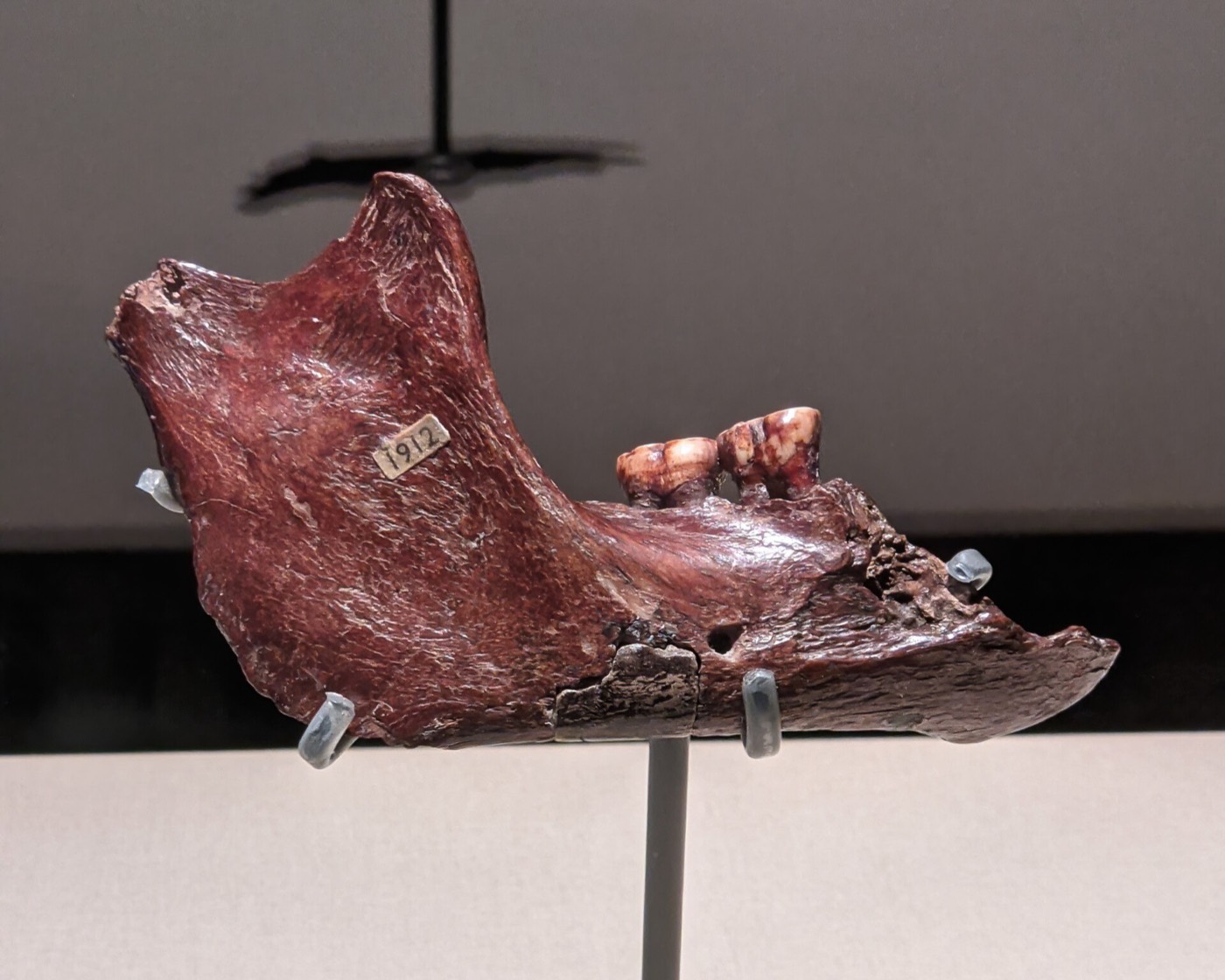
Dawson and Woodward said skull fragments and half a jaw from a Sussex gravel pit came from one early human, a new genus they named Eoanthropus dawsoni: a human-like braincase with an ape-like jaw, of Early Pleistocene age.

Claimed age
Early Pleistocene (no figure in years)—
Claimed
1912Charles Dawson, Arthur Smith Woodward
Verdict
Refuted · 195341 years after the claim
Leap
—not a dating claim
Evidence then
3.5 / 8
Sources
129 opened and checked
Record
High confidenceReviewed
What happened
- 1911Dawson says he found a larger skull piece in the pit's spoil heaps; a workman had handed him the first piece years before.
- 1912Dawson and Woodward sift the pit; Dawson reports finding the right half of a jaw in undisturbed gravel.
- 1912Announced to the Geological Society on 18 December. Waterston and Lankester doubt that jaw and skull belong together.
- 1913Teilhard de Chardin finds a canine on 30 August, 18 days after Keith ridiculed Woodward's reconstruction; it matches the model canine Woodward had inserted.
- 1915Dawson tells Woodward by postcard of 'Piltdown II' finds at a second site. Miller names the jaw a fossil chimpanzee, Pan vetus.
- 1916Dawson dies. Woodward's dig at the pit that year finds nothing.
- 1925Dart announces the small-brained Taung child; Piltdown's big-brain, ape-jaw pattern weighs against its acceptance.
- 1950Oakley and Hoskins report fluorine tests: neither skull nor jaw is Lower Pleistocene.
- 1953Weiner, Oakley and Le Gros Clark show the jaw and canine are a modern ape's, filed and stained to look fossil.
- 1955Full report: the skull was stained too, and the fauna, flints and bone tool were planted; none of the finds came from Piltdown.
- 1959Radiocarbon dates the skull to about 620 and the jaw to about 500 radiocarbon years.
- 2016DNA and CT work find one orangutan and one working method across all pieces; the authors name Dawson the likely sole forger.
Objections 1 of 8 proved wrong
- The skull is human, but the jaw resembles a chimpanzee's in all its details, so the two are unlikely to come from one individual.Held up — The jaw was a modern orangutan's, stained and planted with human skull pieces (1953, 1955). The chimpanzee identification itself was wrong.
- The bones could be older or younger than the flints and fossils beside them, so their age cannot be read from the gravel.Held up — The animal fossils had been gathered elsewhere, some abroad, and planted with the bones and artificially stained flints (1955).
- The gravel is not Early Pleistocene; it formed long after the first cold period, so the remains are younger than claimed.Held up — Fluorine tests (1949-50) showed neither skull nor jaw was Lower Pleistocene; radiocarbon later put both at only centuries old.
- The canine is a chimpanzee's upper canine, not the lower canine Dawson and Woodward described.Proved wrong — One 2016 morphometric study (not replicated) places it among lower canines, as Woodward said; it is a subadult orangutan's.
- The canine looks immature, yet its crown is worn down heavily, which is contradictory.Held up — The wear had been made by filing (1953). Lyne's explanation, a milk tooth, was wrong, and his point was disregarded at the time.
- The carved bone 'implement' from the pit does not show convincing ancient workmanship.Held up — The 1955 study found it had been shaped with a steel knife.
- The Piltdown II molar probably came from the first site, and some mistake was made about its origin.Held up — Woodward denied it, but the 1953 study judged the molar almost certainly from the Piltdown I jaw, and 2016 work ties it to the same orangutan.
- From about 1925, new fossils from Java, China and Africa showed no mix of human braincase and ape jaw, so Piltdown fit nothing else.Held up — Piltdown proved to be a forgery; removing it made the fossil record far more consistent (1953).
Evidence at the time within ~5 years of the claim
- Unambiguous evidencePartly — Skull pieces were clearly human, but whether the ape-like jaw came from the same creature was doubted at the first meeting (Waterston, Lankester).
- Documented contextPartly — Most skull pieces came from a workman or spoil heaps. Dawson said he found the jaw in undisturbed gravel; Woodward dug up one skull piece nearby.
- Independent dating methodsNo — Age was inferred only from animal fossils and flints found in the same gravel; no other dating method was used.
- More than one labPartly — Only one chemical test was made, by a county analyst on a skull fragment. Anatomists at other institutions described the specimens or casts.
- Professional recoveryPartly — Dawson, a solicitor and amateur antiquarian, made most finds; Woodward, a museum palaeontologist, joined the digging from 1912.
- Peer-reviewed reportYes — Full description read to the Geological Society in December 1912 and printed with the discussion in its Quarterly Journal in 1913 (society norms of the time).
- Open to criticsPartly — Casts were widely studied, but the originals were generally locked away and shown only to a select few.
- Independent teamsNo — All finds came from Dawson's digs with Woodward or from Dawson alone (Piltdown II). Woodward's 1916 dig, the year Dawson died, found nothing.
- Outside stakeNo — Seen then as a respected amateur. Private 1909 letters (his big-find note to Woodward; his wife's plea to H. Gladstone for recognition) read as motive later; FRS nomination 1913. Hindsight: yes.
What settled it Forensic analysis, Independent redating, Morphology
Weiner, Oakley and Le Gros Clark (1953) showed the jaw and canine were a modern ape's: teeth filed flat, surfaces stained, fluorine and nitrogen levels unlike fossil bone. Their 1955 report showed the skull was stained too and the fauna, flints and bone tool were planted.
What would change this record
This record would be wrong if the jaw proved to be an ancient hominin rather than a modern orangutan, the tooth wear and stains proved natural, and skull and jaw were shown to come from one Early Pleistocene individual.
Notes
- Status. Every Piltdown find was shown in 1953-55 to be forged or planted, and recent studies accept this. Debate remains over who was involved: Dawson alone (De Groote et al. 2016) or others too, perhaps Teilhard de Chardin (Thackeray 2016).
- Accepted view then. Known fossils (Java, Neanderthal) were low-browed, but British anatomists expected a large-brained, ape-jawed missing link, which Piltdown matched.
- Now understood. Modern forgery; human remains possibly medieval, jaw recent
- Dating basis. Relative only: inferred from Pliocene and early Pleistocene animal fossils and crude 'Chellean' flints in the same gravel. No numerical age was given.
- Correction. Starter brief says the 1953 exposure was '...using fluorine testing among other evidence.' More precisely: the 1949-50 test only showed non-Lower-Pleistocene age; 1953 added filing marks, staining and improved fluorine/nitrogen tests (S7).
- Correction. The 1953 paper exposed only the jaw and teeth and still allowed the skull might be Upper Pleistocene. The skull's staining and the planted fauna, flints and bone tool were shown in 1955 (S7, S8).
- Correction. Doubts began at once, not decades later: at the first meeting (18 Dec 1912) Waterston and Lankester doubted the jaw and skull belonged together, and Reid disputed the Early Pleistocene age (S3).
- Correction. Early critics called the jaw a chimpanzee's (Waterston; Miller's Pan vetus). It is a modern orangutan's, probably from Borneo (S8, S10). Miller was also wrong that the canine was an upper tooth.
- Correction. The human pieces are not one medieval skull: 2016 work found at least two, perhaps three, 'possibly medieval' people; new radiocarbon attempts failed, so older dates need caution (S10).
- Correction. De Groote et al. (2016) name Dawson as the likely single forger but say it is uncertain whether he acted alone; Thackeray (2016) argues Teilhard de Chardin knew (S10, S11).
- Resolution came in stages: Early Pleistocene age refuted 1950 (38 yr); jaw and canine shown modern 1953 (41 yr); full hoax (skull, fauna, flints, tool) 1955 (43 yr). Support was eroding by 1950 (S8). Why so slow: originals were locked away, critics mostly used casts (S10, S5); faking was skilful, with secondary dentine implying natural wear (S8); WWI and Dawson's 1916 death disrupted work (S10); the 1949 fluorine test could not separate recent from Upper Pleistocene bone. The find matched hopes for a big-brained ancestor and weighed against the 1925 Taung child (S12). Dawson is now known to have faked other specimens (S10). Methods count 3: anatomy, fauna, flints, all one source.
People and evidence
- Proponents. Charles Dawson, Arthur Smith Woodward, Grafton Elliot Smith, Arthur Keith
- Critics. David Waterston, Gerrit S. Miller, Marcellin Boule, Joseph S. Weiner, Kenneth P. Oakley, Wilfrid Le Gros Clark
- Evidence types. human remains, morphology, fauna, lithics, artifacts, stratigraphy, chemistry · 3 independent lines
- Record confidence. high — Core facts rest on primary reports read in full (1913, 1915, 1953, 1955, 2016). Feature coding is judgment; the radiocarbon ages are flagged as unreliable by later re-daters.
Sources · 12 · 9 opened and checked · DOIs matched against Crossref
- S1Dawson, C. & Woodward, A. S. 1913. On the discovery of a Palaeolithic human skull and mandible in a flint-bearing gravel overlying the Wealden (Hastings Beds) at Piltdown, Fletching (Sussex). Part I, Geology and flint-implements [C. D.]. Quarterly Journal of the Geological Society of London 69: 117-123.Read in the public-domain scan (URL). Dawson's account of the finds, the jaw in undisturbed gravel, Woodhead's chemical test, and the age conclusion.
- S2Woodward, A. S. 1913. II. Description of the human skull and mandible and the associated mammalian remains. In Dawson & Woodward, On the discovery of a Palaeolithic human skull and mandible... Quarterly Journal of the Geological Society of London 69: 124-144.Read in the scan. Names Eoanthropus dawsoni; capacity 'at least 1070 c.c.'; states the then 'very general belief' in low-browed early man.
- S3Smith, G. E. 1913. Preliminary report on the cranial cast [of the Piltdown skull]; with Discussion of the paper (Lankester, Keith, Boyd Dawkins, Reid, Waterston and others). Quarterly Journal of the Geological Society of London 69: 145-151.Read in the scan. Discussion of 18 Dec 1912 (pp. 147-151): Waterston and Lankester doubt jaw-skull association; Reid disputes Early Pleistocene age; Keith argues Pliocene.
- S4Waterston, D. 1913. The Piltdown mandible. Nature 92(2298): 319.Paywalled; only the opening line was read. Its 'chimpanzee foot with a human leg' argument is quoted in S5.
- S5Miller, G. S., Jr. 1915. The jaw of the Piltdown man. Smithsonian Miscellaneous Collections 65(12): 1-31.Read in full text. Worked from casts; names the jaw Pan vetus; calls the canine a chimpanzee's left upper canine; quotes Waterston 1913.
- S6Oakley, K. P. & Hoskins, C. R. 1950. New evidence on the antiquity of Piltdown man. Nature 165(4193): 379-382.Paywalled; not read. The fluorine results are summarised in S7 and S8.
- S7Weiner, J. S., Oakley, K. P. & Le Gros Clark, W. E. 1953. The solution of the Piltdown problem. Bulletin of the British Museum (Natural History), Geology 2(3): 139-146.Read in full. Filing, staining, fluorine and nitrogen evidence; still allows the skull may be Upper Pleistocene. Crossref misnames first author as 'Weimer'.
- S8Weiner, J. S., Le Gros Clark, W. E., Oakley, K. P., Claringbull, G. F., Hey, M. H., Edmunds, F. H., Bowie, S. H. U., Davidson, C. F., Fryd, C. F. M., Baynes-Cope, A. D., Werner, A. E. A. & Plesters, R. J. 1955. Further contributions to the solution of the Piltdown problem. Bulletin of the British Museum (Natural History), Geology 2(6): 225-287.Read intro and Weiner's outline: full extent of the hoax, history of objections (Waterston, Miller, Lyne, Hrdlicka, Weidenreich), reasons faking went unsuspected.
- S9de Vries, H. & Oakley, K. P. 1959. Radiocarbon dating of the Piltdown skull and jaw. Nature 184(4682): 224-226.Paywalled; not read. Its dates (skull 620±100, jaw 500±100) are reported in S10.
- S10De Groote, I., Girdland Flink, L., Abbas, R., Bello, S. M., Burgio, L., Buck, L. T., Dean, C., Freyne, A., Higham, T., Jones, C. G., Kruszynski, R., Lister, A., Parfitt, S. A., Skinner, M. M., Shindler, K. & Stringer, C. B. 2016. New genetic and morphological evidence suggests a single hoaxer created 'Piltdown man'. Royal Society Open Science 3(8): 160328.Read in full (CC BY). Casts vs locked originals, dates and their caveats, one orangutan, single forger most likely Dawson. Author name Burgio per correction 10.1098/rsos.160679.
- S11Thackeray, J. F. 2016. The Piltdown case: Further questions. South African Journal of Science 112(9/10): Art. a0170, 2 pp.Read in full (CC BY). Accepts the forgery but argues the case is not closed; suspects Teilhard de Chardin knew of it.
- S12Rowan, J. & Wood, B. 2024. Dart and the Taung juvenile: making sense of a century-old record of hominin evolution in Africa. Biology Letters 20(7): 20240185.Read Piltdown passages (CC BY). Piltdown's big-brain, ape-jaw model weighed against Taung (1925); forger 'almost certainly Dawson'.
Drafted researcher agent (claude-opus-5-5) · 2026-09-23Skeptic revise · 2026-09-23Stage revisedOpen issues proponent_stake is coded 'no' under the contemporaries'-eyes rule; re-coding with hindsight (1909 letters, 1913 FRS nomination) would flip it to 'yes' -- worth testing both codings in the analyst's cross-tabs.; objections[3] ('wrong') rests on one unreplicated 2016 morphometric study; don't read it as evidence the critics were broadly biased -- Miller's main jaw/skull objection (objections[0]) held.; Did not add a specific year for the Piltdown II announcement in timeline[4]; skeptic flagged 1917 as needing verification in S8 and I did not spend a lookup confirming it, so left unstated.; D19 re-rating 2026-09-23: unchanged — refuted fits: hoax exposed by 1953-55 forensic work (filed ape teeth, staining, planted fauna and flints).Raw record · Suggest a correction