Cases / Great Sphinx Weathering Controversy
Open
Great Sphinx Weathering Controversy
Robert Schoch, a geologist working with John Anthony West, argued that 'precipitation-induced weathering' of the Sphinx and its enclosure walls, and deeper weathering under the enclosure floor at its front and sides, show the Sphinx was first carved millennia before Khafre (c. 2500 BC).
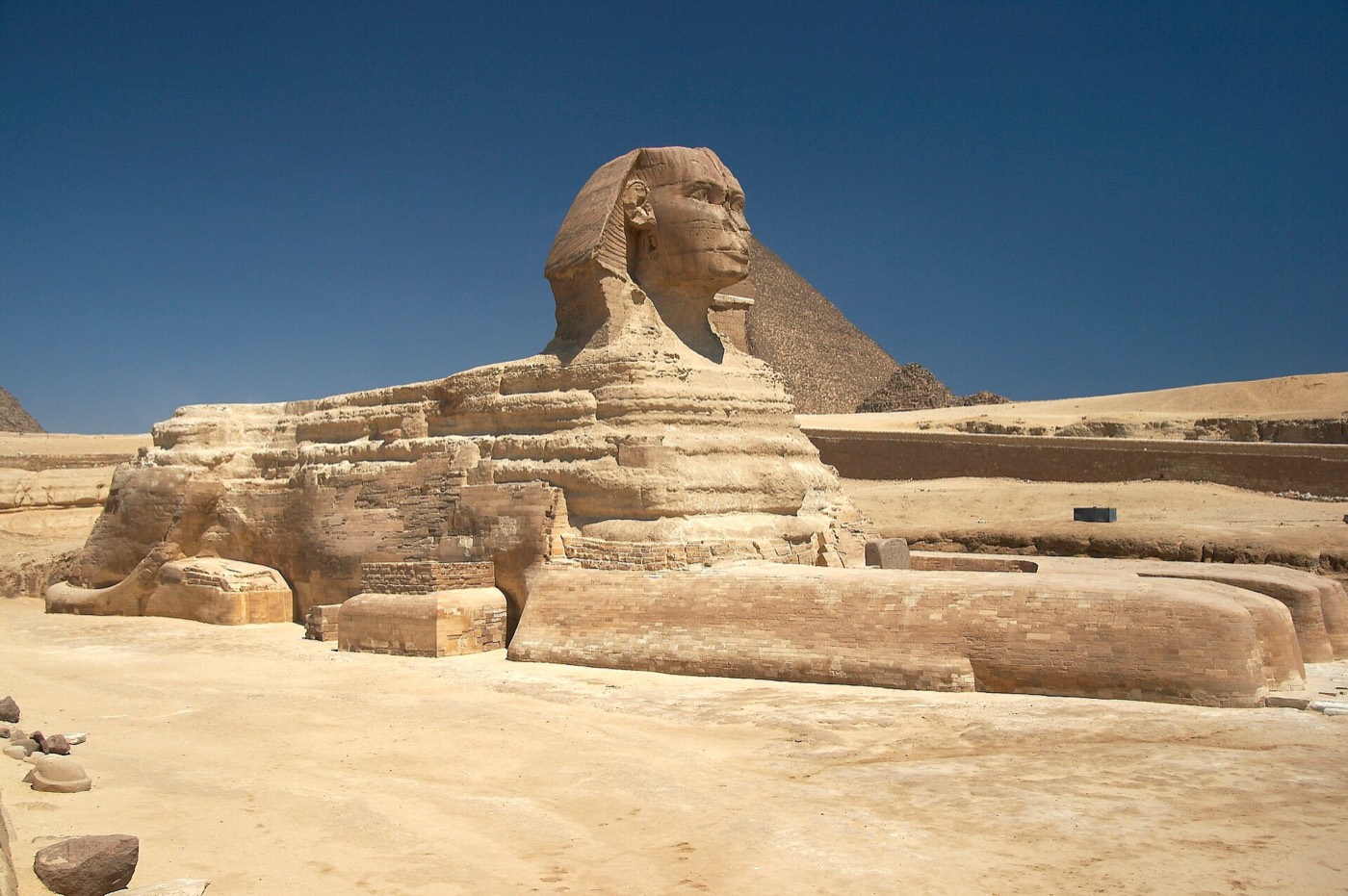

Claimed age
c. 7000-5000 BC ('probably a minimum')7.9k yrs
Claimed
1991Robert M. Schoch, John Anthony West
Verdict
Open35 years and counting
Leap
1.8×× the accepted limit then
Evidence then
3.5 / 8
Sources
1913 opened and checked
Record
Medium confidenceReviewed
What happened
- 1990Chowdhury, Punuru & Gauri relate Sphinx limestone weathering to stratum-specific 'ink-bottle' pore systems.
- 1991Schoch and West present the case that the Sphinx's weathering reflects rainfall in a humid era, implying a much older monument.
- 1992Schoch's KMT article estimates first carving at 'ca. 7000 to 5000 B.C.', a 'tentative estimate' that is 'probably a minimum'.
- 1992Dobecki & Schoch report in Geoarchaeology that weathering below the enclosure floor 'is not uniform'.
- 1992Lehner publishes the 1979-83 ARCE photogrammetric study, reconstructing a Sphinx carved in the 4th Dynasty and renovated in the 18th.
- 1994Harrell (KMT) argues that wet sand fill and salts explain the weathering and disputes the seismic picks; Schoch rebuts, Harrell replies.
- 1994Lehner (KMT) argues that Schoch's control tombs lie in different beds and that 'two-stage' temples are normal core-and-casing work.
- 1995Gauri, Sinai & Bandyopadhyay (Geoarchaeology) argue that arid weathering of alternating strata and re-exposed karst explain the features.
- 2001Reader (Archaeometry) links the erosion to rainfall run-off and a pre-Khufu Sphinx; comments by Shortland & Doherty and by Wilkinson, and his reply, follow.
- 2019Seyfzadeh & Schoch argue from split-lion hieroglyphs that a lion monument stood at Giza at least seven centuries before Khafre.
- 2025Schneiker (GSA abstract) proposes that the body's 'erosion' is a pounded-back core exposed by looting of a stone veneer.
- 2026Reader publishes a book, 'Rewriting the History of the Great Sphinx' (content not reviewed here).
Objections 0 of 8 proved wrong
- Weathering in an arid climate 'can produce the rounded profile' of the Sphinx thorax, given its alternating hard and soft limestone strata, so the profile need not date from a humid phase.Unresolved — Argued from lithology and pore structure (S3), not tested on dated faces of the same beds; Schoch still argues for a much older monument (S9).
- The deep channels in the enclosure walls are 'pre-Pliocene karst features formed by underground water', only exposed when the Sphinx ditch was cut, so they need not record weathering after carving.Unresolved — Schoch counts 'vertical crevices and other solution features' as precipitation weathering (S11); no dating of the channel fills was found.
- Sand buried the Sphinx for most of its history; kept wet by rain and Nile floods, it drove 'clay expansion' and 'salt (halite and gypsum) precipitation', so an early age 'is thus not required'.Unresolved — Schoch replied that durable top beds are worn back most, by 'rain-runoff cascading over the walls'; Harrell answered that the walls were cut sloping (S13). Untested.
- Schoch's control tombs are not comparable: the Debehen tomb is in higher beds and eastern-escarpment tombs in a 'much more durable unit' than Member II; they are also 'higher and drier' (Harrell).Unresolved — Harrell reports undulating profiles, with less relief, on nearby 4th-Dynasty quarry walls in more durable beds (S13); no bed-matched measured comparison was found.
- The seismic 'weathered' layer may be a coral-bearing reef facies, and line S3's lower velocities would make the rear floor more weathered, the reverse of Schoch's reading.Unresolved — This layer is the basis of Schoch's age figure; no core-calibrated re-survey was found, so weathering versus facies is undecided.
- 'Two-stage' temple building is ordinary core and casing, 'standard for Old Kingdom stone buildings'; such huge core blocks are 'nearly exclusive' to Khafre's temples, the Sphinx Temple and Menkaure's.Unresolved — West and Schoch hold that the core blocks were weathered before the granite casing was fitted (quoted in S14); no dating of that weathering was found.
- The uneven erosion fits 'rainfall run-off', 'experienced at Giza until the late Fifth Dynasty', not 'rainfall per se', implying that the Sphinx 'may pre-date the reign of Khufu'.Unresolved — A water-erosion reading with a smaller shift (pre-Fourth Dynasty); comments by Shortland & Doherty and Wilkinson (S6, S7) and Reader's reply (S8) could not be read.
- The Sphinx body shows 'very little erosion': its soft layers were pounded back and veneered, and looted veneer exposed a rough core 'misidentified as erosion'.Unresolved — A 2025 conference abstract, not peer-reviewed; it concerns the body, not the enclosure walls, where Harrell notes the profile is strongest (S12).
Evidence at the time within ~5 years of the claim
- Unambiguous evidenceNo — Contemporaries disputed whether the profile and channels record rainfall: Harrell (1994) proposed wet sand and salts, Gauri et al. (1995) arid weathering and old karst.
- Documented contextPartly — A surveyed rock-cut monument (ARCE photogrammetry), but exposed bedrock has no sealed sequence to date; the case rests on weathering, not stratified finds.
- Independent dating methodsNo — No absolute dating. The 7000-5000 BC figure scales seismic weathering depths against a rear taken as c. 2500 BC.
- More than one labNo — No laboratory dating was involved.
- Professional recoveryYes — Field and seismic work by geologist Schoch with seismologist Dobecki, with permission of the Egyptian Antiquities Organization.
- Peer-reviewed reportPartly — The seismic data appeared in Geoarchaeology (1992), but its abstract gives no age; the dating argument ran in KMT, a popular magazine (S11).
- Open to criticsYes — The walls are a standing monument and the seismic profiles were published; Harrell (1994) re-analysed the published profiles.
- Independent teamsPartly — Gauri's group, Harrell and Lehner examined the evidence within about four years, all against the claim; no independent group corroborated it (Dobecki co-authored).
- Outside stakeUnknown — No documented commercial, religious or nationalist motive; a critic's allegation of motive (Lehner 1994) is not documentation.
What would settle it for a field partner
- Paired 36Cl depth profiles with measured Cl (10Be dating of carbonates often fails) in the enclosure walls and in bed-matched 4th-Dynasty quarry faces and dated masonry with the same sand burial and salt history.High costWould show: Shared burial, salt and inheritance effects cancel. Clearly longer modelled exposure on the walls than on the controls would support an earlier cut; matching exposure, Khafre's date.
- Re-survey the enclosure floor (seismic refraction plus resistivity), calibrated by shallow cores at front, sides and rear, to measure the depth of weathered rock directly.Medium costWould show: Whether floor weathering is really 50-100% deeper at front and sides, the basis of Schoch's date (S11), or the low-velocity layer is a reef facies, as Harrell argued (S12).
- AMS-date any charcoal in mortar behind the earliest masonry repairs on the Sphinx body, sampled as the ARCE program did for other Giza monuments (Bonani et al. 2001, S19).Low costWould show: An Old Kingdom date would mean the body was already worn when first repaired, favouring Schoch; a New Kingdom date fits Lehner's expectation for the first repairs (S11).
- Laser-scan wall recession in the enclosure and on 4th-Dynasty quarry walls and tombs, matched bed by bed and for burial and run-off position, with each model's prediction stated in advance.Medium costWould show: Similar recession on matched beds supports Khafre's date; far deeper recession in the enclosure than burial, salts and run-off can explain supports an earlier cut.
What would change this record
Toward refuted: 36Cl profiles or bed-matched recession on the enclosure walls match securely 4th-Dynasty faces with similar burial and salt exposure. Toward vindicated or partial: the walls show far longer exposure than burial, salts and run-off can explain.
Notes
- Status. Khafre's reign remains the standard attribution; critics argue wet sand, salts, rock strata and karst explain the weathering, while Schoch keeps an older date (2019). No direct dating of the enclosure walls was found.
- Accepted view then. Carved for Khafre (Fourth Dynasty, c. 2500 BC), as were the adjacent Sphinx and Valley temples: the standard Egyptological attribution.
- Dating basis. Schoch (1992): floor weathering 'fifty to 100 percent deeper' at front and sides than at the rear (taken as c. 2500 BC) gives a 'tentative estimate'. Seismic depths, not radiometric dating.
- Correction. Brief: critics 'proposed salt weathering, flash floods, differing rock quality'. Salts (Harrell, S12) and rock quality (Gauri et al., S2; Lehner, S14) are right. Not flash floods: Harrell invoked sand kept wet by rain and Nile floods (S12).
- Correction. Brief: 'From 1991–92 geologist Robert Schoch (with John Anthony West) argued'. West advocated the idea first and 'enlisted Dr. Schoch to develop the supporting evidence' (Harrell 1994, S12).
- Schoch's figure comes from seismic depth ratios; he wrote that the carving 'may be even earlier than 9,000 years' (S11). His four lines (weathering, two-stage temples, old repairs, seismic) all partly rest on reading weathering, so 3 are counted. Reader (S5) is a separate, smaller pre-Khufu revision. Test basis: 36Cl exposure dating (S16), 36Cl from calcium (S17), 10Be in carbonates often fails (S18), mortar charcoal dated at Giza (S19). No published 36Cl, U-series or carbonate dating of the enclosure walls was found by the researcher or the skeptic (2026-09-23).
People and evidence
- Proponents. Robert M. Schoch, John Anthony West, Thomas L. Dobecki
- Critics. K. Lal Gauri, James A. Harrell, Mark Lehner
- Evidence types. geology, morphology, architecture · 3 independent lines
- Record confidence. medium — Paywalled S1-S5 read as abstracts only; the 1992-94 KMT exchange read in online reprints. The 2001 comments (S6, S7) are unread. 'No direct dating' rests on searches.
Sources · 19 · 13 opened and checked · DOIs matched against Crossref
- S1Dobecki, T.L. & Schoch, R.M. (1992). Seismic investigations in the vicinity of the great Sphinx of Giza, Egypt. Geoarchaeology 7(6): 527-544.Abstract read: subsurface weathering below the enclosure floor 'is not uniform' ('varied periods of subaerial exposure'); cavities found. Gives no age.
- S2Lal Gauri, K., Sinai, J.J. & Bandyopadhyay, J.K. (1995). Geologic weathering and its implications on the age of the sphinx. Geoarchaeology 10(2): 119-133.Abstract read: cites 'Schoch and West (1991)'; arid weathering of hard/soft strata and pre-Pliocene karst; the Sphinx 'may still be regarded as of pharaonic origin'.
- S3Chowdhury, A.N., Punuru, A.R. & Gauri, K.L. (1990). Weathering of limestone beds at the great sphinx. Environmental Geology and Water Sciences 15(3): 217-223.Abstract read on publisher page: weathering controlled by 'ink-bottle' pore systems that vary from stratum to stratum. Predates the 1991 claim.
- S4Lehner, M. (1992). Reconstructing the Sphinx. Cambridge Archaeological Journal 2(1): 3-26.Abstract read: 1979-83 ARCE study; Sphinx modelled as carved in the 4th Dynasty and renovated in the 18th. Does not address rainfall weathering.
- S5Reader, C.D. (2001). A Geomorphological Study of the Giza Necropolis, with Implications for the Development of the Site. Archaeometry 43(1): 149-165.Abstract read: run-off, not 'rainfall per se'; Sphinx 'may pre-date the reign of Khufu'. Crossref pages 149-165 overlap S6-S8; article likely ends p. 159 (unconfirmed).
- S6Shortland, A.J. & Doherty, C.J. (2001). Comments on 'A Geomorphological Study of the Giza Necropolis, with Implications for the Development of the Site'. Archaeometry 43(1): 160-162.Crossref metadata confirmed; no abstract; Wiley page HTTP 403 (rechecked 2026-09-23). Cited for existence only.
- S7Wilkinson, T.A.H. (2001). Comment on C. D. Reader, 'A Geomorphological Study of the Giza Necropolis, with Implications for the Development of the Site'. Archaeometry 43(1): 163-165.Crossref metadata confirmed; no abstract; full text not accessible. Cited for existence only.
- S8Reader, C.D. (2001). A Response to Comments on 'A Geomorphological Study of the Giza Necropolis, with Implications for the Development of the Site'. Archaeometry 43(1): 166-168.Crossref metadata confirmed; no abstract; full text not accessible. Cited only to show a reply was published.
- S9Seyfzadeh, M. & Schoch, R.M. (2019). Major Geological Fissure through Prehistoric Lion Monument at Giza Inspired Split Lion Hieroglyphs and Ancient Egypt's Creation Myth. Archaeological Discovery 7(4): 211-256.Abstract read: lion monument 'at least seven centuries before the time of Khafre'; restates remodelling from 'the much older' lioness Mehit. A minimum, not a retreat.
- S10Schneiker, R. (2025). The Great Sphinx: A New View on the Erosion Enigma. Geological Society of America Abstracts with Programs.GSA abstract read: 'very little erosion'; body pounded back and veneered; looted veneer left a core 'misidentified as erosion'. Body only; not peer-reviewed.
- S11Schoch, R.M. (1992). Redating the Great Sphinx of Giza. KMT: A Modern Journal of Ancient Egypt 3(2) (Summer 1992). Author's online reprint.Reprint read: four lines of evidence; floor weathering 'fifty to 100 percent deeper' at front and sides; 'ca. 7000 to 5000 B.C.', 'probably a minimum'. Issue per Harrell (S12).
- S12Harrell, J.A. (1994). The Sphinx controversy: another look at the geological evidence. KMT: A Modern Journal of Ancient Egypt 5(2): 70-74.Reprint read ('From KMT Vol. 5, No. 2'); on Harrell's University of Toledo publication list. Wet sand, clay and salts; seismic critique; West 'enlisted Dr. Schoch'.
- S13Harrell, J.A. (1994). Reply to R.M. Schoch's letter (KMT 5(2): 5-7) on 'The Sphinx controversy'. KMT: A Modern Journal of Ancient Egypt 5(3): 3-4.Reprint read; issue and pages from Harrell's publication list. Reports Schoch's counterpoints, e.g. 'rain-runoff cascading over the walls', with Harrell's answers.
- S14Lehner, M. (1994). Notes and photographs on the West-Schoch Sphinx hypothesis. KMT: A Modern Journal of Ancient Egypt 5(3): 40-48.Reprint read ('From KMT Vol. 5, No. 3, Fall 1994, pp 40-8'); title as given by the reprint. Control-tomb beds; core-and-casing construction.
- S15Reader, C.D. (2026). Rewriting the History of the Great Sphinx. Book (JSTOR).Crossref/OpenAlex metadata only; publisher and content not checked. Cited only for the timeline entry.
- S16Phillips, F.M., Leavy, B.D., Jannik, N.O., Elmore, D. et al. (1986). The Accumulation of Cosmogenic Chlorine-36 in Rocks: a Method for Surface Exposure Dating. Science 231(4733): 41-43.Abstract read: 36Cl builds up in exposed rock and can date surface exposure over 10^3 to 10^6 years. Method source for the 36Cl test.
- S17Stone, J., Allan, G., Fifield, L. & Cresswell, R. (1996). Cosmogenic chlorine-36 from calcium spallation. Geochimica et Cosmochimica Acta 60(4): 679-692.Metadata confirmed; content not read. Cited only for its title's point that 36Cl is produced from calcium, the main cation in limestone.
- S18Merchel, S., Braucher, R., Benedetti, L., Grauby, O. et al. (2008). Dating carbonate rocks with in-situ produced cosmogenic 10Be: Why it often fails. Quaternary Geochronology 3(4): 299-307.Metadata confirmed; content not read. Cited only for its title's point that in-situ 10Be dating of carbonate rocks often fails.
- S19Bonani, G., Haas, H., Hawass, Z., Lehner, M. et al. (2001). Radiocarbon Dates of Old and Middle Kingdom Monuments in Egypt. Radiocarbon 43(3): 1297-1320.Open PDF read: the ARCE program sampled charcoal specks in mortar between blocks of Old and Middle Kingdom monuments. Method source for the mortar test.
Drafted researcher agent (claude-sonnet-5) · 2026-09-23Skeptic revise · 2026-09-23Stage revisedOpen issues Declined: objections from the 2001 comments (S6, S7). Wiley returns HTTP 403 and the only summary found is a personal website, so their arguments are not recorded; S6-S8 stay 'exists'.; Declined: S5 pages left at Crossref's 149-165. They overlap S6-S8, but Wiley's contents page is unreadable (HTTP 403), so the likely 149-159 is unconfirmed.; Declined: the carbonate-crust test was dropped rather than reworded, since no source read shows closed-system calcite on the walls. Savchuk 2026 not added: its content was not checked.; proponent_stake 'partial' rests on a critic's account of West's aim (S14); a proponent-side source would be better. Hawass removed from key_critics: no text by him on this claim was read.; Schoch's 1994 KMT letter (5(2): 5-7) was not read; his counterpoints are given as Harrell reports them (S13). S11's volume 3(2) is inferred from Harrell's 'summer 1992 KMT'.; Main session: proponent_stake recoded unknown — a critic's allegation is not a documented stake.; D19 re-rating 2026-09-23: unchanged — open fits: Schoch's weathering and seismic readings vs salt, wet-sand, karst and facies explanations, none tested by direct dating; the evidence is disputed, not withdrawn or shown false.Raw record · Suggest a correction