Cases / Troy / Hisarlık
Vindicated
Troy / Hisarlık
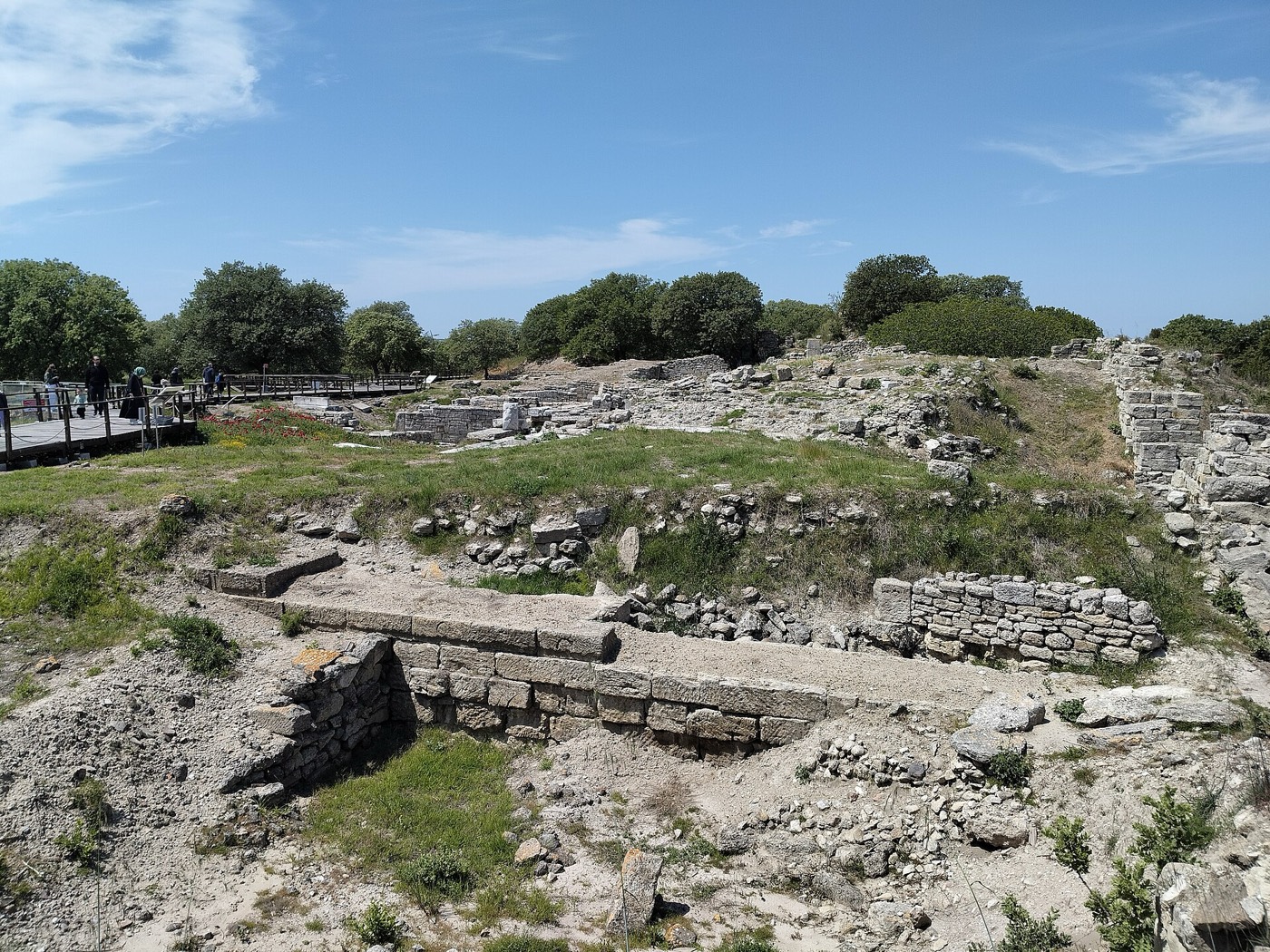
In 1865 Frank Calvert, who had trial-trenched at Hisarlık since 1863, publicly identified the mound as the site of Homer's Troy. Schliemann adopted this from 1868 and excavated from 1871. His further claim, that the finds proved the Iliad's war happened, is tracked as a separate candidate.

Claimed age
Homer's Troy; traditional fall c. 1184 BCE (Eratosthenes)3.1k yrs
Claimed
1865Frank Calvert, Heinrich Schliemann
Verdict
Vindicated · 189429 years after the claim
Leap
—not a dating claim
Evidence then
2.5 / 8
Sources
1915 opened and checked
Record
Medium confidenceReviewed
What happened
- 1863Frank Calvert, who owns part of the Hisarlık mound, begins trial excavations there.
- 1865Calvert publicly identifies Hisarlık as the site of Troy to London's scholarly community.
- 1871Schliemann, who adopted Calvert's identification from 1868, begins large-scale excavation, cutting a deep trench through the mound.
- 1873Schliemann announces finding 'Priam's Treasure' in the Troy II layer and removes it from Ottoman territory without authorization.
- 1890Schliemann dies; his architect Wilhelm Dörpfeld takes over the excavation.
- 1893Dörpfeld's campaigns (1893-94) expose Troy VI, a fortified Late Bronze Age city above (later than) Troy II, correcting Schliemann's mistaken layer.
- 1932Blegen re-excavates (to 1938); Troy VI fell to earthquake, he concludes; Troy VIIa's fire (c.1180 BCE) may be too late for a Mycenaean attack.
- 1983Traill argues Schliemann's 1873 accounts of the find are inconsistent; Easton (1984) disputes how much was fabricated.
- 1988Manfred Korfmann (Tübingen) begins new excavations and later argues for a large lower city beyond the citadel.
- 1998Hawkins reads the Karabel hieroglyphic inscription, firming up Hittite geography linking Wilusa to the Troad.
- 2002After 2001 press criticism and a Tübingen symposium, Kolb (2004) and Hertel disputed the lower city's scale; Easton et al. defended the broader picture.
- 2005Jablonka and Rose respond to Kolb; Troy/Wilusa's identity is uncontested but the lower city's scale stays disputed.
Objections 1 of 7 proved wrong
- Hisarlık is too small and too close to the coast to match Homer's description of Troy; Bunarbashi (Pınarbaşı), further inland, fits the Iliad's topography better.Proved wrong — Subsequent excavation found dense Bronze Age fortification and occupation at Hisarlık and none at Bunarbashi; Hisarlık is now the identification accepted by nearly all archaeologists.
- Schliemann gave conflicting accounts, in about a dozen places, of discovering 'Priam's Treasure,' and his autobiographical writings elsewhere contain demonstrably false claims.Held up — Comparing Schliemann's early reports shows contradictions in date, location and who was present; how much of the discovery story was invented, versus merely retold inconsistently, is disputed (Easton 1984).
- Schliemann identified the 'Burnt City' (Troy II) and its gold treasure as Priam's Homeric Troy, but this layer considerably predates the Late Bronze Age setting of the Iliad.Held up — Dörpfeld's and later Blegen's stratigraphy showed Troy VI and VIIa, later and higher layers than Troy II, belong to the Late Bronze Age; the 'Treasure' layer predates the traditional war by roughly 1,000 years.
- Korfmann's claim of a large lower city beyond the citadel, making Troy VI/VIIa a major Anatolian trading hub or 'Bronze Age federation of cities,' is unsupported by the excavated evidence.Unresolved — A ditch and some lower-town structures were excavated, but the scale, population and economic importance of the lower settlement remain disputed among specialists.
- The identification of Hittite Wilusa with Troy/Ilios rests on a chain of contested name associations (Alaksandu-Alexandros, Wilusa-Ilios, Appaliunas-Apollo) rather than direct proof.Unresolved — Most Hittitologists regard the convergence of geography (Hawkins 1998) and texts as strong; Schürr goes further, denying Hisarlık was Wilusa's stronghold at all, a minority view.
- Even granting Hisarlık is Wilusa, no text names a specific war matching the Iliad's cast and events; Bronze Age Wilusa saw several documented conflicts over centuries.Unresolved — Hittite records mention repeated Wilusa-related conflicts from the 15th-13th centuries BCE; which, if any, Homer's poem reflects (or whether it conflates several) is unresolved (Cline 2013).
- Troy VI's destruction looks like an earthquake, not a sack; Troy VIIa's fire (c. 1180 BCE) is generally dated too late for a Mycenaean attack, and its attackers are unidentified.Unresolved — Blegen attributed Troy VI's fall to earthquake and favored Troy VIIa as the war layer, but VIIa's destruction date is widely seen as too late for the Mycenaeans; who destroyed it remains unknown.
Evidence at the time within ~5 years of the claim
- Unambiguous evidencePartly — Man-made walls and pottery, not natural, but by 1865 not yet distinguished from the known Greco-Roman ruins above; the Troy identification rested on topography and tradition, not the finds.
- Documented contextPartly — Calvert recorded his 1863-65 trial trenches in his own publications, but not to modern stratigraphic standards; no full excavation had yet been conducted by 1870.
- Independent dating methodsNo — No scientific dating method existed in the 1860s. The identification rested on topography, ancient testimonia (Homer, Strabo) and comparison of exposed masonry and pottery to known ancient styles.
- More than one labNo — Not applicable in the 1860s; no laboratory analysis was involved in the original identification.
- Professional recoveryPartly — Calvert was an experienced excavator and had dug elsewhere in the Troad for years, but archaeology was not yet a formal profession and no trained team accompanied him.
- Peer-reviewed reportPartly — Calvert announced the identification to London's scholarly community in 1865, the norm for the period, but not peer review in the modern sense.
- Open to criticsPartly — Calvert owned part of the mound and hosted visiting scholars, including Schliemann from 1868, but no independent excavation by another party had yet occurred.
- Independent teamsNo — Before 1871 only Calvert and Schliemann's 1870 probe had dug at Hisarlık; neither constituted a second independent team confirming the identification.
- Outside stakeUnknown — Calvert owned part of the mound (S1); no read source documents a profit motive for his 1865 claim. Schliemann's later self-promotion and fabrications (1873) postdate this claim; see objections.
What would settle it for a field partner
- Apply Bayesian radiocarbon modelling to archived samples from the Troy VIIa destruction deposits at an independent laboratory.Medium costWould show: A precise calendar date for the destruction, testable against Hittite-recorded conflicts and the wider Late Bronze Age collapse.
- Independently re-analyze the published Troy VIIa destruction evidence (fire layer, skeletons, sling-bullet caches) alongside Troy VI's earthquake evidence, for trauma versus natural-catastrophe indicators.Medium costWould show: Whether the c. 1180 BCE destruction reflects warfare specifically, rather than earthquake or accidental fire, and whether Troy VI's earlier quake is unrelated.
- Extend geophysical survey and targeted excavation of the proposed lower-city ditch and wall circuit.High costWould show: The true extent and defensive function of the Late Bronze Age settlement, resolving the Korfmann-Kolb size dispute.
- Systematically re-examine Hisarlık's Late Bronze Age finds for local Luwian/Hittite-script material and compare naming formulae to the Alaksandu treaty and Ahhiyawa texts.Low costWould show: Stronger direct (not just geographic) textual anchoring of Hisarlık to the Hittite toponym Wilusa.
What settled it New excavation, Expert review
Dörpfeld's 1893-94 campaigns exposed Troy VI, a fortified Late Bronze Age citadel of the Iliad's era above Schliemann's older 'Burnt City' (Troy II), confirming the site while correcting the layer. Blegen (1932-38) and Korfmann (from 1988) built on it; the identification has stood since.
What would change this record
Discovery elsewhere in the Troad of a larger Late Bronze Age fortified city with a stronger claim (e.g. texts naming it Ilios or Wilusa) would overturn the identification. A Hittite text placing Wilusa elsewhere would undo only the Wilusa equation.
Notes
- Status. Core claim vindicated: nearly all archaeologists and Hittitologists accept Hisarlık as Bronze Age Troy (Wilusa); Schürr (2019) disputes the Wilusa link. Whether the Iliad's war happened is a separate, unresolved claim.
- Accepted view then. Most 19th-c. topographers placed Troy at Bunarbashi, following Le Chevalier; others saw it as legend. Hisarlık was known only as Greco-Roman New Ilium.
- Now understood. Troy VI-VIIa, c. 1700-1180 BCE (= Wilusa)
- Dating basis. No physical dating existed in 1865; the claim rested on topography, Homer/Strabo and ancient chronographic tradition (Eratosthenes' 1184 BCE). Schliemann later (1873) wrongly placed this in the older Troy II layer.
- Refined since. Schliemann's 'Priam's' city was the wrong layer: Troy II predates the Iliad's setting by about 1,000 years; Dörpfeld (1893-94) and Blegen (1932-38) placed Late Bronze Age Troy in Troy VI-VIIa.
- Refined since. Schliemann's accounts of finding 'Priam's Treasure' conflict (Traill 1983; Easton 1984 disputes how much was invented); the objects' Bronze Age authenticity is generally accepted.
- Refined since. Hittite geography now anchors the site: Hawkins's 1998 Karabel reading placed Wilusa in the Troad, and most Hittitologists equate Wilusa with Troy; Schürr (2019) disputes the name equations.
- Refined since. Korfmann (from 1988) argued for a large lower city and trade hub; its scale and role are disputed (Kolb 2004 vs Jablonka & Rose 2004), though a ditch and some lower-town structures were excavated.
- Correction. Brief credits 'Frank Calvert in the 1860s' as first to propose Hisarlık=Troy. Charles Maclaren's 1822 book (verified via Internet Archive) argued this decades earlier; Calvert was first to excavate (from 1863) and renewed it in 1865.
- Correction. The brief frames the Korfmann-Kolb debate as about whether the war happened. Sources (Kolb 2004; Hertel & Kolb 2003; Easton et al. 2002) show it was about Troy VI's lower-city scale and economic importance, not the war's historicity.
- Correction. Schliemann's account of finding 'Priam's Treasure' is documented as inconsistent (Traill 1983), though Easton (1984) disputes how much was deliberate fabrication; the objects' Bronze Age authenticity is separate and generally accepted.
- Claim moment: anchored to Calvert's 1865 identification (best-sourced, fieldwork-tied: Allen 1995, checked), not Maclaren 1822 (topographic only; book's existence confirmed via Internet Archive, content not re-read this session) or Schliemann's 1873 Troy-II claim (a later, narrower error). The claim splits cleanly: (1) Hisarlık=Troy/Wilusa, essentially settled by 1894 (Dörpfeld), nearly unanimous since; (2) a Homeric war, still unresolved. Mundane check: no hoax; Schliemann's unreliability (S2) is about his narration, not the remains' authenticity. 'Inscription' = the Karabel relief (Hawkins 1998), distinct from Hittite 'written-sources' (treaties).
People and evidence
- Proponents. Frank Calvert, Heinrich Schliemann, Wilhelm Dörpfeld, Carl Blegen, Manfred Korfmann, C. Brian Rose
- Critics. Frank Kolb, Dieter Hertel, David A. Traill, Diether Schürr, M.I. Finley
- Evidence types. stratigraphy, architecture, artifacts, inscription, written sources, geology · 4 independent lines
- Record confidence. medium — Core dates and the Korfmann-Kolb debate are now well sourced and checked (S11-S15, S17, S18). The 1184 BCE tradition (S16) and Maclaren's priority (S19) are confirmed only at metadata/existence level.
Sources · 19 · 15 opened and checked · DOIs matched against Crossref
- S1Allen, S.H. (1995). 'Finding the Walls of Troy': Frank Calvert, Excavator. American Journal of Archaeology 99(3): 379-407.Abstract read: Calvert began trial excavations in 1863, seven years before Schliemann's 1870 start, and announced the Hisarlık identification in 1865.
- S2Traill, D.A. (1983). Schliemann's 'discovery' of 'Priam's Treasure'. Antiquity 57(221): 181-186.Abstract read: Schliemann gave at least four (of about a dozen) inconsistent early accounts of the 1873 find; cites Calder (1972) on fabrications in his autobiography.
- S3Easton, D.F.; Hawkins, J.D.; Sherratt, A.G.; Sherratt, E.S. (2002). Troy in recent perspective. Anatolian Studies 52: 75-109.Abstract read: written after 2001 press criticism of Korfmann and a Feb. 2002 Tübingen symposium; reviews Hittite textual evidence; calls the criticism 'considerably exaggerated.'
- S4Hertel, D.; Kolb, F. (2003). Troy in clearer perspective. Anatolian Studies 53: 71-88.Abstract read: disputes Korfmann's characterization of Troy VI as palatial city/trade hub/'Bronze Age federation'; responds directly to Easton et al. 2002.
- S5Jablonka, P.; Rose, C.B. (2004). Late Bronze Age Troy: A Response to Frank Kolb. American Journal of Archaeology 108(4): 615-630.Metadata confirmed via Crossref; no abstract available in OpenAlex and full text not accessed this session.
- S6Kolb, F. (2005). Late Bronze Age Troy: A Response to P. Jablonka and C.B. Rose. American Journal of Archaeology 109(1).Abstract read: Kolb maintains the Troy excavation's publications mingle findings with 'assumptions and wishful thinking.' Direct PDF link 404'd on re-fetch; DOI resolves.
- S7Cline, E.H. (2013). The Hittite Texts: Assuwa, Ahhiyawa, and Alaksandu of Wilusa. In The Trojan War: A Very Short Introduction. Oxford University Press, pp. 54-68.Abstract read: Wilusa likely = Troy, Ahhiyawa likely = Mycenaeans; four possible 15th-13th century BCE conflicts; unclear which, if any, Homer reflects.
- S8Schürr, D. (2019). Ist Troja das Wilusa der Hethiter? Über Namensassoziationen und ihre fatale Rolle bei der Historisierung Hisarlıks / Is Troy the Hittite Wilusa? About name associations and their role in the historization of Hisarlık. Gephyra 18: 33-57.Abstract: the Wilusa=Ilios and Alaksandu=Alexandros name-equations are not cogent; no lower-town wall has been excavated; denies Hisarlık was Wilusa's stronghold at all (minority view).
- S9Kraft, J.C.; Rapp, G.; Kayan, I.; Luce, J.V. (2003). Harbor areas at ancient Troy: Sedimentology and geomorphology complement Homer's Iliad. Geology 31(2): 163-166.Publisher header/metadata confirmed; abstract text not accessible this session. Cited only as the source of the coastal-geomorphology evidence, not for unread specifics.
- S10Easton, D.F. (1995). The Troy treasures in Russia. Antiquity 69(262): 11-14.Abstract read: confirms the Schliemann-excavated treasures were moved from Berlin and held quietly in Moscow and St Petersburg for about 50 years.
- S11Cline, E.H. (2013). 5. Early excavators: Heinrich Schliemann and Wilhelm Dörpfeld. In The Trojan War: A Very Short Introduction. Oxford University Press, pp. 71-84.Schliemann's dig (Hisarlık, located by Calvert) found Troy II, wrongly thought Homer's Troy; he 'later had to accept it was Troy VI.' Dörpfeld excavated fortifications untouched by Schliemann.
- S12Cline, E.H. (2013). 6. Returning to Hisarlik: Carl Blegen and Manfred Korfmann. In The Trojan War: A Very Short Introduction. Oxford University Press, pp. 85-102.Abstract read: Blegen (from 1932) thought Troy VI fell to earthquake and Troy VIIa to war, but VIIa's date is too late for the Mycenaeans; Korfmann's lower-city findings 'have been questioned.'
- S13Easton, D. (1984). Schliemann's mendacity - a false trail?. Antiquity 58(224): 197-204.Abstract: a direct reply to Traill's debunking of Priam's Treasure; argues Schliemann's harshest modern critics overstate their case (cites Calder 1972; Dohl 1981).
- S14Kolb, F. (2004). Troy VI: A Trading Center and Commercial City?. American Journal of Archaeology 108(4): 577-613.Abstract: Late Bronze Age trade was palace/elite-directed and limited in volume; Troy's alleged role as commercial hub is unfounded given evidence from Troy and its supposed harbor at Beşik Bay.
- S15Hawkins, J.D. (1998). Tarkasnawa King of Mira 'Tarkondemos', Boğazköy sealings and Karabel. Anatolian Studies 48: 1-32.Abstract: Hawkins's 1997 reading of the Karabel hieroglyphic inscription (King Tarkasnawa of Mira) resolved key western Anatolian historical geography, firming up the Wilusa/Troad location.
- S16Kokkinos, N. (2009). Ancient Chronology, Eratosthenes and the Dating of the Fall of Troy. Ancient West & East 8: 37-56.Crossref/OpenAlex metadata confirmed (title, authors, year, venue); no abstract available and full text not read this session, so the 1184 BCE figure is not independently confirmed by content.
- S17Finley, M.I.; Caskey, J.L.; Kirk, G.S.; Page, D.L. (1964). The Trojan War. Journal of Hellenic Studies 84: 1-20.Abstract read: Finley's skeptical case on the war's date and nature, with responses from Caskey, Kirk and Page printed alongside; a broadcast talk turned into the classic statement of the problem.
- S18Korfmann, M. (2004). Was There a Trojan War?. Archaeology 57(3): 36-41.Excavator's own account, page text read: lower settlement 17th-early 12th c. BCE (Troy VI/VIIa); destroyed c.1180 BCE, with fire, skeletons, sling bullets.
- S19Maclaren, C. (1822). A Dissertation on the Topography of the Plain of Troy. Edinburgh: Archibald Constable & Co.Internet Archive record confirms title, author (Charles Maclaren, 1782-1866) and date; the specific Hisarlık=Troy argument (per the skeptic's OCR check) was not independently re-read this session.
Drafted researcher agent (claude-sonnet-5) · 2026-09-23Skeptic revise · 2026-09-23Stage revisedOpen issues Declined moving year_claimed to Maclaren 1822 (review's preferred option). Kept Calvert/1865: best-sourced, fieldwork-tied (Allen 1995). Maclaren's book exists (Internet Archive) but content unread this session; priority noted separately.; Declined: adding the Bötticher/Zavadil 1880s necropolis objection (minor). Zavadil 2009 is a German-language monograph not directly verifiable via lookup.py within this session's budget.; Declined adding a fully separate falsifier per sub-claim (Troy/Wilusa/war); shortened instead to distinguish the Wilusa equation from the Troy/Hisarlık identification within the 280-char budget.; D19 re-rating 2026-09-23: partial → vindicated — core claim (Hisarlık is Homer's Troy) is accepted; Schliemann's Troy II layer error is a refinement; the Trojan War's historicity is split out as candidate trojan-war-historicity.Raw record · Suggest a correction