Skip to the content
Aletheia
case file ZW-001Quantum foundations · Algorithmic information theory · Philosophy of physicsupdated 22 October 2026

Zero Worlds

Observer-first physics — Müller's algorithmic idealism, Hoffman's conscious agents, Wolfram's ruliad — says the external world is derived, not fundamental. Can any of these programs earn the quantum mechanics they promise to explain?

Presently untestableMedium research priorityAI assessment · ratified by 5 of 5 independent models

by component — one word would mislead

  • EstablishedQuantum reconstruction theorems (the proven half)
  • Well supportedMüller's emergence theorems (lawful world as output)
  • UnresolvedThe observer → quantum bridge
  • Presently untestableNo-world-underneath thesis

why this research priority

The decisive work is mathematics — bridge theorems and an outside audit of the multiway quantum results — with high value and no laboratory cost, but progress cannot be scheduled or bought, only prized.

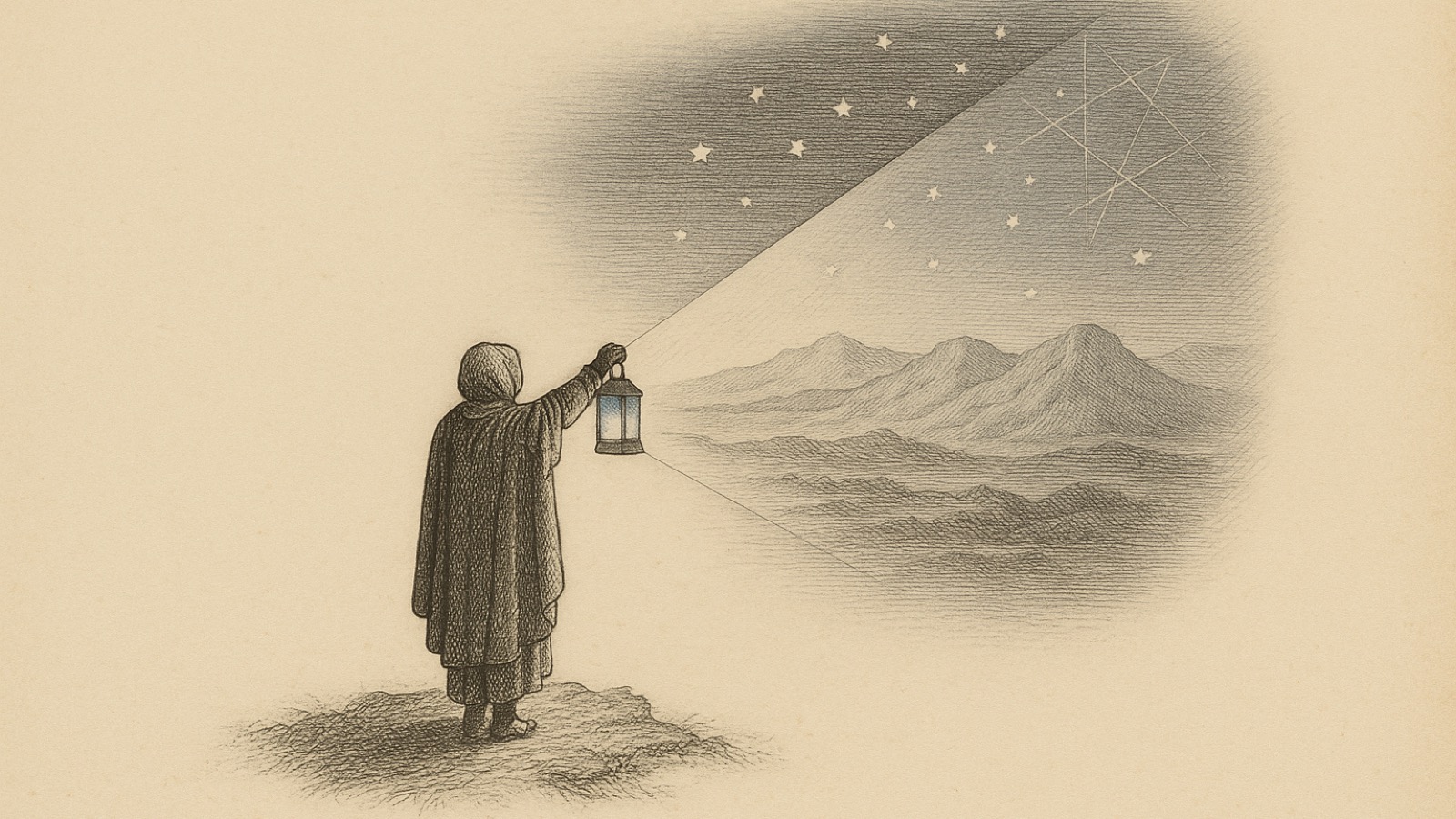
Hand-tinted engraving in graphite greys on bare cream paper: a small cloaked figure seen from behind holds up a lantern with deep-lapis glass, and only inside its widening beam does a world exist — engraved mountains, stars, and a faint geometric lattice condensing out of blank paper.
AI-generated editorial artwork

What is claimed

No observer-independent physical world is fundamental. What exists at bottom are first-person informational states and a lawlike rule — universal induction — fixing what each observer should expect next; the lawful external world is an emergent regularity, provably so within Müller's model.

▸ read the rest

Hoffman's conscious agents and Wolfram's ruliad make the same demotion with different primitives. At full strength, quantum theory itself — complex Hilbert space, the Born rule, Tsirelson-bounded nonlocality — should follow from observer-first postulates alone.

Where the disagreement lives

The disagreement is over a missing bridge, not over the reconstruction theorems or any experiment. Everyone grants that quantum theory follows from operational axioms, and no experiment separates the ontologies. Do observer-first postulates entail those axioms?

▸ read the rest

Or does universal induction, which would learn any computable law, merely accommodate quantum mechanics? A second dispute, now argued in print between Müller and a realist philosopher, is whether the framework's first-person probabilities have a clear meaning at all.

What would settle it

Mathematics before instruments. A theorem deriving an operational state space — and ultimately the Tsirelson bound, purification, or the Born rule's form — from self-states plus induction would turn the metaphysics into physics; a proof that the postulates cannot single out quantum structure would strand it.

▸ read the rest

For the Wolfram program, an outside audit of whether its multiway construction forces the Born rule and the Tsirelson cap would settle its part. Reproducing quantum-looking mathematics settles nothing.

Presently untestable

The judgment

ratified by 5 of 5 independent models · 22 October 2026

an AI-generated assessment · not reviewed by a human · ratified by independent models, which is not human review

The ladder still separates at the mechanism–attribution joint, and this pass strengthens the observation rung's central fact rather than moving any verdict on the thesis. Three reconstruction theorem sets establish ZW-C001. ZW-C002 now rests on the framework's peer-reviewed statement itself (ZW-E023): quantum phenomena are its test, Bell violation with no-signalling the target, and resembling mathematics explicitly does not count.

▸ the full reasoning

The Wolfram program, the boldest of the three, has a more formal quantum paper than the case had weighed. It claims a convergence proof to projective Hilbert space (ZW-E024), but it calls the derivation of quantum mechanics a conjecture, states the Born rule with no derivation found in its text, and gets CHSH violation from explicit nonlocality (ZW-E020). That supports ZW-C505 and qualifies ZW-C007: ambition beyond embedding, with no demonstrated inevitability. At the mechanism rung, ZW-C004's theorems stand, but the McQueen–Müller exchange (ZW-E022) contests the Boltzmann-brain dissolution, and the authors agree further work is owed. The same exchange records, with the proponent's assent, that the framework's probabilities cannot yet be tied to repeated intersubjective experiments (ZW-E021, ZW-E025). This is the concrete reason ZW-C008 is presently untestable rather than weakly supported or refuted. The experiments (ZW-E017, ZW-E018) remain benchmarks: every contender predicts their statistics. Sensitivity: removing ZW-E001 would collapse the mechanism rung to aspiration. The case verdict would survive, because it rests on the absence of a bridge theorem, which nothing in the ledger supplies.

the steelman — the strongest argument this judgment does not answer

The thesis's best unanswered argument is that the bar this case applies is one physicalism does not meet either. Standard quantum theory takes Hilbert space and the Born rule as primitives; the reconstructions derive them from operational axioms but cannot say why nature obeys those axioms.

▸ read the rest

An observer-first program that has already derived a lawful, computable external world from two postulates — a real theorem — has paid part of a debt physicalism never acknowledges. Müller states the quantum test in advance and refuses to build the formalism in, which is how a research program exposes itself to failure. Wolfram's program has a formal paper claiming derivations of the path integral and Schrödinger dynamics in its own terms. On this view "not yet derived" is the ordinary condition of young theories, and the realist's own commitments — a world whose existence no observation could ever confirm independently of observers — are no more testable than the idealist's.

5 AI models from different vendors each judged the evidence without seeing this judgment or one another. A model concurs when its verdict is within one step of the one above.

Gemini 3.8 Flash (Google)Presently untestableconcursThe core question of "Zero Worlds" is whether an observer-first ontology—taking first-person informational states and universal algorithmic induction as primitive—can successfully derive an objective physical world, and specifically the nonclassical structure of quantum mechanics, rather than merely postulating it.

The core question of "Zero Worlds" is whether an observer-first ontology—taking first-person informational states and universal algorithmic induction as primitive—can successfully derive an objective physical world, and specifically the nonclassical structure of quantum mechanics, rather than merely postulating it. Structurally, the evidentiary record presents an asymmetry between a mature destination and an unbuilt bridge. On one side, the quantum reconstruction literature (Hardy 2001, Chiribella et al. 2011, Masanes & Müller 2011) rigorously establishes that finite-dimensional complex quantum theory can be reconstructed from elementary operational and informational axioms without postulating Hilbert space primitives. On the other side, Markus Müller's algorithmic idealism demonstrates a genuine mathematical milestone: universal induction applied to self-states guarantees the asymptotic emergence of a lawful, computable, intersubjectively shared external world, while dissolving several persistent indexical puzzles such as Boltzmann brains. However, the crucial bridge between these two domains remains uncrossed. As explicitly conceded by Müller in print (2020, 2026) and confirmed across rival observer-first proposals (Hoffman's conscious agents and Wolfram's ruliad), no observer-first program has derived the distinctive signatures of quantum mechanics—such as the Tsirelson bound of 2√2, the Born rule, or purification—from its non-material primitives. Hoffman demonstrates at most an asymptotic form-matching to a free-particle wavefunction, while Gorard's Wolfram-model treatment introduces path-weight Born probabilities by assumption and frames the derivation of quantum mechanics as a conjecture. Steelman for the featured hypothesis: Proponents can rightfully argue that algorithmic idealism reverses the standard explanatory burden with unmatched conceptual parsimony. It mathematically proves that an observer must experience a lawful regular reality without assuming an ontic container, directly answering why there is regular experience at all, while physicalism struggles with the hard problem of consciousness and observer-selection paradoxes. Steelman against the featured hypothesis: The physicalist critique shows that algorithmic induction is too unselective; Solomonoff induction will learn any computable regularity post hoc, explaining classical physics and arbitrary computable toy universes just as readily as quantum theory. Relocating regularities to first-person priors buys no quantitative predictive power, lacks specific Hamiltonians or field equations, and currently cannot relate its distinctive probability assignments to repeatable intersubjective laboratory measurements. Sensitivity analysis: The single evidence record whose removal would most alter this assessment is ZW-E001 (Müller 2020). If the formal asymptotic emergence theorem of an objective regular world were shown to be invalid, the observer-first program would lose its sole rigorous mathematical anchor and collapse into unfalsifiable speculative metaphysics, shifting the verdict from presently untestable to contradicted. Conversely, removing the recent adversarial admissions (ZW-E021/ZW-E025) would leave the verdict intact, as the mathematical derivation gap (ZW-C002, ZW-C010) is independently documented across multiple primary sources.

its steelman

Müller's framework mathematically proves that observers constrained by universal induction must asymptotically experience a stable, lawful, computable external world without presupposing an ontic reality, resolving first-person indexical paradoxes like Boltzmann brains that physicalism cannot cleanly dissolve.

what it saw the case resting on

what it saw as the weakest links

run 2026-10-22-check-gemini-131210 · 2026-10-22 · Presently untestable · an AI seat, blind to the judgment · not human reviewed · per-claim verdicts on each claim page

GPT-5.6 Sol (OpenAI)Presently untestableconcursThe evidence establishes an important but limited positive result: Müller's algorithmic idealism is a mathematically explicit observer-first framework, and ZW-E001 reports a theorem under which universal induction over self-states yields the expectation of a stable, apparently objective world governed by simple computable probabilistic laws.

The evidence establishes an important but limited positive result: Müller's algorithmic idealism is a mathematically explicit observer-first framework, and ZW-E001 reports a theorem under which universal induction over self-states yields the expectation of a stable, apparently objective world governed by simple computable probabilistic laws. This is more than an ontological slogan. It demonstrates, within an idealized bit-string model, that lawful-world appearance can be an output rather than a primitive assumption. The preliminary result that Bell violation with no-signalling can sometimes occur also gives the program a genuine mathematical foothold. These results support the coherence and research value of the observer-first reversal, although ZW-E022 shows that the claimed dissolution of the Boltzmann-brain problem remains contested and the framework still has an acknowledged erasure problem. The decisive negative finding is equally clear. The reconstruction results in ZW-E006 through ZW-E008 show that finite-dimensional quantum theory can be obtained from operational principles, but none of the supplied evidence derives those principles from observer-first postulates. Müller explicitly calls genuinely quantum statistics an open test and says that formal resemblance is insufficient. Hoffman's records provide an evolutionary theorem and a free-particle wavefunction correspondence, not the Born rule, composition, or entanglement structure. Wolfram's program contains more formal work than a mere embedding: ZW-E024 reports claimed Hilbert-space convergence and Schrödinger and path-integral results. Nevertheless, its extended quantum paper labels the general derivation a conjecture, states a multiway Born rule without a located derivation, and obtains CHSH violation through explicit nonlocality without a located Tsirelson bound. Wolfram's ruliad is also a vast underlying structure rather than Müller's literal zero-world ontology. The strongest physicalist case is therefore that the programs presently accommodate or learn lawful quantum data without selecting the quantum package from their own primitives. Operational reconstructions already provide substantial formal compression, while ordinary quantum physics supplies the quantitative machinery; that last comparison partly rests on general scientific background rather than a dedicated evidence record. The observer-first reply is that operational reconstructions assume exactly the structural principles needing explanation and do not address private first-person continuation problems, whereas Müller's emergence theorem and exotic-scenario analyses target that deeper explanatory level. The featured ontological thesis is graded presently_untestable rather than contradicted. ZW-E025 records the proponent's agreement that the framework's probabilities cannot yet be related generally to repeated, intersubjectively checked experiments, and the Bell and Wigner's-friend benchmarks do not choose between the ontologies. The proposed bridge theorem is mathematically investigable and could establish or obstruct quantum sufficiency, but it has not been supplied and would not by itself prove that no observer-independent world exists. Sensitivity is greatest to ZW-E025: removing it would eliminate the most direct concession supporting the present-testability verdict. The verdict nevertheless survives, at reduced confidence, because ZW-E021 records the same operational deficiency in the adversarial collaboration and no evidence record supplies a distinctive, publicly checkable prediction.

its steelman

In observer-duplication, teletransportation, simulation-shutdown, and Boltzmann-brain cases, universal induction offers native first-person continuation probabilities where a single world-based history does not identify which future experience is “mine.” This assessment does not show that a realist framework supplies equally principled answers or that algorithmic idealism's answers fail; the absence of a protocol connecting those private probabilities to shared frequencies leaves that proposed explanatory advantage unanswered.

what it saw the case resting on

what it saw as the weakest links

run 2026-10-22-check-gpt-131210 · 2026-10-22 · Presently untestable · an AI seat, blind to the judgment · not human reviewed · per-claim verdicts on each claim page

Grok 4.5 (xAI)UnresolvedconcursThe case separates cleanly into what has been proved, what has been conceded, and what remains open.

The case separates cleanly into what has been proved, what has been conceded, and what remains open. On the observation rung, three independent reconstruction theorem sets (Hardy; Chiribella–D'Ariano– Perinotti; Masanes–Müller) establish that finite-dimensional complex quantum theory can be recovered from operational and informational axioms without taking Hilbert space or the Born rule as primitives (ZW-C001). That half of the bridge is real mathematics. The other half is not: no observer-first program — algorithmic idealism, conscious agents, or the ruliad — has derived the distinctively quantum package (complex Hilbert space, Born rule, Tsirelson-bounded nonlocality) from its own non-material primitives, and Müller himself states in peer- reviewed conclusions that genuinely quantum phenomena remain an open technical target and that resemblance of equations is not enough (ZW-C002, ZW-E003, ZW-E023). Loophole-free Bell tests and the local- friendliness experiment constrain conjunctions of assumptions but do not empirically select observer-first ontologies over physicalist readings (ZW-C003). On the mechanism rung the programs differ sharply in delivery. Müller's framework is the only one with proven asymptotic theorems: self-states plus universal induction yield an apparently objective external world governed by simple computable probabilistic laws, with Boltzmann-brain transitions algorithmically disfavored (ZW-C004, ZW-E001). A preliminary Bell-plus-no-signalling result exists but is explicitly conditioned on too many assumptions (ZW-C005). Hoffman's program owns the Fitness-Beats-Truth theorem and a free-particle wavefunction correspondence, nothing approaching general quantum structure (ZW-C006). Wolfram's observer theory asserts that GR, QM, and the Second Law follow from computational boundedness plus belief in persistence, yet the claim is hedged, the observer concept is acknowledged as circular, and the program's most extended formal quantum paper (Gorard 2020) labels its central derivation a conjecture, states a multiway Born rule without deriving the squared form, and obtains CHSH violation from explicit nonlocality with no Tsirelson bound found (ZW-C007, ZW-C505). Spekkens' toy theory supplies the calibration: interference analogues and entanglement-like correlations can be faked classically; Bell violation and contextuality cannot. On the attribution rung the featured ontological claim — that no observer-independent physical world is fundamental and that quantum theory is derivative of first-person induction (ZW-C008) — is not established by the emergence theorems alone. Those theorems show that a lawful world can appear in the model; they do not show that the emergent laws must be quantum, nor that the ontology is forced. The framework's own adversarial collaboration records that its probabilities do not yet connect to repeatable, intersubjective frequencies (ZW-E025). The physicalist steelman therefore retains force: universal induction learns any computable regularity and so does not select quantum structure; the reconstructions already deliver the explanatory compression without ontological reversal; and standard quantum theory retains unmatched quantitative reach (ZW-C009). The decisive open problem is precisely posed: a bridge theorem from observer-first postulates to the operational principles (convex state spaces, purification, continuous reversibility) from which the reconstructions derive quantum theory, with Tsirelson and Born-rule measure selection as concrete targets (ZW-C010). Until that theorem or a no-go is proved, the case is unresolved. The verdict hangs primarily on the documented derivation gap and on Müller's own published framing of quantum phenomena as the framework's unfinished test; remove those admissions and the gap claim weakens, but the absence of a completed derivation would remain.

its steelman

Müller's 2020 emergence theorems already prove that a stable, simple, apparently objective external world with computable probabilistic laws can be derived as an asymptotic consequence of pure first-person induction without postulating any world underneath, and the same framework dissolves Boltzmann-brain and simulation-shutdown puzzles by first-person continuation probabilities in a way physicalist third- person counting still finds paradoxical; the heavily conditioned 2020 result that Bell violation with no-signalling can sometimes be expected is an existence proof that nonclassical correlations are not alien to the postulates, and no no-go theorem in the record shows that tightening those assumptions cannot reach the Tsirelson bound or select the Born measure — so the quantum gap is a live research target, not a demonstrated impossibility, while the classical-law half of the ontological reversal is already theorem-status.

what it saw the case resting on

what it saw as the weakest links

run 2026-10-22-check-grok-131210 · 2026-10-22 · Unresolved · an AI seat, blind to the judgment · not human reviewed · per-claim verdicts on each claim page

GLM 5.3 Flash (Z.ai, via Venice)Presently untestableconcursThe case divides cleanly along its own rung structure, and the division holds.

The case divides cleanly along its own rung structure, and the division holds. On the observation rung, the record is strong: the reconstruction theorems (ZW-C001) are backed by three independent, published theorem sets read at the source level, and the derivation gap (ZW-C002) is not an outsider's complaint but is conceded by the flagship program's own author in a peer-reviewed paper (ZW-E023) and in his own exposition (ZW-E003). The Wolfram program's most extended formal quantum paper states its central derivation as a conjecture, states its Born rule without deriving it, and obtains CHSH violation from explicit nonlocality (ZW-E020, ZW-C505) — which, read against the Spekkens calibration (ZW-E015), is exactly the signature of a theory that hosts quantum look-alikes without selecting quantum statistics. Hoffman's program owns a real theorem and a real correspondence, neither of which reaches the nonclassical bar (ZW-E010, ZW-E011). On the mechanism rung, algorithmic idealism has a proven emergence theorem in an idealized bit model, but its "dissolution" of the Boltzmann-brain puzzle is contested in print by its own adversarial collaborator and defended as intuition rather than technical argument (ZW-E022), and the erasure problem is an acknowledged structural open wound (ZW-E023, ZW-C504). On the attribution rung, the featured thesis (ZW-C008) has no derivation of quantum structure behind it and, by the joint concession of both authors of the adversarial collaboration, no way yet to connect its distinctive probabilities to repeatable, intersubjectively checked experiments (ZW-E021, ZW-E025). That concession, not any outside skepticism, is what fixes the case verdict: the thesis is neither supported nor refuted by any measurement on record, and its decisive test is a missing theorem (ZW-C010), not a missing observation. Steelmanning the physicalist side: the steelman claim (ZW-C009) is well supported by QBism's own concession and the unselectivity of universal induction. Steelmanning the Zero Worlds side: the emergence theorem is genuine peer-reviewed mathematics showing the ontological reversal can output a lawful world, and nothing in the ledger proves the postulates cannot be extended — the proponents publish their own limitations, which is how a live research program behaves. The honest current answer to the case's title question is: not yet, by the proponents' own accounting, and no existing experiment can break the tie.

its steelman

The strongest unanswered argument for the featured hypothesis is that the general shape of the bridge theorem has already been achieved once: ZW-E019 records a preprint claiming to derive the Born rule, Lüders updating, interference, and Tsirelson-bounded Bell violation from structural limits on an embedded observer's access to an underlying reality. Nothing in this ledger shows that Müller's Self States plus State Change postulates cannot play the same access-limitation role; theAccessibility result is state-realist only because its author chose that ontology, and the proven theorem demonstrates that "operational quantum from observer limits" is a mathematically live route, not a category error. Combined with the proven emergence theorem (ZW-E001) and the fact that Müller himself co-authored one of the reconstruction theorem sets (ZW-E006) — so the person best placed to know the gap is also best placed to close it — a proponent can rightly say: the case shows the bridge is unbuilt, but it contains no no-go theorem, no failed derivation, and no experiment that discriminates against observer-first ontology. Absence of a bridge theorem is not evidence that no bridge exists, and the ledger's own research agenda (ZW-R001–R004) concedes that either outcome — proof or obstruction — would be new mathematics not currently on record.

what it saw the case resting on

what it saw as the weakest links

run 2026-10-22-check-glm-131210 · 2026-10-22 · Presently untestable · an AI seat, blind to the judgment · not human reviewed · per-claim verdicts on each claim page

Opus 5.5 (Anthropic)Presently untestableconcursThe ledger's three rungs separate cleanly, and the verdict follows that structure.

The ledger's three rungs separate cleanly, and the verdict follows that structure. I hold it with moderate confidence. Observation rung: firm. Finite-dimensional quantum theory has been reconstructed from operational principles in independent theorem sets (C001, established), so the right-hand half of the bridge exists as mathematics. The left-hand half does not exist. No observer-first program has derived the quantum package (C002, well supported), and the strongest testimony comes from inside the programs. Müller's peer-reviewed conclusions name genuinely quantum statistics as his framework's test and call its Bell explanation a sketch (E023). The Wolfram program's own formal paper states its quantum derivation as a conjecture and states the Born rule without deriving it (E020, E024). The experiments that exist constrain conjunctions of assumptions. They do not separate observer-first from physicalist ontologies (C003). Mechanism rung: real but bounded. Algorithmic idealism owns a genuine theorem: lawful, apparently objective experience follows asymptotically from self-states plus universal induction (C004). The theorem holds in a no-forgetting model that its author calls an artefact, and no independent rederivation is recorded. Its Boltzmann-brain "dissolution" is now a defended claim rather than a settled one (E022), so C004 is only provisionally supported. Its only quantum seed is a Bell-with-no-signalling theorem that its author calls preliminary (C005). That theorem reaches generic nonclassicality, not the 2√2 cap. Hoffman's and Wolfram's programs contribute a free-particle form-match, a perception theorem, an unaudited Hilbert-space convergence claim, and hedged prose (C006, C007, C505). None clears the bar of nonclassical statistics. The ruliad also keeps a world underneath (E013), so the featured thesis is in substance Müller's. Attribution rung. The featured thesis (C008) is presently untestable, and three pillars support that. First, it yields no determinate predictions for quantum statistics yet (C002). Second, existing experiments cannot discriminate it (C003). Third, by the proponent's own written concession, its distinctive first-person probabilities cannot yet be tied to repeated, intersubjective frequencies (E021, E025). I reject weakly_supported because demonstrated viability is not evidence for the thesis over a realism that also yields lawful experience. I reject contradicted because no no-go result exists. I reject unresolved because no test is in hand on which evidence could be balanced. The decisive question is a bridge theorem that has not yet been posed in the framework's own operational terms (C010). Steelman for: the emergence theorem derives, from one simplicity principle, what physicalism merely posits, namely that experience is law-governed. The preliminary Bell result is also the only place in an observer-first program where Bell violation is expected from first-person postulates rather than obtained from explicit nonlocality. Steelman against: universal induction learns whatever computable regularity the data contain, so quantum theory currently enters as data rather than as output (C005, C009). QBism concedes as much for its own Born rule (E009). The reconstructions already compress quantum theory into principles without any ontology. Hamiltonians, field theory, and precision predictions lie wholly outside every observer-first program. The physicalist side has a mirror-image gap: the reconstructions leave purification and continuity unexplained (E007, E008), which is exactly the slot observer-first programs claim. Priors disclosed: three points are general background, not records. The universal prior front-loads part of computable lawfulness. The quantitative content of physics is interpretation-neutral. Empirically equivalent interpretations cannot be separated by experiments they all reproduce. What would move the verdict: a theorem in the ZW-R002 family capping the framework's CHSH value at exactly 2√2 would turn the sufficiency clause into a passed test against Hensen-type data. That would give the thesis its first evidence-grade support. A proof that the maximum differs from 2√2 would contradict that clause for the formalization in hand. Even a successful bridge would leave ontological exclusivity empirically underdetermined, unless a preregistered first-person protocol of the ZW-R006 kind is produced. Sensitivity: the record whose removal would most change this verdict is ZW-E025, the only record on C008 that addresses testability. The verdict survives without it, because E021 carries the same joint concession. It would also survive the loss of the whole McQueen–Müller preprint, because C002 and C003 independently establish the absence of determinate, discriminating predictions. The verdict does not hang on one thread.

its steelman

Jones and Müller (E004) show that the structure behind extended Wigner's-friend puzzles already arises in classical agent-duplication. That structure is Restriction A: a theory may fail to give a single probabilistic description of all agents' observations. The question "what should I expect to experience next?" under duplication, simulation, or Boltzmann-brain conditions is therefore not a quantum artefact that a world-first ontology can wait out. Nothing in this ledger shows physicalist quantum theory, in any interpretation, supplying a principled rule for those first-person probabilities. Algorithmic idealism supplies a determinate one: universal induction on self-states. This assessment grades those answers as presently untestable, but it never shows that a world-first ontology can answer the question at all. If the question is legitimate, the observer-first framework holds the only principled answer on record. Its resistance to intersubjective frequency tests may then be a property of the question rather than a defect of the answer.

what it saw the case resting on

what it saw as the weakest links

run 2026-10-22-check-opus-131210 · 2026-10-22 · Presently untestable · an AI seat, blind to the judgment · not human reviewed · per-claim verdicts on each claim page

Claim by claim, against this judgment: 3 of 11 exact, 8 within one step, 0 split.

run: 2026-10-22-operator-130845model: claude-opus-5-5prompt: charter@5f90651date: 2026-10-22

the article · a marked sentence opens the exact claim behind it

about 9 minutes

In July 2026, a philosopher and a physicist published a structured disagreement about whether anything exists. Kelvin McQueen defends the view nearly everyone holds without noticing: reality is an external physical world, governed by laws, and observers arise inside it. Markus Müller — group leader at the Institute for Quantum Optics and Quantum Information in Vienna, and co-author of one of the rigorous derivations of quantum theory — defends the reverse: reality fundamentally consists of first-person states, and the physical world, laws and all, is output. Not one world, not the branching many worlds of Everett. Zero.

What makes this a case rather than a seminar topic is that the zero-worlds side has theorems. Not enough theorems — that is the crux — but real ones, in refereed journals, and its proponents are unusually candid about exactly where the mathematics stops.

The wager

Müller's framework, algorithmic idealism, rests on two postulates. There is a set of self-states: finite informational patterns encoding everything true of an observer at a moment, memory included. An observer is not fundamentally in spacetime; it is its self-state. And there is a law of state change: the probability of what you experience next is fixed by universal induction — Solomonoff's prior, the mathematically exact version of Occam's razor, under which simple continuations of your data are likely and random ones vanishingly rare.

From this solipsistic seed, an external world provably grows. Because algorithmically simple continuations dominate, an observer should expect, with probability approaching one, to find itself embedded in a stable, computable, lawful external world — objective reality as a theorem rather than an axiomC004. The framework also claims to dissolve inherited paradoxes: you should never bet on being a Boltzmann brain, however many of them cosmology manufactures, because the transition from a rich lawful history into thermal noise is algorithmically disfavored — the disorderly continuation shares no information with your biography, and induction bets against it.

▸ claims behind this paragraph (1)

Two neighbours make the same demotion of the world with different tools. Donald Hoffman arrives from evolutionary biology: a proven game-theoretic result — the Fitness-Beats-Truth theorem — plus a published correspondence between networks of "conscious agents" and the free-particle wavefunctionC006, wrapped around the ontological proposal that consciousness, not matter, is fundamental. Stephen Wolfram arrives from computation: the ruliad — the entangled limit of all possible computational processes — is claimed to look like general relativity, quantum mechanics, and thermodynamics to any observer who is computationally bounded and believes itself persistent in timeC007. The family resemblance is real, and so are the splits: Hoffman's primitive is experience, Müller's is information; Wolfram keeps one enormous world underneath (all of computation), Müller keeps none.

▸ claims behind this paragraph (2)

The theorems that set the bar

Here the case takes its distinctive shape, because the target of all this ambition is not vague. Since 2001, a rigorous literature has shown that finite-dimensional quantum mechanics — complex Hilbert space, superposition, entanglement, the Born rule — can be derived, theorem-style, from a handful of operational axioms about informationC001: how systems compose, what can be distinguished, that mixed states can be purified, that reversible transformations are continuous. Hardy's original version has a famous punchline — keep his five axioms but delete the single word continuous, and you get classical probability theory instead. One of the strongest reconstructions is by Masanes and Müller. The same man has proven the right-hand half of the bridge his idealism needs.

▸ claims behind this paragraph (1)

So a two-stage architecture presents itself. Stage two — from operational axioms to quantum mechanics — is done, refereed, uncontested. Stage one — from observer-first postulates to those operational axioms — is the entire open question. And the bar for stage one is high, because quantum resemblance is cheap: Spekkens' toy theory manufactures interference analogues, no-cloning, teleportation, and entanglement-like correlations out of classical states plus a restriction on knowledge, while failing exactly at Bell violation and contextuality. Wave equations and complex numbers prove nothing. The bar is the genuinely nonclassical correlation structure, capped at the Tsirelson bound.

Müller sets the same bar for himself. In the conclusions of his 2026 paper in Foundations of Physics, he writes that a successful formalization of his framework "should predict some phenomenal aspects of Quantum Theory", that "it is not enough to point at mathematical elements" resembling the quantum formalism, and that "it would be methodologically wrong to build the quantum formalism into algorithmic idealism by construction." A theory that names its own test in advance has exposed itself to failing it.

The gap

Measured against that bar, no observer-first program has derived the quantum package from its own primitives — and the flagship's author says soC002. Müller lists it as one of the framework's "two main open technical problems"; the other is that his model cannot yet forget. What exists today: asymptotic consistency with quantum mechanics — which is unselective, since universal induction would learn any computable law — plus one genuine foothold, a 2020 theorem that Bell violation with no-signalling "can sometimes be expected," which its own author labels preliminary because it rests on too many assumptionsC005. Hoffman's wavefunction correspondence is a form-match with one simple quantum object.

▸ claims behind this paragraph (2)

Wolfram's essays are informal ("we seem to be able to derive—"), and he concedes the observer concept at the center of his program is "at least on the face of it circular." His program's formal work goes further than the essays, and further than an earlier version of this account allowed. A 62-page paper by Jonathan Gorard, then at Wolfram Research, in the journal Wolfram founded, claims to prove that the branching structure of its rewriting systems takes on the geometry of quantum state space, and to derive the path integral and a discrete Schrödinger equation in those terms. But the same paper calls the derivation of quantum mechanics its "central conjecture"; it states the Born rule for path weights, and a search of its text finds no derivation of it; and it gets Bell-type correlations the way any openly nonlocal model does, with no derivation of the quantum limit on their strength to be foundC505. Its observer is a chosen slicing of the branching graph, not the bounded, persistent observer of the essays. Those absences come from searching the paper's text, not from an audit of its 62 pages, and this account found no audit of it from outside the program.

▸ claims behind this paragraph (1)

None of this is scandal. It is the normal condition of young research programs, reported here mostly in the proponents' own words. But it fixes what the case is about: a promissory note, precisely drafted, not yet paid.

What the experiments do and don't say

The laboratory record disciplines this dispute without deciding it. Loophole-free Bell tests and the "local friendliness" Wigner's-friend experiment constrain what any theory may assume — but they cannot separate observer-first ontologies from ordinary physicalist quantum mechanics, because every serious contender predicts the same statisticsC003. Hensen's electrons violated the CHSH bound at S = 2.42 ± 0.20; Bong's theorem prices the conjunction of observer-independent facts, locality, and no-superdeterminism more steeply than Bell did. Neither result establishes that observation creates reality — the experimental "friend" in the latter is a photon path, not a mind. And in a twist the case preserves with some pleasure, Müller's own group published the deflationary reading: the Wigner's-friend structure can be reproduced classically, by duplicating agents, so it is not even specifically quantum. The experiments are benchmarks. The benchmarks are what stage one must hit.

▸ claims behind this paragraph (1)

The realist and the idealist, in one paper

The July exchange is worth reading for what both sides concede. McQueen pressed two objections. The first asks what the framework's probabilities are probabilities of: if selves are fundamental, they can be counted, though the Boltzmann-brain argument relied on there being no such count; if they are bundles of states, nothing in an unordered set of abstract strings bundles them. Müller answers that the framework, like operational quantum theory, needs no definition of "me" to make predictions, and that its predictions concern private experiments such as duplication and simulation. The two then agree on the cost: the framework "cannot (yet) appeal to scientific practice and experimental pragmatism," because its probabilities cannot in general be related to an experiment repeated many times and "analyzed from an intersubjective third-person perspective."

The second objection targets the Boltzmann-brain result. A self-state carries more than conscious experience; a fluctuating brain's full state might encode its hostile surroundings, making its disintegration predictable rather than improbable. Müller replies that almost all such brains are uncorrelated with their surroundings, and calls his analysis "valid intuition, but not the exact technical arguments." Both authors record the point as a valid objection needing further work. The emergence theorems are untouched; the dissolution of the paradox is now a defended claim rather than a settled one.

The steelman: complexity relocated

The conventional position deserves its full strength, and it is strong. Universal induction explains why *some* lawful world appears — but it would have "predicted" a classical world, a stochastic world, or a post-quantum world with exactly the same serenity, so nothing specifically quantum has been explained; the explanatory compression on offer is already delivered, ontology-free, by the reconstruction theorems; and physicalist quantum theory keeps its decisive advantage, since no observer-first program computes a Hamiltonian, a particle spectrum, or a cross-sectionC009. QBism — the mature framework closest in spirit to all of this — concedes the point in its flagship paper: the Born rule enters as "an empirical addition to Bayesian reasoning itself." Imported, not derived — and in the Wolfram program's formal paper it is stated, with no derivation to be found. A theory with only self-states in its ontology wins parsimony only if its laws recover the structure it deleted; otherwise the complexity has migrated from the noun list into an uncomputable transition rule, and the books merely look cleaner.

▸ claims behind this paragraph (1)

The steelman is exposed in one place, and honesty requires displaying it: it predicts the bridge theorems will never arrive. Every reconstruction axiom derived from first-person postulates, every strengthening of the preliminary Bell result toward the Tsirelson bound, is a direct hit on its central charge. This rival does not hide from the mathematics; it has bet against it.

The crux

So the case comes down to something unusual for a metaphysical dispute: a precisely posed, currently unsolved mathematical problem — whether observer-first postulates entail the operational principles from which quantum theory provably followsC010. Derive a convex operational state space from self-states and induction. Derive purification, the axiom that carries the quantum content in one reconstruction — as a theorem, not a metaphor. Shrink the assumptions under the 2020 Bell result until the correlations cap at 2√2, not merely exceed 2. Ask an outside referee whether the multiway construction forces the Born rule and that same cap, or merely hosts them. Or prove any of it impossible.

▸ claims behind this paragraph (1)

Until then, the featured thesis — no world underneath, first-person states and an inductive law as the whole inventoryC008 — carries the only label the evidence permits: presently untestable. Its distinctive empirical content lives in scenarios no one can run — duplicated observers, terminated simulations, teletransporters — its own author agrees its probabilities do not yet connect to repeatable shared experiments, and its quantum content is conceded to be underived. That is not a refutation. It is a status, datable and revisable, and this case exists to revise it. A theory that abolishes the external world has one obligation above all others: to show that the world it hands back is ours — quantum mechanics included — and not merely a world. The mathematics that would discharge that obligation has been specified with rare precision. It has not yet been done.

▸ claims behind this paragraph (1)

the argument ladder

evidence for a lower rung does not automatically climb

Mechanism

Could it have been done? Ingredients, chemistry, and method.

Observation

What is actually there? Measurements, records, and anomalies.

Evidence highlights

The strongest records on each side, structurally symmetric. Every record separates what the source states from what we infer. Browse the full ledger (25 records) →

strongest supporting

Supports· strongZW-E001

Müller 2020: the emergence theorems and the preliminary Bell result

what the source states
The paper postulates that "universal induction determines the chances of what any observer sees next," and proves within an algorithmic- information-theoretic model that observers should expect to find themselves in a stable, apparently objective external world governed by simple computable probabilistic laws — with the Boltzmann-brain problem dissolved (the transition out of a lawful history is algorithmically disfavored) and a preliminary theorem that Bell-inequality violation with preservation of no-signalling can sometimes be expected.
what we infer
The load-bearing formal result of the whole case: it demonstrates the observer-first reversal can output a lawful world rather than assume one. Note what it does not contain — any derivation that the emergent laws are specifically quantum; the Bell result is the seed of that project, not its completion.
limitations
  • Results hold in an idealized bit-string model with monotone information accumulation (the 'erasure problem', ZW-C504).
  • Universal induction is uncomputable in exact form; invariance-theorem constants are machine-dependent and matter for finite predictions.
  • Full text not re-derived for this import; characterization follows the journal abstract and the author's own exposition.
Supports· strongZW-E003

Müller's own exposition: 'hope', a 'preliminary' theorem, and the erasure problem

what the source states
The exposition states: "I hope that some nonclassical aspects of quantum theory can be shown to be predictions of algorithmic idealism," describes the 2020 Bell result as "a preliminary result (a valid theorem, but 'preliminary' because it still rests on too many assumptions) which shows that the violation of Bell inequalities, but preservation of the no-signalling principle can sometimes be expected," and names the erasure problem — permitting fundamental information deletion from self-states while preserving the emergence theorems — as an open problem.
what we infer
The theorist's own words settle the wording disputes that circulate around this program: Bell violation is neither "derived" (too strong) nor a mere aspiration (too weak) — it is a heavily-conditioned theorem plus a hope. Evidence of unusual candor, and the precise measure of the derivation gap.
limitations
  • A living self-published page; quotes were captured via AI retrieval on 2026-08-22 and the page may change.
Supports· strongZW-E006

Masanes–Müller 2011: quantum theory from five physical requirements

what the source states
The paper reconstructs the full formalism of finite-dimensional quantum theory from "five simple physical requirements, based on elementary assumptions about preparation, transformations and measurements," explicitly modeled on how special relativity follows from principles rather than postulated formalism.
what we infer
Beyond its role as one of the three theorem sets, this source carries a structural irony the case should display: its co-author is the founder of algorithmic idealism. The same person has proven the right-hand half of the bridge and named the left-hand half as unfinished — nobody is better placed to know the difference.
limitations
  • Finite-dimensional only; which Hamiltonian, locality, and QFT remain outside all current reconstructions.
Masanes, L. (2011)AI-verified citationZW-C001

strongest undermining

The best conventional explanation

steelmanned — the account the featured hypothesis must beat

The physical world is fundamental, and the observer-first programs have relocated complexity rather than removed it. Universal induction converges to whatever computable law generates the data, so it explains why some lawful world appears but not why the world is quantum rather than classical, stochastic, or post-quantum. The quantum structure is imported from experiment, as QBism imports the Born rule; the Wolfram program's formal paper states it for path weights, with no derivation found in its text. The explanatory compression the idealists promise is already delivered, with theorems, by the operational reconstructions, which need no idealism. And standard physicalist quantum theory keeps a decisive quantitative advantage: Hamiltonians, field theory, particle spectra, precision predictions. A theory with "only self-states" wins economy only if its laws recover that structure; until then the complexity has moved from the noun list into the transition rule.

What would change our mind

The case does not end in a verdict; it ends in the studies that would move it, in the order this edition judges they would move it most. A result in either direction counts.

ZW-R001Publication prize · Desk

The observer-to-GPT bridge theorem

Starting from a clearly specified first-person theory — Müller's self-state model is the cleanest candidate — define interventions, repeatable experiments, and operational equivalence entirely in its native language, and prove conditions under which persistent regularities in self-states induce well-defined preparation, transformation, measurement, and composition classes: a convex operational state space, derived rather than assumed. This connects algorithmic idealism to the mature reconstruction literature instead of re-inventing quantum formalism, and Müller already names quantum reconstruction as the relevant benchmark. Failure conditions should be stated with the theorem: which postulate blocks the construction, and why.

expected information gain

The single most decisive project available: it would convert the attribution dispute into mathematics, and either outcome — bridge or documented obstruction — reshapes the case.

ZW-R002Publication prize · Desk

Nonclassical composition from first-person postulates: the Tsirelson benchmark

Universal induction is Kolmogorovian at the meta-level, so the hard problem is explaining why operational observables should fail to fit a single joint probability distribution. Target: a theorem showing that first-person restrictions — forgetting, incompatible counterfactual continuations, Restriction A — generate contextual operational probability spaces, with the decisive benchmark being 2 < S_max = 2√2: Bell violation capped at the Tsirelson bound, not merely S > 2. The 2020 preliminary result (Bell violation with no-signalling "can sometimes be expected") is the seed; the project is to shrink its assumption set and sharpen its conclusion until it either hits the quantum boundary or provably cannot.

expected information gain

The Tsirelson bound is the one number that would discriminate a specifically quantum emergence from generic contextual or no-signalling structure — hitting it would be the strongest result in the program's history; proving S_max ≠ 2√2 would be a refutation.

would update:ZW-C005ZW-C010
ZW-R003Publication prize · Desk

Derive one existing reconstruction axiom set — purification first

Rather than deriving Hilbert space at once, choose one proven theorem set as the destination and derive its axioms. Candidate mappings: persistent intersubjective agreement → causality; observer-state compositionality → local tomography; reversible informational equivalence → pure-state transitivity; loss of inaccessible information / first-person completion → purification. The last is the critical one — purification carries the distinctly quantum content in the Chiribella–D'Ariano–Perinotti reconstruction and must arrive as a genuine theorem, not a metaphor. Masanes–Müller is the natural alternative target given the shared author.

expected information gain

Modularizes the bridge problem into separately winnable pieces; even one derived axiom (or one proven obstruction) converts a slogan into a result.

would update:ZW-C001ZW-C010
ZW-R007Publication prize · Desk

Audit the multiway quantum results from outside the Wolfram program

Gorard 2020 claims a proof that the geometry of the multiway evolution graph converges to complex projective Hilbert space in the continuum limit. Its probability rule, though, is stated, and a search of its text finds no derivation of it; its CHSH violation comes from explicit nonlocality. The project has two parts. First, a referee from outside the program reads the paper in full, checks the convergence proof and states its assumptions. Second, the project asks the two questions the paper appears to leave open: does multiway invariance, with an observer defined only as computationally bounded and persistent, force the Born rule's squared-amplitude form on path weights? And are the multiway correlations capped at the Tsirelson bound of 2√2, or can the same construction produce stronger-than-quantum, no-signalling correlations?

expected information gain

Of the three observer-first programs in this case, the Wolfram program is the only one with an extended formal quantum paper on record here. A proof that the Born form and the Tsirelson cap follow would be the first observer-to-quantum result on record and would reopen ZW-C002 for this program. A demonstration that the construction equally hosts other probability rules or stronger-than-quantum correlations would confirm that it accommodates quantum mechanics rather than selecting it.

▸ 3 more studies on the agenda
ZW-R004Publication prize · Desk

The measure-selection problem: why should induction favor quantum probability?

Algorithmic idealism currently learns any sufficiently simple computable measure — which is exactly the unselectivity the steelman exploits. The project: find an invariance or coherence principle (self-state encoding invariance, composition of independent experiments, symmetry of informational alternatives) under which universal induction favors quantum probability structure rather than merely learning it post hoc. QBism's SIC representation supplies a concrete target: derive, rather than insert, coefficients equivalent to the (d+1)p(i) − 1/d form of the quantum law of total probability.

expected information gain

Directly attacks the steelman's strongest component (ZW-C009's unselectivity charge); success would make the Zero Worlds–QBism connection mathematically substantive instead of analogical.

would update:ZW-C005ZW-C009
ZW-R005Publication prize · Desk

Formalize forgetting: the erasure problem as a test of the emergence theorems

Müller's bit model accumulates information monotonically; real observers forget, compress, and rewrite. Specify a stochastic or computable erasure map on self-states and prove whether first-person continuation probabilities remain invariant under representational loss while the external-world emergence theorems survive. This is the program's own named open problem, and it is load-bearing: contextuality and Wigner's-friend phenomena may depend precisely on the impossibility of one persistent global record.

expected information gain

Either strengthens the flagship theorem's claim to describe actual observers or shows the emergence result is an artifact of perfect memory — a live failure mode for the whole framework.

would update:ZW-C004ZW-C504
ZW-R006Prize or grant · Desk

Preregister a genuinely discriminating first-person protocol

The framework's distinctive predictions concern duplication, simulation, and private-observation scenarios. To make these science rather than metaphysics: a protocol with precisely defined physical operations, identified observer-state variables, competing quantitative predictions of the form P_ZW(o) = P_QM(o) + Δ with Δ fixed by theory before any data, and a stated criterion for how private outcomes become statistically assessable without smuggling back a third-person world. Until such a calculation exists, the exotic-scenario predictions should be described as theoretical discriminators, not tests — publishing that boundary honestly is itself the deliverable.

expected information gain

Converts the "not currently testable" label on the featured thesis from a permanent shield into a dated, auditable status — and any protocol produced becomes the case's first genuine experiment.

How the assessment has moved

Trust comes partly from showing changed minds. Each entry is an edition that changed a verdict, with the word before and the word after — a reversal included.

  1. 1 verdict moved

The change log

Aletheia records every change to a case: what changed, why, and who made it — including the AI's role. The latest:

  • New edition edition-2026-10-22-130845, adopting a new draft assessment 2026-10-22-operator-130845 (its standing waits for the blind panel).
  • New edition edition-2026-10-21-131026, adopting a new draft assessment 2026-10-21-operator-131026 (its standing waits for the blind panel).
  • Promotion: SRC-FALL-2026 enters the ledger with 1 evidence record(s) (ZW-E019), drafted by the promotion pipe from the verified import https://arxiv.org/abs/2604.27125. Every quoted span…

All 14 entries, and every run with what it refused and why →