case file DEEP-001Comparative iconography · Comparative mythology · Archaeologyupdated 30 September 2026
Deep Memory
Distant places, familiar forms: how much of the resemblance between bird-men, handled objects, navel-of-the-world names, feathered serpents, civilising teachers and flood stories across distant ancient cultures belongs to a shared past, and how much to the ways people make images, tell stories and look for connections?
Weakly supportedThe civiliser lineup against retelling
Provisionally supportedHandled objects: shape known, use argued separately
Well supportedDates and intermediates
UnresolvedThe navel names
Weakly supportedWhether resemblance can be measured
why this research priority
The decisive tests are cheap desk work — a blind lineup on original passages, the excavators' named seal corpus, four name histories — and each moves several verdicts. None tests the grand thesis directly.
AI-generated editorial artwork
What is claimed
That resemblances among images and stories from distant ancient cultures record a shared past — one common source or long-distance contact — rather than independent invention or later retelling.
▸ read the rest▾ less
Primary sources read so far describe the compared objects: Pillar 43's handled forms, the Assyrian ritual bucket, a Jiroft object that hung on a cord, the Rapa Nui birdmen, Berossus's Oannes and Urfa Man's grip. The navel names, the feathered serpent and the flood stories rest on the founding page's word alone.
Where the disagreement lives
The dispute is whether any specific resemblance is rarer than chance and linked by dated intermediates, or whether common motifs, shared constraints and modern retelling explain it. No one has counted specific composites against controls.
▸ read the rest▾ less
The civiliser lineup signal may measure modern summaries rather than original accounts. The excavators report missing links, and the Rapa Nui birdmen are later additions. The navel names differ in language and date. Matching object kinds changes how resemblance ranks.
What would settle it
A dated chain for any one parallel would settle it: most concretely, a securely dated Neolithic seal carrying a specific Pillar 43 motif long after the site.
▸ read the rest▾ less
Beside it, specific composites counted against matched controls from unconnected cultures, and a blind human lineup of original civiliser passages beating random pairs. Against a shared past: that lineup falling to chance, the bundle comparison holding under narrower classes, and the navel names traced to modern or colonial origins.
an AI-generated assessment · not reviewed by a human
The case stays unresolved: primary sources settle what several compared objects are, but nothing tests whether any resemblance records a shared past. The founding page's experiments are weak self-reports: 55% for a bird-person class (DEEP-E013, on DEEP-C005) and 37% for a cosmic serpent (DEEP-E016, on DEEP-C025), qualified by uneven coverage and broad classes (DEEP-E018, DEEP-E019); the civiliser lineup at 62.5% against 9% (DEEP-E020, DEEP-E021, on DEEP-C027); kind-matched controls changing a lineup (DEEP-E022, on DEEP-C038).
▸ the full reasoning▾ less
No record states the bundle null (DEEP-C057) or that all three classes are widespread (DEEP-C056). The primaries describe objects: handle-like forms (DEEP-E025, on DEEP-C067) whose meaning the team cannot decide (DEEP-E028, on DEEP-C012); Jiroft wear read as long suspension on a cord (DEEP-E035, on DEEP-C009), on one object (DEEP-E038); a ritual water bucket via an unchecked transcription (DEEP-E055, on DEEP-C044); Hoa Hakananai'a reliefs carved after komari added to the finished statue (DEEP-E068, DEEP-E069, on DEEP-C059), read against a myth recorded in the nineteenth century (DEEP-E071, on DEEP-C080); Oannes fish-bodied (DEEP-E043, on DEEP-C081) and teaching the arts (DEEP-E046, on DEEP-C092); and too many missing links to trace survival (DEEP-E061, DEEP-E062, on DEEP-C072). Two of these raise the cost of a shared past — one leg is late, no chain is established — without testing convergence. The navel names, the Viracocha label, the flood coding and the judges' disagreement have no record. 'Contradicted' would need the composite count or the blind lineup to come out against a shared past; missing intermediates are not proof of independence. Any supported grade would need a record pointing beyond base rates. What evidence exists leans toward convergence and retelling. The record whose removal would most change the verdict is DEEP-E020: without it nothing points toward resemblance beyond base rates, and the case would tilt toward weak support for the conventional accounts.
the steelman — the strongest argument this judgment does not answer
The strongest unanswered case is regional. On Pillar 43 three box-like objects with handle-like attachments sit beside a vulture (DEEP-E025); millennia later, in the same broad region, Assyrian relief figures hold a bucket the ritual texts name (DEEP-E086).
▸ read the rest▾ less
The excavators ground their caution in missing links rather than counter-evidence, and allow that surviving imagery may have changed meaning (DEEP-E061, DEEP-E062) — so the functional divergence this assessment leans on is what survival with reinterpretation predicts. The test that could show it, specific Pillar 43 motifs on securely dated Neolithic seals, is unrun. More broadly, the catalogue null tests broad classes, which the page concedes are not the specific images (DEEP-E019), so the strongest evidence against a common source has not been aimed at it; and the lineup signal (DEEP-E020, DEEP-E021) is a measurement the critics answer only with reasons. None of this changes a verdict, because none adds a record of a connection; each names the test that would.
5 AI models from different vendors each judged the evidence without seeing this judgment or one another. A model concurs when its verdict is within one step of the one above.
▸Gemini 3.8 Flash (Google)ContradicteddisputesThe featured hypothesis of Deep Memory proposes that recurring, visually striking motifs across ancient, geographically separated cultures—specifically bird-headed figures, handled 'handbag' or bucket shapes, sacred 'navel of the world' toponyms, and civilizing flood teachers—reflect a shared prehistoric heritage, deep-time memory, or trans-oceanic contact.
The featured hypothesis of Deep Memory proposes that recurring, visually striking motifs across ancient, geographically separated cultures—specifically bird-headed figures, handled 'handbag' or bucket shapes, sacred 'navel of the world' toponyms, and civilizing flood teachers—reflect a shared prehistoric heritage, deep-time memory, or trans-oceanic contact. The case for the hypothesis rests upon the intuitive power of perceptual resemblance: human observers and unconstrained algorithmic models consistently notice salient morphological parallels across continents, such as the 62.5% top-ranking match between claimed civilizer pairings in unconditioned lineup experiments (DEEP-C027). When these images and narratives are placed side by side, their thematic convergence appears startling and unlikely to arise by pure random coincidence. However, when subjected to rigorous archaeological, stratigraphic, and methodological testing, the transmission hypothesis is contradicted by the primary evidence. In every case where direct contextual evidence is retrieved, the apparent parallels dissolve into heterogeneous local developments separated by thousands of years and vast geographical expanses without intermediate links. The three arched, handled forms on Göbekli Tepe Pillar 43 (c. 9000 BCE) have no established function—potentially representing arched architecture rather than portable containers (DEEP-C012)—and the excavation team emphasizes that there are far too many missing links to assert continuity with later Near Eastern objects (DEEP-C072). The Neo-Assyrian banduddû (c. 800 BCE) is specifically a ritual water-sprinkling bucket documented in exorcism rituals (DEEP-C044), while the Jiroft chlorite 'handbag' exhibits wear traces consistent with suspension cords on an isolated specimen that cannot be generalized (DEEP-C009). On Rapa Nui, the birdman bas-reliefs on the back of the Hoa Hakananai'a moai are demonstrably not archaic survivals, but secondary petroglyphs carved centuries after the statue's manufacture to illustrate a local ethnohistoric cult (DEEP-C059). Furthermore, the founder's own experimental controls demonstrate that high visual lineup scores collapse once object kinds are properly controlled (DEEP-C038), while broad motifs like bird-people and cosmic serpents are ubiquitous cross-cultural baselines occurring in 37% to 55% of world traditions (DEEP-C005, DEEP-C025), exactly as predicted by independent cognitive and material convergence. Sensitivity: The single evidence record whose removal would most alter this assessment is DEEP-E028 (the excavation team's statement confirming no secure functional identification for Pillar 43's forms) or DEEP-E061 (the team's statement that missing links preclude tracing survival). Even if both were removed, the case verdict of contradicted firmly survives, as the refutation rests on independent physical re-carving sequences (DEEP-E068), distinct textual functions (DEEP-E055), and foundational material constraints (DEEP-C047).
its steelman
The striking morphological specificity of the three arched handled objects on Göbekli Tepe Pillar 43, including their upper-register placement above animals, presents an idiosyncratic composite motif whose precise formal configuration remains unexplained by generic utility or raw material constraints alone.
run 2026-09-30-check-gemini-103112 · 2026-09-30 · Contradicted · an AI seat, blind to the judgment · not human reviewed · per-claim verdicts on each claim page
▸GLM 5.3 Flash (Z.ai, via Venice)UnresolvedconcursThis case asks whether cross-cultural resemblances — bird-men, handled objects, navel names, civilisers, floods — record a shared past or arise from independent invention and retelling.
This case asks whether cross-cultural resemblances — bird-men, handled objects, navel names, civilisers, floods — record a shared past or arise from independent invention and retelling. On the ledger as it stands, neither answer is earned. The only quantitative signal pointing toward the shared-past reading is the V1 civiliser lineup result (DEEP-C027: 62.5% vs 9%), and it rests entirely on the founder's self-report of his own unaudited experiment, with run data never retrieved; the same site's pilots then showed that kind-matching changed lineup results (DEEP-C038, itself only weakly self-reported), which is the proponent's own caveat against overreading V1. The catalogue frequencies (55%, 37%; DEEP-C005, DEEP-C025) are likewise self-reports, and the one result that would make the motif bundle diagnostic — that the three-class bundle stands out against documentation-preserving comparisons (DEEP-C057) — has no supporting record at all; the site's own qualifications about uneven coverage are the only records touching it. On the sceptical side, the key method claims (DEEP-C026, DEEP-C034, DEEP-C035) have no evidence records in the ledger, so the case cannot currently say that resemblance fails to discriminate either; the strongest sceptical datum actually retrieved is the excavator's 'missing links' reply (DEEP-C072), which is a weak, informal comment-thread statement. What the ledger does establish is mostly local and non-diagnostic: the Pillar 43 forms have no secure function per the team (DEEP-C012, well supported), the Jiroft handbag's cord-suspension wear reading is real but single-object and abstract-level (DEEP-C009), the Hoa Hakananai'a reliefs postdate the statue (DEEP-C059, the best-evidenced claim in the ledger), and the banduddû ritual reading rests on an unchecked secondhand transcription (DEEP-C044). Every well-supported claim concerns a single object or site; none connects two cultures. The honest verdict is unresolved: the transmitted-past hypothesis is neither supported nor contradicted by retrieved evidence, and the strongest pro-hypothesis datum is precisely the one whose audit is missing. No prior-assessment or outside information enters this judgement; where a claim's verdict rests on general plausibility rather than records, the per-claim reasoning says so.
its steelman
The Berossus half of the civiliser parallel is now documented at source level, not from the founder's page: fragment F1 in a scholarly translation records Oannes as a fish-bodied figure from the sea who taught writing, mathematics, city-building, temple-founding and law-making (DEEP-E043, DEEP-E046), and the translators' table aligns him with U-An, first of the apkallu (DEEP-E079). A proponent can rightly say that this specific template — arrives from water, brings the arts of civilisation, is fish-cloaked — matches figures reported from the Americas, and that nothing in this ledger explains that resemblance away: the retelling-convergence mechanism (DEEP-C034) has no evidence records, the V1 lineup's 62.5%-versus-9% result is unrebutted by any retrieved run data, and no record in the ledger demonstrates that compressed modern retellings manufactured the similarity. The one experiment that measured the resemblance found it far above chance, and this assessment has no retrieved evidence that the measurement is wrong — only that it is unaudited.
run 2026-09-30-check-glm-103112 · 2026-09-30 · Unresolved · an AI seat, blind to the judgment · not human reviewed · per-claim verdicts on each claim page
▸GPT-5.6 Sol (OpenAI)UnresolvedconcursInterpreted as the hypothesis that the distant resemblances substantially preserve a shared source or transmission history, the case is unresolved.
Interpreted as the hypothesis that the distant resemblances substantially preserve a shared source or transmission history, the case is unresolved. The packet establishes several local propositions, but local truth does not supply the historical links needed for the larger inference. The Jiroft study reports wear interpreted as long suspension on a cord, while the Assyrian material weakly supports a ritual water-bucket interpretation. Neither result identifies the uncertain forms on Göbekli Tepe Pillar 43 or connects the three traditions. Likewise, the later addition of birdman reliefs to Hoa Hakananai'a is reasonably supported, but that chronology supplies no transmission chain to earlier bird-human imagery. The Oannes records support a fish-bodied civilising figure within Mesopotamian tradition and a scholarly Oannes–U-An alignment, but the packet does not complete the iconographic identification or extend it to distant civilisers.
The strongest case for shared history is the reported civiliser-lineup asymmetry: claimed partners allegedly ranked first in 62.5% of completed lineups, compared with 9% for random pairs. That is potentially discriminative rather than a mere assertion that two selected images look alike. The reported bird-person and cosmic-serpent frequencies also show that the project attempted quantitative baselines. However, all three numerical results are founder self-reports without retrieved run data, coding rules, completeness counts, or an independent replication. Moreover, no evidence record actually states the claimed result that the three-motif bundle failed to stand out, and no records substantiate the flood-clustering results. These omissions prevent either positive or negative statistical conclusions.
The strongest case against the hypothesis is structural. Resemblance and broad geographical frequency are compatible with transmission, convergence, selection, and later retelling; they cannot alone identify a source, date, or capabilities. The excavation-team material also says that too many intermediate links are missing to establish survival of the Göbekli imagery into later periods. The image-pilot report that kind-matched controls changed a lineup result further indicates that comparison-set construction can generate or erase apparent distinctiveness. Nevertheless, these considerations do not demonstrate independent invention and therefore do not contradict transmission.
The single evidence record whose removal would most change the balance is DEEP-E020, the only record giving the claimed partners' 62.5% first-place rate. Without it, DEEP-E021 supplies only the random-pair baseline and the case loses its clearest positive quantitative observation. The unresolved verdict survives without DEEP-E020 and becomes, if anything, less favorable to the featured hypothesis; the verdict therefore does not hang on that record.
its steelman
The reported civiliser-lineup asymmetry—claimed partners ranking first in 62.5% of completed lineups against 9% for random pairs—is the strongest unanswered pro-hypothesis observation. Because the underlying lineups, exclusions, source passages, and coding data were not supplied, this assessment cannot determine whether independently recorded civiliser accounts contain a rare shared bundle that ordinary hero narratives lack.
run 2026-09-30-check-gpt-103112 · 2026-09-30 · Unresolved · an AI seat, blind to the judgment · not human reviewed · per-claim verdicts on each claim page
▸Grok 4.5 (xAI)MixedconcursThe ledger's evidence records, dominated by the founder's self-reports of unaudited catalogue and lineup pilots plus a thin set of excavator notes and abstracts, yield a mixed picture for the founding question of how much cross-cultural resemblance in bird-men, handled objects, navel names, civilisers and floods records a shared deep past versus independent invention, material constraint, later contact or retelling.
The ledger's evidence records, dominated by the founder's self-reports of unaudited catalogue and lineup pilots plus a thin set of excavator notes and abstracts, yield a mixed picture for the founding question of how much cross-cultural resemblance in bird-men, handled objects, navel names, civilisers and floods records a shared deep past versus independent invention, material constraint, later contact or retelling. Methodological claims that historical meaning requires dates, contexts and connections beyond bare resemblance (C002), that catalogue geography of broad classes cannot by itself separate invention from ancient transmission (C026), and that motif similarity alone cannot underwrite a lost-civilisation source's identity, date or capabilities (C035) stand as established on disciplinary priors and are nowhere contradicted by the retrieved records; they correctly scope every positive parallel. Local observations reinforce the cautions: the Göbekli team itself states that no final decision on the meaning of Pillar 43's three forms is possible (E028 supporting C012) and that missing links prevent secure claims of imagery survival into later Near Eastern objects (E061/E062 supporting C072); Pitts et al. establish that the birdman bas-reliefs on Hoa Hakananai'a post-date the statue (E068/E069 supporting C059); the Jiroft wear reading of cord suspension is only abstract-level and single-object (E035/E038 for C009); Assyrian banduddû function rests on a second-hand transcription (E055 for C044); and Oannes–apkallu correspondence is at best contextual from Berossus fragments (E075/E076 for C053). Statistical claims of motif frequencies (C005, C025, C056), civiliser lineup elevation (C027), flood regional clustering and Genesis-detail unevenness (C031, C054), and AI-pilot disagreement or kind-matching effects (C037, C038) remain weakly supported at best because they rest solely on the founder's unretrieved run data and are further qualified by the page's own uneven-coverage notes (E018/E019). Hands-on-body pose admits a material-constraint contributor (C047) without settling symbolism. Navel-name claims are partly unresolved (C015) or rest on differing source histories (C018). Sensitivity: removal of DEEP-E028 (the team's explicit refusal of secure identification for the Pillar 43 forms) would most shift weight toward shape-based handled-object parallels and thereby soften the mixed verdict, yet the verdict survives without it; the remaining methodological anchors, missing-links statement, later birdman sequence, single-object wear caveat and unaudited statistics still prevent any strong shared-past conclusion. Taken together the records document that broad classes are common, that specific functions and sequences often diverge or post-date, and that the tools so far deployed (catalogue, AI lineups, text coding) do not isolate a distinctive deep bundle, leaving the balance between shared inheritance and convergence unresolved in detail but currently tilted against a single lost source.
its steelman
The V1 civiliser lineup's reported 62.5 percent first-rank rate for claimed partner figures versus 9 percent for random pairs, if driven by structural parallels already present in the unmodernised source passages rather than by summary compression or kind-matching artefacts, constitutes a quantitative signal of shared narrative templates that the methodological cautions and missing-link statements do not directly dissolve or re-explain.
run 2026-09-30-check-grok-103112 · 2026-09-30 · Mixed · an AI seat, blind to the judgment · not human reviewed · per-claim verdicts on each claim page
▸Opus 5.5 (Anthropic)UnresolvedconcursI read the featured hypothesis as the shared-past reading of the Deep Memory question.
I read the featured hypothesis as the shared-past reading of the Deep Memory question. On that reading, a substantial part of the resemblance among the catalogued bird-men, handled objects, belly poses, navel names, serpents, civilisers and floods records a common source, long-distance contact or very old transmission. The rival accounts are independent invention, material convergence and retelling. On this ledger the hypothesis is unresolved. That is not a finding that the evidence is balanced. The verdict stops short of contradicted for structural reasons, not out of charity.
The best-supported claims in the case are methodological. Resemblance alone cannot assign a history (C002). A broad motif's geographical distribution cannot by itself separate very old transmission from repeated invention (C026). Similarity cannot establish a source's identity, date or capabilities (C035). These hold on inference, and they set the bar: the hypothesis needs evidence other than likeness, such as dated intermediates, shared arbitrary detail or a channel. The ledger contains none.
Every item leaning toward a shared past is either the resemblance itself or an unaudited self-report of it: the 55% and 37% base rates (C005, C025) and the 62.5%-versus-9% civiliser lineup (C027). All of these come from the founder's page, which the ledger records as unverified hypothesis material.
Where non-resemblance data have been retrieved, they point to local histories: - The excavator describes the Pillar 43 forms only by shape. The team declines a final
reading while entertaining a building interpretation (E025, E028; C012).
- The banduddû's ritual use comes from Assyrian texts, transcribed secondhand (C044). - The Jiroft object's function comes from its own wear (C009). - The Rapa Nui birdman reliefs were added after the statue. They are read against a myth
recorded in the nineteenth and early twentieth centuries (C059; E071).
- Oannes is aligned by his translators with U-An, first sage of a Mesopotamian apkallu
list (C053; E079).
The one named route is survival of Göbekli imagery into later Near Eastern objects. It is unestablished in the excavators' own words (C072).
Steelmanning the sceptical reading: this is a consistent pattern, not scattered noise. Each resemblance examined closely resolves into a different function, date or local lineage. High base rates make any trio of matches unremarkable. And on the founder's own account, matching object kinds in the image pilots changed the lineup result (C038).
Steelmanning the hypothesis: none of this is incompatible with it. A deep common source would be expected to be reinterpreted locally. Missing intermediates are an absence of retrieved evidence, not a demonstrated gap, and the excavators call survival possible. The catalogue null (C057) exists only as an anchor. Its catalogue is, by its author's account, thinnest for the ancient Near East and Rapa Nui, and it is coded in broad categories (E018, E019). Three of the six themes (navel names, feathered serpents, floods) have no retrieved primary or scholarly source at all. The civiliser theme has scholarly records only for its Mesopotamian member.
A contradicted verdict would need a demonstrated independent origin, or dates excluding contact, for a load-bearing parallel; the ledger holds neither. No evidence record gives absolute dates for the compared cultures. The chronological and geographical priors that make direct contact between Göbekli Tepe, the Olmec and Rapa Nui implausible are therefore acknowledged here but not used. The verdict is not mixed, because nothing on the hypothesis's side discriminates between histories. It is not presently untestable, because the discriminating tests are specified and feasible (R002–R005).
Sensitivity: the single most influential record is E028. It is the excavation team's statement that no final decision on the Pillar 43 forms is possible, together with its building reading, and it is the only strong-rated record that speaks to what those forms were. Without it, Schmidt's "handle-like attachments" (E025) would stand unopposed, and the handled-object comparison would look firmer at the level of shape. The verdict still survives as unresolved, because shape resemblance carries no history under C002 and C026. The verdict hangs on no single thread. It rests on the absence of any record bearing on transmission, which only new evidence can change: dated seals (R004), source-level civiliser lineups (R003), or an audited co-occurrence test.
its steelman
The one measurement in the ledger that points to a real, above-chance pattern is left unanswered. In the V1 lineups the claimed civiliser partners ranked first in 62.5% of completed lineups against 9% for random pairs (E020, E021). No record shows that signal to be an artefact. The alternative this assessment leans on is similarity manufactured by translation, colonial recording and modern retelling (C034), and it has no evidence record. It also cannot account for the oldest member of the set. Berossus's Oannes already appears from the sea and teaches writing, laws, city-building and agriculture in an ancient text (E043, E046), long before any modern comparative writing. The untested prediction (R003) is whether the Andean, Mexican and Colombian civiliser accounts share those elements in their earliest colonial versions at a rate above random hero narratives. That test could come out in the hypothesis's favour.
run 2026-09-30-check-opus-103112 · 2026-09-30 · Unresolved · an AI seat, blind to the judgment · not human reviewed · per-claim verdicts on each claim page
contestedThe panel splits on claims the case rests on (DEEP-C002, DEEP-C034, DEEP-C026, DEEP-C018). The disagreement is shown here, not resolved by hiding it.
4 accounts, side by side · the edition of 2026-09-30
1The resemblances descend from one common source — at its strongest, a lost civilisation whose emissaries carried the images and stories outward
2The resemblances record long-distance contact between particular cultures, with dated intermediates and a plausible route
3The resemblances are independent inventions converging on the same forms from shared bodies, animals, materials and practical problems
4The resemblances are largely made after the fact — by translation, borrowing, comparative writing and the selection of matching examples from a very large pool
the article · a marked sentence opens the exact claim behind it
about 10 minutes
The state of the question
Bird-headed figures on a Neolithic pillar in Turkey, an Assyrian palace wall and a Rapa Nui statue; handled shapes carved millennia apart; sacred centres called the navel of the world; a teacher who comes from the sea. The claim is that such resemblances record a shared past — one lost source, or long contact between particular peoples. The evidence so far is narrower. Primary sources settle what several of the compared objects are, and in two places they make a shared past harder to hold: one set of birdmen was carved late, and the excavators of the oldest site report no traceable chain to later imagery. What stays open is the question itself. Nobody has counted whether a specific combination of features recurs more often than chance, and the one measured signal for a deeper link has not been checked against original texts.
plate I · photograph — duotone applied in display; original unmodified
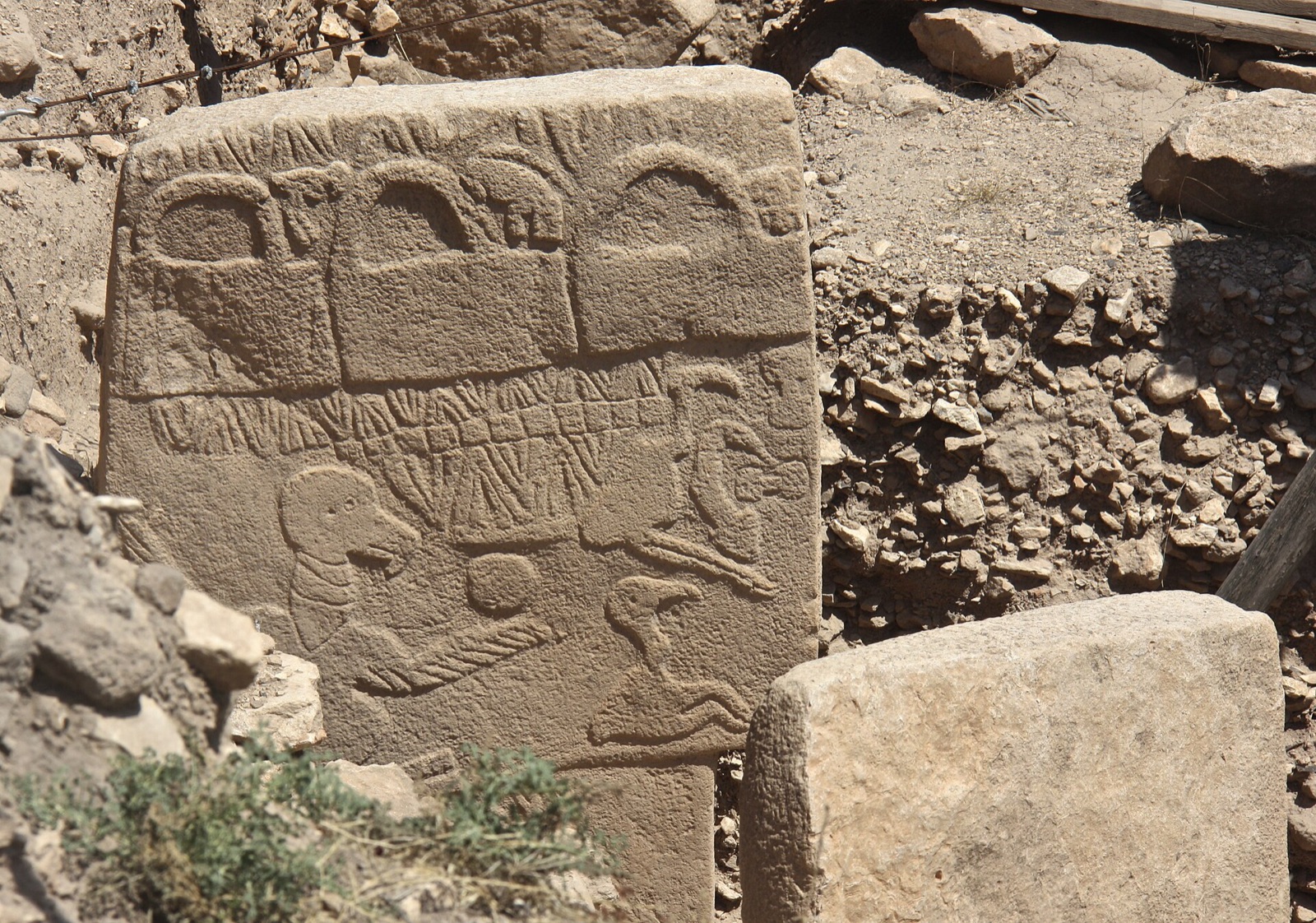
In the photograph: a limestone T-shaped pillar standing in an excavated enclosure, its face carved in low relief — three arched shapes with handle-like tops along the upper edge with small animal figures between them; below, a large bird with spread wings beside a disc, a scorpion, and further animal figures; the pillar's lower part is out of frame. The Commons file titles it the Vulture Stone, Göbekli Tepe, Şanlıurfa, south-east Anatolia, Turkey; the founder's site calls it Pillar 43 of Enclosure D.
The founding page of this case states its working rule: the historical meaning of a resemblance depends on the objects' dates, contexts, differences and possible connections, not on the resemblance aloneC002. This site accepts that as sound reasoning rather than a tested finding. That page — a self-published, AI-assisted essay — also reports five small experiments by its author. Their figures are unaudited, and this site has not seen the data. The rest comes from primary work on particular objects: the Göbekli Tepe excavators, a wear study, a survey of a Rapa Nui statue, a translation of the Babylonian priest Berossus, and one page of Assyrian ritual texts seen through a blog's transcription.
▸ claims behind this paragraph (1)▾ claims behind this paragraph
A common source. The forms descend from one ancestor — at its strongest, a lost civilisation whose emissaries taught the rest. It predicts that specific composites (this pose, this object, this arrangement) recur more than chance allows, the oldest near the source.
Long-distance contact. Particular peoples met and exchanged images or stories. It predicts dated intermediates and a route.
Independent invention. Similar bodies, animals, materials and problems make similar forms. It predicts broad motifs everywhere, and specific composites no commoner than chance.
Later retelling. The likeness is partly made afterwards, by translation, borrowing, comparative writers and picking matches from a vast pool. It predicts modern summaries that resemble each other more than their originals do.
More than one can be true in different cases.
Bird-men
plate X · photograph — duotone applied in display; original unmodified
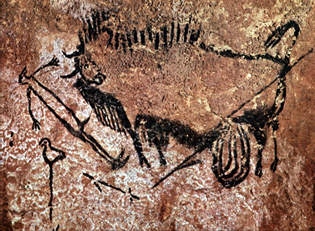
In the photograph, a small file (about 315 px wide): a cave painting in black on ochre rock — a bison with its entrails hanging beneath it, a stick-figure man with a bird-like head leaning backwards, a bird on a post, and a long line beside them. The Commons file titles it Lascaux 01; the founder's site calls it the shaft scene.
plate V · photograph — duotone applied in display; original unmodified
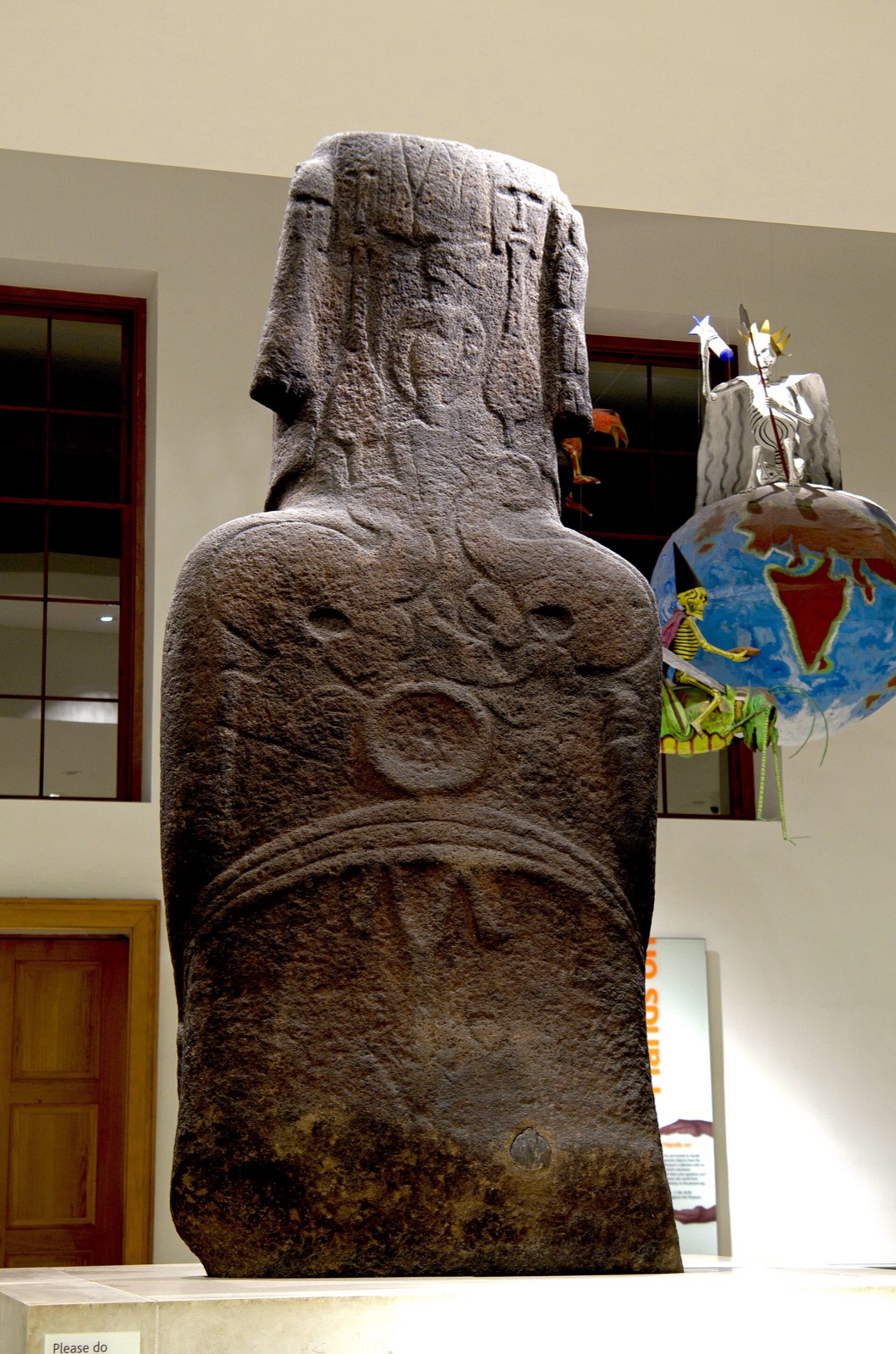
In the photograph: the back of a dark basalt statue in a museum gallery, carved in low relief with two facing bird-headed figures at the top, a disc within ring-and-belt lines at the waist, and paddle-like shapes; a modern painted globe hangs behind. The Commons file titles it the petroglyphs on the back of the Hoa Hakananai'a statue.
The page's catalogue experiment reports that a broad bird-person class appears in 55% of 926 sampled traditionsC005. That is a base rate: how often something occurs in general. A motif found in more than half of all traditions is one you would expect to meet in any two cultures chosen at random. The page adds its own caveats. Coverage is thin for the ancient Near East and Rapa Nui, the very regions compared, and a broad class says nothing about how often a profile head, a bent limb and a rounded object occur together. That composite is what a common source needs, and nobody has counted it.
▸ claims behind this paragraph (1)▾ claims behind this paragraph
plate II · photograph — duotone applied in display; original unmodified
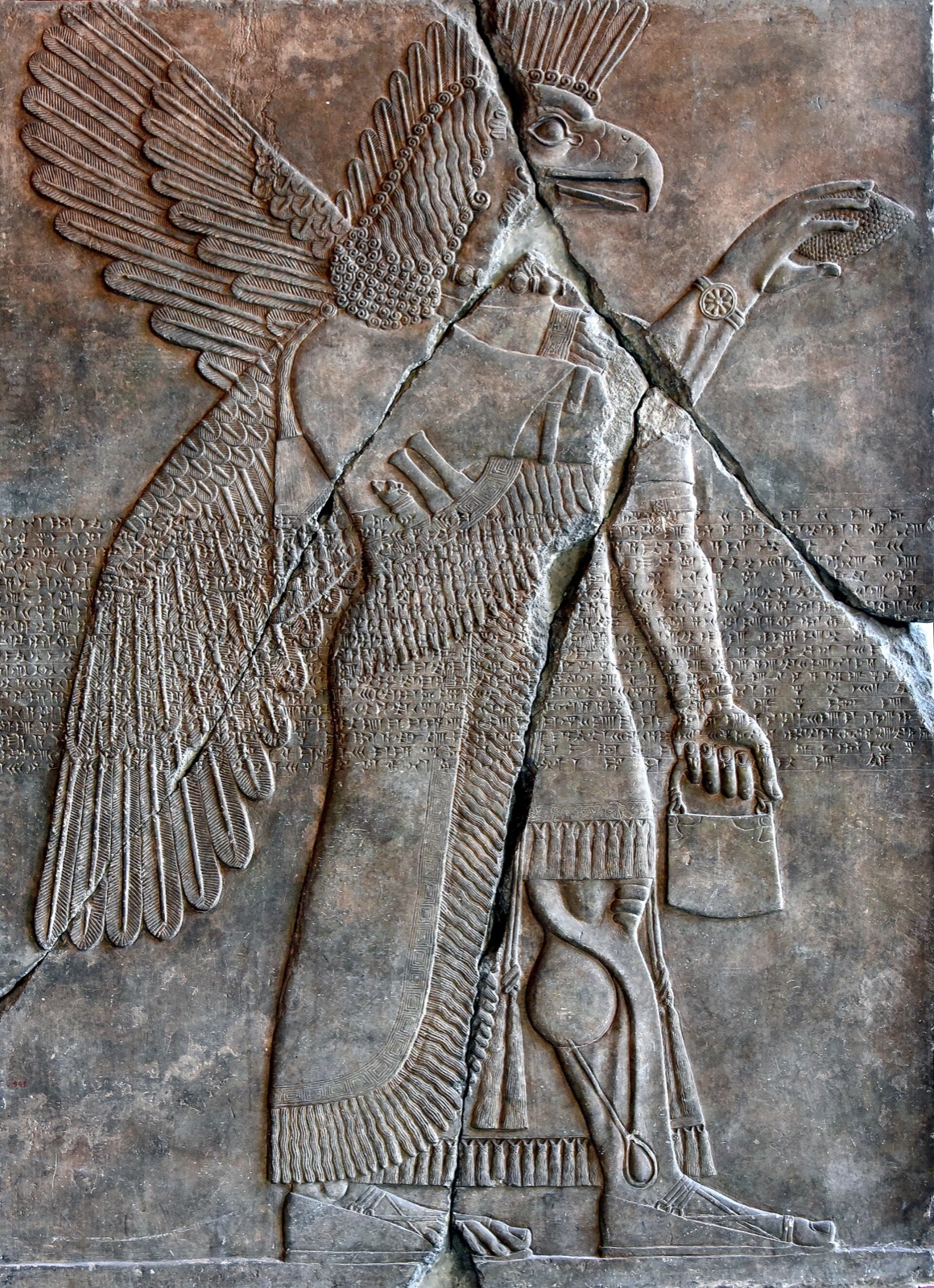
In the photograph: an alabaster relief panel with an eagle-headed, winged figure in profile striding right, a bucket hanging from the lowered hand and a cone raised in the other, lines of cuneiform cut across the middle of the panel and across the figure. The Commons file titles it a wall panel with an eagle-headed and winged apkallu holding a bucket and cone, from Nimrud, Iraq, 9th century BCE, Pergamon Museum.
Osama Shukir Muhammed Amin FRCP(Glasg) · 2019-07-20 16:03:09 · source · CC BY-SA 4.0
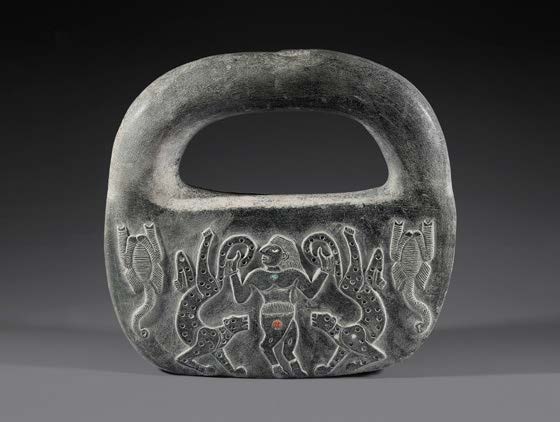
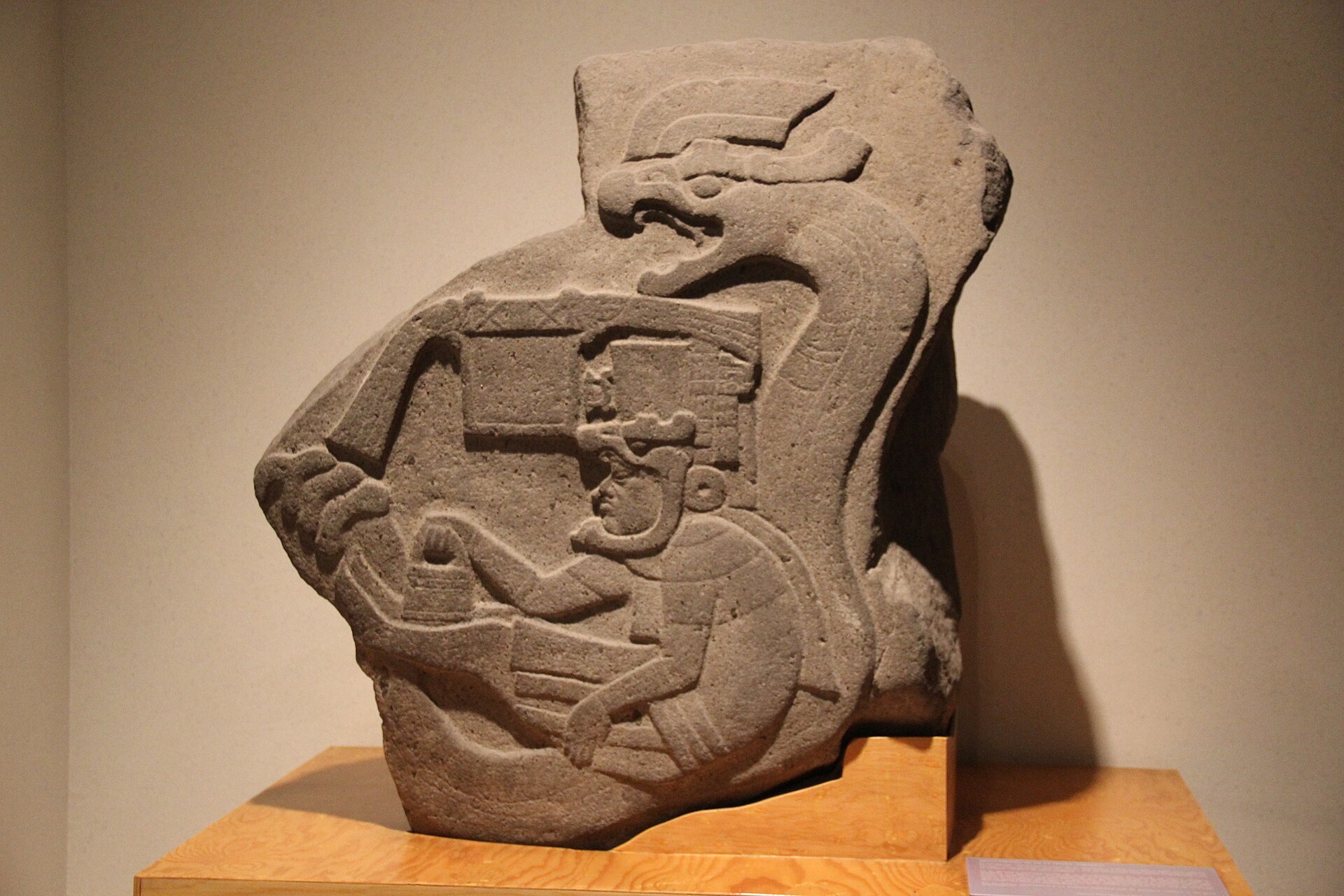
Four objects make this comparison: three arched forms on Pillar 43 at Göbekli Tepe, the bucket carried by Assyrian genii, a chlorite “handbag” from Jiroft in Iran, and a pouch held by a seated figure on an Olmec monument at La Venta. The outlines rhyme. But, as the founding page says, shape and function are separate questionsC065, and the sources show how differently the four stand.
▸ claims behind this paragraph (1)▾ claims behind this paragraph
A blog's transcription of Frans Wiggermann's edition of the Assyrian ritual texts states that the *banduddû* is the bucket held by many figures on the reliefsC043, and that in rituals it was filled with water: the exorcist takes the bucket, fetches water, casts a spell over it and sprinkles the patient. That weakly supports the bucket-and-purifier readingC044. The transcription is unchecked, and the genie's cone is not in it.
▸ claims behind this paragraph (1)▾ claims behind this paragraph
plate IV · photograph — duotone applied in display; original unmodified
In the photograph, a small file (about 560 px wide): a dark stone object shaped like a bag with a heavy arched handle, its face carved with a standing figure gripping a serpent on each side and further animal figures at the edges. The Commons file titles it a chlorite object from Jiroft, Kerman, c. 2500 BCE, Bronze Age I, National Museum of Iran.
The Jiroft object is the only one tested physically. Massimo Vidale and Roberto Micheli describe a chlorite handbag in the Tehran museum with wear clearly visible on its handle, which they read as showing that it hung for a long time on a cordC009. They add the limit themselves: one object, and an inference far from granted.
▸ claims behind this paragraph (1)▾ claims behind this paragraph
plate III · photograph — duotone applied in display; original unmodified
In the photograph: a carved basalt block on a museum plinth — a figure seated in profile wearing a tall headdress and holding out a small handled object, enclosed by a serpent whose crested head rises above. The Commons file titles it Olmec Monument 19, La Venta, 1300–400 BC.
So the row reads: a ritual bucket, one Iranian object that probably hung on a cord, a Mexican pouch known only by caption, and three Anatolian forms their excavators decline to name. A common source predicts that the particular handle — attachment, proportions, decoration, the figures beside it — recurs across these more often than across handled containers from unconnected cultures. No one has run that comparison.
plate VI · photograph — duotone applied in display; original unmodified
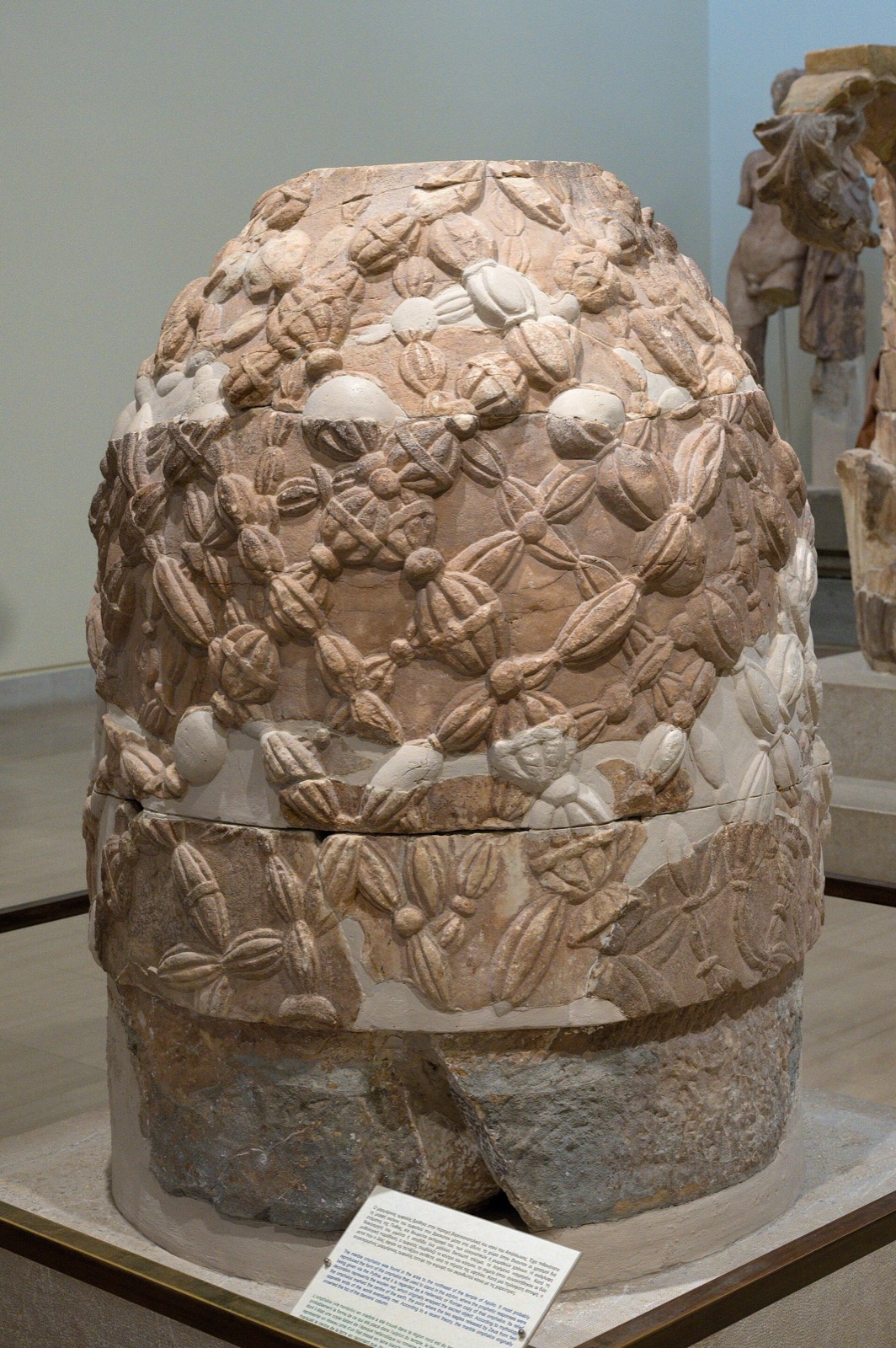
In the photograph: a conical stone covered in a carved net of knotted cords with bosses, standing in joined pieces on a museum floor beside a printed label. The Commons file titles it the omphalos in the Archaeological Museum of Delphi.
Delphi's omphalos is a netted stone, Greek and ancient. Cusco is glossed as a navel in Garcilaso de la Vega's history, written after the conquest. Rapa Nui is Te Pito o te Henua. Göbekli Tepe means “navel hill” in Turkish. The founding page argues that these are different kinds of evidence, differing in language, date of first record and whether the builders used the nameC018. No source history has been retrieved, but the point rests on something plain: four languages across more than two millennia, one of them — Turkish — arriving in Anatolia thousands of years after Göbekli Tepe's builders were gone.
▸ claims behind this paragraph (1)▾ claims behind this paragraph
The sharpest test is that name. The page states that it describes the mound's shapeC015, and that the Kurdish names mean “wish hill”, without giving a source for either. A bodily word for a centre is available in any language. What would change the picture is an early usage by the builders themselves, at two or more sites.
▸ claims behind this paragraph (1)▾ claims behind this paragraph
plate VII · photograph — duotone applied in display; original unmodified
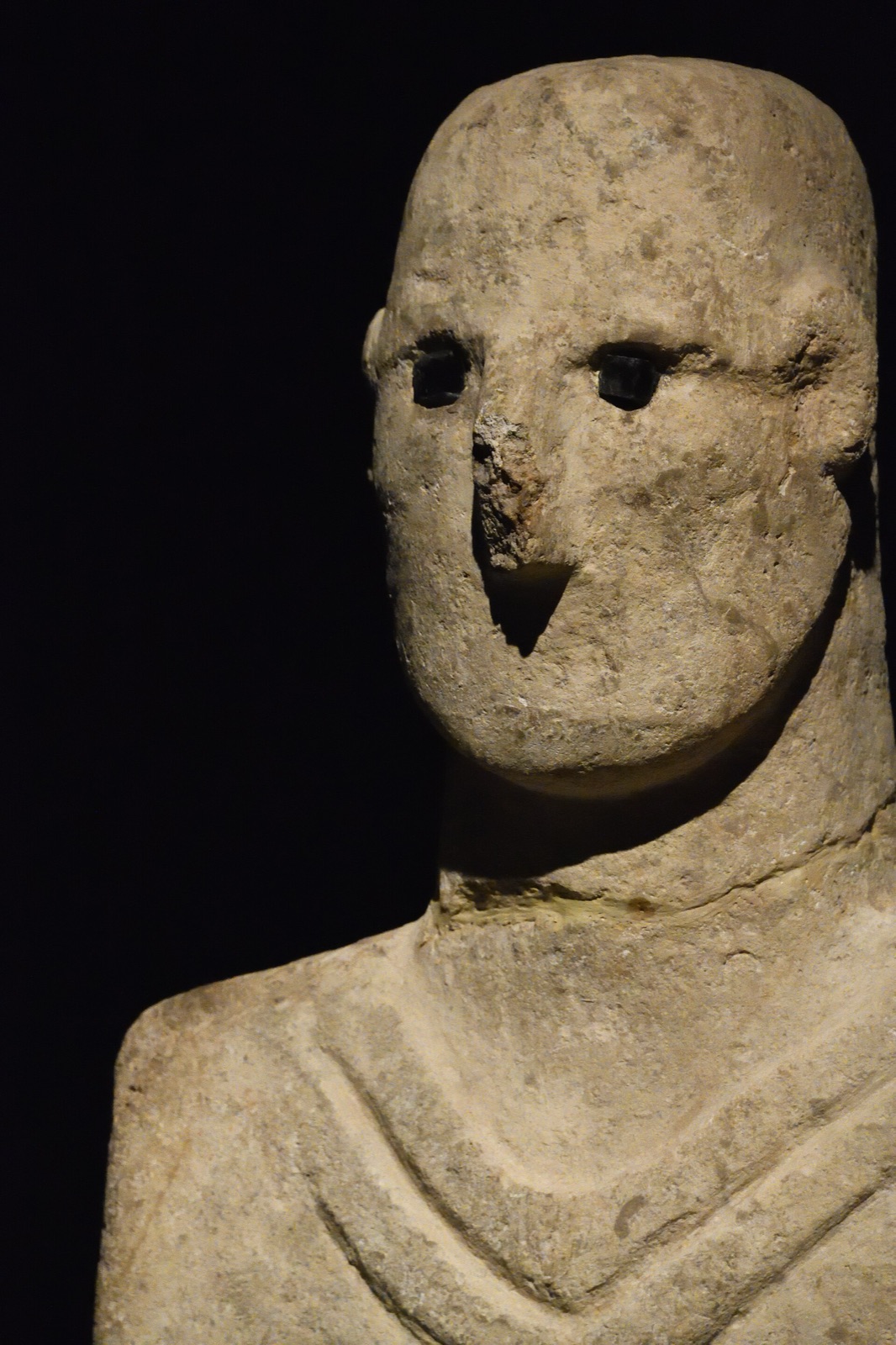
In the photograph: the head and shoulders of a pale limestone statue against a dark background — a smooth ovoid head, deep eye sockets holding dark inlays, a broken nose, no mouth, V-shaped lines carved on the chest (read by the excavation team as a necklace); the arms and hands are out of frame. The Commons file titles it Urfa Man in the Urfa museum, September 2019; the excavation team records the statue's findspot as Urfa-Yeni Mahalle / Yeni Yol, not Göbekli Tepe.
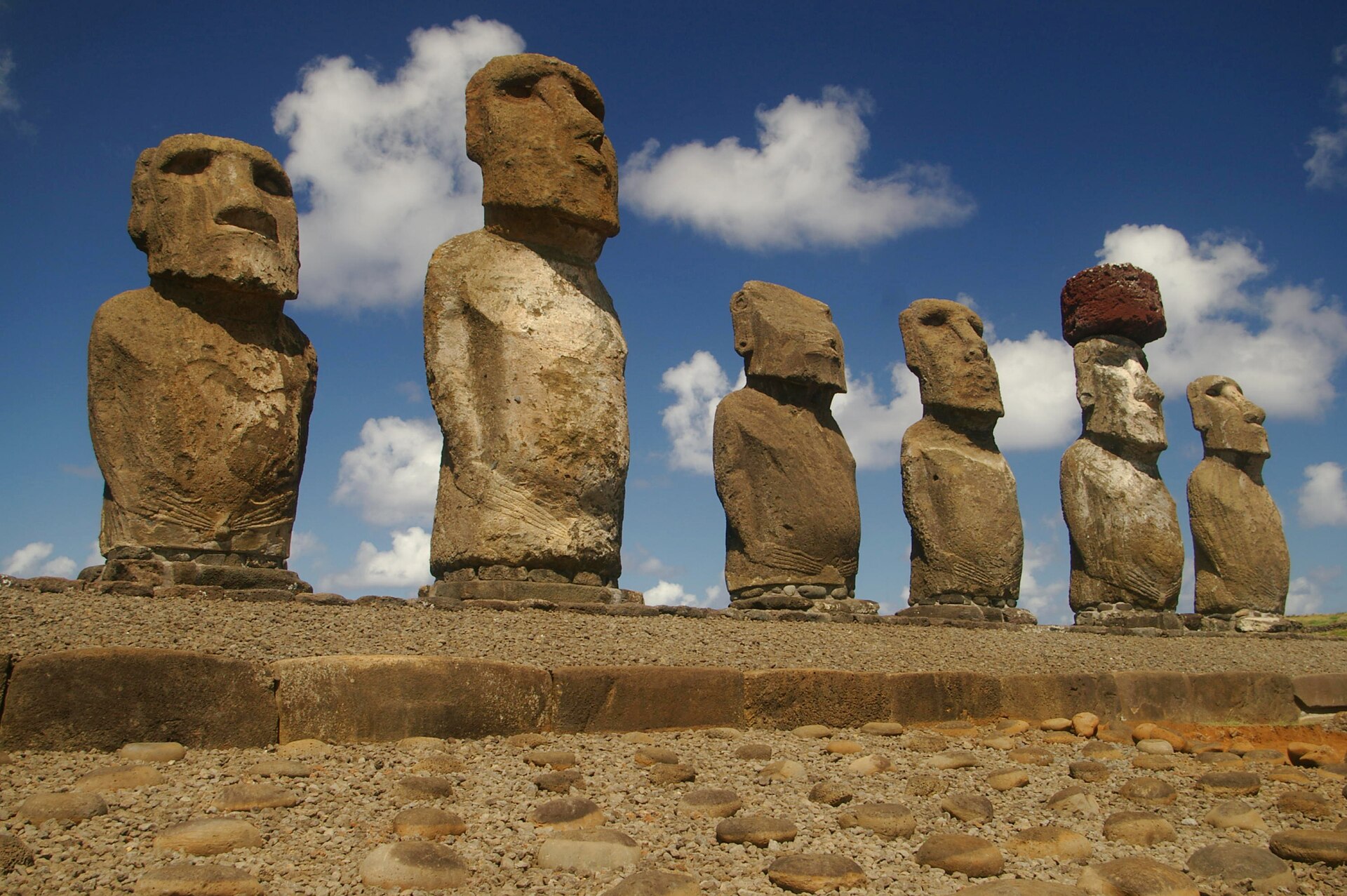
Urfa Man, a limestone statue from Şanlıurfa that the page dates to about 9000 BCE, is described by the Göbekli Tepe team: both hands seem to grab his penisC021. A hand at the groin and a hand across the belly look close in outline but are different gestures. The moai of Ahu Tongariki, some ten thousand years later, rest their hands on the abdomen.
plate VIII · photograph — duotone applied in display; original unmodified
In the photograph: seven stone statues standing on a long platform of fitted stone against a blue sky with clouds, one wearing a red stone topknot, hands carved low on the belly of several figures, a cobbled forecourt in front. The Commons file titles it Ahu Tongariki (cropped); the founder's site places the platform on Rapa Nui.
The plainest case for convergence is on the founding page: carving limbs against a stone body stops them breaking, so material constraints plausibly shape the poseC047. This site accepts that as sound mechanics, untested here. It explains why hands rest on the body, not where. A survey of stone figures from unconnected cultures would decide: if the pose varies with stone and tool, constraint wins; if it clusters along a route, something else is at work.
▸ claims behind this paragraph (1)▾ claims behind this paragraph
plate XII · photograph — duotone applied in display; original unmodified
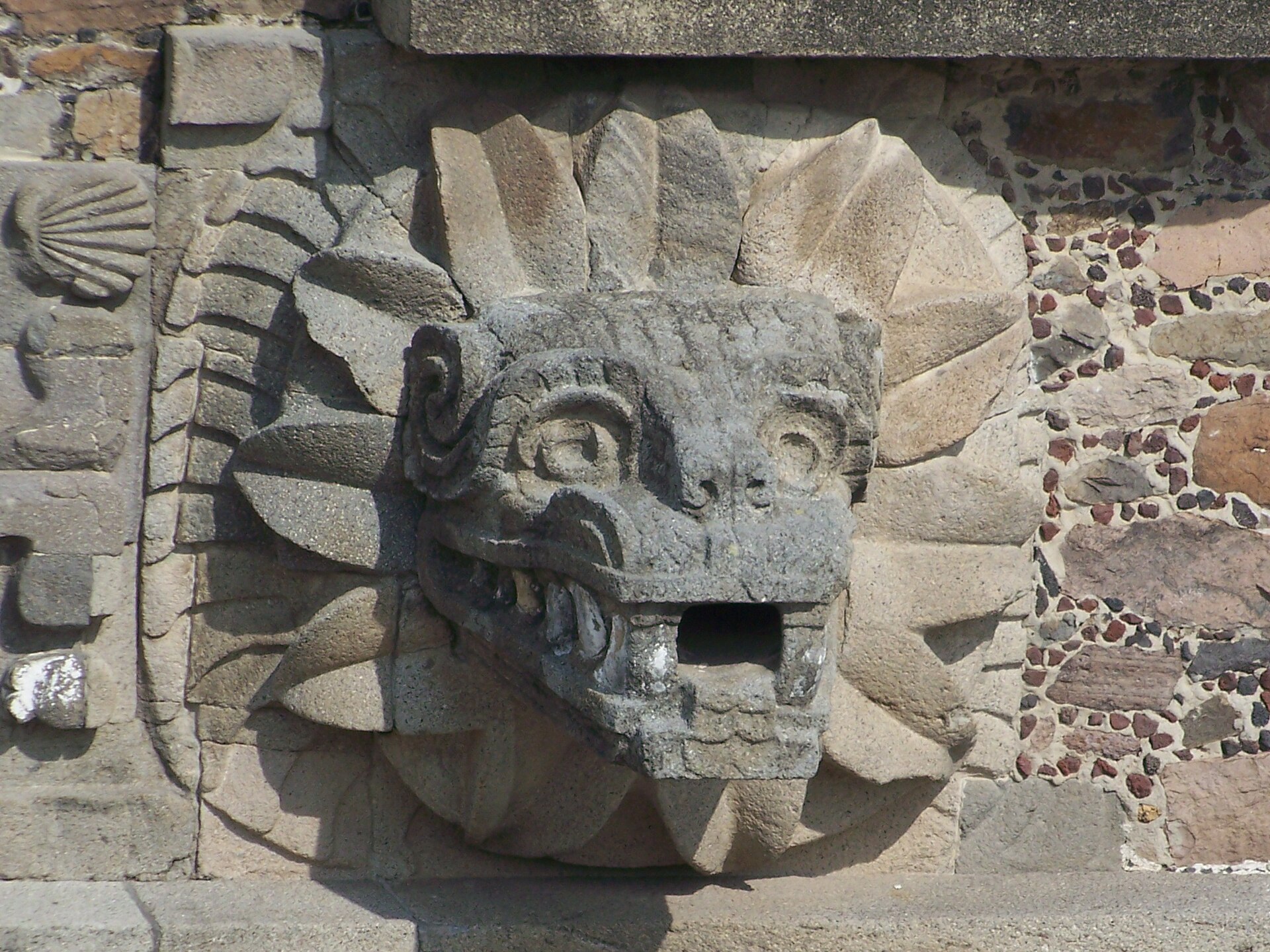
In the photograph: a stone serpent head with open jaws and teeth projecting from a wall, ringed by a collar of carved feathers, with a shell carved on the wall beside it. The Commons file titles it the Teotihuacan Feathered Serpent.
Snakes coil around the Olmec figure, writhe in the Jiroft hero's grip, and project in feathered collars from the temple at Teotihuacan. The page reports a broad cosmic-serpent class in 37% of sampled traditionsC025, another high base rate on the same footing. The Mesoamerican feathered serpent is far more specific than “snake”.
▸ claims behind this paragraph (1)▾ claims behind this paragraph
plate IX · photograph — duotone applied in display; original unmodified
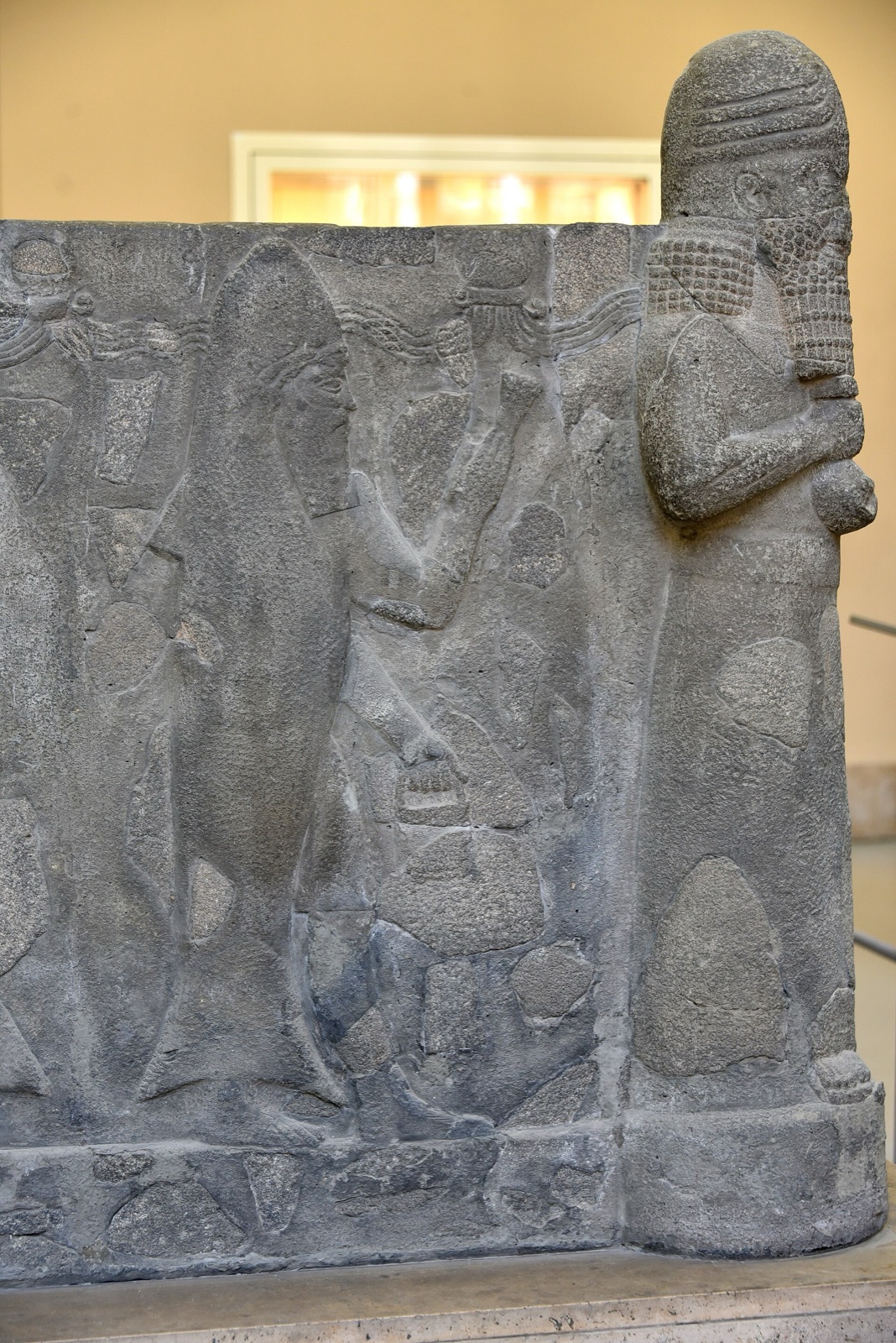
In the photograph: a basalt block carved in relief — a robed figure from whose shoulders wavy streams run, a figure beside him wearing a fish's head and skin as a cloak, and at the corner a bearded figure in the round with a tall headdress. The Commons file titles it the god Ea (Sumerian Enki) with a fish-cloaked apkallu, part of a basalt water basin from Assur, Iraq, reign of Sennacherib, 7th century BCE, Pergamon Museum.
Osama Shukir Muhammed Amin FRCP(Glasg) · 2019-07-20 15:43:01 · source · CC BY-SA 4.0
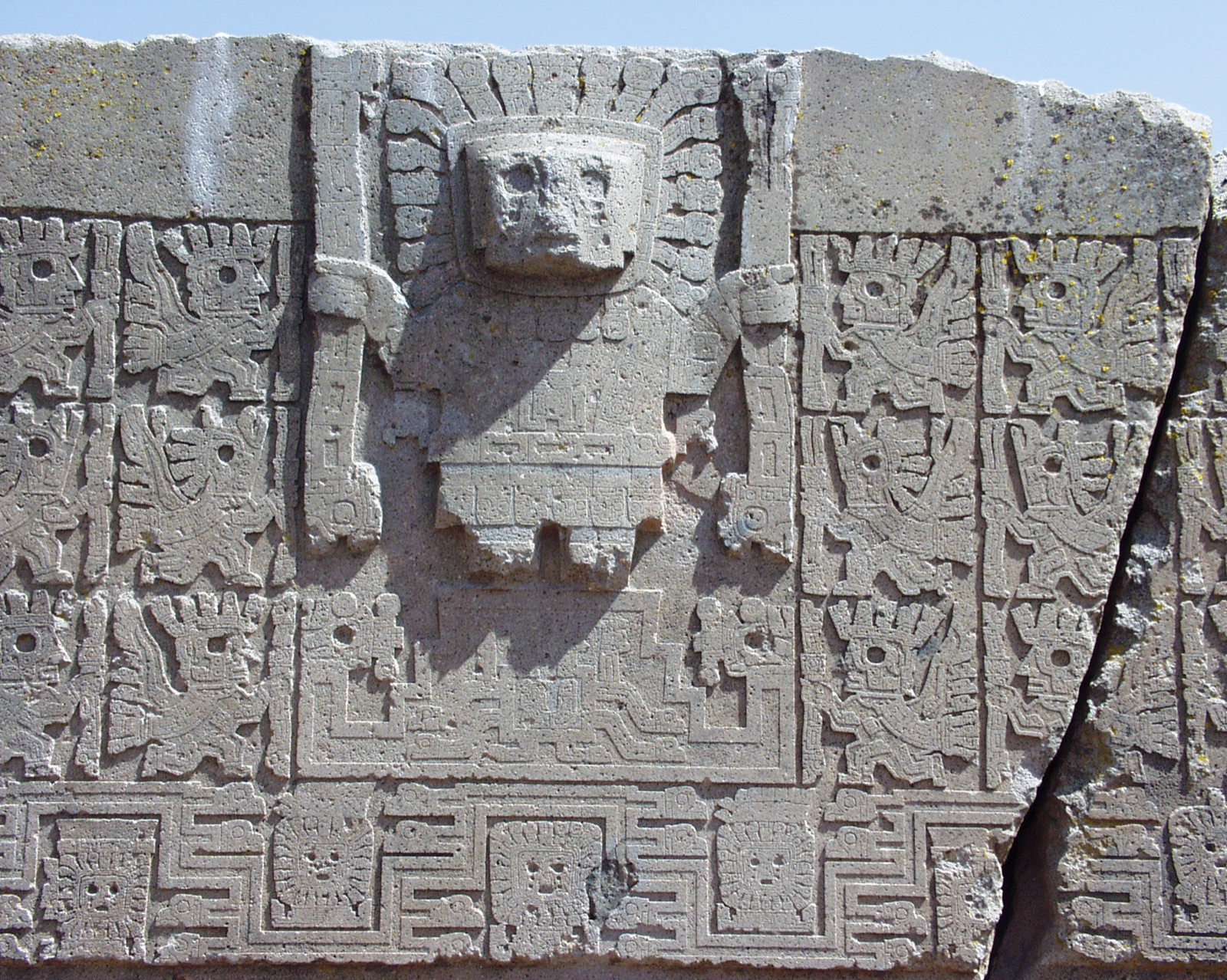
A figure arrives, often from the sea, teaches writing, farming or law, and leaves: Oannes in Babylonia, Viracocha in the Andes, Quetzalcoatl in Mexico, Bochica among the Muisca.
plate XI · photograph — duotone applied in display; original unmodified
In the photograph: a detail of a carved stone lintel — a frontal figure with a rayed headdress holding a staff in each hand, flanked by rows of winged running figures in profile, above a meander border of small faces. The Commons file titles it a detail of the Gate of the Sun, Tiwanaku (Tiahuanaco), Bolivia.
At Tiwanaku, the staff-bearer on the Gate of the Sun is often called Viracocha. The founding page states that the identification is modernC028, which this site has not traced.
▸ claims behind this paragraph (1)▾ claims behind this paragraph
The page's pilot had an AI code 263 flood-story summaries. It reports that details cluster by regionC031 and that details associated with Genesis are unevenly spreadC054. Every account tolerates regional clustering. The Genesis pattern is what retelling after missionary contact predicts, though being recorded after contact does not prove borrowing. Neither result has been checked: one AI coded one compiler's summaries. The data re-coded by people from original texts, with Genesis-like details dated against contact, would move both.
▸ claims behind this paragraph (2)▾ claims behind this paragraph
The verdict is unresolved: the primary sources describe the objects without testing any connection between them. That is not balance. What a shared past needs — a dated intermediate, a route, a specific composite rarer than chance — has not appeared, and two findings raise its price: late birdmen read against a post-contact myth, and excavators who see too many missing links. What evidence there is leans toward common motifs, shared constraints and retelling.
The best unanswered argument for a shared past is regional. Pillar 43's handled forms and the Assyrian bucket lie in one broad region, millennia apart. The excavators rest their caution on missing links, not counter-evidence, and allow that surviving imagery changes meaning; on that view, the objects' different uses are what survival with reinterpretation would produce. And the catalogue's null result tests broad classes, not the specific images, so the strongest evidence against a common source has not been aimed at it.
What would change the picture:
A blind human lineup of original civiliser passages that holds near 62.5% — or falls to chance.
A securely dated Neolithic seal from Upper Mesopotamia carrying a specific Pillar 43 motif — the arched forms, the bird with a disc — long after the site.
Specific composites counted across the compared objects and a matched control set from unconnected cultures.
The four navel names traced to their first record, with the builders' own usage shown or shown absent.
Every later Göbekli team statement on the three forms, in case one commits to containers or buildings.
the argument ladder
evidence for a lower rung does not automatically climb
Mechanism
Could it have been done? Ingredients, chemistry, and method.
The strongest records on each side, structurally symmetric. Every record separates what the source states from what we infer. Browse the full ledger (37 records) →
strongest supporting
▲Supports· strongDEEP-E025
Schmidt 2006 describes three box-like objects with handle-like attachments on Pillar 43
what the source states
In his 2006 short note the excavator describes the upper part of Pillar 43's western side: above the pattern of angles between the vulture and the 'ibis' one sees "three big, similarly carved box-like objects with handle-like attachments", with another line of angles forming the upper limit of the relief.
what we infer
This is the excavation team's own first published description of the forms, and it is the record the earlier declined 'top register' claim required. Note the excavator's words are 'box-like' and 'handle-like'; he does not name a function.
limitations
Preliminary field note, not a final publication.
Describes shape only; says nothing about function.
Schmidt 2006: each of the three objects is accompanied by an animal
what the source states
The same sentence continues that the three "objects with handle-like attachments, each accompanied by an" animal, sit immediately above the pattern of angles.
what we infer
The founder's caption 'three arched objects with small animals' matches the excavator's description on this point.
limitations
The word 'animal' is hyphenated across a line break in the PDF ('ani-mal'); the quote stops before it.
Excavation team: no final decision on the meaning of the three forms is possible
what the source states
After offering its building reading of the three rectangular objects with cupola-like arches, the team's post closes the discussion: "A final decision on the meaning of these images" is not possible at the moment, and it notes that the meaning of these images is hard to guess.
what we infer
This is the excavation team's own published statement that the forms have no secure identification, which is what both ledger claims assert. The post is dated 2016 (updated 2017); a later team publication could supersede it, and the response to Sweatman and Tsikritsis (2017) was not retrievable.
limitations
A blog post by a team member, not a monograph statement.
Dated 2016/2017; later team publications not checked.
steelmanned — the account the featured hypothesis must beat
Broad motif classes are common everywhere — by the page's own unaudited count, a bird-person in over half of sampled traditions and a cosmic serpent in over a third — so meeting them in two cultures is expected. Shared bodies, animals, materials and problems produce convergent forms: a handle is how anyone carries a thing, and arms carved against a stone body are less likely to break. Galleries select resemblances from a huge pool and compare unlike kinds, and matching kinds changes the result. Where dated, the compared pieces are far apart and often late: the Rapa Nui birdmen were added to an older statue and are read against a myth recorded after European contact, and the Göbekli excavators report no established chain to later imagery. Translation and comparative writing make stories converge, so modern summaries of Oannes, Viracocha and Quetzalcoatl may match better than their originals. The navel names come from four languages across millennia.
What would change our mind
The case does not end in a verdict; it ends in the studies that would move it, in the order this edition judges they would move it most. A result in either direction counts.
Blind human lineup test of the civiliser accounts from original passages
Rerun the V1 lineup design with human raters and unrecognisable, source-level passages (Berossus via Polyhistor/Eusebius for Oannes; Sarmiento/Betanzos for Viracocha; Sahagún for Quetzalcoatl; Simón for Bochica), with controls from random hero narratives. Compare the first-rank rate to the 62.5% / 9% figures.
expected information gain
Distinguishes similarity of the original accounts from similarity manufactured by compressed modern retellings — the page's own stated limitation of V1.
Test the excavators' named intermediate: do Göbekli Tepe motifs demonstrably persist into Neolithic stamp seals?
Retrieve Atakuman 2015 (Cambridge Archaeological Journal 25/4, 'From monuments to miniatures') and the seal corpus it publishes. For each Pillar 43 motif class relevant to this case — the H-shaped symbol, the arched box-like forms, the bird-with-disc composition — record whether a securely dated Neolithic stamp seal or image-bearing object from Upper Mesopotamia carries the same motif, with the object's site, stratum and date. Decision rule: if at least one of these specific motifs appears on dated seals continuing for a millennium or more after Göbekli Tepe, the team's 'survival into seals' statement gains a documented instance and the ledger's principle that geography alone cannot separate transmission from invention acquires its first dated intermediate for the local case; if none of the specific motifs appears and the continuity is confined to generic animal figures, the 'missing links' statement stands and the intermediate class is closed for this case. Either way the result bears only on continuity within Anatolia, not on any chain to Assyria or beyond.
expected information gain
Names and checks the only candidate intermediate class the diggers themselves offer; a positive result converts a general caution into a dated local continuity, a negative one removes the one named route for the handled-object and bird-figure parallels.
For omphalos (Delphi), Garcilaso's gloss of Cusco, Te Pito o te Henua / Te Pito Kura and Göbekli Tepe, find the earliest attestation of the 'navel' meaning, the language it is recorded in, and whether the builders' own usage is documented — from primary texts (Pausanias/Pindar for Delphi; Garcilaso de la Vega 1609; early Rapanui lexicons; Turkish/Kurdish toponymic records).
expected information gain
Tests CLM-DEEP-018 directly: if the four names differ in date and origin as the page proposes, the navel parallel drops to a shared bodily metaphor; if any shares an early, builder-used meaning, that is unexpected and worth reporting.
Buildings or objects? Read every team statement on the three forms of Pillar 43
Retrieve Schmidt 2012 (Göbekli Tepe: A Stone Age Sanctuary, p. 244 and the Pillar 43 discussion), Becker et al. 2012 (ZORA 5), and Notroff et al. 2017 ('More than a vulture', the response to Sweatman and Tsikritsis). For each, record verbatim what the authors say the three arched forms are or might be, and whether any commits to a container, a building, or neither. Decision rule: if any team publication later than 2017 commits to a handled object or container, the ledger's 'function uncertain' claims weaken and the founder's 'handbag' comparison regains its Göbekli leg; if every team text either offers the building reading or refuses a decision, the uncertainty claims are confirmed by the full run of the team's literature and the comparison of a known Assyrian bucket with these forms should be presented as a comparison of shapes only.
expected information gain
Settles whether the 'no decision' statement is the team's standing position or a 2016 snapshot, and puts the rival building reading on the record alongside the container reading, each from the excavators' own words.
▸ 1 settled — answered, superseded or retired▾ settled — kept as the record of what was asked
DEEP-R001Publication prize · Desk
answered · 2026-09-19 · set by 2026-09-19-edition-deep-memory-125325
Retrieve the primary literature the page leans on for the handled objects
The Tepe Telegrams discussion of Pillar 43 and the Vidale & Micheli abstract were retrieved and read. DEEP-E028 records the team's statement that no final decision on the meaning of the three forms is possible, deciding DEEP-C012 (well supported); DEEP-E025 records Schmidt's 'box-like objects with handle-like attachments' (DEEP-C067); DEEP-E035 records the authors' reading of the Jiroft wear as long suspension on a cord and DEEP-E038 their single-object caveat, deciding DEEP-C009 (provisionally supported at abstract level). The paper's body, Sweatman & Tsikritsis 2017 and the team's 2017 response remain unread; the full run of team statements is DEEP-R005's target and the Vidale body is a blocked source.
Obtain the Vidale & Micheli wear-trace study (Iranian Journal of Archaeological Studies), the Tepe Telegrams posts on Pillar 43 (Notroff et al. 2016, 2017) and Sweatman & Tsikritsis 2017, and read them against CLM-DEEP-007, -009, -012 and -042. Record what each states about the handled forms' shape, wear and function, so that the page's secondary captions can be replaced by primary observations.
expected information gain
Moves the handled-object claims from a founder's captions to the excavators' and wear analysts' own statements; settles whether the 'hung on a cord' wear reading and 'function unknown' are what the primaries say.
Trust comes partly from showing changed minds. Each entry is an edition that changed a verdict, with the word before and the word after — a reversal included.
Aletheia records every change to a case: what changed, why, and who made it — including the AI's role. The latest:
Research agenda: DEEP-R001 open → answered (The Tepe Telegrams discussion of Pillar 43 and the Vidale & Micheli abstract were retrieved and read. DEEP-E028 records the team's statement…
Intake from report proposals/2026-09-19-report-deep-memory-120902/report.md: 7 source(s), 25 evidence record(s), 9 claim(s), 2 research item(s) verified and added (proposal…
Correction applied from proposals/2026-09-19-draft-deep-memory-121715: IMG-DEEP-P07.depicts — "In the photograph: the head and shoulders of a pale limestone statue against a dark…