UnresolvedWhether a drug was needed, or there was a vision to explain
ContradictedThe Christian half
why this research priority
The decisive tests are cheap and unrun. Eleusinian and early-Christian vessels sit in collections, the methods are routine, and the one physical find can be re-read for the price of a library request.
AI-generated editorial artwork
What is claimed
The Eleusinian Mysteries served a psychedelic kykeon made from lye-processed ergot, and the earliest Greek-speaking Christians inherited that sacrament as a drugged Eucharist.
▸ read the rest▾ less
The author's scholarly form is weaker: he does not defend a psychedelic Last Supper and says the smoking gun remains elusive. This case grades the strong form and treats 'some community spiked its cup' as its weak version.
Where the disagreement lives
The dispute lives in two cells nobody has measured: no Eleusinian vessel and no early-Christian vessel has ever been chemically tested. Around them sit four further points of contention. The one recipe names nothing psychoactive.
▸ read the rest▾ less
The only ergot find, in Iberia, is unreplicated and not yet read at its source. No one has settled whether any ancient text describes a vision during initiation. And the earliest Eucharist texts describe a Jewish table, with no chain shown from mystery cult to church.
What would settle it
Chemical tests of Eleusinian cups for LSA and related compounds above soil background would settle the Greek half; a preregistered survey of early-Christian vessels would test the Christian half.
▸ read the rest▾ less
Three further checks would decide the steps between: reading and re-testing the 2002 Pontós find, an independent blinded repeat of the lye chemistry with a profile of the whole drink, and an audit of the ancient texts for any experience during initiation.
this edition · 30 September 2026
No verdict moved in this edition.
The article was re-told: 2,541 words, from 3,580.
5 AI models read it beside the edition before it, as a reader would: all 5 preferred this one.
an AI-generated assessment · not reviewed by a human
The case splits: its foundations hold, the Greek attribution is weakly supported against an untested sanctuary, and the strong Christian claims are contradicted — so the roll-up is mixed. Ritual drug use is established by independent residue chemistry (TIK-E001, TIK-E002, TIK-E003, TIK-E004), and the Hymn's recipe is what it says (TIK-E006); neither discriminates between accounts.
▸ the full reasoning▾ less
The 48-run hydrolysis experiment (TIK-E008) makes lye-processed ergot feasible for TIK-C005. The preprint (TIK-E038) fixes the narrow window for TIK-C028. The work is unreplicated and the hands are interested. Residual ergometrine (TIK-C029) and the paspali-host point (TIK-C034) have no evidence of their own and are unresolved. The dose step (TIK-C033) is graded only weakly, on the measured yield under TIK-C005 and an unchecked threshold. LSA's human profile (TIK-E012) keeps TIK-C006 mixed. For TIK-C007 the decisive cell is empty, not negative (TIK-E009). The silent recipe (TIK-E015), the audited accounts (TIK-E016) and the methodological critique (TIK-E019) press against it. It is propped only by the Pontós find, one unreplicated analysis read through citation (TIK-E007, on TIK-C004). TIK-C008 is unresolved: no record shows ritual sufficiency or its failure, and the proponents' 'numerous accounts' are uncited (TIK-E040, TIK-E041). On the Christian side the record is contrary, not empty. Justin and the Didache describe a Jewish thanksgiving rite (TIK-E022, TIK-E023, on TIK-C011 and TIK-C013). The one drugged-cup text is fraud polemic (TIK-E021, on TIK-C010). Specialists reject the inheritance thesis (TIK-E017, TIK-E018, TIK-E020, on TIK-C012), and the author declines the strong form (TIK-E024). The record whose removal would most change the verdict is TIK-E008. Without it TIK-C005 reverts to a 26-year-old proposal, TIK-C007 loses its only mechanism, and the Greek half slides toward contradicted. Independence is thin throughout, and the funding tie on the program positioned to test TIK-C007 and TIK-C010 (TIK-E027) includes this project's founder.
the steelman — the strongest argument this judgment does not answer
The Mysteries were secret by law, and every countervailing record here is silence where silence is expected. The Hymn is public myth (TIK-E015) and the accounts are public stone (TIK-E016); neither would record a secret ingredient gathered free from the field. Meanwhile the hypothesis has come out right both times it was checked.
▸ read the rest▾ less
The one goddess-linked sanctuary whose vessel and worshipper were examined reportedly showed ergot in the cup and in a man's teeth (TIK-E007, on TIK-C004). The one test of the mechanism came out positive under conditions Greek technology could supply (TIK-E008, on TIK-C005). Complex psychotropic ritual drinks are chemically real in the Hellenistic world (TIK-E003), and drug-occasioned mystical experience is real (TIK-E013). The skeptical account has never been tested at Eleusis at all (TIK-E009). A hypothesis that predicts correctly whenever it is checked, against a rival never checked, deserves more than 'weakly supported'. This assessment does not answer that argument. It holds that two checks — one unreplicated, one unread at its source — cannot carry the weight, and that the empty cell is empty for both sides.
5 AI models from different vendors each judged the evidence without seeing this judgment or one another. A model concurs when its verdict is within one step of the one above.
▸Gemini 3.8 Flash (Google)Weakly supportedconcursBrian Muraresku's hypothesis in The Immortality Key is structured as a ladder of increasingly speculative claims that cleanly bifurcates into a Greek mystery cult half and an early Christian inheritance half.
Brian Muraresku's hypothesis in The Immortality Key is structured as a ladder of increasingly speculative claims that cleanly bifurcates into a Greek mystery cult half and an early Christian inheritance half. A fair appraisal must acknowledge the strength of the foundation: ritual psychoactive consumption is archaeochemically established in the ancient Mediterranean (TIK-C001, TIK-C002), evidenced by cannabis residues on Judahite altars at Tel Arad, alkaloid-bearing hair at Bronze Age Es Càrritx, and psychotropic compounds in Ptolemaic ceremonial pottery. Crucially, the 2026 bench experiment by Antonopoulos et al. (TIK-E008) provides empirical proof of chemical feasibility, demonstrating that wood-ash lye hydrolysis can convert toxic ergot ergopeptides into psychoactive lysergamides (LSA and iso-LSA) under parameters attainable in antiquity (TIK-C005). Furthermore, microremains of ergot in a vessel and human dental calculus at Mas Castellar de Pontós (TIK-C004) suggest that ergot was present in a cultic space associated with Demeter and Kore.
Despite these genuine feasibility points, the historical and archaeological edifice collapses as it ascends. At Eleusis itself, there is a total analytical void: not a single vessel from the sanctuary has ever undergone organic residue analysis (TIK-E009). The canonical Homeric Hymn describes an ordinary mixture of meal, water, and mint without mentioning additives or complex processing steps (TIK-C003, TIK-E015), and the sanctuary's audited epigraphic accounts record normal agricultural expenditures with no trace of drug compounding (TIK-E016). Pharmacologically, LSA is notorious for causing nausea, sedation, and dysphoria (TIK-E012), casting severe doubt on whether a crude ergot decoction could reliably generate the transformative, positive visions reported by initiates (TIK-C006), while religious studies and anthropology show that non-pharmacological ritual drivers are fully sufficient to produce profound mystical experiences (TIK-C008).
The Christian extension fails entirely. Surviving first- and second-century documentary sources—including the Didache, Paul's first letter to the Corinthians, and Justin Martyr—demonstrate that the Eucharistic liturgy originated within Second-Temple Jewish thanksgiving meal practices rather than pagan mystery cults (TIK-C011, TIK-C013, TIK-E022, TIK-E023). Justin Martyr actively denounced mystery rituals as demonic imitations, refuting direct syncretic continuity. The sole patristic reference to a manipulated cup describes second-century Gnostic stage magic and philters rather than an entheogenic sacrament (TIK-E021). Even Muraresku himself conceded on the record that the Last Supper entheogen hypothesis is unsupportable (TIK-E024). Sensitivity analysis indicates that TIK-E008 is the single evidence record whose removal would most weaken the case: without its chemical validation of alkaline detoxification, the mechanism rung would fall back to unresolved toxicity objections, further lowering the viability of the Eleusinian hypothesis. However, even with TIK-E008 in place, the complete absence of physical or documentary evidence for transmission to Christianity leaves the overarching case weakly supported.
its steelman
The strongest argument for the featured hypothesis that this assessment does not answer is the unexplained presence of ergot microremains within both a ceremonial vessel and human dental calculus at Mas Castellar de Pontós—an Iberian Demeter sanctuary—combined with the untested status of all excavated vessels from Eleusis (TIK-R001), leaving open the empirical possibility that systematic residue analysis of Telesterion chalices could confirm deliberate lysergamide preparation.
run 2026-09-30-check-gemini-110606 · 2026-09-30 · Weakly supported · an AI seat, blind to the judgment · not human reviewed · per-claim verdicts on each claim page
▸GPT-5.6 Sol (OpenAI)ContradicteddisputesThe evidence supports several lower-rung propositions without supporting the featured historical synthesis.
The evidence supports several lower-rung propositions without supporting the featured historical synthesis. Direct chemical measurements show that psychoactive plants were used in ancient ritual contexts, while the Bes vessel and the reported Dioscoridean recipes make deliberately compounded botanical drinks historically plausible. Most importantly for the Greek half, TIK-E008 demonstrates that a narrowly specified wood-ash-lye process can convert Claviceps purpurea ergopeptides into LSA and iso-LSA. This answers a feasibility objection: ergot need not invariably imply untreated ergot poisoning. It does not show that Eleusinian personnel knew or used the process, and the successful result required the experiment's strongest lye, low ergot loading, and long reflux.
The best affirmative archaeological link is the reported Mas Castellar de Pontós find: ergot in a ceremonial vessel and dental calculus at an Iberian sanctuary associated with Demeter and Kore. That observation is important but presently travels through an unreplicated, secondhand citation to an unobtained 2002 primary report. It is also an analogy from Iberia, not a measurement at Eleusis. Against deliberate ergot use at Eleusis stand the canonical recipe's barley meal, water, and mint, the lack of any attested alkaline-processing step, and the reported silence of unusually detailed sanctuary accounts. Those are not decisive exclusions because secret, gathered, or ordinarily accounted ingredients could escape them. No Eleusinian vessel has been systematically analyzed, so TIK-C007 remains weakly supported rather than refuted.
The pharmacological bridge is weaker still. Producing roughly an active literature dose of LSA does not establish that the complete extract would reliably cause a profound, positive experience. The reviewed human literature instead describes variable psychoactivity with substantial nausea, autonomic effects, anxiety, and occasional severe outcomes. Nor does any supplied evidence establish the stronger causal claim that the experiences attributed to initiation required a drug rather than ritual, expectation, fasting, secrecy, and collective emotion.
The Christian extension fails more clearly. The Didache presents Jewish-form thanksgiving over cup and bread, and Justin describes bread and wine mixed with water while construing mystery-cult parallels as imitation rather than ancestry. Irenaeus's Marcosian account describes a color trick and separate accusations about love potions, not a psychedelic Eucharist. No evidence record supplies a material, textual, or institutional transmission chain from Eleusis or another mystery cult to the earliest Christian meals. Thus the verdict does not mean that no isolated Christian ever consumed a psychoactive substance; TIK-C010 remains unresolved. It means that the featured conjunction—psychedelic Eleusis inherited as the original Eucharist—is contradicted because its original-Eucharist, transmission, and pagan-origin components conflict with the earliest documentary evidence.
The single removal that would most alter this assessment is TIK-E023, the earliest and clearest record of a Jewish-form Eucharistic thanksgiving. Removing it would weaken the documentary case against the Christian extension, but the case verdict survives because TIK-E022, TIK-E024, the absence of a transmission chain, and the unresolved Christian material record still fail to support—and substantially undermine—the featured strong form.
its steelman
The decisive pro-hypothesis prediction remains untested: preregistered lysergamide analysis of securely contexted Eleusinian mixing and drinking vessels, followed by comparable analysis of the earliest securely attributed Christian liturgical cups, will reveal a non-background psychoactive residue pattern linking the two practices. No systematic residue survey of either material corpus is in the evidence, while the reported Mas Castellar vessel and dental-calculus finds provide a concrete cultic precedent for exactly the kind of otherwise secret practice that public recipes and normative liturgies could omit.
run 2026-09-30-check-gpt-110606 · 2026-09-30 · Contradicted · an AI seat, blind to the judgment · not human reviewed · per-claim verdicts on each claim page
▸Grok 4.5 (xAI)MixedconcursThe case is a deliberate ladder whose rungs must be assessed separately rather than allowed to borrow strength upward.
The case is a deliberate ladder whose rungs must be assessed separately rather than allowed to borrow strength upward. At the observation base, deliberate ritual use of psychoactive plants in the ancient Mediterranean and Near East is well documented by direct chemistry: cannabis residues on Iron Age Judahite altars, multiple alkaloids in Bronze Age Menorcan hair, and a complex fermented psychotropic preparation in a Ptolemaic Bes vessel. Greco-Roman compounding of wine with visionary botanicals is at least provisionally attested via Dioscorides summaries and the same Bes residue work. These findings retire blanket cultural impossibility and supply a non-zero prior, but they remain distant in substance, route, cult, and century from either Eleusis or the Eucharist.
The mechanism rung is stronger than it was before 2026. Wood-ash lye, a technology available in antiquity, converts the toxic ergopeptides of Claviceps purpurea into LSA and iso-LSA under narrowly specified conditions (5 percent w/v, initial pH 12.5, at least 120 minutes reflux), yielding roughly a milligram of the lysergamides per gram of ergot. About one gram therefore meets literature minimum effective doses of LSA. Residual ergometrine persists even after peptide clearance, and Claviceps paspali hosts arrived in Europe only in the nineteenth century, so any historical reconstruction must stay with C. purpurea and accept an incomplete detoxification profile. Human LSA data (largely morning-glory exposures) show psychoactivity accompanied by prominent nausea, autonomic effects, anxiety, and occasional severe events; the claim that an achievable dose would reliably deliver the profound, largely positive visionary experience reported for Eleusis therefore remains only weakly supported. The further claim that ritual factors alone (fasting, procession, secrecy, drama, collective emotion) were causally insufficient is presently untestable from the supplied records; modern psilocybin trials demonstrate that pharmacology can occasion mystical-type experience, yet supply no historical necessity proof.
Attribution at Eleusis rests on a single unreplicated 2002 report of ergot sclerotia in a ceremonial vessel and dental calculus at Mas Castellar de Pontós, an Iberian sanctuary linked to the Eleusinian goddesses, plus the newly demonstrated chemical feasibility. No vessel from Eleusis itself has ever been analyzed; the Homeric Hymn names only barley meal, water, and mint; and the sanctuary’s audited grain accounts record no drug expenditure. The Iberian find is therefore analogy, not identity, and the affirmative claim that the kykeon contained deliberately prepared ergot is only weakly supported. The empty cell is real and administrative rather than scientific, but an untested absence cannot be converted into positive evidence.
The Christian half collapses under the earliest documents. The Didache’s berakah-style thanksgivings over cup and bread, Justin Martyr’s description of ordinary bread and wine mixed with water framed polemically against Mithraic imitation, and the absence of any non-polemical pharmacological Eucharist leave the strong-form claim that the original Eucharist was a psychedelic potion contradicted. Irenaeus’s account of Marcus is hostile heresiology describing stage magic and love-philters, not independent attestation of a sacrament. Specialist testimony (McGovern, Bremmer, Ehrman, Brown) and the author’s own on-record concessions further undermine both “some communities” and the full pagan-continuity transmission thesis. The Eucharist’s form and content read as Second-Temple Jewish meal practice; the claim that it developed out of pagan mystery-cult ritual rather than that matrix is contradicted.
Structurally, therefore, the lower observational and mechanistic rungs are mixed-to-positive while the two attribution rungs and the transmission framework are weak-to-negative. The featured hypothesis as a single continuous ladder fails; its halves must be allowed to stand or fall apart. The decisive missing measurements remain organic residue analysis at Eleusis and on early Christian liturgical vessels. Until those exist, the grand synthesis cannot rise above mixed.
its steelman
The still-unperformed organic-residue analysis of securely contexted vessels from the Eleusis sanctuary itself, which the 2026 paper acknowledges has never been permitted; a positive ergoline result there would instantly convert the Iberian analogy and the now-demonstrated lye chemistry into the strongest direct case yet made for a psychedelic kykeon, leaving the phenomenological intensity of the Mysteries and any later literary echoes newly potent.
run 2026-09-30-check-grok-110606 · 2026-09-30 · Mixed · an AI seat, blind to the judgment · not human reviewed · per-claim verdicts on each claim page
▸GLM 5.3 Flash (Z.ai, via Venice)MixedconcursThe case is a ladder, and the verdict splits cleanly along the case's own intended fracture line.
The case is a ladder, and the verdict splits cleanly along the case's own intended fracture line. The observation rung is genuinely solid: four independent archaeochemical studies (Tel Arad, Es Càrritx, the Bes vessel, Pinwheel Cave) establish that psychoactive plants were deliberately used in ancient ritual, and first-century pharmacology plausibly included visionary wine preparations. The mechanism rung is the strongest post-book development: the 2026 lye-hydrolysis experiment demonstrates, with published methods and quantified yields, that wood-ash lye can convert toxic ergopeptides into LSA and iso-LSA at doses near the literature minimum effective dose from roughly a gram of ergot — retiring the "ergot necessarily means ergotism" objection at the level of possibility, though only under narrow conditions and from an interested network with no independent replication. Above that, the ladder fails. The Eleusinian attribution (TIK-C007) rests on one unreplicated, secondhand-cited find a thousand kilometers away, against a canonical recipe naming nothing psychoactive and an unusually well-audited sanctuary economy recording no drug expenditure; the pharmacological payoff (TIK-C006) is not established, since the LSA literature stops at "psychoactive, can hallucinate" and does not reach "reliably profound and positive." The Christian half fails outright: the earliest documentary witnesses (Didache, Justin) show a Jewish berakah-form rite over bread and wine-with-water, the only "drugged cup" text is hostile heresiology about a conjuring trick, the proponent himself declines to defend the Last Supper claim, and the transmission thesis is rejected by specialists including reviewers from the thesis's own constituency. Sensitivity: TIK-E008 (the 2026 experiment) is the single record whose removal would most change this verdict — without it, C005, C028 and C033 collapse toward unresolved and the Greek mechanism rung loses its only hard result. The mixed verdict survives that removal, because the background rung, the documentary record against the Christian half, and the proponent's own concessions do not depend on it. TIK-E007 (Mas Castellar) is the second-most consequential record; removing it would drop C004 to unresolved but again not flip the case verdict.
its steelman
Every rung of this hypothesis that has ever been subjected to a direct test has returned a pro-hypothesis result: ancient ritual psychoactive use is now chemically proven in three independent Mediterranean contexts; the twenty-six-year-old detoxification prediction was run in 2026 and worked; and the one place in the archaeological record where ergot, evidence of ingestion, and a sanctuary of the two Eleusinian goddesses coincide is Mas Castellar de Pontós. Meanwhile the single cell that could falsify or confirm the Greek headline — organic residue analysis of curated vessels from Eleusis itself — has never been performed and, per the 2026 paper, has never been permitted. A proponent can rightly say the evidential trajectory is monotonically positive wherever measurement has been possible, and that the decisive test is blocked by administration, not by science; my assessment treats the Eleusinian absence as untested and therefore leaves that possibility genuinely open.
run 2026-09-30-check-glm-110606 · 2026-09-30 · Mixed · an AI seat, blind to the judgment · not human reviewed · per-claim verdicts on each claim page
▸Opus 5.5 (Anthropic)ContradicteddisputesThe featured hypothesis has two parts.
The featured hypothesis has two parts. The Eleusinian kykeon was a deliberately prepared ergot psychedelic, and the earliest Christians inherited that sacrament as the original Eucharist. The ladder lets the two halves be weighed separately, and they come out very differently.
The lower rungs are sound and largely independent of the proponent network. Residue and tissue chemistry at Tel Arad, Es Càrritx and in the Bes vessel (E001–E003) well supports deliberate ritual use of psychoactive plants. Drug-compounded wines in Greco-Roman pharmacology are well supported, partly on background knowledge of Dioscorides pending R006. The Hymn's kykeon is, as text, meal, water and mint (E006). The one strong post-book result is the 2026 lye experiment (E008, E038), which shows that ergopeptides can be hydrolyzed to LSA and iso-LSA. Its fine print makes the historical reconstruction more demanding, not less: complete detoxification came only at the harshest condition tested (C028), ergometrine persisted (C029), and the yield clears the cited threshold dose by a thin margin (C033). Nothing shows that such a drink would reliably produce a profound, positive experience (C006, E012), or that a drug was needed at all. C008's only support is one unlocated assertion (E040). The Greek headline, C007, therefore rests on possibility, a weak motive, and one secondhand, unreplicated ergot find in a Demeter/Kore-linked sanctuary in Catalonia (C004, E007). Against it stand a recipe that names nothing psychoactive (E015) and sanctuary accounts that show no drug expenditure (E016). That second point rests on Clinton's testimony, not yet checked against the stones. C007 is weakly supported: untested rather than refuted, because no Eleusinian vessel has ever been analyzed (E009).
The Christian half fails on positive documentary evidence rather than silence. The earliest liturgies describe bread and a cup in Jewish thanksgiving form (E023). Justin describes bread with watered wine and frames mystery parallels as imitation (E022). The one "drugged cup" text is heresiology about a conjuring trick and love-philters (E021). The proponent himself declines to defend the Last Supper claim and concedes the transmission gap (E024). C011 and C013 are contradicted. C012 is the hinge of the "religion with no name." Every one of its dependencies is weak, unresolved or contradicted, and no channel of transmission is documented, so it is contradicted as well. Only the weak existential form, C010, stays open, because no early-Christian vessel has had any chemistry (R005).
Steelman for: the chemistry now permits the Greek half, and the Pontós find has never been shown to be contamination. The decisive Eleusinian test has been blocked rather than failed. Normative church orders would not record a marginal or secret practice.
Steelman against: even a positive Eleusinian residue would leave the Christian half untouched. The pro-side strand is one interest network: Road to Eleusis, "Mixing the Kykeon", the 2026 experiment and preprint, and YAPP (E010, E011, E008, E038, E040, E027). Its internal agreement is therefore not corroboration. And no one in this ledger has read the one physical datum at the primary level. I treat the expert quotations (E016–E018, E020) as testimony, not proof. The verdict rests on primary texts, measurements and the dependency structure.
Verdict: contradicted for the two-part thesis as featured, carried by the Christian half. The Eleusinian half, standing alone, is weakly supported and decidable by R001.
Sensitivity: the record whose removal would most change this verdict is E023, the Didache, the earliest and most diagnostic liturgical witness. Without it, C013 and C011 would rest on Justin, writing a century after the events, plus the proponent's concession, and would lose confidence. The case verdict survives, because C012 would still have no positive evidence and failing dependencies. It does not hang on one thread.
No record in this packet is marked provisional. C029, C033 and C034 have no linked evidence record and are graded on disclosed alternative bases.
its steelman
The Mas Castellar de Pontós find is the observation this assessment discounts but does not explain. Ergot fragments were reported inside a ceremonial vase and in the dental calculus of a 25-year-old man, within a sanctuary attributed to Demeter and Kore (E007). That puts substance, ingestion and the Eleusinian goddesses' cult in one context, which is exactly the physical signature the hypothesis predicts. Nobody has shown it to be ordinary grain contamination. The site-wide comparison against cereal from mills and storage pits (R010) has never been made. The samples have never been re-analyzed (R004). The matching test on Eleusinian vessels has never been permitted (E009). A proponent can rightly say that the premise the whole continuity thesis needs, ritual ergot in the cult of the two goddesses, stands against an untested absence at Eleusis, not a negative result. Nothing in this ledger rules it out.
run 2026-09-30-check-opus-110606 · 2026-09-30 · Contradicted · an AI seat, blind to the judgment · not human reviewed · per-claim verdicts on each claim page
Claim by claim, against this judgment: 5 of 17 exact, 9 within one step, 3 split. Split — where review should start: TIK-C029 · TIK-C033 · TIK-C034.
contested2 of 5 models place the case verdict more than one step away. The disagreement is shown here, not resolved by hiding it.
5 accounts, side by side · the edition of 2026-09-30
1The drugged kykeon: ergot on the sanctuary's barley, processed in wood-ash lye, supplied psychoactive lysergamides and the initiates' visions were pharmacological
2The ritual machine: fasting, procession, secrecy, darkness and light, ritual drama and collective emotion generated the experience without any drug, and the kykeon was barley, water and pennyroyal
3A phenomenon that may not need explaining: the ‘life-changing vision’ is a modern reading of a few ancient lines about afterlife hopes, and no ancient text attests a transformative experience during initiation
4The inherited sacrament: Dionysian wine carried the pharmacology and the earliest Greek-speaking Christians drank a drugged Eucharist, whether as the original rite or in some communities only
5The Jewish table: the Eucharist descends from Second-Temple meal blessings over bread and cup, exactly as the Didache and Justin present it, with no drug and no mystery-cult lineage
the article · a marked sentence opens the exact claim behind it
about 11 minutes
Did the Eleusinian Mysteries — the Greek initiation that Pindar and Cicero link with knowledge of death and what comes after — run on a drug, and did the first Christians inherit it as their Eucharist? Brian Muraresku's 2020 bestseller The Immortality Key says yes to both. The kykeon, the barley drink of the rites, was laced with ergot, a grain fungus whose alkaloids are chemical cousins of LSD; a version of that sacrament then passed into the Christian cup. The evidence divides the thesis. That ancient peoples used mind-altering plants in ritual is now chemical fact, and a 2026 experiment showed ergot can be made drinkable with ancient technology. But no vessel from Eleusis has ever been chemically tested, and the earliest Christian documents describe bread and wine at a Jewish thanksgiving table. The Greek half is open and cheap to test; the strong Christian half is contradicted by the record.
The thesis sounds like one claim. It is a ladder of them, and every step has to pay its own way: what holds at the bottom proves nothing about the top.
Five accounts of one cup
The drugged kykeon. Ergot on the sanctuary's barley, cooked in wood-ash lye, supplied compounds related to LSD, and the initiates' visions were pharmacological. It predicts ergot-derived alkaloids in Eleusinian cups, and a drink that reliably gives a profound, mostly positive experience at a dose one person could be served.
The ritual machine. Fasting, procession, secrecy, darkness and light, ritual drama and mass emotion were enough, and the kykeon was what its recipe says. It predicts cereal and mint in the cups and nothing more.
A phenomenon that may not need explaining. The “life-changing vision” both sides argue over may be a modern reading of a few ancient lines about afterlife hopes. If no ancient text describes a transforming experience during initiation, there is nothing for a drug or a ritual to explain.
The inherited sacrament. Dionysian wine carried the pharmacology, and the earliest Greek-speaking Christians drank a drugged Eucharist — in the strong form as the original rite, in the weak form in some community somewhere; this article treats the two as strengths of one account. It predicts psychoactive residues in early-Christian vessels and a traceable chain from mystery cult to church.
The Jewish table. The Eucharist descends from Jewish meal blessings over bread and cup, as the earliest texts present it. It predicts what those texts describe: bread, wine mixed with water, thanksgiving, and hostility to pagan mysteries.
What would decide between them is, almost everywhere, a measurement nobody has made.
What the chemistry has settled
Residue chemistry has moved ancient drug use from iconography to measurement. On the altars of an eighth-century BCE Judahite shrine at Tel Arad, cannabis was burned with animal dung. In human hair from a Bronze Age burial cave on Menorca: ephedrine, atropine and scopolamine, measured in the tissue itself. In a Ptolemaic Egyptian mug shaped like the god Bes, a fermented multi-plant brew including harmal and blue lotus — though the mug was bought from a Cairo dealer, so its chemistry is stronger than its provenance. At a California rock-art site, chewed wads of hallucinogenic Datura were tucked into ceiling cracks. People in the ancient world really did take mind-altering substances in religious settingsC001: independent teams, independent materials, direct chemistry.
▸ claims behind this paragraph (1)▾ claims behind this paragraph
plate I · photograph — duotone applied in display; original unmodified
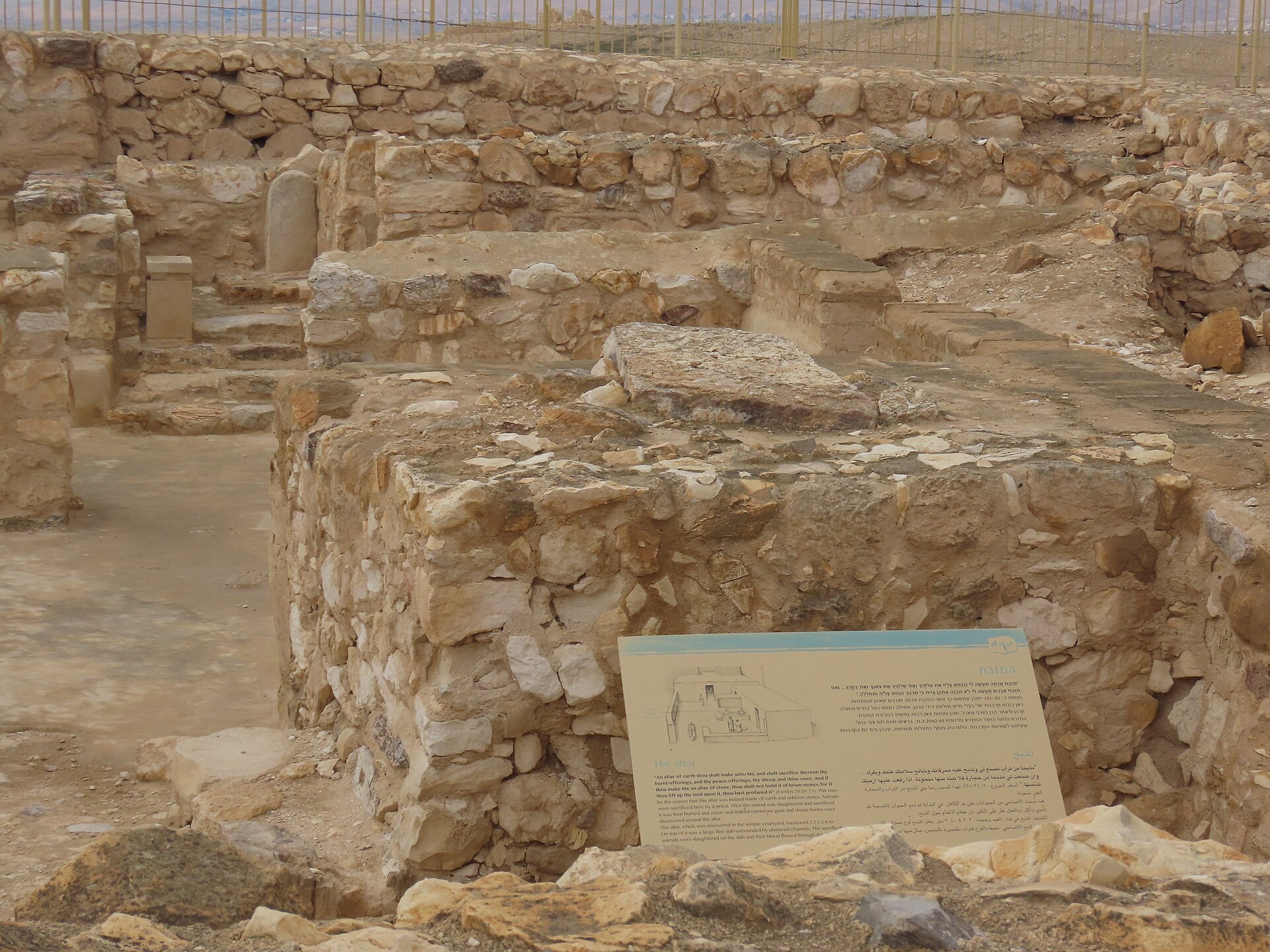
The temple complex in the upper fortress at Tel Arad, Israel — the eighth-century BCE Judahite shrine whose two limestone altars carried the residues analyzed in 2020: cannabis with animal dung on the smaller, frankincense with animal fat on the larger (TIK-E001). The photograph shows the excavated shrine as displayed at the site; the analyzed altars themselves are curated in the Israel Museum, Jerusalem. The site is in the Negev, not Greece; nothing in the photograph depicts Eleusis or the Eucharist.
Dioscorides, the first-century pharmacologist, describes — as Muraresku summarizes him; the passages themselves have not yet been checked here — wines compounded with psychoactive plantsC002 such as henbane and mandrake, one credited with “not unpleasant visions.” These were medical recipes; nothing in them makes a drug-wine a sacrament.
▸ claims behind this paragraph (1)▾ claims behind this paragraph
So the bottom of the ladder holds. But a cannabis altar in Iron Age Judah is no evidence that ergot was in the cup at Eleusis, and less than none that a Christian in Corinth drank it.
The drink with a published recipe
Antiquity left one recipe for the kykeon. In the Homeric Hymn to Demeter, the founding myth of the Mysteries, the grieving goddess refuses red wine and asks instead for barley meal and water mixed with soft mintC003. That is the whole list. No ancient source names ergot or describes any processing beyond mixing. The Hymn is a myth, not a liturgical manual, and the rites were secret by law, so its silence is not proof. But everything psychoactive in the modern hypothesis is an addition to this text, not a reading of it.
▸ claims behind this paragraph (1)▾ claims behind this paragraph
plate II · photograph — duotone applied in display; original unmodified
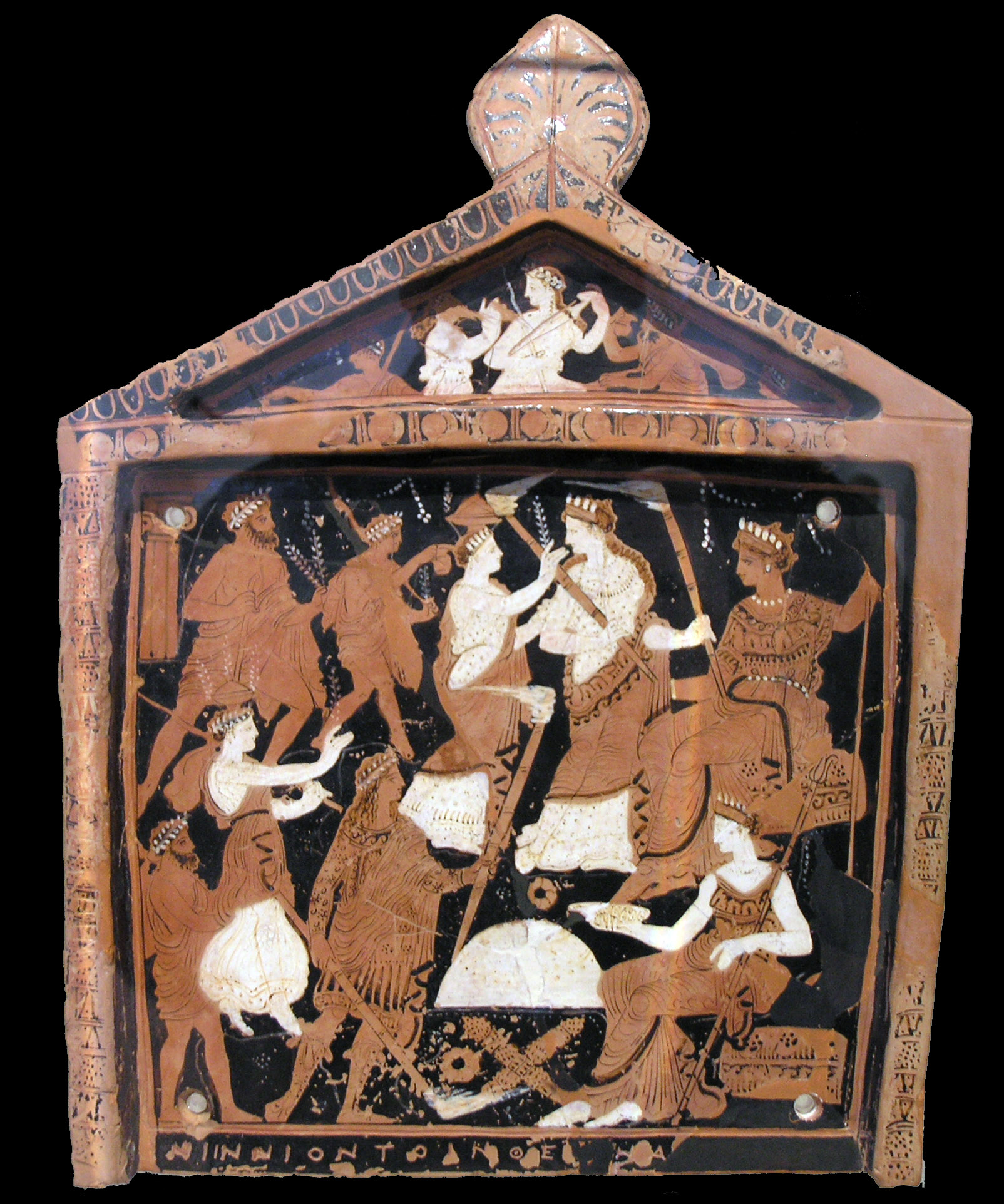
The Ninnion Tablet (National Archaeological Museum, Athens): a fourth-century BCE clay votive plaque dedicated at Eleusis by a woman named Ninnion, generally read as the only surviving ancient depiction of the Mysteries' rites — processing initiates with branches and, on some figures' heads, the lidded vessels associated with the kykeon. The tablet does not depict what those vessels held; the contents of the kykeon are the question carried by TIK-C003 and TIK-C007.
Marsyas · 19 December 2005 (original upload date) · source · Public domain
The founders of the hypothesis built on the barley. Ergot, Claviceps purpurea, grows on cereals, and its alkaloids are relatives of LSD, which Albert Hofmann first made from ergot. In 1978 Hofmann, the mushroom writer R. Gordon Wasson and the classicist Carl Ruck proposed in The Road to Eleusis that ergot on the barley near Eleusis was the kykeon's secret — though Hofmann conceded, “We have no way to tell what the chemistry was of the ergot of barley or wheat raised on the Rarian plain.” In 2000 Ruck and two colleagues proposed a route: break down the toxic alkaloids in alkali to leave a safer, psychoactive drink.
plate III · photograph — duotone applied in display; original unmodified
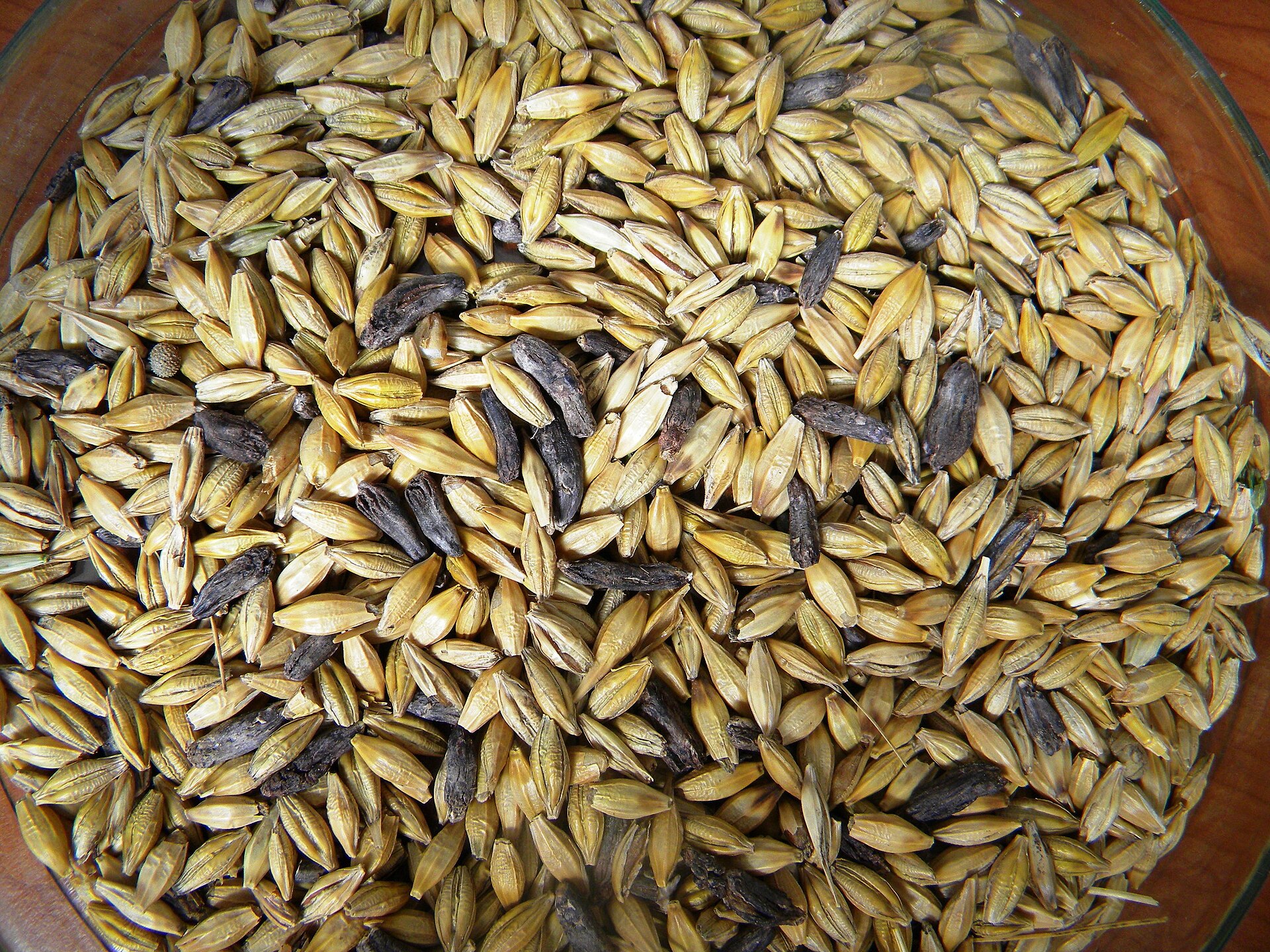
Harvested barley (Hordeum vulgare) contaminated with the dark sclerotia of ergot (Claviceps purpurea) — the fungus named by the Eleusinian hypothesis (TIK-C005). Raw sclerotia contain the toxic ergopeptides that cause ergotism. The photograph documents the organism and its grain host, not any ancient practice.
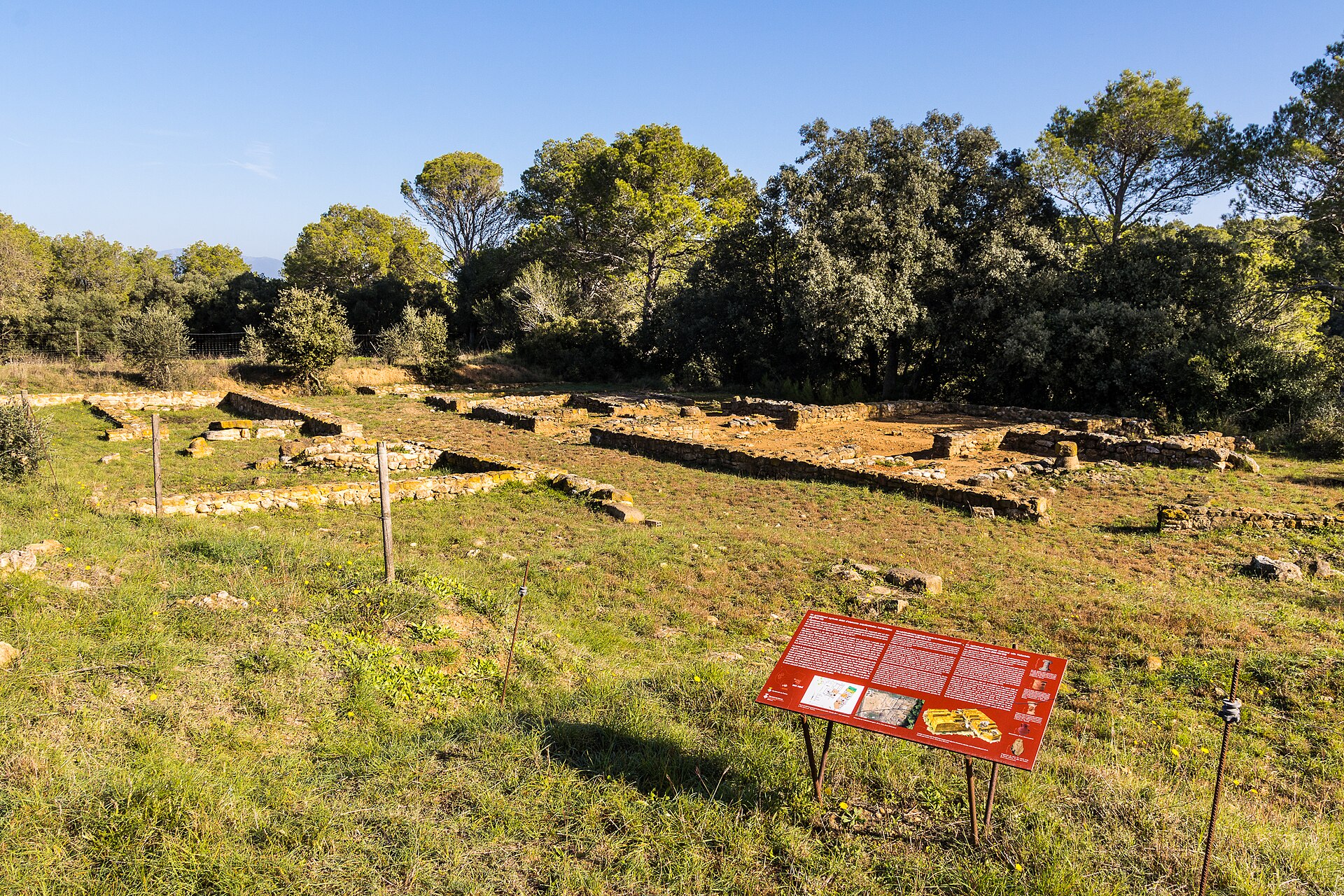
Its limits are as large as they sound. It is one analysis, never replicated, made a thousand kilometers from Eleusis. This site has read it only as the 2026 chemistry paper reports it. Neither the 2002 chapters nor the excavation report behind the link to the two goddesses has been obtained. Retellings tend to harden “fragments of ergot” into “hallucinogenic alkaloids detected,” which the quoted wording does not say. And ergot is what barley carries: a barley vessel with ergot in it is, absent more, a barley vessel. Reading the chapters would settle whether the report compared the finds with grain from the site's own stores, the contrast that would lift them above background.
plate IV · photograph — duotone applied in display; original unmodified
The excavated Iberian settlement of Mas Castellar de Pontós (Girona, Catalonia), near the ancient Greek colony of Emporion. A 2002 analysis reported fragments of ergot inside a ceremonial vessel and in human dental calculus from this site, whose sanctuary is linked to Demeter and Persephone. The site lies roughly a thousand kilometers from Eleusis; the analysis, its standing, and its limitations are carried by the evidence record attached to TIK-C004.
The standing objection was toxicity: raw ergot causes ergotism — gangrene and convulsions, not transcendence. In February 2026 a team including Ruck and members of a Greek entheogen-research center tested the 2000 proposal. Across forty-eight runs they boiled powdered ergot in wood-ash lye, an alkali ancient Greeks could make. They showed that the toxic alkaloids can be broken down completely while the psychoactive compounds LSA and iso-LSA appearC005, at about half a milligram of each per gram of ergot. “Ergot would have poisoned everyone” no longer works as an objection to possibility.
▸ claims behind this paragraph (1)▾ claims behind this paragraph
Then there is the gap between a molecule and a night. From the measured yield the authors extrapolate that about a gram of processed ergot per initiate would reach the minimum effective dose of LSAC033. The threshold comes from the pharmacological literature and has not been checked here. And LSA is not LSD: it is much weaker, and the human record, mostly from people who ate morning-glory seeds, shows hallucinations and euphoria mixed with sedation, nausea and anxietyC006. The authors suggest the recipe's pennyroyal might smooth the effect, and say themselves that the idea is untested. Whether the whole drink gives the night of a lifetime or a queasy one, nobody has tested.
▸ claims behind this paragraph (2)▾ claims behind this paragraph
plate V · photograph — duotone applied in display; original unmodified
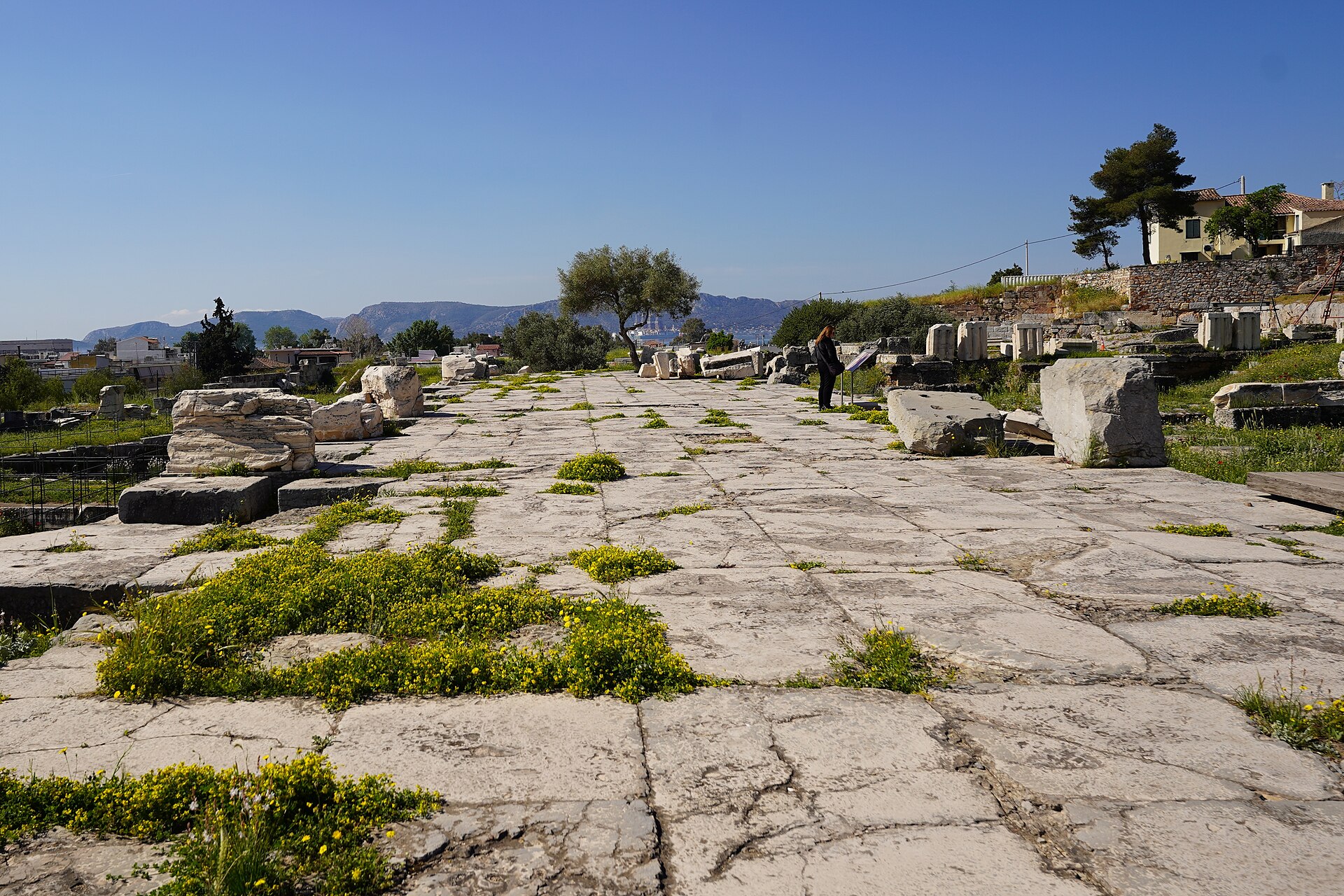
The floor of the Telesterion at Eleusis — the initiation hall in which, for nearly two millennia, the Mysteries reached their climax. Where in the programme the kykeon was drunk, and whether in this hall, this ledger does not settle. The sanctuary is excavated and its ceramics curated; the residue question the photograph cannot answer is carried by TIK-C007.
Both sides agree on the strangest fact in the controversy: no vessel from Eleusis has ever been chemically analyzed. The 2026 paper says so while calling for exactly that work; the absence, it says, “is not decisive, since no systematic research has ever been conducted or since permission for such has never been granted.” Proponents read the blank as “not yet tested,” skeptics as “nothing found.” It is an untested absence. It leaves the headline Greek claim — deliberately prepared ergot in the Eleusinian kykeonC007 with circumstantial support and nothing where its direct evidence should be.
▸ claims behind this paragraph (1)▾ claims behind this paragraph
The case against it is specific. The one recipe names nothing psychoactive. The sanctuary's accounts were carved on stone and publicly audited. Kevin Clinton, a leading epigrapher of Eleusis, says they track the sacred grain into sacrifices and dedications, “none of it for the production of ergot or drugs.” An ingredient gathered free from the fields would not show in accounts, so the silence is not fatal, but it is an audited silence. And the scholars Sharday Mosurinjohn and Richard Ascough name a habit this literature has shown since 1978: “mild circumstantial evidence” hardened into “a ‘fact,’ on which is built each subsequent round of conjecture.”
Was there a vision to explain?
Beneath the question of the cup sits the one that gives it point: did the initiates' experience need a drug at allC008? In a 2006 double-blind trial, psilocybin gave volunteers experiences they rated months later among the most meaningful of their lives. So the drug route to such experience exists; that does not show Eleusis took it. The ritual account needs no supply chain or secret technology, and the rite ran for nearly two thousand years. But it is asserted more often than shown.
▸ claims behind this paragraph (1)▾ claims behind this paragraph
The 2026 authors call a psychedelic core “reasonably certain” on the strength of “numerous accounts of the experience,” which they do not quote. The ones they name, Pindar and Cicero, link initiation with knowledge of death and the afterlife, not with what happened in the hall. One question has not been settled. Read apart from the twentieth-century scholar Carl Kerényi's interpretation of a passage in Plato's Phaedrus, does any ancient text describe a transforming experience during initiation? If none does, drug and ritual alike are explaining something modern scholars built.
The Christian half
The crossing into Christianity runs through Dionysus. Some scholars read the Gospel of John as deliberately painting Jesus in the wine god's colorsC009: water into wine at Cana, “I am the true vine.” Others read the same lines as Jewish images of messianic plenty. Either way it is a claim about texts. For a drug to cross, Dionysian wine must have been psychedelic — “a big if,” Muraresku said at Harvard in 2021 — and a real community must have taken over the practice, not just the imagery. He asked the next question himself: “Where are the drugs?”
▸ claims behind this paragraph (1)▾ claims behind this paragraph
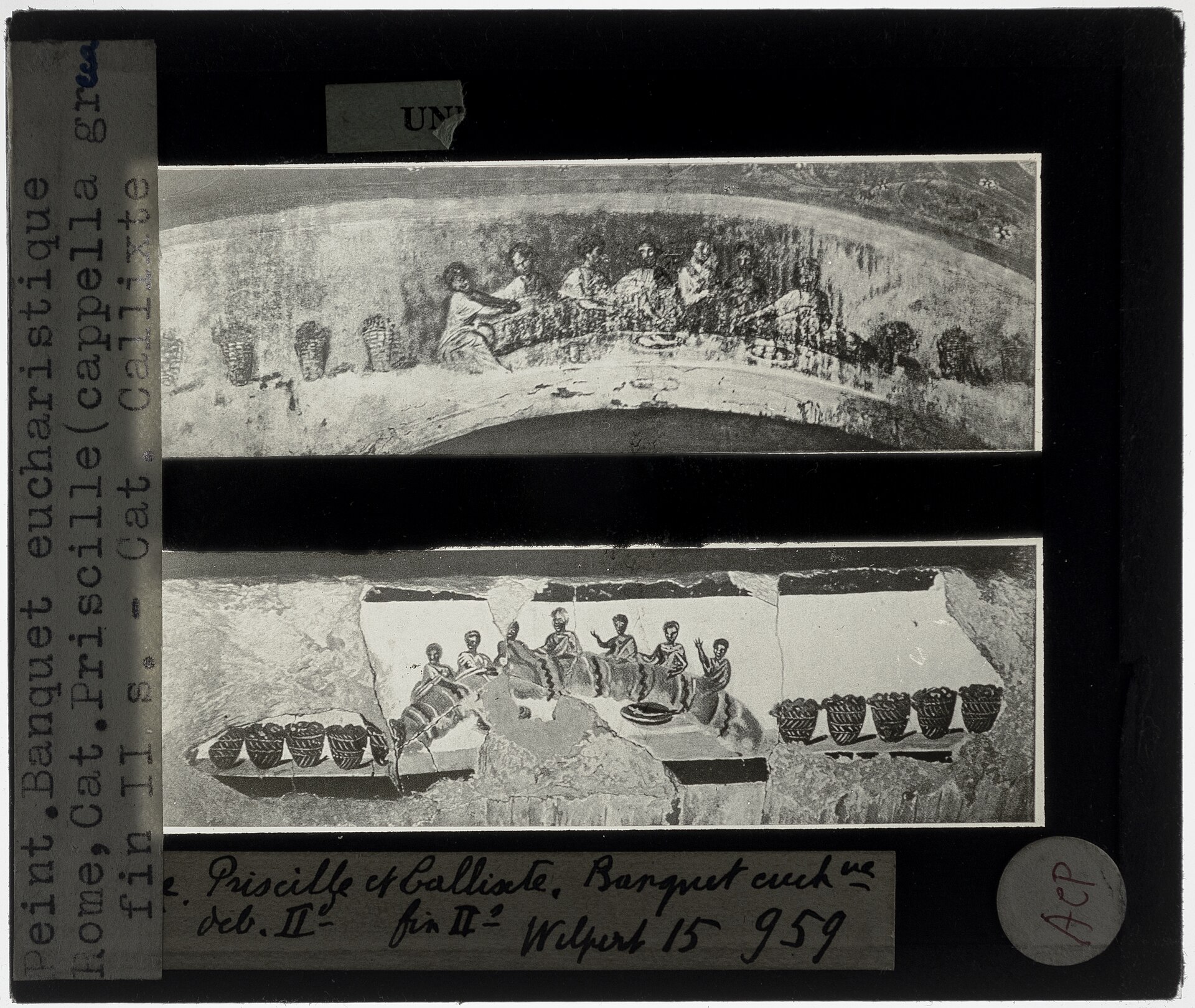
The early record shows a Jewish table. The Didache, a church manual dated roughly 50–120 CE, gives thanks over the cup “for the holy vine of David” and over broken bread. Justin Martyr, around 155, describes “bread and a cup of wine mixed with water.” He says the Mithraic meal is what “wicked devils have imitated,” so in his telling the borrowing ran the other way. The nearest thing to a drugged cup is a hostile account. Irenaeus accuses the Gnostic teacher Marcus of a trick that turned wine “a purple and reddish color,” and of brewing love potions. That is a charge of fraud, not a record of a sacrament. So the claim that the original Eucharist was a psychedelic potionC011 is contradicted. The weaker claim that some early community spiked its cupC010 is neither supported nor refuted: these texts describe the approved rite, and no securely identified early-Christian liturgical vessel has ever been chemically tested.
▸ claims behind this paragraph (2)▾ claims behind this paragraph
plate VI · archival lantern slide — duotone applied in display; original unmodified
An early-twentieth-century teaching slide, labeled in French, pairing the two most famous early depictions of the Christian eucharistic meal: the "Fractio Panis" fresco of the Capella Greca in the Catacomb of Priscilla, Rome (late second century, upper) and a banquet scene from the Catacomb of Callixtus (lower), photographed for Joseph Wilpert's 1903 corpus. Both scenes show bread, a cup, and baskets (TIK-C011); the frescoes do not show what the painted cups held, and the chemical question sits with TIK-C010.
Unknown (EuroPhot art-history slide series, after Wilpert 1903) · source · Public domain
The specialists are blunt. Patrick McGovern of the Penn Museum, a founder of biomolecular archaeology whom Muraresku consulted, calls the evidence linking psychedelics and Christianity “extremely weak to nonexistent.” The mystery-cult historian Jan Bremmer: “Christianity was not a mystery cult.” Bart Ehrman finds the findings implausible. Jerry Brown, himself a writer on psychedelic Christianity, says the book “fails to make a compelling case for its grand theory.” And Muraresku concedes more than his marketing does: of a psychedelic Last Supper, “I don't hang my hat on that claim”; on his own site, “the smoking gun remains elusive.”
The Athanatos Foundation, which Muraresku founded, supports the Yale Ancient Pharmacology Program, and the program is building the residue-testing capacity this case needs. Its published funding statement names E. Jhong, the Robert and MeiLi Hefner Foundation, the Athanatos Foundation and B. Muraresku. E. Jhong founded this site. The program best placed to test these claims is thus funded by the hypothesis's author, his foundation, and the founder of the page you are reading. Funding is provenance, not refutation: chemistry stands or falls on replication. But any result from that program will be read here with that tie in view. Critics' motives are read the same way, as context and never as evidence about an ancient cup.
What would settle it
On the Greek side, the chemistry has been shown once, the one physical find is unread at its source, and the sanctuary is untested. On the Christian side, the strong claim is contradicted and the weak one untested. What would change the picture is concrete and cheap. The vessels exist, and the methods are those already used at Arad and Menorca.
Test the Eleusinian cups for LSA, iso-LSA and lysergic acid above soil levels. Chemists reportedly read ergot's fats as a sign of cereal, a point this site has not confirmed, so on their own they would say only “barley was here.” Lysergamides across a series of cups would make the drugged kykeon the best-evidenced claim of its kind; cereal without them would be the first real negative.
Read the 2002 Pontós chapters and re-test the samples, to learn whether the one physical find rises above ordinary grain.
Repeat the lye chemistry in an unaffiliated laboratory on blinded ergot, and profile the whole drink, not just its LSA.
Survey early-Christian vessels under a protocol published in advance, so that a null counts as much as a hit.
Audit the ancient texts for any description of an experience during initiation.
The full list of tests, ranked by what each would settle, follows.
the argument ladder
evidence for a lower rung does not automatically climb
Attribution
Was it actually done? The claims the thesis stands or falls on.
The strongest records on each side, structurally symmetric. Every record separates what the source states from what we infer. Browse the full ledger (30 records) →
strongest supporting
▲Supports· strongTIK-E001
Cannabis and frankincense residues on the Tel Arad shrine altars
what the source states
Residue analysis of the two altars from the eighth-century BCE Judahite shrine at Arad identified cannabis with animal dung on the smaller altar — consistent with heating the resin to release psychoactive compounds — and frankincense with animal fat on the larger.
what we infer
Psychoactive ritual technology was in use inside the broad religious world Judaism emerged from — which undercuts any claim that such practice was culturally alien to it. It is a prior update only: burning cannabis on an Iron Age altar is a different substance, route, cult, and century from a drinkable Eucharist.
limitations
Fumigation, not ingestion; a Judahite shrine, not a Greek sanctuary or Christian meal.
Alkaloids measured directly in Bronze Age human hair from Es Càrritx, Menorca
what the source states
UHPLC-HRMS analysis of human hair from the burial and cult cave of Es Càrritx detected ephedrine, atropine, and scopolamine, which the authors present as direct evidence that people there had consumed multiple alkaloid-bearing plants by around 1000 BCE.
what we infer
The strongest background datum for the Western Mediterranean: the compounds are measured in human tissue (consumption, not proximity). It does not say which ceremony, what purpose — visionary, therapeutic, social — or anything about later Greek mysteries.
limitations
Tropane and ephedra alkaloids, not ergot; Menorca, not Attica; ~600 years before the classical Mysteries' peak.
Chewed Datura quids at the Pinwheel Cave rock-art site
what the source states
Quids recovered from ceiling crevices at a California rock-art site contained atropine and scopolamine and were identified as chewed Datura wrightii; the authors describe the result as unambiguous confirmation of hallucinogen ingestion at a rock-art site.
what we infer
The methodological benchmark: archaeology can move past speculative iconography and connect a psychoactive plant, human consumption, and a ritualized space with chemistry. Its relevance to this case is method and background rate, not geography — California is not an evidence link between Eleusis and Christianity.
limitations
No cultural or geographic connection to the Mediterranean; comparative evidence only.
The Hymn's kykeon is meal, water, and soft mint (lines ~205–211); no ancient source names ergot, and none describes an alkaline-processing step in the drink's preparation.
what we infer
The hypothesis must therefore posit a secret additive and a secret technology, neither attested — a construction that text cannot falsify, which cuts both ways but leaves the affirmative burden entirely on future chemistry (TIK-R001).
limitations
Argument from silence in a cult that was secret by law; the same silence is compatible with a secret ingredient.
Clinton: the sanctuary's audited accounts record no drug expenditure
what the source states
Kevin Clinton (Cornell), a leading Eleusis epigrapher, is quoted: the Athenian sanctuaries "produced annual financial accounts that were publicly audited and published on stone; any expenses for drugs would have been public knowledge. Athens produced a financial account of its entire production of barley and wheat, from which a portion of grain was given to the sanctuary, to be sold and the funds used for sacrifices and dedications, none of it for the production of ergot or drugs." He adds that no evidence of drug use has been found at Eleusis and that the book "demonstrates how not to do research on ancient religion."
what we infer
The best documentary counterargument on the Greek side: the sanctuary's economy is unusually well recorded, and the record shows grain used conventionally. It is not decisive — a secret rite's ingredient could be small-scale, unpurchased (gathered from the Rarian field), or hidden in ordinary grain flows — but it converts the argument from silence into an argument from a specific, published, audited silence.
limitations
Expert testimony via journalism: the inscriptions themselves are not audited by this case yet — following Clinton's claim into the epigraphic corpus is part of TIK-R006.
McGovern's repudiation: the book's own star scientific witness
what the source states
Patrick McGovern (Penn Museum biomolecular archaeology), who advised Muraresku and is cited throughout the book, is quoted: any scientific evidence supporting a connection between psychedelics and Christianity is "extremely weak to nonexistent," and Muraresku "misconstrues and overinterprets the very limited, ambiguous archaeological and archaeobotanical data for religious use of psychedelics in antiquity to reinvigorate the discredited ergot theory for Eleusis and to build a fanciful tale about the Eucharist with no basis in Christian tradition."
what we infer
Weighty for a specific structural reason: this is the field's central archaeochemist, whose own work the book leans on, disputing the interpretation of material he helped evaluate. It is testimony about interpretation, not a dataset — where McGovern makes concrete claims, the follow-up belongs with the underlying reports.
limitations
Secondary journalism with an acrimonious personal history between source and subject visible in the same article; treated as expert testimony, not archaeological evidence.
steelmanned — the account the featured hypothesis must beat
Eleusis worked without a drug. Fasting, procession, secrecy, darkness and light, ritual drama and collective emotion produced the experience, if there was a transforming 'vision' at all rather than afterlife hopes read through a modern lens. The kykeon was barley, water and mint, as its one recipe says. Ancient drug-wines were medicine, not mystery sacraments. The Pontós ergot, if it survives re-reading, is the fungus barley carries, found in a barley vessel, unless the report shows a contrast with the site's grain. The Eucharist descends from Jewish meal blessings, as the Didache and Justin present it. This account's unpaid debt: nobody has tested the vessels that could falsify it, and ritual sufficiency is asserted more than shown.
What would change our mind
The case does not end in a verdict; it ends in the studies that would move it, in the order this edition judges they would move it most. A result in either direction counts.
TIK-R001Prize or grant · Lab
Organic residue analysis of securely contexted vessels from Eleusis
The empty cell both sides argue from: no artifact from the Eleusis sanctuary has ever been chemically analyzed — per the 2026 feasibility paper, systematic residue research has never been conducted or permitted (TIK-E009). The test: obtain permission for modern organic residue analysis (GC-MS/LC-MS/HRMS panels including ergoline markers) of curated, securely contexted drinking and mixing vessels from the sanctuary, with extraction blanks, soil controls, and preregistered target compounds — the protocol the Tel Arad, Es Càrritx, and Bes-vessel studies have already normalized elsewhere. Vessels stored since early excavations exist in collections; the blocker is administrative, not technical.
expected information gain
The highest in the case, in both directions: replicated ergoline residues in Eleusinian cups would transform TIK-C007 from weakly supported to the best-evidenced claim of its kind anywhere, while a methodologically sensitive null across many vessels would convert the current untested absence into a tested one and largely close the Greek half. No other single test moves the headline claims comparably.
Specify lysergamide-targeted analytes, not ergot lipids, for any Eleusinian residue programme
Residue chemists are reported to use ergot lipids (ricinoleic-acid triglycerides and estolides) as a marker for cereals in vessels — a premise this ledger has not verified, since the 2018 Pontós study that reports it could not be checked against its text this pass. A lipid-based assay on Eleusinian or Pontós ceramics would therefore report 'barley was here', an expected result for any kykeon vessel, and could not distinguish contaminated grain from a processed preparation. This item asks that TIK-R001 and TIK-R004 be run with targets that could discriminate: LSA, iso-LSA, lysergic acid and their degradation products by UHPLC/Q-TOF-HRMS on interior sherd extracts, with soil and exterior-surface controls, paired with the lipid assay as a cereal control. A lysergamide signal above background, in a vessel whose lipid profile also shows cereal, would move the claim of deliberately prepared ergot in the Eleusinian kykeon (TIK-C007); a cereal-positive, lysergamide-negative result across a curated series would be the first genuine negative at the sanctuary rather than the present untested absence.
expected information gain
Converts the empty cell at Eleusis into a discriminating test: it prevents a predictable 'ergot present' from being read as a hit and makes a null result informative.
Recovery and modern re-analysis of the Mas Castellar de Pontós materials
The case's one hard archaeological datum rests on a single 2002 analysis (TIK-E007) that has never been independently replicated — and whose primary publication this case has so far seen only through the 2026 paper's citations. Two steps, in order: obtain and audit the primary 2002 chapters (Juan-Tresserras, in Pons i Brun ed., pp. 548–556 and 477–481) against the downstream retellings; then re-analyze the surviving vessel residue and dental-calculus samples with current methods (UHPLC-HRMS ergoline panels, ancient-DNA or peptide confirmation of Claviceps), with chain of custody documented.
expected information gain
Binary and large for TIK-C004: confirmation would give the Eleusinian hypothesis a replicated archaeological anchor for the first time; failure to confirm — or a primary text materially weaker than the citations imply — would remove the modern case's only substance-in-cult-context datum. The desk half (retrieving the primary text) costs almost nothing and disciplines every retelling immediately.
Read Juan-Tresserras 2002 (pp. 548–556, 477–481) for what was identified at Pontós and against what background
Open the two chapters in Pons i Brun (ed.), Mas Castellar de Pontós (2002), and Juan-Tresserras 2000 (Complutum 11), and record: (i) the identification method for the reported ergot (microscopy of sclerotium fragments, phytoliths, any alkaloid chemistry); (ii) whether the report compares the vessel and dental-calculus finds with grain or flour samples from elsewhere on the site (mills, storage pits) — the contrast that would lift the find above the cereal-marker base rate; (iii) the vessel's form, context and associated residues; and (iv) the excavators' basis (Adroher, Pons & Ruiz de Arbulo 1993, AEspA 66) for the Demeter/Persephone attribution of the sanctuary. A documented site-wide contrast would raise the diagnosticity of TIK-C004 toward TIK-C007; its absence would leave Pontós a barley-vessel with the fungus barley carries.
expected information gain
Replaces a citation chain with the primary text and decides whether the case's one hard physical datum is diagnostic or background.
▸ 9 more studies on the agenda▾ the rest of the agenda
TIK-R002Small grant · Lab
Independent replication of the lye-hydrolysis result with blinded ergot
The 2026 detoxification experiment (TIK-E008) was performed once, by a team including the hypothesis's originators and an entheogen-research center. The test: an unaffiliated analytical-chemistry group repeats the alkaline-hydrolysis protocol on blinded ergot samples of known but undisclosed variable alkaloid content — including sclerotia from different hosts and regions — and reports conversion efficiency, residual ergopeptide levels, and the pH/time sensitivity of the safety margin. The original paper's own data show lower pH or shorter treatment leaves toxic ergopeptides detectable, so robustness under sloppy conditions is the live question, not whether the textbook reaction runs.
expected information gain
The fastest credibility lever available to the pro side: confirmation by a disinterested laboratory would make the mechanism rung network-independent; failure or a narrow safety envelope would reopen the classic toxicity objection at practical strength even though the 2026 paper closed it at the level of possibility.
Pharmacological profile of the full reconstructed preparation
Nobody has profiled what the lye process actually produces as a whole. The test: receptor-binding panels, toxicology, and pharmacokinetic dose modeling of the complete reconstructed extract — LSA, iso-LSA, and every co-product, not the isolated compounds — against the question the history needs answered: at doses achievable from about a gram of ergot, does this preparation plausibly produce a profound, largely positive visionary experience in most recipients, or sedation, nausea, and dysphoria? The human LSA literature (TIK-E012) is dominated by morning-glory-seed exposures and cannot answer for this matrix.
expected information gain
Decides whether the hypothesis's motive survives contact with pharmacology: if the reconstructed drink cannot plausibly deliver the reported phenomenology, the ergot-kykeon loses its point even with the chemistry proven; if it can, the mechanism rung is complete from fungus to phenomenology.
Preregistered residue survey of early-Christian liturgical vessels
The Christian half's claims (TIK-C010, TIK-C011) have never been tested with chemistry: no securely identified early-Christian cup, chalice, or communion vessel has undergone organic residue analysis. The test: a preregistered survey across museum collections — vessel identification criteria, target compound panels, contamination controls, and both positive and null publication commitments frozen in advance — of vessels with secure liturgical attribution from the first four centuries. Preregistration matters doubly here because the program best positioned to run such work (YAPP) is funded by the hypothesis's author and this project's founder (TIK-E027), so the protocol must be critic-proof before results exist.
expected information gain
One replicated psychoactive positive would transform TIK-C010 and force the documentary reading of TIK-C011 to be reargued; a well-documented broad null would substantially close the Christian half. Either outcome converts claims currently running on capability and analogy into claims running on measurements.
Audit Kerényi's reading of Phaedrus 250b–c against the text and modern commentaries
Set Kerényi 1967 (Eleusis, p. 99) beside Plato, Phaedrus 250b–c in Greek and the commentaries of Yunis (2011), Waterfield (2002) and Cosmopoulos (2015), and separately check whether Plutarch fr. 178 Sandbach, Pindar fr. 137 and Sophocles fr. 837 describe an experience during initiation or the afterlife expectations of initiates. Determine whether any ancient text independent of Kerényi's construction attests a transformative experience at initiation. If none does, the antecedent of TIK-C008 is a modern construction and the claim that the 'beatific vision' originates with Kerényi stands; if one does, the phasmata argument is narrowed to Plato alone.
expected information gain
Decides whether the drug-versus-ritual dispute has a phenomenon to explain, which governs the weight of every mechanism claim above it.
Adversarial review: can drug-free ritual reliably generate the reported experience?
The mainstream alternative — fasting, procession, secrecy, darkness, ritual drama, and mass emotion suffice (TIK-C008) — is asserted more often than it is evidenced. The test: an adversarial collaboration between a proponent and a skeptic of the pharmacological reading, reviewing the modern literature on non-pharmacological induction of intense mystical-type experience (sensory deprivation, collective ritual, expectancy, sleep restriction) against the phenomenological profile the ancient testimonia actually describe, with the evidential bar and the testimonia list frozen before either side argues.
expected information gain
Bounded but real: if matched non-pharmacological ritual demonstrably produces experiences of the reported intensity and reliability, the drug hypothesis loses its explanatory motive (though not its possibility); if it demonstrably cannot, the Mysteries' two millennia of stable operation become genuinely anomalous and the pharmacological reading gains its strongest indirect support.
Philological and epigraphic audit of the load-bearing texts
Desk work the popular debate has skipped: (1) pull the exact Dioscorides passages behind the visionary-wine summaries (TIK-E005) and fix book, chapter, and translation; (2) audit the Eleusinian financial inscriptions behind Clinton's audited-accounts argument (TIK-E016) — what the stones actually record, published corpus references; (3) sweep the ancient kykeon testimonia beyond the Homeric Hymn for any hint of an additive or processing step; (4) fix the canonical statements of the ritual-sufficiency position (Burkert and successors) with exact locators. Every item replaces a secondhand characterization currently in this ledger with a primary locator.
expected information gain
Modest per item but structural in sum: this case currently carries several expert characterizations of texts rather than the texts themselves, and each audited locator either hardens an evidence record or exposes a drift — the exact failure mode (rhetorical solidification into "fact") the methodological critics have documented in this literature (TIK-E019).
Co-administration test of pennyroyal constituents with LSA/iso-LSA
The 2026 authors propose, and mark as untested, that pulegone and rosmarinic acid from pennyroyal potentiate or prolong the effects of LSA/iso-LSA. The test is a controlled co-administration study — in vitro receptor and MAO-A assays first, then an animal behavioral model — comparing the LSA/iso-LSA mixture alone with the mixture plus pennyroyal extract at ratios matching the reconstructed kykeon. Measured potentiation or prolongation would support the pennyroyal 'entourage effect' claim and bear on whether the full preparation could deliver what TIK-C006 requires; no difference would retire the proposal.
expected information gain
Tests the one mechanism the proponents have added since 2020 before it migrates into the narrative as fact.
Open the other reported ergot-in-vessel and ergot-in-body finds
The report names, from a secondary survey that could not be retrieved, further claimed ergot finds: pyxides from the Middle Bronze Age cult area at Portorusso (Otranto) (Aprile & Tiberi 2016), a small vessel from a La Tène burial at Czernikowice, Poland (Łaciak et al. 2023), and the gut contents of Grauballe Man (Stolarczyk et al. 2020), plus the two other archaeological cards the book relies on, a Calvari d'Amposta beer and a Pompeian villa drug-wine (Ciaraldi 2000). Open each primary report and record the analyte (lipids, sclerotia, alkaloids), the context, and whether the analysts distinguished deliberate from incidental presence — in particular any quantitative dose estimate of the Grauballe kind. Together these fix the base rate TIK-R008 needs and test whether Pontós is unique in combining ingestion with a Demeter-linked context.
expected information gain
Widens or narrows the 'ritual ergot' pattern and supplies models for testing deliberate against incidental presence.
Base-rate survey: how common were psychoactive additives in ritual vessels?
The background rung (TIK-C001, TIK-C002) runs on spectacular positives with no denominator: nobody knows what fraction of ancient ritual vessels carry potent botanical additives, so nobody knows how surprising any single find is. The test: a blinded residue survey across a representative sample of ritual and domestic vessels from comparable Mediterranean contexts — sacred and secular, urban and rural — with the analyst blinded to context, reporting additive frequencies by vessel class. The Bes-vessel and Es Càrritx methods make this routine chemistry; the design contribution is the sampling frame.
expected information gain
Converts the whole background rung from anecdote to rate: a high base rate would make ritual pharmacology unremarkable everywhere (raising the prior for Eleusis while lowering every find's diagnosticity); a very low one would make each cult-context positive — including any future Eleusinian hit — far more diagnostic than it is now.
Trust comes partly from showing changed minds. Each entry is an edition that changed a verdict, with the word before and the word after — a reversal included.
Aletheia records every change to a case: what changed, why, and who made it — including the AI's role. The latest:
Candidate edition edition-2026-09-16-034911 amended before publication (second amendment): "Nor did the process yield clean lysergamides: [ergometrine and its epimer remained detectable…
Correction by the operator: TIK-E038.title — "The 2026 preprint's fine print: full detoxification only at pH 12.5, 5% w/v, 120 min; ergometrine still present — part 1" → "The preprint's…
Correction by the operator: TIK-C035.statement — "The field-collected ergot used in the 2026 kykeon experiments was identified by rDNA-ITS sequencing as Claviceps purpurea (strain ATHUM…