UnresolvedA reflecting population near Earth, and its height
Presently untestableArtificial and extraterrestrial origin
why this research priority
Several cheap, unrun tests on existing scans could decide the population statistics, and two lab tests reach the light-versus-flaw question that no existing measurement settles.
AI-generated editorial artwork
What is claimed
Some one-time, star-like marks on 1950s Palomar survey plates were real flashes of light through the telescope, and in the strong version, sunlight glints off artificial objects orbiting before Sputnik.
▸ read the rest▾ less
Proponents go further and propose an extraterrestrial origin, which they themselves call unfalsifiable.
Where the disagreement lives
The dispute is whether any mark was made by light entering the telescope rather than by a flaw in the emulsion — something microscopy cannot decide and no calibration yet measures. Both sides accept the marks exist; the flagship nine are confirmed on copy glass and reported on the original negative.
▸ read the rest▾ less
The population patterns — fewer candidates in Earth's shadow, timing near nuclear tests, clusters over Earth — hold on the proponents' own catalog, and the two tested independently did not survive. If the near-Earth geometry held, nothing yet separates artificial reflectors from natural ones.
What would settle it
Blind-test the coma signature — the distortion telescope optics stamp on real light — against known defects and deliberate flashes, and calibrate how flashes look on period emulsion. Those would decide light versus flaw.
▸ read the rest▾ less
Then reproduce the Earth-shadow shortfall on an independently built catalog, under a preregistered null that models the plate background as it is. Artificial origin would need a size or structure argument not built on a catalog that excluded bright sources. Extraterrestrial origin has no test on the table.
this edition · 30 September 2026
No verdict moved in this edition.
The article was re-told: 2,543 words, from 3,378.
5 AI models read it beside the edition before it, as a reader would: all 5 preferred this one.
an AI-generated assessment · not reviewed by a human
The case verdict is unresolved: the marks are real plate features, but nothing yet decides whether any was made by light through the telescope rather than by an emulsion flaw. The observation level is secure. The 1950 nine are confirmed by the critics on the Edinburgh copy (TRN-E002, on TRN-C001) and recovered by an independent pipeline (TRN-E008, on TRN-C004).
▸ the full reasoning▾ less
They are reported on the original Caltech negative (TRN-E022, on TRN-C024), which removes the copy-chain route of TRN-C007 (TRN-E005) for the two flagship events (TRN-E023). The crux TRN-C020 has narrowed from original-or-copy to flash-or-flaw. The microscopy authors concede their method cannot decide it, and their microscopist leaned defect (TRN-E024). Sharpness (TRN-C002, TRN-E003) is a sound measurement read two ways (TRN-E004, TRN-E006) without calibration. The two mechanisms that would decide the crux, flash sharpness (TRN-C102) and defect rates (TRN-C101), are both held on their anchors alone. The coma signature (TRN-E014, on TRN-C011) is the one physical discriminant, and it is unvalidated. The population claims split by replication type. They survive reanalysis of the author-supplied rows (TRN-E010 and TRN-E015 on TRN-C005 and TRN-C006; TRN-E052 on TRN-C129). They fail an independent extraction and a corrected null (TRN-E009 on TRN-C006; TRN-E011 on both). The modelling preprint concedes part of the background objection (TRN-E051, on TRN-C005), and the hotspot paper's random controls meet its clustering criterion (TRN-E079, on TRN-C122). That pattern indicts the catalog, not yet the sky. Attribution inherits all of it. TRN-E074 assumes near-Earth origin, and TRN-E020 offers a natural route sharing the geometry (both on TRN-C021). TRN-E038's exclusion of that route (TRN-C117) rests on a size inference its authors call biased by bright-source exclusion (TRN-C111; TRN-E062, TRN-E063). The proponents call the intelligence reading unfalsifiable (TRN-E083). The single record whose removal would most change the case is TRN-E011, the only strong record against the shadow deficit. Without it TRN-C005 would rise to provisionally supported and TRN-C021 with it, leaving TRN-C020 untouched; the case verdict would survive.
the steelman — the strongest argument this judgment does not answer
Nine sharp, round marks lie within ten arcminutes of one another on one fifty-minute exposure. They are reported on the original telescope negative (TRN-E022) and are absent from the overlapping plate six days later (TRN-E002).
▸ read the rest▾ less
A second event puts three sixteenth-magnitude points within ten arcseconds that vanish within the hour and never return to magnitude 25.5 (TRN-E007). The proponents read the nine marks' sharpness as what a sub-second flash should leave on a long exposure (TRN-E006). The defect account has no measured rate for clustered, star-like flaws on original negatives (TRN-C101 is held on its anchor). The defect account must also explain several things together. The shadow and nuclear-window signals persist and grow under a classifier trained to remove defects (TRN-E015; TRN-E052 and TRN-E053 on TRN-C129). One environmental route to a spurious timing pattern tests negative (TRN-E017, on TRN-C006). An archive with no shared ancestry shows narrow-profiled candidates (TRN-E013) that carry, on the author's reading, the coma signature of light through the optics (TRN-E014). No single defect mechanism in the record accounts for clustering, sharpness, filter-strengthening and cross-archive recurrence together. This assessment does not answer that conjunction. It holds that each element is separately undercut — unblinded, uncalibrated, same-catalog, unvalidated — and that a conjunction of undercut elements is not yet evidence.
5 AI models from different vendors each judged the evidence without seeing this judgment or one another. A model concurs when its verdict is within one step of the one above.
▸Gemini 3.8 Flash (Google)UnresolvedconcursThe hypothesis that star-like transients on 1950s photographic plates record optical flashes from near-Earth objects pre-dating Sputnik 1 occupies an intriguing intersection of archival astronomy, image forensics, and technosignature searches.
The hypothesis that star-like transients on 1950s photographic plates record optical flashes from near-Earth objects pre-dating Sputnik 1 occupies an intriguing intersection of archival astronomy, image forensics, and technosignature searches. Evaluating this case requires strictly separating the attribution ladder: confirming a physical mark on glass does not prove incident photons; incident photons do not establish a near-Earth origin; and near-Earth objects do not establish artificial or extraterrestrial technology.
On the observational foundation, the canonical events—specifically the nine April 1950 sources and the July 1952 triple transient—are established as physical realities of the historical plates (TRN-C001, TRN-C003). Crucially, recent microscopy of the original April 1950 telescope negative at Caltech (TRN-E022, TRN-C024) confirms all nine marks exist on the primary emulsion, definitively eliminating the skeptical hypothesis that they were introduced during downstream copying or digitization (TRN-C007). However, that same inspection delivered an essential limitation (TRN-E024): microscopy cannot distinguish a sub-second optical flash from an intrinsic emulsion flaw, and the examining microscopist favored an emulsion defect.
At the ensemble level, macroscopic statistical signals—such as the Earth-shadow deficit (TRN-C005) and correlation with atmospheric nuclear tests (TRN-C006)—reproduce mathematically within the VASCO working catalog (TRN-E010), but break down under rigorous external scrutiny. Watters et al. demonstrated that spatial non-uniformity and plate-edge defects explain away the shadow deficit, while the nuclear correlation tracks telescope observing schedules (TRN-E011). Hayes's independent pipeline recovery confirmed the canonical events but found no significant nuclear association under proper exposure modeling (TRN-E009). The most promising affirmative avenue remains Busko's report of off-axis optical coma on Hamburg plates (TRN-C011), but this lacks blind validation.
Sensitivity analysis: The single evidence record whose removal would most alter this assessment is TRN-E024 (the Yang & Villarroel microscopy report). If TRN-E024 were removed while TRN-E022 remained, the presence of the nine April 1950 sources on the original telescope glass negative would appear to establish incident optical light, tilting the case verdict toward provisionally supported. However, because TRN-E024 candidly confirms that microscopy cannot separate optical flashes from emulsion defects—and documents that the microscopist leaned toward defects—the verdict of unresolved solidly survives.
Steelman synthesis: Critics convincingly demonstrate that unvalidated archival plate catalogs are heavily contaminated by emulsion defects and scanner noise, and that ensemble correlations evaporate when accounting for survey footprints and scheduling. Conversely, proponents rightly highlight that the canonical events are physically present on the original telescope glass negative, that the July 1952 triple possesses stellar profiles vanishing within an hour, and that optical coma matching telescope optics has been preliminarily detected on Hamburg plates. Because incident light remains indistinguishable from emulsion flaws under microscopy, the case is unresolved.
its steelman
The July 1952 triple transient displays three 16th-magnitude sources within 10 arcseconds possessing stellar point-spread functions that vanish within 50 minutes, accompanied by preliminary detections of off-axis optical coma matching telescope optics on independent Hamburg Schmidt plates.
run 2026-09-30-check-gemini-110238 · 2026-09-30 · Unresolved · an AI seat, blind to the judgment · not human reviewed · per-claim verdicts on each claim page
▸GPT-5.6 Sol (OpenAI)UnresolvedconcursThe evidence establishes several low-level observations much more firmly than it establishes the featured near-Earth-flash hypothesis.
The evidence establishes several low-level observations much more firmly than it establishes the featured near-Earth-flash hypothesis. The April 1950 marks exist on surviving copies, and TRN-E022 provisionally places all nine on the original telescope negative. The July 1952 triple is repeatedly recovered in the digitized material, while an independent extraction pipeline recovers both canonical events and most of the published 5,399-object catalog. The nine April marks are also demonstrably sharper than comparison stars. These are substantial results, but none by itself shows that light made the marks: TRN-E024 expressly reports that microscopy cannot distinguish a short flash from an intrinsic original-emulsion flaw, and the inspecting microscopist regarded defects as a reasonable attribution.
The strongest case for incident light is instead the independent Hamburg work. Candidates occur in an unrelated observatory and digitization lineage, and TRN-E014 reports the field-dependent coma expected when light passes through the telescope optics. If blind validation confirms that defects cannot reproduce this signature, at least some historical marks would cross the crucial light-through-the-optics threshold. At present, however, that result comes from a single unblind-validated classifier in a single-author preprint and does not identify any Palomar candidate as a photon event. Likewise, the physical argument that sub-second flashes should be sharp is plausible, but no historical-emulsion calibration yet shows that the observed profiles discriminate flashes from defects.
The near-Earth rung is weaker still. The reported Earth-shadow deficit is a reproducible property of the supplied 107,875-row catalog under the stated geometric control, and it strengthens under the group's visual-label-based quality filter. That is the best geometric argument for sunlight-dependent objects. Against it, TRN-E011 finds that spatially non-uniform candidate backgrounds invalidate the uniform null and remove the deficit in closely related datasets. The newer altitude and hotspot analyses remain inside the same contested catalog lineage, assume rather than demonstrate real orbital sources, fit simplified shell models poorly, and produce an altitude range that the authors explicitly say is not a confidence interval. The nuclear association similarly reproduces on the supplied rows but becomes null under independent extraction with exposure modeling, making it evidence about catalog construction or schedule at least as readily as about the sky.
Thus the steelmanned positive case is a convergence of original-negative marks, flash-compatible sharpness, an independent-observatory coma signature, and sunlight-sensitive ensemble structure. The steelmanned negative case is that ordinary plate defects demonstrably contaminate these searches, original-emulsion defects survive the original-negative test, morphology is non-diagnostic, and every near-Earth population result rests on one unvalidated catalog and disputed controls. Artificial and extraterrestrial attribution adds further unsupported rungs. The featured hypothesis is therefore unresolved rather than contradicted: genuine anomalies remain, but the packet does not yet establish either incident light for the canonical events or near-Earth distance for any event.
The single evidence record whose removal would most change this verdict is TRN-E014, because it is the only positive record offering a physical optical-path discriminant on material independent of Palomar. Without it, the positive case would rely almost entirely on ambiguous morphology and contested catalog statistics. The unresolved verdict nevertheless survives its removal, though with a substantially stronger lean toward plate artifacts; the assessment does not hang on that one thread.
its steelman
The assessment does not answer the Hamburg coma observation: candidates from an independent telescope reportedly carry the radial, field-dependent aberration expected from light traversing its parabolic optics, and no blinded experiment in this packet has shown that known emulsion, copying, or scanning defects can reproduce that pattern.
run 2026-09-30-check-gpt-110238 · 2026-09-30 · Unresolved · an AI seat, blind to the judgment · not human reviewed · per-claim verdicts on each claim page
▸Grok 4.5 (xAI)UnresolvedconcursThe featured hypothesis asks whether at least some star-like single-exposure marks on pre-Sputnik POSS-I plates record real optical flashes from near-Earth objects.
The featured hypothesis asks whether at least some star-like single-exposure marks on pre-Sputnik POSS-I plates record real optical flashes from near-Earth objects. The evidence records establish the lowest observational rungs with high reliability while leaving the decisive physical-origin and attribution rungs unresolved, so the case as a whole remains unresolved rather than weakly supported or mixed. Physical presence of the two canonical multiple-source events is now secure: the nine April 1950 marks exist on surviving glass copies (E002) and, per the Yang & Villarroel microscopy preprint, on the original telescope negative itself (E022), while the July 1952 triple is recovered on copy material and in the original survey digitization (E007, E022). Independent source-extraction pipelines recover both events and a large fraction of the published candidate list from the same digitized lineage (E008), and profile statistics confirm the 1950 nine are systematically sharper than stars of comparable brightness (E003). The plate-copy genealogy is likewise established (E005): DSS and SuperCOSMOS descend from a shared intermediate positive, so common-mode copy defects can appear in both modern datasets. These facts retire scanner artifacts and pure software ghosts for the flagship events and make the marks real emulsion features. They do not, however, establish that the features were produced by light that entered the telescope. The same microscopy manuscript that places the nine on the original glass explicitly states that single-source morphology cannot distinguish a sub-second flash from an intrinsic emulsion defect (E024), and the inspecting microscopist leaned toward defects. Sharpness is therefore ambiguous: it is consistent both with short flashes (E006 physics argument) and with the artifact class assigned by a random-forest classifier trained on unmatched detections (E004). Ordinary emulsion and copying defects are known to generate isolated star-like points at non-negligible rates (E011 and the broader GRB-era archival literature summarized therein), so contamination remains a live null. Population statistics that could favor a near-Earth reflective population—the Earth-shadow deficit and nuclear-test window excess—are reproduced on the author-supplied 107875-row working catalog (E010, E015) yet disappear or become insignificant under independent extraction with exposure modeling (E009) or after proper nulls that reject spatial uniformity (E011). The Watters reanalysis further shows that the bulk of the working-catalog rows lie near catalog stars and that the nuclear correlation tracks the Palomar observing schedule. Proponent rebuttals defend catalog power (E012) but do not supply external validation or a preregistered multi-pipeline reconstruction. Preliminary Hamburg results (E013, E014) offer the only material outside the Palomar copy chain and report coma consistent with off-axis optics, yet remain single-author preprints without blind validation against known defects or controlled flashes; they cannot yet carry the case. Higher rungs—artificial objects, extraterrestrial artifacts, specific altitude shells, NHI-only toy-model fit—are either presently untestable or rest on the unresolved lower rungs and contested catalog. Because the hypothesis requires both light-through-optics (C020) and near-Earth origin (C021), and because neither has been secured against the defect null by a decisive, independently replicated measurement, the ledger warrants unresolved. General priors on photographic-plate defect rates and the absence of any pre-Sputnik artificial population calibrate skepticism but are not required for the verdict; the internal contradictions among the supplied evidence records suffice. Sensitivity is high to the single most comprehensive undermining record (E011): without it the ensemble statistics would look provisionally supportive and the case verdict would shift toward weakly_supported; with it the statistics remain contested and the origin question stays open. The microscopy ceiling (E024) is nearly as load-bearing: it converts what was framed as a decisive original-plate test into a non-discriminating one.
its steelman
The unvalidated but directionally positive Hamburg coma-aberration signature on an independent telescope, emulsion, and digitization lineage (E014), which if confirmed by blind testing against controlled flashes and the full defect bestiary would supply a physical discriminant for light-through-optics that the Palomar originals themselves cannot provide and that no defect model currently reproduces.
run 2026-09-30-check-grok-110238 · 2026-09-30 · Unresolved · an AI seat, blind to the judgment · not human reviewed · per-claim verdicts on each claim page
▸GLM 5.3 Flash (Z.ai, via Venice)MixedconcursThe case splits cleanly by rung, and the split is the finding.
The case splits cleanly by rung, and the split is the finding. The observation rung is solid: the nine April 1950 marks are physically present on surviving copy glass and confirmed by an inspection from the critics' side (TRN-E002), an independent pipeline recovers the canonical events without the proponents' software (TRN-E008), and the sharper-than-stellar profile measurement was made and confirmed by the skeptics themselves (TRN-E003). The copy-genealogy mechanism (TRN-C007) is real and properly dissolves the "two independent digitizations" argument, but the microscopy manuscript (TRN-E022/E023) removes its reach over the two flagship events. That should be a proponent victory, and at the lowest rung it is — yet the same manuscript concedes the case's actual crux: microscopy cannot distinguish a sub-second flash from an emulsion defect on the original negative (TRN-E024), its own microscopist leaned defect, and the only candidate physical discriminant (the Hamburg coma signature, TRN-E014) is a single-author, unblind-validated preprint. So TRN-C020 — light entered the telescope — is genuinely unresolved, and everything above it inherits that status. The ensemble lines fare no better than a draw: the Earth-shadow deficit and nuclear-window correlation replicate statistically on the original 107,875 rows (TRN-E010, TRN-E015) but vanish or attenuate under independent extraction and corrected null models (TRN-E009, TRN-E011), a pattern that marks the correlations as properties of the catalog until a preregistered reconstruction (TRN-R004/R008) settles it. Above near-Earth, the ladder loses its moorings entirely: Cann's natural dusty-plasma proposal would satisfy "near Earth" without "artificial" (TRN-E020), and the proponents themselves call the intelligence interpretation unfalsifiable (TRN-E083). Sensitivity: removing TRN-E011 (Watters) would most change this assessment, likely flipping the ensemble claims toward supported; the mixed verdict nonetheless survives because TRN-E009 independently sustains the nuclear-correlation split and TRN-E024 independently caps the positive case at an unresolved TRN-C020. Verdict: mixed, moderate confidence.
its steelman
The Hamburg line is unrebutted and unreachable by the skeptical mechanism: candidates on an independent telescope, emulsion stock, archive, and digitization lineage (TRN-E013) reportedly show the off-axis coma aberration expected only for light that passed through the telescope optics (TRN-E014) — a signature plate-surface artifacts should not naturally reproduce — and Watters et al. 2026, the case's most comprehensive critique, examined only Palomar material and never touched it. Combined with all nine 1950 marks being physically present on the original Caltech emulsion (TRN-E022) and the copy-defect route being thereby closed for the flagship events (TRN-E023), a proponent can correctly say: the skeptics' pathway is a possibility argument with no measured base rate (the per-generation defect census, TRN-R007, has never been done), the flash-profile calibration that would make sharpness diagnostic has never been run (TRN-R002), and the one published physical discriminant favoring incident light has not been refuted by anyone.
run 2026-09-30-check-glm-110238 · 2026-09-30 · Mixed · an AI seat, blind to the judgment · not human reviewed · per-claim verdicts on each claim page
▸Opus 5.5 (Anthropic)UnresolvedconcursThe hypothesis needs two rungs that the ledger keeps apart.
The hypothesis needs two rungs that the ledger keeps apart. The first is that light entered the telescope (C020). The second is that the light was sunlight reflected from objects near Earth (C021). The records secure the observation rung beneath both and decide neither, so the case is unresolved.
The observation rung is solid. The critics confirmed the nine 1950 marks on the Edinburgh copy (E002). An independent pipeline recovers eight of them and the whole 1952 triple (E008). An unreviewed manuscript places all nine on the original negative (E022). C020 is unresolved as a finding, not as a default. That same manuscript concedes that microscopy cannot tell a flash from an original-emulsion defect, and the one outside eye leaned toward defect (E024). Sharpness is ambiguous without a flash calibration (E003, E006). Coma is unvalidated and has been reported only on Hamburg plates (E014).
C021 rests on the Earth-shadow deficit (C005). The deficit reproduces on the working rows (E010, E015). It loses significance under Watters's null, which allows for an uneven background (E011). The proponents concede spatial effects (E051), and their shell fits are poor (E055). The analogous nuclear-window signal vanished in the one independently extracted catalog that models exposure (E009). The deficit has never faced that test. Its umbra also lies near the ecliptic, where a depletion of transients is separately reported (E030). That overlap is a confound nobody has separated (my inference).
For the hypothesis: - The deficit has the required sign and survives a centre-of-plate cut. - Nine marks share one ~10-arcminute region, where Hayes's pipeline finds ~0.2 false positives
per control field.
- Coma, the right kind of test, came back positive.
Against the hypothesis: - The 1950 field is a defect-prone plate corner, and the neighbouring plate has comparable
marks (E002, E024).
- Ensemble signals that vanish under independent extraction behave like catalog properties. - At least 91% of ensemble features came from a set earlier removed for proximity to catalog
stars (E011).
- Defects are ubiquitous on plates (a prior).
Above C021: - Artificiality has no discriminating evidence (C022). - Extraterrestrial origin is conceded unfalsifiable by its proponents (C023, E083). - The size-based exclusion of the natural dusty-plasma alternative fails on the ledger's own
record of that mechanism (C117, E020).
That nothing human orbited before October 1957 is background, not a finding of these records.
Sensitivity: removing E011 would most change the verdict. The deficit would then face only the proponents' own concession (E051). A defect cannot know where Earth's shadow falls, so an uncontested deficit would bear on C020 and C021 together. The case would likely move to weakly_supported. The verdict does not survive intact without E011: on the near-Earth rung it hangs substantially on that one record.
its steelman
Reflectors inside Earth's umbra cannot glint, so the shadow deficit is a directional prediction made in advance. The working catalog deviates exactly that way, threefold: 0.46% of candidates fall in the umbral cone against ~1.4% expected. Independent code reproduces this. A centre-of-plate subset that sidesteps the edge excess gives the same result (0.45%). The deficit is larger among ML-favoured candidates (E010, E015, E052). An uneven background explains why such a deviation might not be significant, but not why it points into the shadow. My ecliptic point names a possible channel, not a mechanism. No record identifies a process that would empty the umbra. The test that would settle it has never been run: the deficit on an independently extracted catalog, against a preregistered null that allows for an uneven background (TRN-R005).
run 2026-09-30-check-opus-110238 · 2026-09-30 · Unresolved · an AI seat, blind to the judgment · not human reviewed · per-claim verdicts on each claim page
Claim by claim, against this judgment: 3 of 24 exact, 18 within one step, 3 split. Split — where review should start: TRN-C101 · TRN-C102 · TRN-C104.
contestedThe panel splits on a claim the case rests on (TRN-C101). The disagreement is shown here, not resolved by hiding it.
4 accounts, side by side · the edition of 2026-09-30
1The marks are emulsion, copy-chain and scan defects on an unvalidated catalog; the ensemble patterns are properties of the observing schedule and a non-uniform plate background, not the sky
2The marks are sub-second sunlight glints from artificial reflective objects near Earth before Sputnik — in the strong form, extraterrestrial technological artifacts
3The marks are real near-Earth glints from natural reflective bodies (e.g. storm-aggregated icy dust or meteoroid debris), sharing the shadow-deficit geometry but not the hardware
4The marks are real optical flashes of exotic astrophysical origin (e.g. dark-matter proposals), asserted on the premise that they are real without engaging the artifact question
the article · a marked sentence opens the exact claim behind it
about 11 minutes
The first great photographic atlas of the sky carries marks nobody has yet explained. On glass plates exposed at Palomar Observatory in the early 1950s, years before any satellite flew, astronomers have catalogued star-like points that appear on one exposure and never again. The boldest reading is that some were sunlight glinting off artificial objects in orbit before Sputnik. The evidence so far establishes less, but not nothing. The marks are physically real, and the most famous ones are reported on the original telescope negative rather than a later copy. Statistical patterns in the population hold up in the proponents' own catalog but not in one rebuilt from scratch. What remains open is the question under all the others: whether any of these marks was made by light at all, rather than by a flaw in the photographic emulsion.
plate I · photograph — duotone applied in display; original unmodified
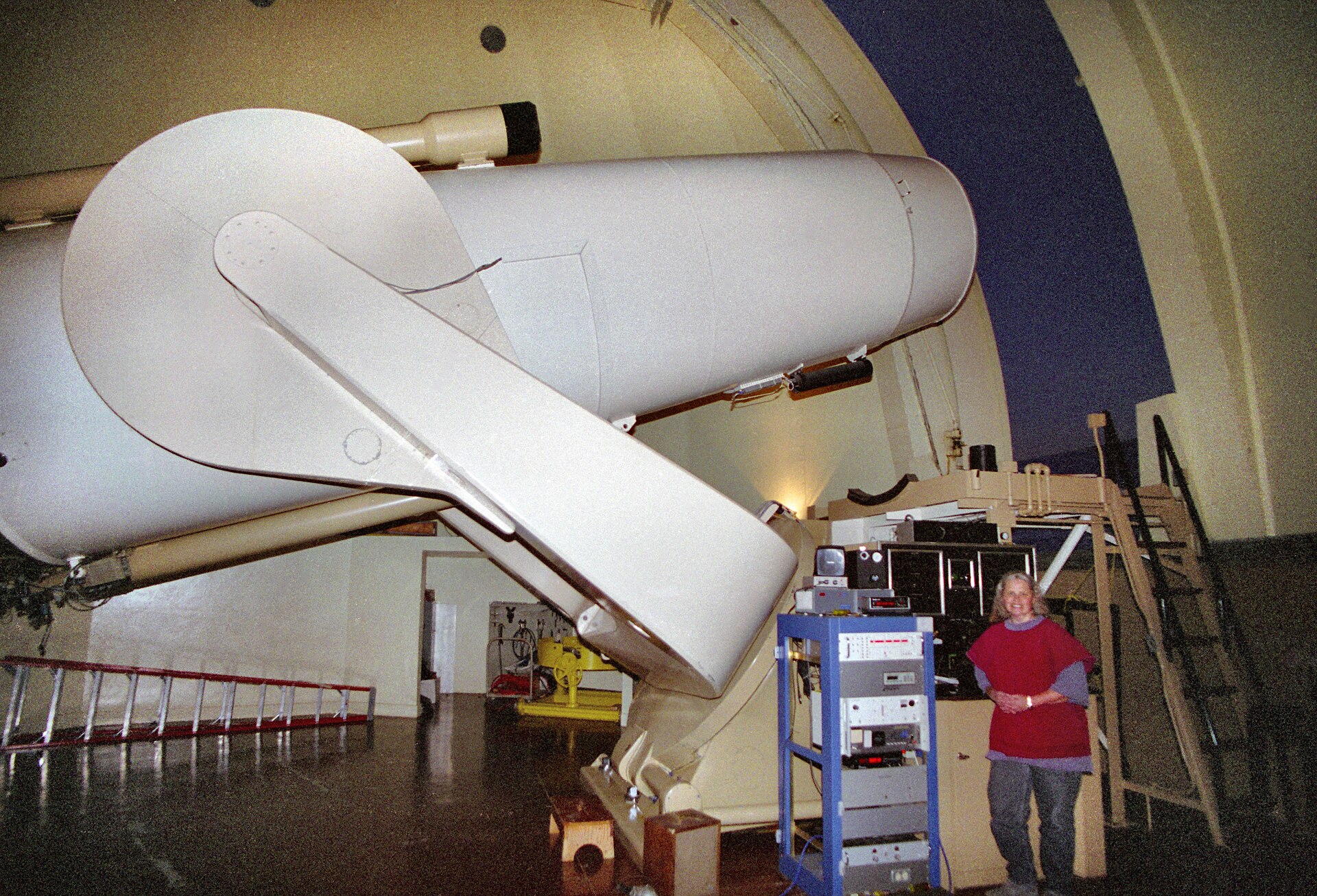
Astronomer Jean Mueller with the 48-inch Oschin Schmidt telescope at Palomar Observatory — the instrument that exposed the POSS-I plates on which every disputed transient candidate in this case was recorded.
Unknown (Palomar Observatory); scanned from the original by Michael Vergara · circa 1994 (per file title; upload 2007) · source · CC BY-SA 3.0
Every explanation must account for the same thing: a small, round, dark grain on glass.
Plate defects. Emulsion does not need the sky to make a dot. Critics note that decades of searching old plates for flashes from gamma-ray bursts ended without one confident find. They argue that ordinary emulsion, copying and scanning flaws make star-like marks often enough to contaminate any search for one-time flashesC101, a rate that is asserted but has never been measured. The account predicts candidates that resemble known defects and gather in plate corners and edges, and population patterns that fade when the catalog is rebuilt.
▸ claims behind this paragraph (1)▾ claims behind this paragraph
Natural bodies near Earth. One preprint accepts real near-Earth flashes but proposes icy dust clumping into metre-scale aggregates after geomagnetic storms. It shares the shadow prediction and differs on size and makeup.
Exotic physics. A dark-matter proposal takes the flashes' reality as its premise and says nothing about defects. It inherits the central question rather than answering it.
plate II · photograph — duotone applied in display; original unmodified
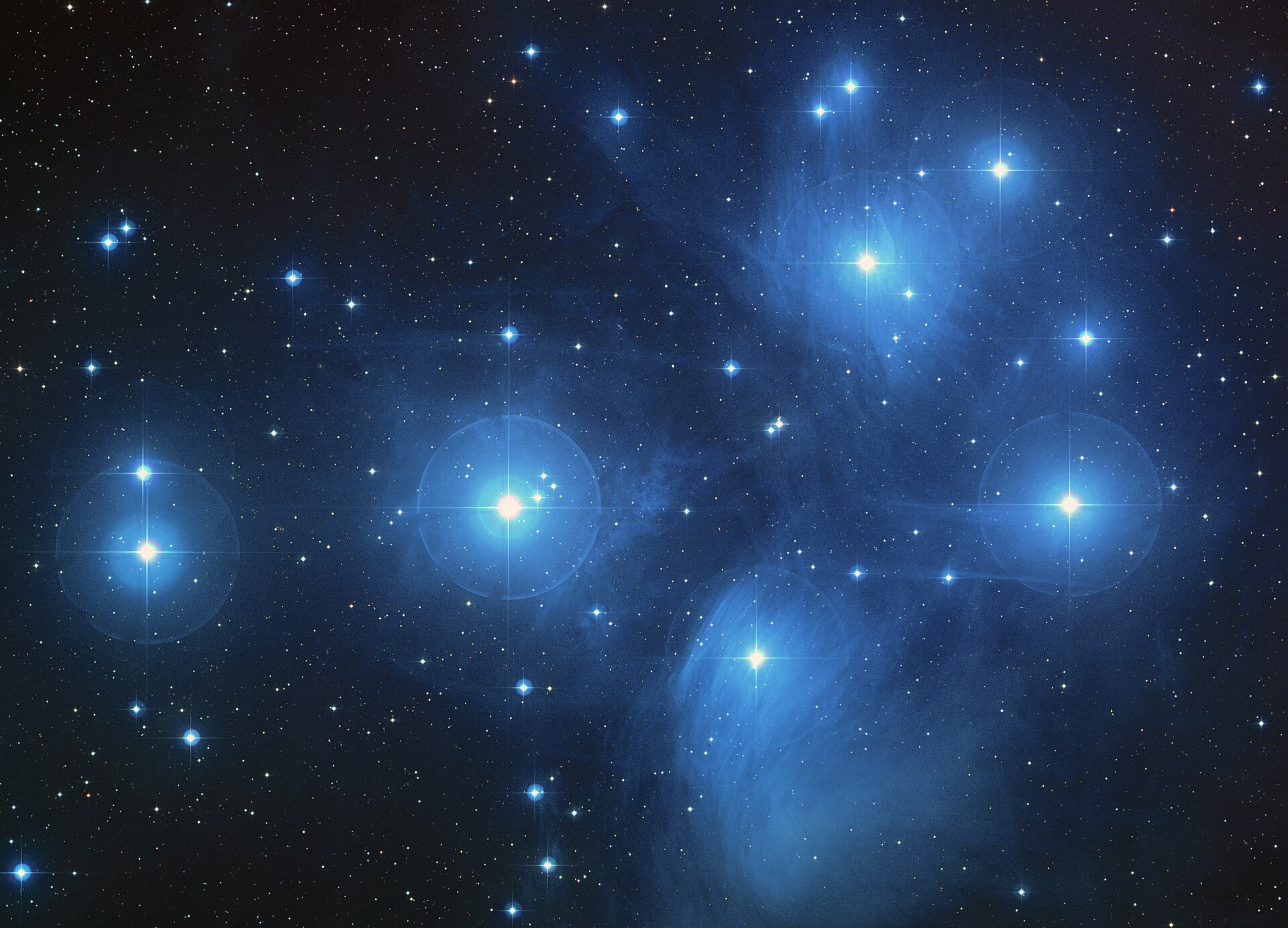
Context only — this image contains no transient candidates and is evidence for nothing in this case. The Pleiades star cluster as recorded by the Palomar Observatory sky survey (digitized Schmidt-plate imagery, released with the 2004 Hubble distance measurement), shown solely to illustrate what survey plate imagery looks like in general: thousands of star-like points per field, any one of which a transient search must distinguish from a defect.
Hambly and his coauthor Blair give the conventional account its strongest form. Their inspection found emulsion holes, bubbles and scratch-like marks on the copy plates, and appear-once detections on the neighbouring field too.
plate III · composite figure — duotone applied in display; original unmodified
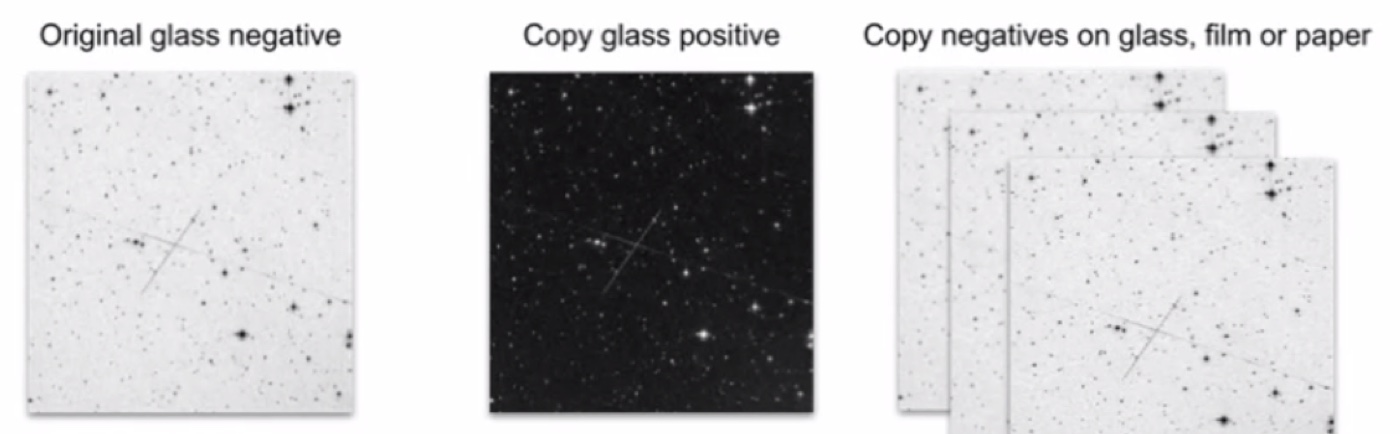
The generation chain that every published analysis in this case depends on. The Palomar survey's original glass negatives were contact-printed to glass positives, and those positives printed again to the second- generation copies that were distributed to observatories and later digitized. The two linear scratches visible in all three panels show what the chain does: a feature introduced at any stage is inherited by everything printed from it downstream, which is precisely why the generation at which a mark first appears settles whether it came from the sky (TRN-C020) and why two "independent" digitizations descending from a shared positive are not independent (TRN-C007). The scratches here are ordinary plate damage, not the disputed transients; no candidate source is depicted.
Not established; panels are reproductions of POSS-I plate material · 2026-08-24 (supplied) · source · Used with permission of the copyright holder
The account carries two debts. Nobody has measured how often copying mints star-like fakes, and it cannot reach plates outside the Palomar family.
The original glass
Only the original negative sits above the shared copy. A preprint by J. Yang and Beatriz Villarroel, not yet peer reviewed, reports microscopy of the negative that was in the telescope on 12 April 1950, now at the Caltech archive, registered star by star against the digitization. It also examines a Harvard copy of the 1952 plate. It finds all nine 1950 sources on the original negative at their published positionsC024, and the 1952 triple on the copy and in the original digitization. For the flagship events, the cousins are answered by the grandparent. The copying argument keeps its force only for the hundred thousand uninspected candidates.
▸ claims behind this paragraph (1)▾ claims behind this paragraph
There the good news stops, for everyone. The study states that microscopy cannot tell a brief flash from a flaw born in the emulsion, because single dots of both kinds look alike. Hambly himself directed the microscopist who examined the plate to the nine. The microscopist found them un-star-like and judged emulsion defects a reasonable attribution, noting that the field lies in a plate corner, where defects are commoner. The study prints that opinion against its own interest. It argues that, judged against steady stars, a sub-second flash should look like a defect. The clean escape would be the same flash caught at a second observatory at the same instant, and it is closed: no such plate exists.
The examination was not blind and has not been repeated outside the group. “Original or copy?” has an answer for these events; “sky or chemistry?” does not.
The case for light
The proponents answer the sharpness finding with physics. A star sits on the plate for the whole exposure, smeared by air and tracking. They argue that a flash under a second long has no time to smear and should look sharper and rounder than a starC102. It is a derivation, not a measurement: nobody has exposed period emulsion to controlled flashes and drawn the curve. Until someone does, sharpness is the case's most-cited observation and its least decisive.
▸ claims behind this paragraph (1)▾ claims behind this paragraph
The stronger development comes from outside Palomar. Ivo Busko, a retired Space Telescope Science Institute developer, searched same-night plate pairs from Hamburg Observatory. He reports appear-once candidates with narrow profiles on a different telescope, emulsion, archive and digitizationC010. The copying argument cannot touch them. Without a candidate rate against matched controls, though, “the same phenomenon” and “the same weakness of old emulsions” look alike.
▸ claims behind this paragraph (1)▾ claims behind this paragraph
His follow-up uses a Hamburg telescope with strong coma, the small comet-shaped smear its optics give to off-axis light. He reports that candidate images carry the coma pattern expected of light through the opticsC011. Scratches and chemistry do not know where the optical axis is; light does. If validated blind against known defects and deliberately made flashes, this would be a detector of real light usable on any archive. It has not been validated, it covers Hamburg only, and the paper says its data do not establish where the light came from.
▸ claims behind this paragraph (1)▾ claims behind this paragraph
Above the single events sits an argument from the whole catalog. The record here is mixed in a useful way: who reproduces what is its most informative feature.
Against this, Watters and colleagues, several of whom work in UAP-research organizations, show that the uniform background the test assumes is false. Candidates rise toward plate corners and edges and gather in clusters and voids. Under a proper null, in closely related datasets, the shortfall is not significant. At least 91% of the rows used belong to a set once removed for lying within 5 arcseconds of catalogued stars. The proponents reply that the critics' subset is twenty times smaller and underpowered. Their modelling preprint concedes part of the point, cutting its sky region to avoid empty stripes and edge effects that “may influence the results.” And the filter that strengthens the signal is the group's own classifier, trained on its own visual judgments. Removing defect-like rows sharpens any signal that defects dilute, whether or not what remains is sky.
But the one catalog rebuilt from whole-plate scans, by Hayes, finds no significant effect once nightly sky coverage is modelled. The relative risk is 1.35 with an interval that includes no effect, and 1.03 in the exposure-weighted model. Watters traces the timing mostly to the observing schedule. The hotspot preprint also reports, in a passage not yet checked here, that all 203 high-probability candidates from the night before the Castle Yankee test project onto Pacific regionsC125. Those are one night's plates, which a direct audit could examine.
The pattern is the tell: the correlations reproduce on the proponents' catalog and fade when the catalog is rebuilt. That does not prove them artifacts; it makes the catalog the battleground. And even a surviving nuclear link would fit fallout reaching the plates as well as glinting objects.
It then argues that among the models it tried — natural bodies, dusty plasma, non-human intelligence — only the last fits all five reported featuresC118. The five are sharp profiles, groupings, the shadow shortfall, nuclear timing, and the geomagnetic pattern. That is a fit among a hand-picked set, built on features contested at the catalog level, and the authors add that nature can always surprise us. The hotspot paper's authors call the intelligence reading “unfortunately not falsifiable.” Nothing in the record tests an extraterrestrial origin. Even a proven pre-Sputnik object would need a separate argument before that word earned its place.
▸ claims behind this paragraph (1)▾ claims behind this paragraph
The marks are on the plates, and independent software finds them: settled. The flagship nine are on the original negative: reported, awaiting review. The population patterns describe the sky: contested, surviving only in the catalog where they were found. Some mark was made by light: unresolved, and everything above depends on it. The light came from near Earth: unresolved. Artificial objects orbited before Sputnik: the headline, unresolved. They were extraterrestrial: not testable now, by its proponents' own account.
What would change our mind
Toward light: - a blind test of the coma signature that separates deliberately made flashes from the full range of defects; - a calibration on period emulsion showing the nine marks match sub-second flashes and not flaws; - a shadow shortfall in an independently extracted catalog, under a preregistered null that models the plate background as it is.
Toward defects: - a measured count of star-like flaws per copying stage, at the rates the catalog needs; - the Castle Yankee-night candidates concentrated on one or two plates, with edge clustering and defect shapes; - the coma test failing; - Hamburg-style candidate rates that match defect rates on matched controls.
Between the two near-Earth accounts: an altitude that survives independent shadow code and orbital motion, and a size estimate that does not depend on excluding the brightest candidates.
Microscopy of single dots has done what it can. Three things still discriminate: the coma signature, statistics on catalogs nobody's thumb has touched, and, for any future flash, simultaneous imaging from two or more stations. That last turns one ambiguous dot into a measured distance or a local artifact.
the argument ladder
evidence for a lower rung does not automatically climb
Attribution
Was it actually done? The claims the thesis stands or falls on.
The strongest records on each side, structurally symmetric. Every record separates what the source states from what we infer. Browse the full ledger (56 records) →
strongest supporting
▲Supports· strongTRN-E002
Physical confirmation of the nine marks on the Edinburgh glass copy
what the source states
Visual inspection of the Royal Observatory Edinburgh glass copy plates of POSS-I fields E0070 and E0086 confirmed the presence of nine point-like detections on E0070 at the positions reported by Villarroel et al., absent from the overlapping plate E0086 exposed six days later — while also finding similar detections on E0086 not present on E0070, and various blemishes (emulsion holes, bubbles, scratch-like marks) on both copy plates.
what we infer
Independent physical confirmation from the critics' side settles the lowest rung — the marks are real features of surviving plate material, not scanner artifacts. The same inspection seeds the undermining case: the phenomenon recurs on a neighboring field, and the plates carry a visible defect population.
limitations
Independent physical copy, not the original negative: the ROE copy is itself a descendant of the intermediate positive (see TRN-C007).
Profile statistics: all nine 1950 marks are sharper than stars
what the source states
SuperCOSMOS profile statistics for the nine candidates all fall on the sharp (negative) side of the zero-mean stellar distribution, roughly −3 ≲ η < −1; the joint probability of drawing nine such values from the stellar profile distribution is of order 0.1⁹. Under the microscope the marks appear more concentrated and circular than stellar images of similar brightness.
what we infer
The measurement itself is common ground between the camps; only its interpretation divides them. This record carries the observation; TRN-E004 and TRN-E006 carry the rival readings.
limitations
Measured on the digitized copy lineage; profile statistics for the original negative do not exist.
The plate-copy genealogy: DSS and SuperCOSMOS share an ancestor
what the source states
Atlas copy production used contact printing: an intermediate glass positive was made from each original POSS-I negative, and second-generation copy negatives were printed from that positive. The DSS and SuperCOSMOS data used in the transient studies are independent scans of independent copy negatives that were generated from the same copy positive of the one original negative.
what we infer
This dissolves the "found in two independent digitizations" argument that made the candidates look robust: a defect on the shared intermediate positive would propagate into both datasets. It simultaneously defines the decisive test — only the original negatives sit above the shared stage.
limitations
Establishes a pathway, not an occurrence rate; no census of star-like copy-stage defects exists (TRN-R007).
Independent extraction finds no significant nuclear-window effect
what the source states
Applying nuclear-test temporal windows to the independently extracted catalog over 368 POSS-I observation nights gives a post-test calendar-day relative risk of 1.35 ([+1] window) that is not statistically significant (95% CI 0.91–2.00, Fisher p = .17) and is schedule-sensitive; a negative binomial model of nightly counts with nightly patch coverage as exposure is null (IRR = 1.03, 95% CI 0.89–1.18, p = .71), as are all asymmetric windows tested.
what we infer
The single most probative negative result for the nuclear correlation, because it varies the disputed step (source extraction) and models the observing schedule — the two main confound channels. A correlation that replicates on the original rows but not in an independently built catalog looks like a property of the catalog.
limitations
The independent catalog was built with preliminary parameters and averages ~7,250 candidates per night — mostly noise — so a real but weak effect could be diluted below detectability.
The Watters reanalysis: no shadow deficit, schedule-driven timing, unvalidated datasets
what the source states
Using two previously published datasets closely related to those in the Villarroel et al. studies: the uniform-random background assumption essential to the Earth-shadow analysis is false (feature counts are spatially heterogeneous, rising toward plate corners and edges, with geometric clusters and voids); after deriving the proper null distribution there is no statistically significant shadow deficit; the nuclear-test correlation becomes insignificant after normalizing by the number of observation days and is almost completely determined by the Palomar observing schedule; at least 91% of the features used in the ensemble studies belong to a set earlier removed for lying within 5 arcsec of catalog stars; a third of the reported linear-cluster features were not confidently distinguished from catalog stars; and it has not been shown that any features in these datasets represent optical transients.
what we infer
The most comprehensive undermining record in the case: it attacks the dataset definitions underneath both headline correlations, not just the statistics on top. Its force depends on how well its closely-related-but-not-identical datasets proxy the actual working catalog — the exact point the proponents' rebuttal presses.
limitations
Works from related public datasets rather than the exact 107,875-row working catalog used in the disputed papers.
The vetted subsets it favors are much smaller; the proponents argue the resulting power loss can hide a real effect (TRN-E012).
Automated morphology classification groups the marks with artifacts
what the source states
A random-forest classifier trained on Gaia-confirmed stars, Pan-STARRS-confirmed galaxies, and unmatched (likely spurious) detections assigns the putative transients artifact-like morphology; the authors conclude the sources are likely spurious artifacts of the photographic emulsion.
what we infer
The strongest published argument that the sharpness observation points down the artifact branch. Note its dependence structure: the classifier is built on the same profile statistics as TRN-E003, so this is an interpretation layer over the same measurement, not a second independent detection.
limitations
The training set's 'spurious' class is defined by absence of a modern counterpart — the very property that defines transient candidates — so a real transient population would also be labeled artifact-like by construction; the proponents press exactly this circularity objection.
Morphological similarity to artifacts is not a demonstration that any specific mark is one.
steelmanned — the account the featured hypothesis must beat
Photographic archives make star-like marks without any sky event: emulsion flaws, development chemistry and handling damage. For this survey, defects on the shared intermediate positive from which both major digitizations descend mean one copying flaw appears “independently” twice. The critics found emulsion holes, bubbles and scratch-like marks on the copy plates, and appear-once detections on the neighbouring field. The microscopist who examined the original 1950 negative judged emulsion defects a reasonable attribution, in a plate corner where defects gather. On this account, the population patterns belong to an unvalidated working catalog, at least 91% of whose rows were earlier set aside as lying near catalogued stars. The observing schedule and a plate background that rises toward corners and edges do the rest. The patterns reproduce when the rows are reused and vanish when the catalog is rebuilt. The account's unpaid debts: no measured rate for star-like defects, and no reach over an independent archive whose candidates reportedly carry the optical signature of real light.
What would change our mind
The case does not end in a verdict; it ends in the studies that would move it, in the order this edition judges they would move it most. A result in either direction counts.
TRN-R003Publication prize · Lab
Blind validation of the coma-aberration discriminant
Build a corpus of known stellar images, deliberately generated sub-second flashes, and the full defect bestiary (scratches, emulsion holes, dust, copy defects, scanner artifacts), plus unknown historical candidates. Freeze Busko's coma classifier before labels are revealed and measure its confusion matrix.
expected information gain
The June 2026 coma result is the strongest new positive line in the case; this test either certifies a physical incident-light detector usable across every plate archive, or closes the line.
Flash-profile calibration on historical Schmidt emulsions
Expose comparable photographic emulsions in a Schmidt system to controlled flashes from milliseconds to seconds alongside continuously illuminated artificial stars; quantify FWHM, profile shape, grain structure, and guiding contribution. Converts the "sharp means artifact" versus "sharp means sub-second flash" standoff into a calibration curve.
expected information gain
Turns the case's pivotal shared observation (TRN-C002) from direction-ambiguous into diagnostic, in whichever direction the calibration falls.
Full independent reconstruction of the VASCO working catalog
Starting from archived whole-plate scans, publish every cut and attempt to reproduce — not merely receive — the ~107,875-object working set. The Hayes result shows why this matters: reasonable independent extraction preserves the canonical events while generating a background population 500 times larger, and every ensemble statistic inherits the catalog it runs on.
expected information gain
Decides whether the ensemble evidence base is an object of study or an artifact of one workflow; prerequisite for every preregistered statistical test below.
Nuclear-window correlation with a preregistered exposure denominator
Rebuild the temporal analysis using raw plate logs to compute the actual searchable solid-angle × time × efficiency for each night, with the nuclear-window definition frozen before outcomes are examined. The Doherty/Hayes split — replicates on the original catalog, vanishes under independent extraction with exposure modeling — makes this the cleanest outstanding statistical crux.
expected information gain
Either retires the case's strangest correlation as a scheduling artifact or establishes it against the strongest known confound — and if it survives, forces the fallout-contamination versus glint-population question into the open.
▸ 8 more studies on the agenda▾ the rest of the agenda
TRN-R005Publication prize · Desk
Preregistered Earth-shadow analysis across independent pipelines
At least three teams independently define candidate catalogs; plate masks, detection thresholds, shadow-geometry assumptions, background model, and statistical tests are frozen before any shadow calculation is run. A deficit appearing across independently constructed catalogs would be qualitatively stronger than any re-analysis of the same rows.
expected information gain
The shadow deficit is the best geometric evidence the near-Earth hypothesis has; this design gives it a fair chance to survive or fail in public, with the Watters background objection built into the nulls.
Plate-level audit of the Castle Yankee night (3–4 May 1954) and the 12–13 March 1955 nights
Identify from the STScI XE plate list every POSS-I red plate exposed on the night before Castle Yankee and on the nights around the 12 March 1955 Nevada test; for each plate, count the high-probability (p ≥ 0.90) transients per plate and per plate quadrant, measure the edge concentration and profile statistics of those detections against matched stars, and compare per-plate detection rates with the distribution of per-plate rates across all 635 plates. Then examine the copy material for those plates under magnification, as Hambly and Blair did for E0070. If the 203 Castle Yankee-night candidates are concentrated on one or two plates with anomalous defect morphology or edge clustering, the plate-artifact account stands but TRN-C006 and the clustering claims lose their high-probability support to a plate explanation; if they are spread across many plates with star-like, coma-consistent images at rates far above the per-plate norm, TRN-C006 gains a plate-level foundation it currently lacks.
expected information gain
Converts the nuclear-window question from a row-count correlation over 107,875 candidates into an inspectable property of a handful of physical plates; either outcome is decisive for the high-probability subset's contribution to TRN-C006.
Rate-based independent-observatory search with matched controls
Extend the Hamburg/APPLAUSE approach to additional plate archives with matched plate-pair cadence and known exposure metadata. The deliverable is not "examples found" but a measured transient-candidate rate versus matched controls, with injection/recovery completeness and per-archive defect rates.
expected information gain
Distinguishes "the sky did this everywhere" from "old emulsions fail similarly everywhere" — the question the preliminary Hamburg sample cannot yet answer.
Measure how often star-like marks are created at each stage of photographic duplication — original, intermediate positive, copy negative, scan — using archives where multiple generations survive. Hambly & Blair supplied the mechanism; this measures its base rate.
expected information gain
Converts the case's strongest mundane mechanism from a possibility argument into a quantitative prior — with the side effect of calibrating every historical plate-transient search, VASCO or not.
Preregistered shell-altitude fit with orbital dynamics and independent shadow code
Reimplement the antisolar-angle deficit profile with an independent shadow calculation (not the earthshadow library), include orbital motion and phase-angle brightness in the forward model, and fit the shell altitude on (a) the VASCO working catalog, (b) the p > 0.7 subset, and (c) Hayes's independent catalog, reporting a formal confidence interval and goodness of fit. The altitude claim moves if all three catalogs return overlapping intervals inside 20,000–36,000 km with acceptable reduced χ²; it fails if the independent catalog shows no altitude-dependent structure or if the preferred altitude tracks the spatial cuts rather than the data.
expected information gain
Replaces a range described by its authors as not a confidence interval with a preregistered estimate on a catalog nobody's thumb has touched; a null on the independent catalog would remove the altitude inference and with it the projection on which the hotspot results depend.
Altitude- and grid-robust hotspot test on an independently extracted catalog
Repeat the Earth-projection excess analysis using Hayes's independently extracted candidate list (SRC-HAYES-2026) rather than the VASCO working catalog, at assumed altitudes of 20,000, 25,000 and 35,786 km, with 5°, 2.5° and 10° cells and shifted grid origins, and with a preregistered control built from the same plates; for the clustering method, derive a null distribution of silhouette values from at least 1,000 random control draws rather than three. The hotspot claims move if the same Earth regions recur across altitudes, grids and the independent catalog with silhouette values outside the control distribution; they fail if the regions migrate with altitude or vanish on the independent catalog.
expected information gain
Separates sky structure from projection geometry, working-catalog composition and survey footprint — the three confounds the current analysis shares across both of its 'independent' methods.
Blind examination of the original POSS-I telescope negatives
Locate the original negatives for the April 1950 nine-source field and the July 1952 triple, plus all surviving intermediate positives and duplicate negatives. Image every candidate coordinate at high resolution — with analysts blinded to which positions are candidates — and record at which generation of the copying chain each mark first appears. Status, 2026-08-24: the core examination has now been performed and reported in an unpublished manuscript this project has read (SRC-YANG-VILLARROEL-2026; results recorded as TRN-E022 through TRN-E024). All nine 1950 sources are on the original glass, which retires the original-versus-copy question for the canonical events — and the manuscript itself reports that microscopy cannot classify individual features as flash versus emulsion defect, which caps this item's remaining discriminating power. What stays open, and what this item now means: publication and outside verification of the registration analysis; a blinded repeat by a party outside the group; and the per-generation first-appearance census across the copy chain, which was not performed and which is the piece that would put a measured base rate under the copy-defect debate (with TRN-R007).
expected information gain
Revised downward, honestly: the decisive either/or this item once promised — artifact economy collapses, or the canonical events close forever — is no longer on the table, because the examination happened and returned neither. Presence on the originals is established (pending review); flash-versus-defect is beyond microscopy. The remaining gain is confirmatory and adversarial — an outside, blinded repetition that either ratifies or breaks the registration the manuscript's conclusions rest on.
Purpose-built multi-station simultaneous imaging for future transients
The prospective test the microscopy manuscript itself proposes after concluding that per-source plate inspection is exhausted: two or more stations separated by a baseline of order 100-1000 km imaging the same field synchronously with deep, short exposures. A flash recorded at both sites is celestial or near-Earth, and for nearby objects the parallax gives a distance outright; a flash at one site only is flagged as local or instrumental at the moment of detection. This converts the single ambiguous dot that microscopy cannot classify into a measurement, and it is the same logic the Earth-shadow filtering already applies to modern survey data — but engineered in, before the fact, rather than reconstructed afterwards.
expected information gain
High for the phenomenon, nil for the historical events: no retrospective analysis can add a second site to 1950. If analogous transients still occur, this is the instrument that would settle their nature per event rather than per population; if they no longer occur, a well-run null is itself informative about the pre-Sputnik population's origin.
Trust comes partly from showing changed minds. Each entry is an edition that changed a verdict, with the word before and the word after — a reversal included.
Aletheia records every change to a case: what changed, why, and who made it — including the AI's role. The latest:
Corrections applied from PR #286 panel review (GPT-5.6 Sol seat: same-case shorthand ids escaped the check): TRN-E078.limitations — ["Single assumed altitude; no sensitivity analysis…
Corrections applied from review note #285 (GPT-5.6 Sol seat on #283): the dangling-id check must hold for every record: TRN-E038.editorInference — "This narrows the natural near-Earth…
Intake from report proposals/2026-09-10-inbox-transients-173613/report.md: 2 source(s), 32 evidence record(s), 18 claim(s), 3 research item(s) verified and added (proposal…