Deep Memory/ An inquiry into ancient resemblance
Essay

A theory from the south

One writer has offered a single story for all of it. Bruce R. Fenton argues that the carvings of Göbekli Tepe are late expressions of a far older sacred tradition whose living descendants are in northern Australia, carried there and onward by a seafaring people whose homeland now lies under the Java Sea.

Fenton is an independent researcher and the author of The Forgotten Exodus: The Into Africa Theory of Human Evolution (2017). He first set Göbekli Tepe beside Aboriginal Australia in 2017, reading incised sacred objects, clan totems and the site's one female figure as southern, and the enclosures as a rite to placate the Rainbow Serpent and reverse the floods of the Younger Dryas; the excavation team replied that year. In February 2025 he restated and extended the argument in an illustrated thread on X, from which every picture and quotation below is taken. This section states the theory as he states it, in his order, and then notes what the thread does and does not supply; where this project has since identified a picture or checked a claim, the note says so. The full transcript, with an addendum recording the checks, is kept with the research files.

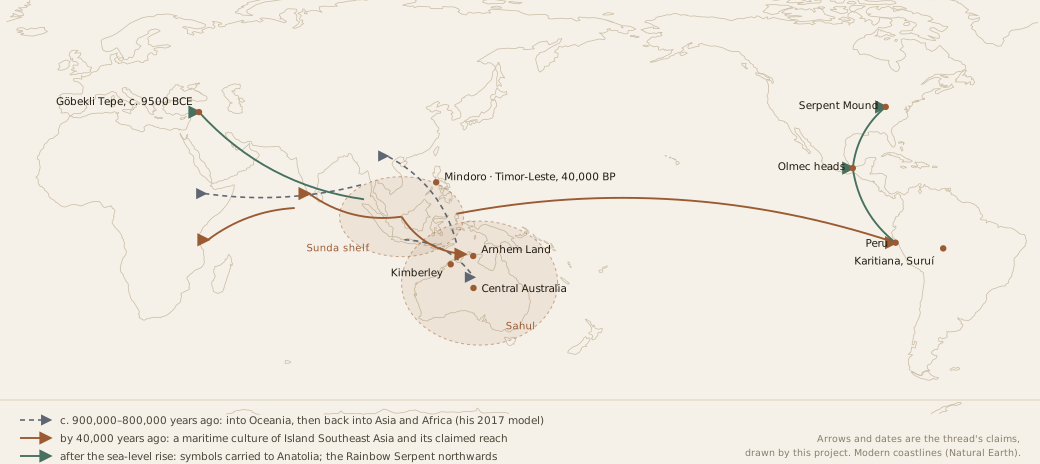
The theory in five moves
  1. A southern cradle. Our ancestors split from Homo erectus in Southeast Asia and entered Oceania about 900,000 years ago. The ancestor of "ALL large-brained human species" arose there around 800,000 years ago and later moved back into Asia and, in his book, Africa.
  2. A drowned maritime world. By 40,000 years ago a seafaring culture spanned Island Southeast Asia. It reached northern Australia, southern Asia, Africa and the Americas, and shared its waters with Denisovans, Neanderthals and other human species. Comet impact and solar outbursts brought a climatic shift and a 130-metre rise in the sea, which sank its heartland on the Sunda shelf.
  3. An original Lore. Before 20,000 years ago all humanity shared one story: Serpent, Tree, Spring, Seven Sisters and Three Brothers, kept in a feminine, matrilineal Lore. The Emu stole the sacred fruit, the ceremonies were "corrupted and stolen by man", a thousand years of war followed, and then the flood. Australia was the ark.
  4. Göbekli Tepe as the threshold. Its bird and ball, buckets, clan totems, bracketed glyphs, T-shaped pillars, birthing goddess and mushroom-headed snakes are the southern symbol set carried north. It marks the moment when "we left the animism of the bush", cultivated barley and drank ergot-laced beer at ceremonies timed to the Taurid meteor stream.
  5. The same story in the Americas. Australasian ancestry in Amazonian and Peruvian genomes arrived by ship. The Olmec colossal heads portray Oceanian mariners and may be more than 10,000 years old. The Rainbow Serpent, with its two feathers, became the feathered serpent of Mesoamerica and the Serpent Mound of Ohio.
World map centred on the Pacific with arrows for the movements Fenton claims: into Oceania about 900,000 years ago, back into Asia and Africa, the reach of an Island Southeast Asian maritime culture by 40,000 years ago, and later routes to Anatolia and northwards through the Americas
The movements as claimedDrawn by this project from the thread and Fenton's 2017 model. The arrows show what the theory asserts, not evidence for it. Modern coastlines from Natural Earth.

Start with the bird and the ball

The thread opens where this site's bird comparison does: the vulture and disc on Pillar 43. Beside it Fenton places a striped, upright figure from Arnhem Land with a rayed ball at its shoulder, and reverses the usual direction of the argument. The Australian painting, he says, came first.

The one on the left is older. There are two interesting stories: the meaning of that bird and ball and how that same sacred art appeared millennia later, thousands of miles away across the ocean.Fenton, 24 February 2025

The pillar detail is securely identified. The painting's site, style and date are not given in the thread, and the claim that it is older than 11,500 years rests on them; an image search in September 2026 did not find the painting. In September 2026 Fenton added a second reading of the pillar: the bird wears a V-neck top like Urfa Man's, so it is a bird-man, and a reader added that its knees bend forward like a person's. Both details are examined in Bird, or bird-man?
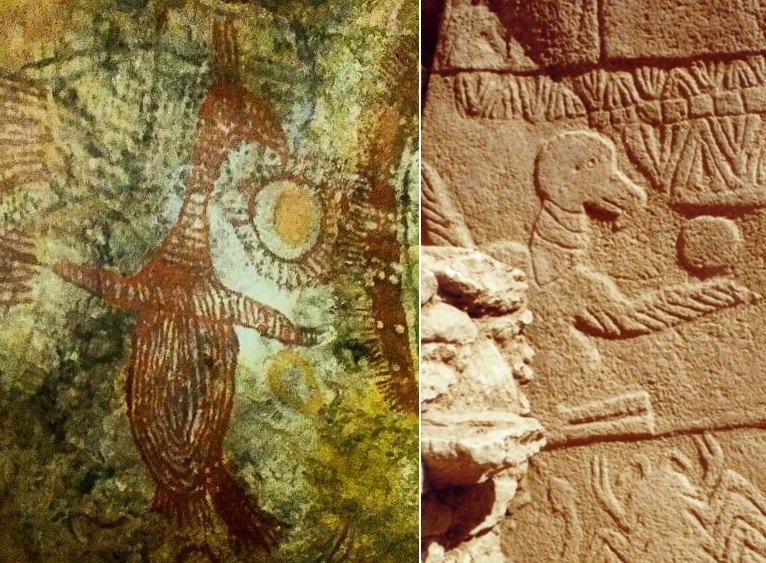
Left: a red-striped upright figure painted on rock with a rayed disc beside its head. Right: the bird and disc carved on Göbekli Tepe Pillar 43
The opening comparisonArnhem Land, undated · Göbekli Tepe, c. 9500 BCE. Fenton's first image. The figure's bent limb and the ball beside it are the shapes he asks the reader to match.

Buckets, totems and the sprouting yam

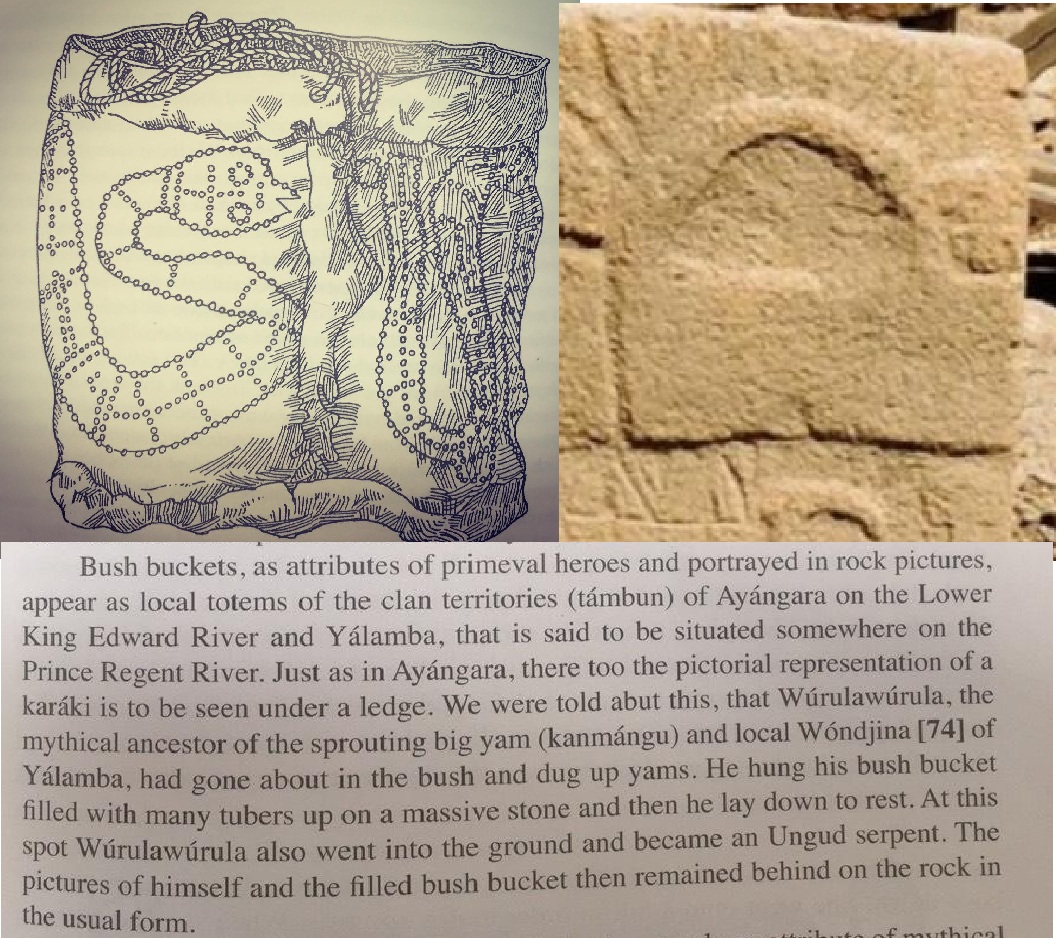
The three handled shapes across the top of Pillar 43, the handbags of so many comparisons, are for Fenton bark buckets, and the small animals beside them are clan totems. His witness is a drawing of a painted bark "bush bucket" and a passage of Kimberley lore printed beneath it.

Buckets and serpents portrayed on large rocks are a tradition that goes back much further than 12,000 years ago.Fenton, 24 February 2025

The passage tells how the ancestor Wúrulawúrula, "the mythical ancestor of the sprouting big yam", dug yams, hung his full bucket on a massive stone, lay down to rest, went into the ground and became an Ungud serpent. His picture and the filled bucket "remained behind on the rock in the usual form." In that one story Fenton finds the bucket, the rock picture and the serpent of Pillar 43 together, with the yam as the sacred thing they carry.

The thread does not name the book. The rivers, the spelling and the words Wóndjina and Ungud match Andreas Lommel's ethnography of the Unambal of the north-west Kimberley, published in 1952, some 800 km west of Arnhem Land, and a search inside its 1997 English edition finds "bush buckets" on one page. The bucket's ethnographic date is the twentieth century; its antiquity is the claim.

A line drawing of a painted bark bucket with a looped handle, a photograph of one arched shape on Pillar 43, and a printed paragraph about bush buckets, the ancestor Wúrulawúrula and the Ungud serpent
Bush bucket, Pillar 43 and the loreDrawing and text from an unnamed publication · Göbekli Tepe, c. 9500 BCE. The printed excerpt is reproduced as Fenton posted it.

Marks on the body, marks on the stone

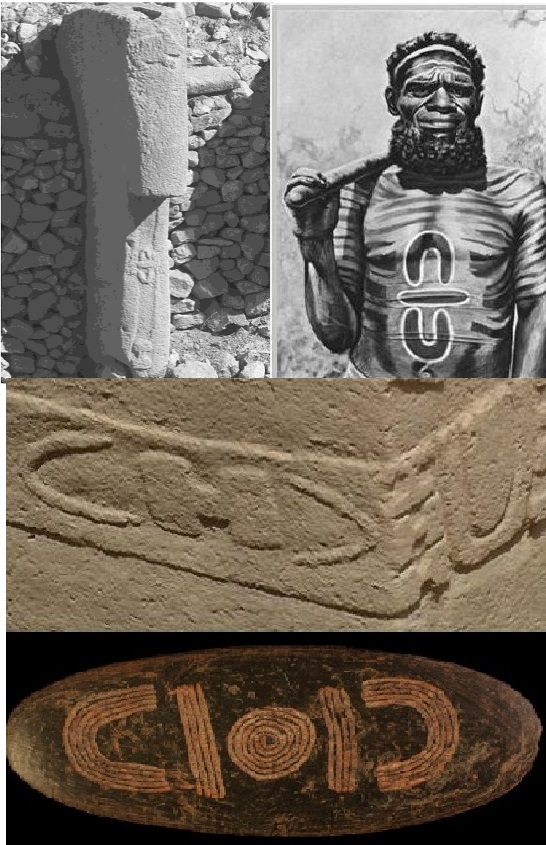
Churinga, or tjurunga, are the incised stone and wooden objects of Central Australia, kept from the uninitiated and engraved with arcs, bars and concentric circles. Fenton sets one beside a bracket-and-disc glyph on a Göbekli Tepe pillar, a relief with bracketed shapes, and a man whose painted chest carries the same design.

While these examples are not identical, it is obvious that we are dealing with symbols sharing a common root.Fenton, 24 February 2025

In its 2017 reply to an earlier version of this comparison, the excavation team observed that the Göbekli Tepe sign has two vertical arms which the Aboriginal sign lacks, and that a superficial likeness does not establish a link. The painted man is a printed portrait held by the Wellcome Collection, captioned "the wizard of the Worgaia, a great medicine man of Central Australia, as the signs on his body show"; its date and first publication are not recorded there. The pillar numbers and the churinga's collection are not identified in the thread.

Montage: a T-shaped pillar with a bracket-and-disc glyph, a man with a painted chest design of brackets around a bar, a relief of bracketed shapes on stone, and an oval churinga incised with arcs and concentric circles
Glyph, body paint, relief, churingaGöbekli Tepe · Central Australia; the portrait is a Wellcome Collection print. Four objects Fenton reads as one family of signs. The concentric circles, he wrote in 2017, are watering holes.

The T

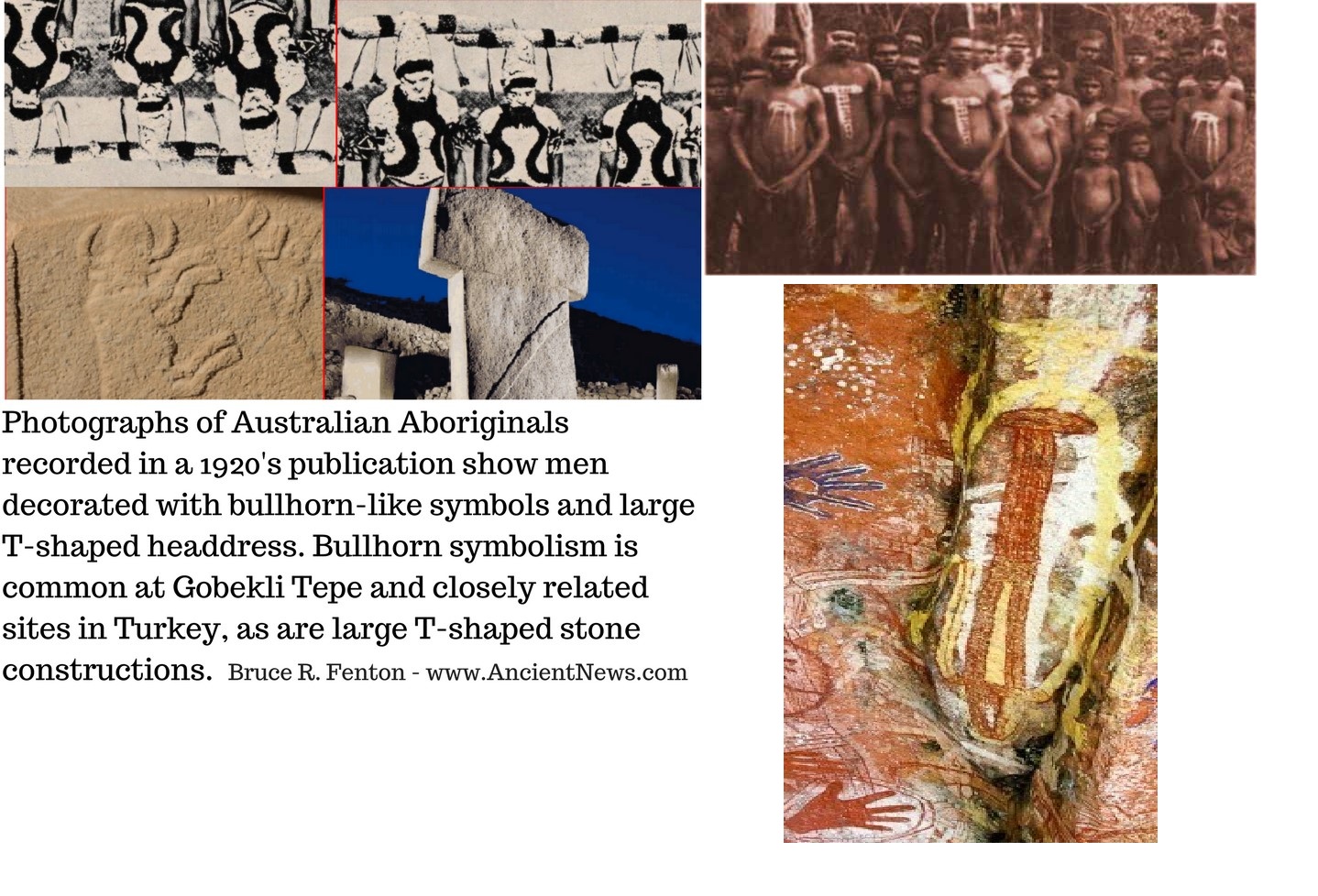
The T-shaped pillars are the most recognisable thing at Göbekli Tepe, and the central pairs in Enclosure D carry arms, hands and belts: they are figures, as the hands section discusses. Fenton's answer from the south is a montage of early photographs of men in tall ceremonial headdresses, a group with painted chest designs, and a rock painting of a long vertical form with a crossbar at the top.

Again we can turn to Northern Australia and find a wealth of linked symbolism including men with T head coverings and art depicting what look like T-shaped stone columns with human legs.Fenton, 24 February 2025

His caption adds "bullhorn-like symbols" and bull imagery at Göbekli Tepe and related sites. The 1920s publication is not named. The headdress photographs match the subjects and style of Spencer and Gillen's Arrernte ceremony photographs of the 1890s, which their later books reprinted; the exact plates have not been identified, and the rock painting's site has not been found. Whether the painted form is a column, a figure or something else is the question the picture poses.

Fenton's captioned montage: early photographs of men wearing tall ceremonial headdresses, a Göbekli Tepe animal relief, an illuminated T-shaped pillar, a sepia group photograph of men with painted chest designs, and a rock painting of a long vertical form with a crossbar and hand stencils
Headdresses, pillars and a painted columnMontage by Bruce R. Fenton, AncientNews.com. His caption is part of the image.

Yinganna, mother and serpent

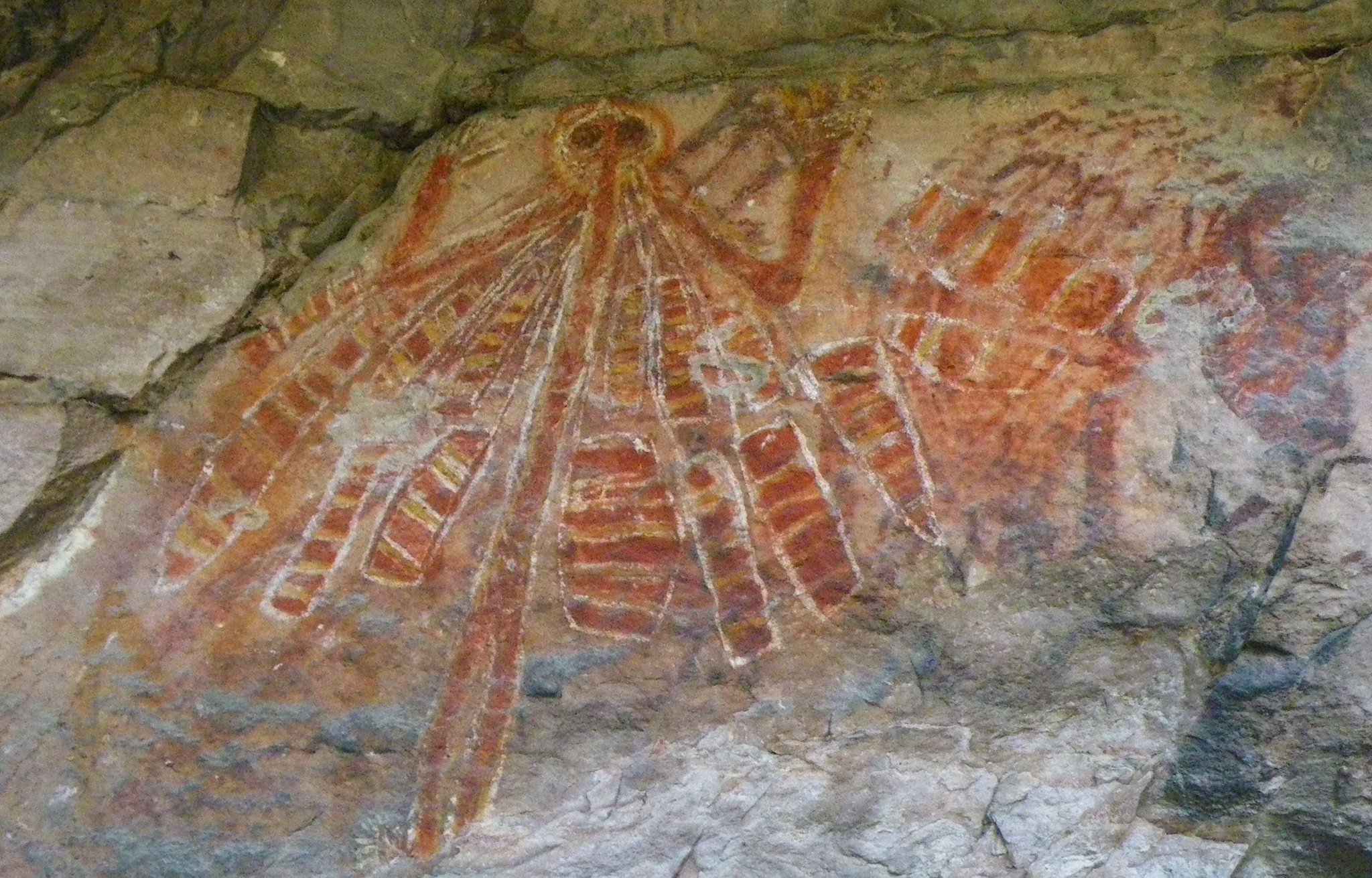
The theory's central figure is a woman who is also a snake. Fenton introduces Yinganna as "a creation spirit and mother goddess figure" who walked the land with her bark buckets, each holding a tribe of people with their animal totems and their lore, and who is "an alter-ego of the infamous rainbow serpent". He points to her head, "shaped like a sacred yam leaf".

In the Kunwinjku accounts of western Arnhem Land, Yingarna is the first mother, who carried the first people in her dilly bags and set them down in their countries; Ngalyod, the Rainbow Serpent of the wet season, is her child. The painting is the Yingarna figure on Injalak Hill beside Gunbalanya, identified here by comparison with published photographs: she is shown with fifteen striped dilly bags hanging from a headband, which is the "yam leaf" Fenton sees. A 2026 survey by Taçon, May, Jalandoni and Mungulda counts it among the region's recent Rainbow Serpent paintings, made after European contact. Taçon, Wilson and Chippindale's study of Arnhem Land rock art places the earliest Rainbow Serpent paintings some 6,000 to 4,000 years ago, in the time of the post-glacial floods.

A large rock painting under an overhang: a round head with two eyes at the top and long banded limbs radiating downwards in red and white ochre
The figure Fenton names YingannaInjalak Hill, Gunbalanya, western Arnhem Land; a recent painting. "Notice her strange head, which is shaped like a sacred yam leaf."

The woman in the Lion Pillar Building

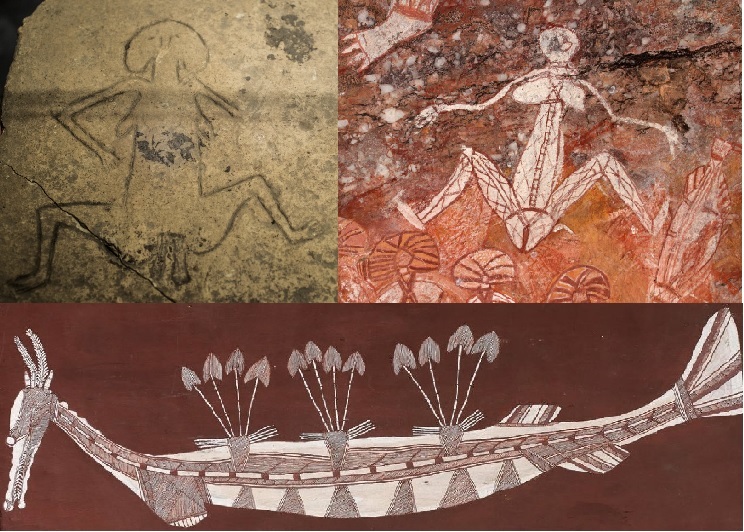
Göbekli Tepe has, in Fenton's words, "a glaring absence of female art", with one exception: a woman incised on a slab in the Lion Pillar Building, squatting with her legs apart and her genitals drawn large. He reads the posture as childbirth and the rounded head as a mushroom, then supplies the Australian key: Yinganna painted in the same posture, and the "mushroom" as a yam leaf.

We can see more of these yam leaves erupting from the back of a rainbow serpent painted in its chimaera form (note the two feathers on the head; it is a feathered serpent).Fenton, 24 February 2025

The excavators describe the incised woman as a later graffito on the slab rather than part of the original decoration. The Arnhem Land painting and the bark painting are not identified in the thread, and an image search did not find them. Plants growing from the Rainbow Serpent's back are a familiar feature of western Arnhem Land painting.

Top left: a woman incised in outline on a stone slab, squatting with legs spread. Top right: a rock painting of a white figure in the same posture above rounded plant forms. Bottom: a bark painting of a long serpent with plants sprouting from its back and two projections on its head
Two squatting figures and a serpentGöbekli Tepe, Lion Pillar Building · Arnhem Land, undated · bark painting, undated. The comparison turns on posture, genitals and the shape of the head.

Snakes with mushroom heads

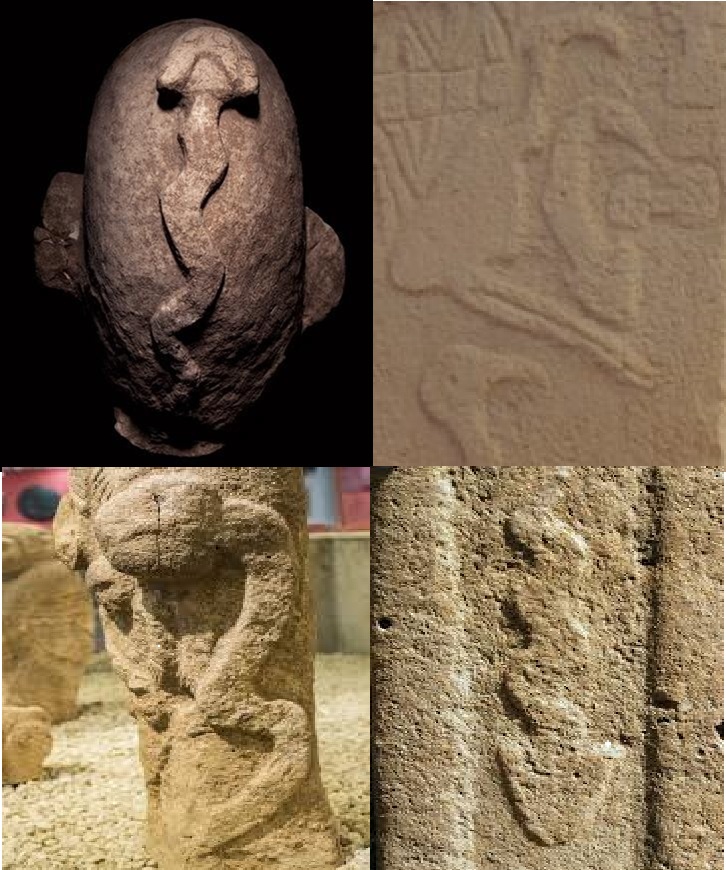
Snakes are the most frequent animal at Göbekli Tepe, in bundles on pillars, singly on sculptures and in the lower registers of Pillar 43. Many have broad, flattened heads. For Fenton this is the identifying mark.

That's because this is no ordinary snake; it is a rainbow serpent, and the head is again akin to what we have seen in art representing the serpentine mother goddess Yinganna. Note here that rainbow serpents are dual, with male and female forms.Fenton, 24 February 2025

The serpents section keeps the broad category "snake" apart from specific combinations. Which of the four carvings come from Göbekli Tepe rather than related sites is not stated in the thread. Viper heads are broad; whether the carvers meant a species, a spirit or both is open.

Four carved serpents with broad flattened heads: one rising up an ovoid standing stone, one beside a bird on Pillar 43, one coiled on a rough sculpture, and one in relief on a pillar
Four broad-headed serpentsPre-Pottery Neolithic, south-east Anatolia. Fenton's evidence that the site's snakes are Rainbow Serpents.

The Lore, the Emu and the flood

Having promised the meaning of the bird and ball, Fenton delivers a frame story, credited to Mark Jones "on the ground in Arnhem Land", which he dates "at around LGM (18,000 – 20,000 years bp)". Before then, he says, all humanity shared one story: Serpent, Tree, Spring, Seven Sisters and Three Brothers. The Emu, a man in the northern tradition and a woman in the southern, stole the sacred fruit. That theft is "when humanity went from the Original feminine Lore into the Law of Man".

Here in the Kimberley we began to paint people, lots of them. Indeed, it is all we painted for nigh on 7,000 years. During this time there were hardly any plants and animals painted, and there were NO serpents. Gods/deities were painted as people. This ends in war which lasts for around a 1000 years and then the flood which wipes out humanity.Fenton, 24 February 2025

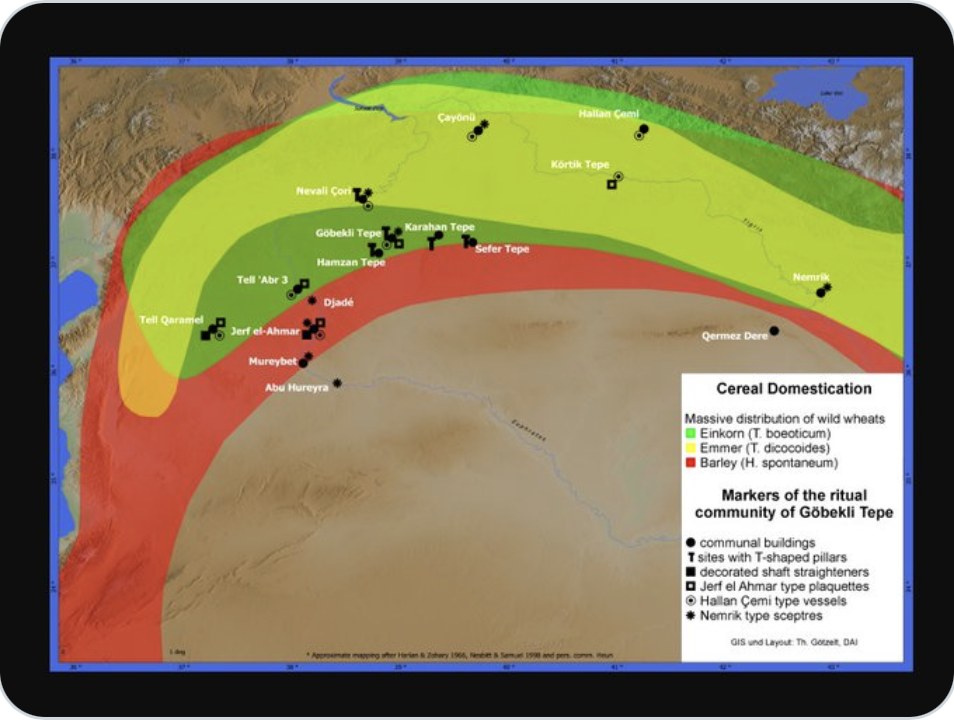
Australia "was like an ark, isolated from the rest of the planet", and every later site is "an increment from the original story". Göbekli Tepe is the increment where "we left the animism of the bush and cultivated the grasses", threshed barley, brewed beer laced with ergot, and held its ceremonies "during the halloween period when we go through the Taurid belt". Farming, of animals and crops, was the breaking of a covenant with the earth and the end of the matrilineal mother goddess.

Part of this post fell between two screenshots and is missing from the transcript. The Kimberley's long phase of human figures, the Gwion paintings, has been dated to about 12,000 years ago by mud-wasp nests over and under the pigment. Göbekli Tepe's limestone troughs with oxalate residues, the basis of the beer claim, were published by the excavators in 2012; ergot is Fenton's inference.

A map on a tablet screen: the distributions of wild einkorn, emmer and barley across the northern Fertile Crescent in green, yellow and red, with symbols for the sites of the Göbekli Tepe ritual community
Wild cereals and the ritual communityMap by Th. Götzelt, German Archaeological Institute, as posted. Fenton's illustration of "the domesticated grains surrounding the ancient sites".

A lost land and the people who sailed from it

How could Arnhem Land and Anatolia share a symbol set? The second thread answers with "a lost civilization and a LOT of lost land". The vanished culture was centred on neither region. It "encompassed all of Island Southeast Asia, a maritime culture that had already mastered sea travel 40,000 years ago", and "as with all naval cultures, its influence spread as far as its people could sail—globally."

Then, a series of catastrophes (likely a combination of comet impact and solar outbursts) initiated a profound climatic shift and a 130-metre sea level rise. […] The idyllic equatorial heartlands of their world, the Sunda plate, almost entirely vanished.Fenton, 25 February 2025

Its world, he adds, "was like Middle Earth": Denisovans, Neanderthals, Homo erectus, Homo floresiensis, perhaps Homo luzonensis and ghost populations, brought into contact by boats. He cites the finding that Papuan genomes carry Denisovan ancestry from at least three deeply divergent sources.

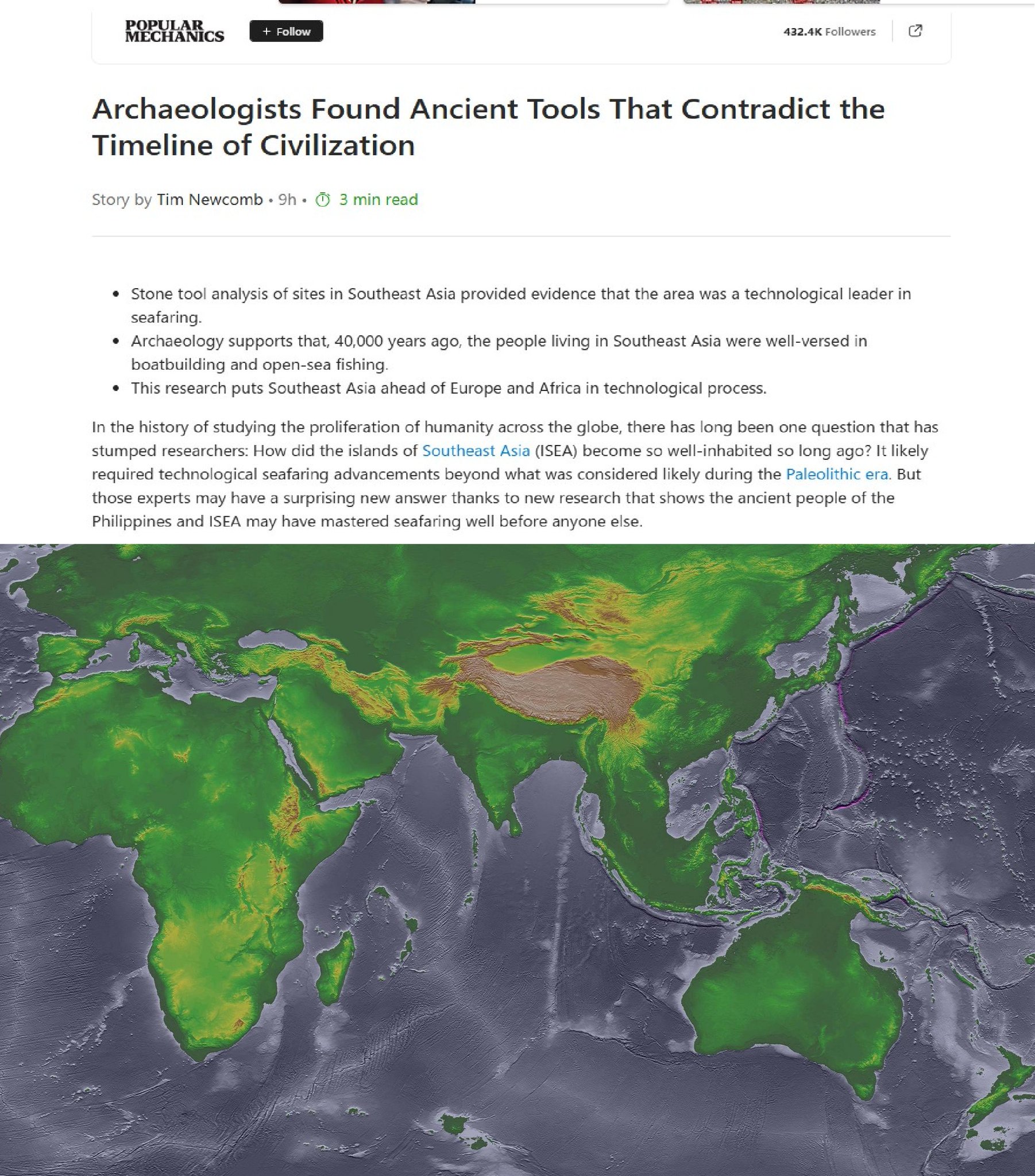
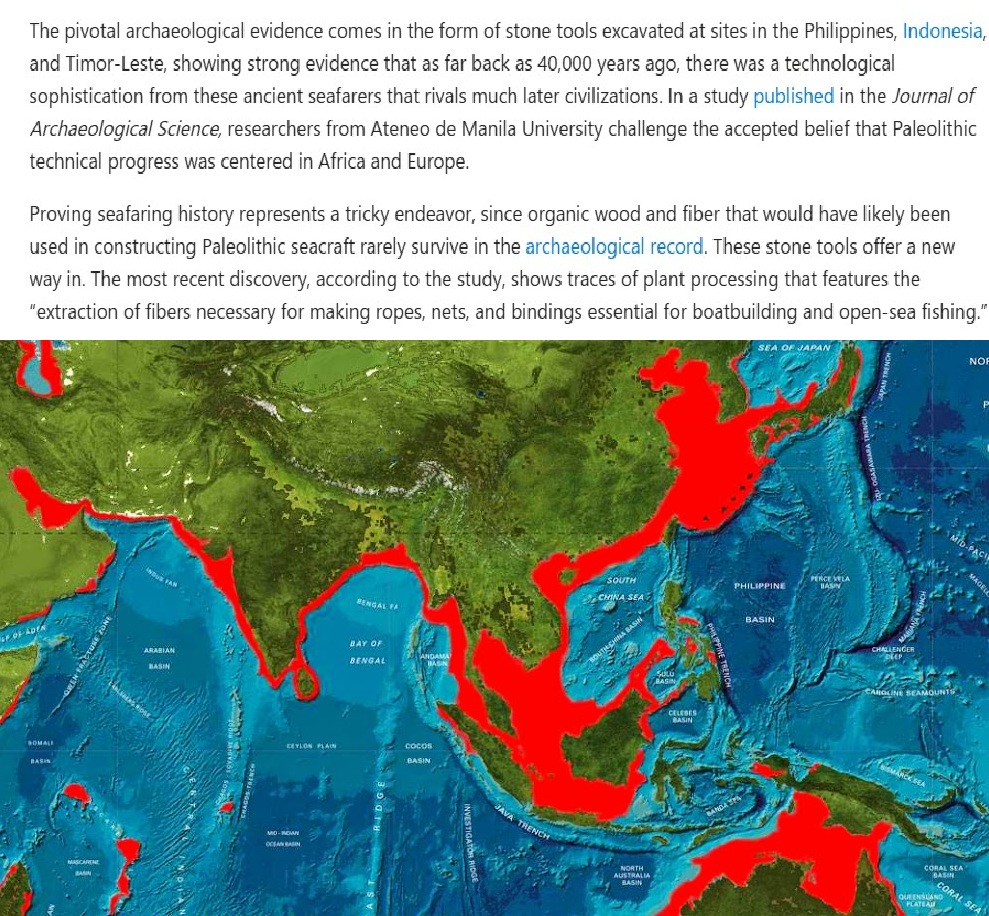
The seafaring evidence he cites is real and recent: microscopic traces of fibre working on stone tools from Mindoro, Timor-Leste and Indonesia up to 40,000 years old, with deep-sea fish bones and fishing gear. The sea did rise by roughly 120 to 130 metres after the glacial maximum, over some ten thousand years, and the Sunda shelf was drowned. The settlements, the catastrophe and the voyages are the theory's additions.

Screenshot of a Popular Mechanics article headed Archaeologists Found Ancient Tools That Contradict the Timeline of Civilization, above a topographic map of the Indian Ocean regionTwo paragraphs of the same article above a bathymetric map on which the continental shelves of Southeast Asia and northern Australia are coloured red
The article and the drowned shelfPopular Mechanics, February 2025, reporting Fuentes and Pawlik · shelf map, source not given. Red marks land at glacial sea level: the Sunda shelf between Malaya, Borneo and Java, and Sahul joining Australia to New Guinea.

Ships to South America

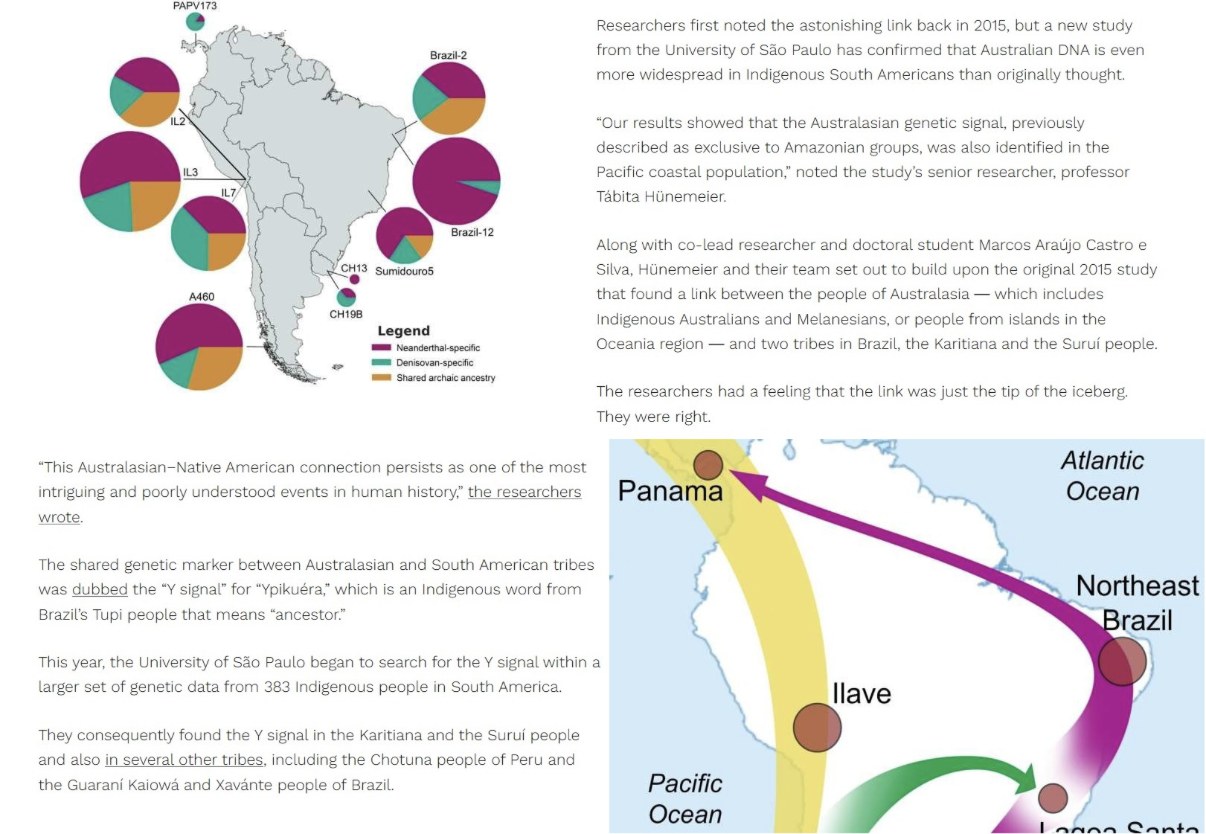
Some Indigenous South Americans, notably the Suruí and Karitiana of Rondônia, carry a small genetic signal related to Australasians that is absent from North America. Fenton takes the missing northern trail as the decisive clue.

How could people from Oceania reach Brazil tens of thousands of years ago and not even pass through North America? In a ship, that's how—possibly bringing with them either Denisovan and Neanderthal crewmates or, more likely, being themselves hybrids.Fenton, 25 February 2025

The signal was reported by Skoglund and colleagues in 2015 and extended in 2021 by Castro e Silva and colleagues to the Pacific coast of Peru and central Brazil. Both papers explain it by an early founding population that entered through Beringia and moved down the Pacific coast; the ship is Fenton's replacement for that route. The graphic is a news article's text and maps, identified from its wording; the maps are the paper's own figures.

A news graphic: pie charts of Neanderthal, Denisovan and shared archaic ancestry in South American genomes on a map, paragraphs on the University of São Paulo study of the Australasian Y signal, and a map with arrows from north-east Brazil to Panama and from Lagoa Santa to Ilave
The Australasian signal in South AmericaAll That's Interesting, 2 April 2021, as posted. The Tupi word Ypikuéra, "ancestor", names the signal.

The faces on the Olmec heads

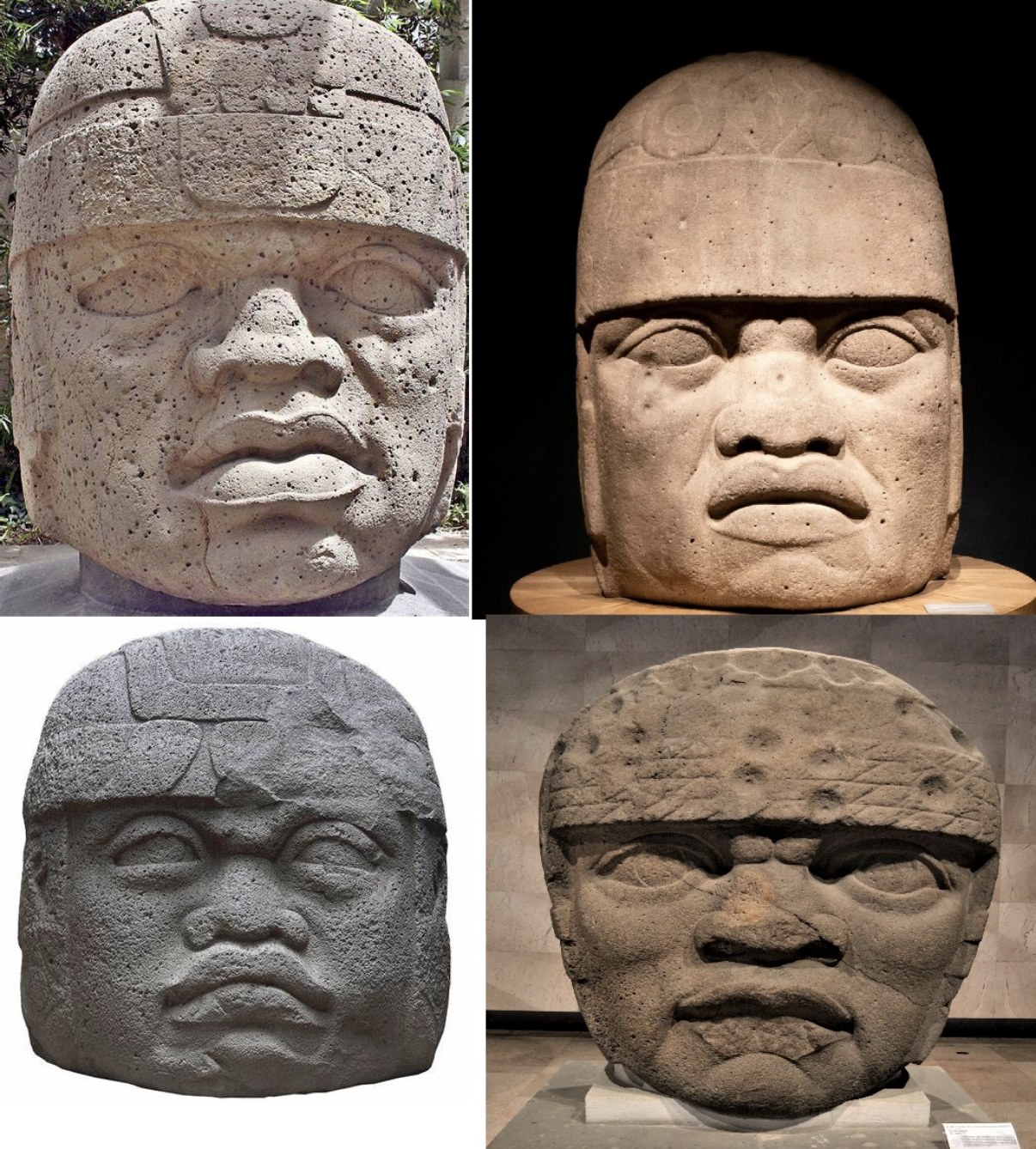
The colossal heads of the Gulf Coast have been called African for a century and a half. Fenton says they are neither African nor local.

Rather than African faces, these are representations of mariners from Oceania or their later descendants. As stone can't be directly dated, these giant heads are all dated to the layers in which they are found or cultures of the region - in reality, their actual age is unknown. I would suggest some may be well over 10,000 years old.Fenton, 25 February 2025

Citing Graham Hancock, he adds the bearded and "East Asian" faces of Mesoamerican art as the mixed crews of ships "plying the coasts of many regions", a reading that meets the bearded civilisers below.

The heads are dated by their excavated contexts to the centuries around 1200 to 900 BCE at San Lorenzo, later at La Venta. An age of ten millennia would require the sculptures to predate every dated Olmec deposit that contains them. All four heads in the montage appear to be from San Lorenzo, whose heads are placed between about 1200 and 900 BCE.

Four Olmec colossal basalt heads with helmets, broad noses and full lips, two photographed outdoors and two in museums
Four colossal headsSan Lorenzo Tenochtitlán, c. 1200–900 BCE by context. Not identified in the thread; matched here to museum photographs as San Lorenzo Colossal Heads 1 and 6 (top) and, less certainly, 5 and 3 (bottom).

Feathers on the serpent

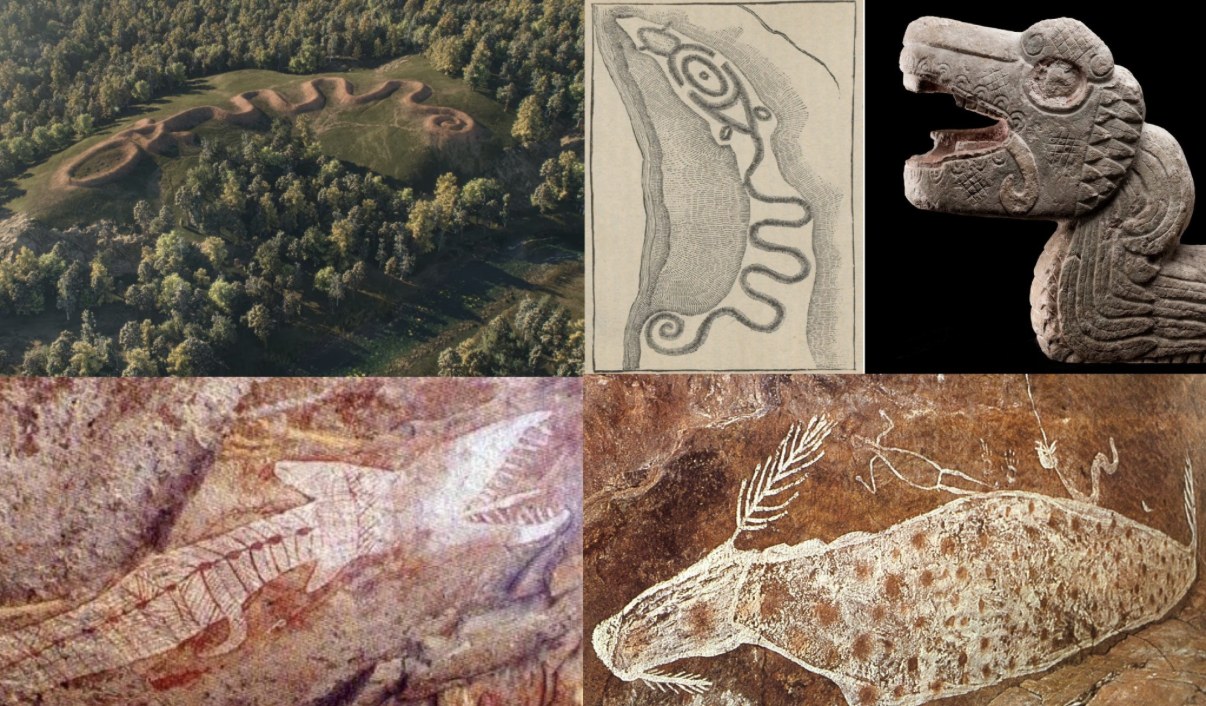
The last link runs north. Serpent Mound in Ohio has two projections behind its head, which Hancock's television series left unexplained. Fenton names them.

Well, I can tell you what these are - they are feathers. Any Australasian Aboriginal people watching must have been shouting at their television screens that day, as the rainbow Serpent is almost always depicted in their art as having these two feathers erupting from its neck.Fenton, 25 February 2025

From there the argument closes its circle. Mesoamerica's feathered serpent, whose lore places its origin "from over the ocean to the east", is "none other than the Rainbow Serpent, carried to prehistoric South America by Oceanian sailors" and brought up through Central America to Ohio. The mound itself he reads as the cosmic serpent swallowing the sun.

The serpents section treats the feathered serpent as a specific combination worth comparing feature by feature; this is a concrete proposal for one of its features. Serpent Mound's radiocarbon dates have been argued between about 300 BCE and 1070 CE. The survey plan in the montage resembles Squier and Davis's of 1848; the stone head and the two paintings were not identified by an image search.

Montage: an aerial view of Serpent Mound winding through trees, a nineteenth-century survey plan of the mound with an oval at its head, a Mesoamerican stone serpent head with feathers, and two Rainbow Serpent rock paintings with plumes behind their heads
Serpent Mound and its cousinsOhio · Mesoamerica · Arnhem Land and the Kimberley, sites not given. The two "feathers" are the shared feature Fenton asks the reader to find in each.

Deep time: the Forgotten Exodus

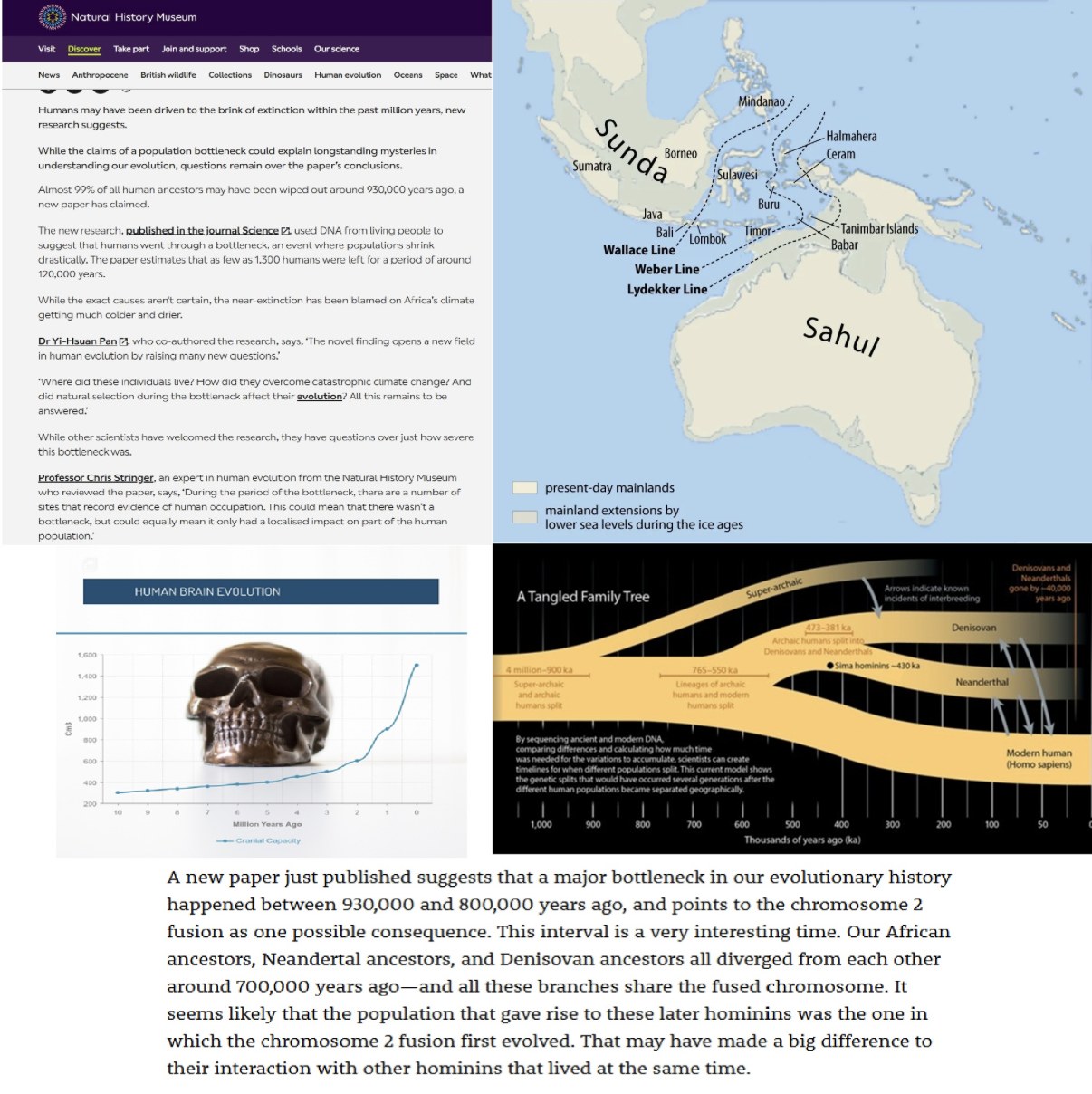
Beneath the symbols lies the model Fenton has argued since 2017: that modern humans did not come out of Africa but went into it. When a 2023 genomic study inferred a severe population bottleneck around 900,000 years ago, he claimed the prediction.

Because my model argues that our ancestors were a small population that split away from Homo erectus in Southeast Asia, entering Oceania approx 900,000 years ago, this would appear identical to a population collapse and bottleneck event! A series of profound genomic changes gave rise to the ancestor of ALL large-brained human species in Oceania around 800,000 years ago.Fenton, 26 February 2025

Hu and colleagues inferred about 1,280 breeding individuals over roughly 117,000 years, between about 930,000 and 813,000 years ago, from the genomes of living people. The study does not place the surviving population anywhere. The oldest accepted evidence for people in Sahul is about 65,000 years old, at Madjedbebe in Arnhem Land.

Composite: a Natural History Museum web page about a human population bottleneck, a map of Sunda and Sahul with the Wallace, Weber and Lydekker lines, a chart of brain size over time with a skull, a diagram titled A Tangled Family Tree, and a caption on the chromosome 2 fusion
The bottleneck compositeAs posted, 26 February 2025. The map's dotted lines mark the sea crossings between Sunda and Sahul that any early crossing had to make.

What the thread supplies

A complete and coherent claim with a named source region, a route, a mechanism and dates. One source passage that can be traced to its book. Several comparisons specific enough to code: a bird with a bent limb and a disc; a handled shape with small animals; a bracket-and-disc sign; a squatting figure with emphasised genitals; a broad-headed snake; two plumes behind a serpent's head. And four published studies, on seafaring, Denisovan ancestry, the Australasian signal and the bottleneck, whose findings are real even where the readings are his.

What it does not yet supply

Dates or sites for the Australian paintings, on which the direction of influence depends; the one painting this project has identified, Yingarna at Injalak Hill, is a recent work, and the best-dated Rainbow Serpent images are younger than Göbekli Tepe. A single "northern Australia" that in fact spans the Kimberley, western Arnhem Land and Central Australia, some 1,500 km apart. Any account of how the symbols reached Anatolia. A reply to the excavators' points about the graffito and the H-sign. One missing passage, which we have left blank rather than reconstructed.

How it meets the studies here

The theory predicts that each Göbekli Tepe motif has an older Australian antecedent, that the same combinations recur along the claimed routes, and that genetic traces follow the voyages. The image pilots already code composition against a nearest-neighbour null and could take a Kimberley and Arnhem Land corpus as a pre-registered case. The source audit shows the discipline the lore passage needs: book, page, recorder, date and mediation. Either would let the theory win or lose on something other than resemblance.

Fenton's theory and the works it draws on

  • Fenton, B. R. Thread on X, 24–26 February 2025. x.com/GenomicSETI; transcript with the screenshot inventory, the September 2026 addendum and the identifications made since.
  • Fenton, B. R. Post on X, 9 September 2026, on the V-neck of the Pillar 43 bird and Urfa Man, with a reply by Archaic Lens (@ArchaicLens) on the bird's knees. Screenshot preserved in inputs/fenton; transcribed in the addendum.
  • Fenton, B. R. (2017). The Forgotten Exodus: The Into Africa Theory of Human Evolution. Also articles at AncientNews.com and in New Dawn, 2017.
  • Notroff, J. (2017). Making headlines: was Göbekli Tepe built by Aboriginal Australians? Tepe Telegrams, 28 November 2017, with Fenton's reply in the comments.
  • Lommel, A. (1952). Die Unambal: ein Stamm in Nordwest-Australien. Hamburg; English edition The Unambal: A Tribe in Northwest Australia (1997). Source of the bush-bucket passage: a Google Books search inside the 1997 edition returns one page for "bush buckets"; the page itself has not been inspected.
  • Taçon, P. S. C., Wilson, M. & Chippindale, C. (1996). Birth of the Rainbow Serpent in Arnhem Land rock art and oral history. Archaeology in Oceania 31(3).
  • Taçon, P. S. C., May, S. K., Jalandoni, A. & Mungulda, C. (2026). Paintings of Rainbow Serpents and other big creatures of Awunbarna, Northern Territory, Australia. Australian Archaeology. doi. Counts the Injalak Hill Yingarna among the region's recent, post-contact paintings.
  • Wellcome Collection, reference 21428i. A shaman or medicine man with extensive body painting, Worgaia, Central Australia. Process print, CC BY 4.0. link. The painted man in the churinga montage.
  • Fraga, K. (2021). Ancient Australian DNA found in Indigenous South American tribes. All That's Interesting, 2 April 2021. link. The news graphic in the thread.
  • Finch, D. et al. (2020). 12,000-year-old Aboriginal rock art from the Kimberley region, Western Australia. Science Advances 6(6).
  • Clarkson, C. et al. (2017). Human occupation of northern Australia by 65,000 years ago. Nature 547.
  • Spencer, B. & Gillen, F. J. (1927). The Arunta: A Study of a Stone Age People. Macmillan. Probable source of the ceremonial photographs.
  • Dietrich, O., Heun, M., Notroff, J., Schmidt, K. & Zarnkow, M. (2012). The role of cult and feasting in the emergence of Neolithic communities: new evidence from Göbekli Tepe. Antiquity 86.
  • Fuentes, R. & Pawlik, A. (2025). Testing the waters: plant working and seafaring in Pleistocene Wallacea. Journal of Archaeological Science: Reports. Reported by Newcomb, T., Popular Mechanics, February 2025.
  • Jacobs, G. S. et al. (2019). Multiple deeply divergent Denisovan ancestries in Papuans. Cell 177(4).
  • Skoglund, P. et al. (2015). Genetic evidence for two founding populations of the Americas. Nature 525; Castro e Silva, M. A. et al. (2021). Deep genetic affinity between coastal Pacific and Amazonian natives evidenced by Australasian ancestry. PNAS 118(14).
  • Hu, W. et al. (2023). Genomic inference of a severe human bottleneck during the Early to Middle Pleistocene transition. Science 381.
  • Squier, E. G. & Davis, E. H. (1848). Ancient Monuments of the Mississippi Valley; Fletcher, R. V. et al. (1996), Midcontinental Journal of Archaeology 21, and Herrmann, E. W. et al. (2014), Journal of Archaeological Science 50, on the age of Serpent Mound.

Image identities and rights register · Compare the proposed explanations