case file ORCH-001Neuroscience · Quantum biology · Anesthesiology · Foundations of physicsupdated 30 September 2026
Collapse, Not Computation
Do conscious moments occur when quantum states orchestrated in neuronal microtubules reach a gravitational collapse threshold — and does anesthesia work by breaking them?
Well supportedCollective electronic and optical behaviour of microtubules
UnresolvedQuantum coherence lasting a conscious moment
Weakly supportedAnesthesia by breaking a microtubule quantum state
UnresolvedGravitational collapse as physics
MixedNon-classical signals in the living brain
UnresolvedThe non-computability motivation
why this research priority
The case turns on one quantity never measured — microtubule coherence at body temperature — and the measurement is within reach of existing ultrafast spectroscopy. Two cheap desk tasks and one measurement fix should come first.
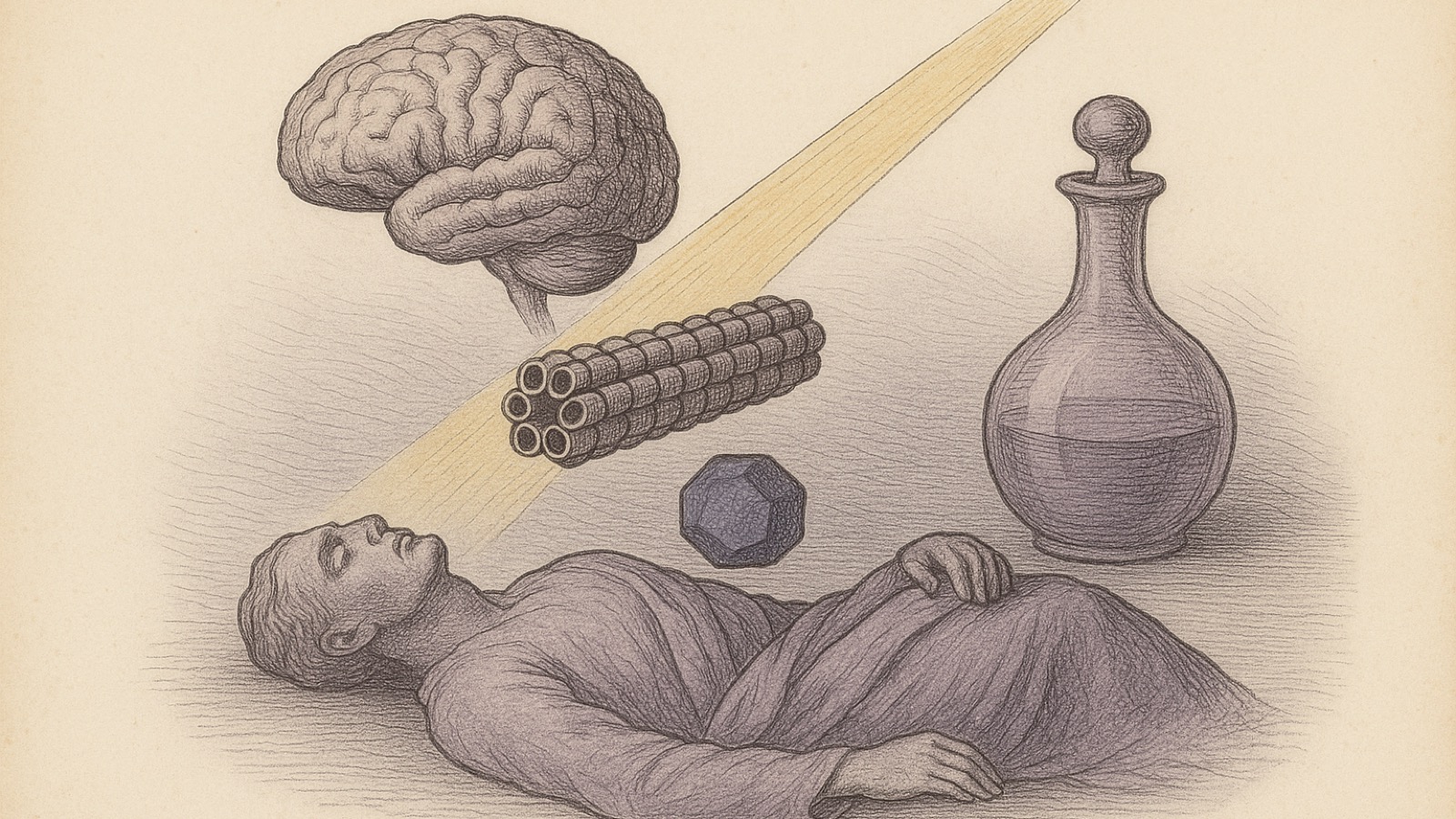
AI-generated editorial artwork
What is claimed
That each conscious moment is a gravity-induced collapse of a quantum state spread across tubulin proteins in neuronal microtubules, and that anesthetics abolish consciousness by breaking that state.
▸ read the rest▾ less
The collapse is Penrose's objective reduction, timed by τ ≈ ℏ/E_G; the rival view holds that receptors, channels and circuits suffice.
Where the disagreement lives
In one unmeasured gap: microtubules demonstrably move electronic energy about one tubulin dimer within picoseconds, but nobody has measured the millisecond-long, many-tubulin coherent state the theory needs.
▸ read the rest▾ less
The theory has never published the threshold that would make such a measurement pass or fail. On the physics side, the live question is whether any dynamics reproducing Penrose's rate survives the underground radiation and spacecraft acceleration-noise limits.
What would settle it
Measuring how long quantum coherence actually lasts in microtubules at body temperature, against a pass/fail threshold proponents publish in advance, would settle the biological half. An anesthetic potency series against the optical signal counts only once its scattering ambiguity is closed.
▸ read the rest▾ less
A tubulin knock-in mouse that cannot bind anesthetic would give causal evidence. The physics needs its own test of whether collapse lifetimes scale as ℏ/E_G.
ratified by 3 of 4 independent models · 30 September 2026
an AI-generated assessment · not reviewed by a human · ratified by independent models, which is not human review
Orch OR is a conjunction — gravitational collapse (ORCH-C030), a millisecond microtubule quantum state (ORCH-C010), and their identity with experience (ORCH-C001) — and is unresolved because its weakest conjunct is unmeasured.
The observations are respectable. ORCH-E001 and ORCH-E004 show microtubules are electronically and optically collective (ORCH-C013).
▸ the full reasoning▾ less
ORCH-E056 reproduces the direction of the quantum-yield trend (ORCH-C021), but ORCH-E075 through ORCH-E079 show that trend's size, and at 295 nm its sign, depend on the scattering correction. None of this is a coherence time. On ORCH-C010, ORCH-E036 shows no unconditional proponent estimate reaches the theory's own 25 ms; ORCH-E035 finds no published pass/fail threshold; and ORCH-E072 and ORCH-E073 show the newest modelling reports radiative, not dephasing, lifetimes.
The physics conjunct is squeezed. Two underground nulls (ORCH-E017, ORCH-E049) exclude the parameter-free stochastic model (ORCH-C031). ORCH-E046, on ORCH-C030, bounds the cutoff through mechanical noise, a channel the no-radiation escape (ORCH-E019) does not reach. ORCH-C030 stays unresolved because ORCH-E071 records the rate's constant as unspecified, and because the dynamics is what the originators dispute (ORCH-C069, per ORCH-E052).
On anesthesia (ORCH-C002), a convulsant moves the flagship assay (ORCH-E003). The best independent animal study finds a stabilizer and a destabilizer both increasing sensitivity (ORCH-E013). The xenon result (ORCH-C025) is unreplicated and rests on calculated headline values (ORCH-E039, ORCH-E040), and it implicates spin chemistry rather than microtubules.
Sensitivity: removing ORCH-E013 would most change the case, lifting ORCH-C012 from mixed and cleaning up the anesthesia arm. The case verdict would survive, because it rests on an absence — no coherence or dephasing time has ever been measured in a microtubule — and no single record removes an absence.
the steelman — the strongest argument this judgment does not answer
The strongest unanswered argument is Meyer–Overton. The correlation between anesthetic potency and lipid solubility is anesthesiology's oldest quantitative regularity.
▸ read the rest▾ less
Proponent quantum-chemical modelling reportedly predicts several volatile agents' potencies from binding to tubulin's delocalized electrons (ORCH-E010, restated at ORCH-E084 to ORCH-E086, all on ORCH-C011). Proponents assert that no other candidate target has a published model that does the same (ORCH-C057, held on a commentary's sentence alone).
Set beside that two admissions from the rival side. Eger and colleagues report that two decades of work found no channel, or combination, sufficient for immobility under inhaled agents (ORCH-E031, on ORCH-C004). The β3 receptor result's own authors conclude that volatile agents act through a broader set of targets (ORCH-E015, on ORCH-C003). On the proponents' reading, for the inhaled agents most of this literature uses, the one structure modelled to reproduce the field's founding regularity is the one Orch OR names, while the rival concedes it has no sufficient target.
This assessment discounts the argument because the modelling is computational and proponent-authored, the uniqueness claim has no survey behind it, and a convulsant moves the related optical assay (ORCH-E003). But no refuting survey and no rival target-level model exists either.
5 AI models from different vendors each judged the evidence without seeing this judgment or one another. A model concurs when its verdict is within one step of the one above.
▸Opus 5 (Anthropic)Unresolvedjudged an earlier versionThe featured hypothesis is a conjunction — gravitational objective reduction is real physics, neuronal microtubules host a coherent state of the required duration and extent, and that collapse constitutes a conscious moment — and it fails or succeeds on its weakest conjunct.
The featured hypothesis is a conjunction — gravitational objective reduction is real physics, neuronal microtubules host a coherent state of the required duration and extent, and that collapse constitutes a conscious moment — and it fails or succeeds on its weakest conjunct. Reading only the attached records, the second conjunct (ORCH-C010) has never been measured in either direction, and the third has no attached test at all. That is why the case verdict is unresolved rather than contradicted: the crux is an absence, and an absence cannot be converted into refutation by accumulating adjacent negatives. It is also why the verdict is nowhere near supported: not one record in the ledger measures a dephasing time, a coherence length, or an entanglement witness in a microtubule, so the theory's central quantity remains a matter of two calculations disagreeing by seven to eight orders of magnitude, neither anchored to an observation. Steelmanning the proponent side properly: the 2023–2024 photophysics is real and partly independent, microtubules are demonstrably not passive scaffolding, tubulin sits on an anesthetic pathway for at least one compound class, a brain-penetrant stabilizer moves anesthetic latency with a large standardized effect across two species, the xenon nuclear-spin result has no classical polarizability explanation on offer, and the Gran Sasso bound demonstrably tests a stochastic completion that Penrose's published criterion does not entail. Steelmanning the skeptical side: the anesthesia arm's flagship experiment failed its own specificity control when a convulsant moved the assay comparably; the methodologically strongest and only genuinely independent animal study found stabilization increasing anesthetic sensitivity, with a destabilizer moving it the same way; the conventional account holds target-level causal evidence — one engineered residue abolishing a drug's action — that no microtubule study approaches; the natural parameter-free collapse model is experimentally dead; and on the corpus's own published numbers no unconditional proponent decoherence estimate reaches the theory's own requirement. Two structural facts dominate the roll-up. First, the ladder genuinely decomposes: the non-computability rung is motivation, not mechanism, and the AI-mathematics results — however solid — move nothing below it. Second, the theory publishes parameter values but no acceptance criteria (ORCH-E035), so each new measurement is absorbable rather than scorable. That is a specification defect, not disconfirmation, but it is the reason thirty years of work has produced no verdict-moving number. Sensitivity: the single record with the most leverage is ORCH-E013 (Li 2025). Removing it would lift ORCH-C012 from mixed toward provisionally supported and would remove the sharpest independent challenge to the anesthesia arm. The case verdict survives its removal unchanged, because the verdict rests on the unmeasured crux at ORCH-C010, not on any undermining record — a robustness that is itself the case's most informative feature, and one that cuts against both camps.
run 2026-09-01-check-opus · 2026-09-01 · Unresolved · an AI seat, blind to the judgment · not human reviewed · per-claim verdicts on each claim page
▸Gemini 3.8 Flash (Google)Weakly supportedconcursOrchestrated Objective Reduction (Orch OR) is an ambitious architectural stack that conjoins a foundational physics proposal—gravitational objective collapse of quantum superpositions—with a neurobiological claim that neuronal microtubules sustain quantum coherent computation at physiological temperatures, and an anesthesiological claim that general anesthetics produce unconsciousness by selectively ablating this quantum substrate.
Orchestrated Objective Reduction (Orch OR) is an ambitious architectural stack that conjoins a foundational physics proposal—gravitational objective collapse of quantum superpositions—with a neurobiological claim that neuronal microtubules sustain quantum coherent computation at physiological temperatures, and an anesthesiological claim that general anesthetics produce unconsciousness by selectively ablating this quantum substrate. When evaluated across the 24 atomic claims and associated empirical evidence records, the case displays a striking dissociation between its solid lower-level biophysical observations and its speculative, highly constrained causal attributions.
On the proponent side, the biological half of the theory is no longer devoid of empirical traction. In vitro experiments demonstrate that microtubules are not merely inert structural scaffolds: electronic energy migrates ~6.6 nm through polymerized tubulin lattices exceeding classical Förster predictions (Kalra et al. 2023), hierarchical tubulin organization produces cooperative superradiant enhancements in ultraviolet quantum yield (Babcock et al. 2024, Gassab & Craddock 2026A), and volatile anesthetics bind tubulin to measurably shorten exciton diffusion (Kalra et al. 2023). In live animals, acute pretreatment with the brain-penetrant stabilizer epothilone B produces substantial, statistically significant delays in the loss of righting reflex in rats and mice (Khan et al. 2024, Huang et al. 2026). Furthermore, the observation that nuclear-spin-bearing xenon isotopes are ~40% less potent than spin-zero isotopes at identical calculated polarizability (Li et al. 2018) establishes that quantum spin degrees of freedom can influence anesthetic outcomes, challenging purely classical lipid-solubility paradigms.
However, the critical links necessary to sustain Orch OR as a unified causal theory collapse under scrutiny. First, the required physiological quantum coherence time (order 25 ms) remains completely unmeasured and theoretically implausible: even the proponents' own optimistic recalculations (Hagan et al. 2002) achieve at best 0.1 ms—over two orders of magnitude short of the gamma-synchrony requirement—while non-proponent estimates range from femtoseconds to picoseconds (Study ORCH-S001). Second, the physics pillar is severely squeezed: dedicated underground searches for spontaneous collapse radiation at Gran Sasso (Donadi et al. 2021) and the Majorana Demonstrator (Arnquist et al. 2023) have definitively excluded the natural parameter-free Diósi–Penrose model, while LISA Pathfinder bounds the spatial regularization scale above nuclear dimensions (Helou et al. 2017). Penrose's heuristic criterion survives only by lacking a dynamical equation that can be subjected to experimental test. Third, the anesthesia attribution is undermined by pharmacological reality: a single point mutation in the GABA_A receptor β3 subunit completely abolishes intravenous anesthetic action in vivo (Jurd et al. 2003), the optical assay's response is matched by the convulsant picrotoxin (Kalra et al. 2023), and an independent laboratory showed that chronic microtubule stabilization with epothilone D increases anesthetic sensitivity rather than conferring resistance (Li et al. 2025).
Sensitivity analysis: The single evidence record whose removal would most alter this assessment is ORCH-E015 (Jurd et al. 2003), which establishes decisive, target-specific causal evidence for conventional classical pharmacology. Without it, the conventional account would rest on multi-target correlations, leaving a wider explanatory opening for microtubule-based hypnosis. Nevertheless, the case verdict of weakly_supported robustly survives its removal, because the failure of the biological coherence timescales (ORCH-E007, ORCH-E036) and the empirical refutation of the parameter-free collapse physics (ORCH-E017, ORCH-E047) independently render the central attribution unviable.
its steelman
The unexplained ~40% attenuation of anesthetic potency in nuclear-spin-bearing xenon isotopes relative to spin-zero isotopes at identical polarizability (Li et al. 2018) provides direct empirical evidence that quantum degrees of freedom influence anesthetic hypnosis in vivo, an observation unpredicted and unaccommodated by classical receptor pharmacology.
run 2026-09-30-check-gemini-104603 · 2026-09-30 · Weakly supported · an AI seat, blind to the judgment · not human reviewed · per-claim verdicts on each claim page
▸GPT-5.6 Sol (OpenAI)ContradicteddisputesThe evidence supports several lower-rung observations while weighing against the featured hypothesis as stated.
The evidence supports several lower-rung observations while weighing against the featured hypothesis as stated. Microtubules are not merely inert scaffolding: excitation migration beyond the stated Förster comparison, polymerization-dependent fluorescence, anesthetic-induced optical changes, tubulin binding by a research anesthetic, and behavioral effects of microtubule-modulating drugs establish interesting photophysics and pharmacology. The affirmative steelman is therefore substantial. Two anesthetics shortened excitation diffusion; acute epothilone B delayed loss of righting reflex in rats and mice; and xenon isotope means show a striking spin-associated ordering that ordinary polarizability does not explain. These observations justify targeted experiments and make dismissal based merely on microtubules being “warm and wet” inadequate.
They nevertheless do not establish the required bridge. No record measures tens-of-milliseconds coherence or entanglement across many tubulins under physiological neuronal conditions, much less connects such a state to a conscious moment or gravitational reduction. ORCH-E036 is especially damaging: no unconditional proponent estimate reaches the theory's 25 ms exemplar, while ORCH-E008 reports only 10^-5 to 10^-4 s. The newer radiative models expressly omit physiological dephasing baths, and radiative darkness is not coherence longevity. Thus the central mechanism claim ORCH-C010 is contradicted by the quantitative evidence currently available, although a direct physiological measurement could overturn that conclusion.
The anesthesia evidence also separates sharply by rung. Tubulin can be affected by anesthetics, and microtubule drugs can alter susceptibility, but the flagship optical assay lacks specificity because picrotoxin produced a comparable effect. Acute epothilone-B resistance coexists with a stronger randomized, blinded chronic study in which epothilone D and vinblastine both increased sensitivity. By contrast, the GABA_A β3 mutation supplies target-specific causal evidence for major intravenous anesthetic effects, although it does not exhaust volatile anesthesia or abolish every hypnosis endpoint. The strong quantum-microtubule anesthesia claim therefore fares substantially worse than the narrower classical account.
On the physics side, two underground searches support exclusion of the natural parameter-free Diósi–Penrose model, and LISA Pathfinder constrains another regularized realization. Penrose's bare τ ≈ ℏ/E_G criterion does not itself entail those radiation signatures, so ORCH-C030 remains unresolved rather than refuted. That survival is not affirmative evidence: the surviving claim lacks a tested, agreed dynamics. AI mathematics likewise weakens one motivation for Orch OR without testing its biology or collapse physics.
Overall, the conjunction “each conscious moment is orchestrated objective reduction” is contradicted by this record: its required coherence rung misses its own quantitative target, its best-specified collapse implementation is excluded, and its anesthesia evidence is nonspecific and directionally inconsistent. This verdict does not depend on a mainstream-plausibility prior. Sensitivity is greatest to ORCH-E036; removing that workpaper would weaken the quantitative case against physiological coherence, but the verdict survives because ORCH-E007, ORCH-E008, ORCH-E072, and ORCH-E073 still leave no qualifying measured or calculated state, while the anesthesia and collapse objections remain.
its steelman
The assessment does not answer the prospective prediction that chemically diverse anesthetics will suppress a prespecified microtubule coherence or optical observable in proportion to clinical potency while matched nonimmobilizers do not. A successful blinded potency series, especially if paired with a tubulin-pocket perturbation that changes behavior without changing receptor pharmacology, would provide the specificity and causal bridge missing from every existing experiment.
run 2026-09-30-check-gpt-104603 · 2026-09-30 · Contradicted · an AI seat, blind to the judgment · not human reviewed · per-claim verdicts on each claim page
▸Grok 4.5 (xAI)UnresolvedconcursThe featured hypothesis is a conjunctive stack: Penrose objective reduction with gravitational lifetime scaling, orchestrated across neuronal microtubule tubulins, with conscious moments identical to those reductions, and with general anesthesia acting substantially by disrupting the required quantum-coherent microtubule state.
The featured hypothesis is a conjunctive stack: Penrose objective reduction with gravitational lifetime scaling, orchestrated across neuronal microtubule tubulins, with conscious moments identical to those reductions, and with general anesthesia acting substantially by disrupting the required quantum-coherent microtubule state. The evidence ledger shows the stack coming apart cleanly rather than standing or falling as one. On the observation rung, microtubules are electronically nontrivial: excitation diffusion beyond simple Förster expectations, polymerization-linked quantum yield trends consistent with collective tryptophan optics, and anesthetic perturbation of those optical observables are real measurements (C020, C021, C013, C011). Acute microtubule stabilization delaying isoflurane LORR and chronic stabilization plus destabilization shifting sensitivity the other way are also real (C023, C024, C012). None of those results is a coherence time, an entanglement witness tied to tubulin, or a collapse event. The mechanism claim that physiological microtubules sustain coherent or entangled states for tens of milliseconds across many tubulins (C010) remains unmeasured; competing decoherence calculations disagree by orders of magnitude and even the favorable proponent recalculation falls short of the theory’s own exemplar, while 2026 modeling still reports radiative rather than thermal-bath dephasing times. The physics conjunct (C030) is damaged in its most natural stochastic Diósi–Penrose completion by two independent underground nulls and a LISA Pathfinder momentum-noise bound (C031, C047, C046), yet Penrose’s bare τ ≈ ℏ/E_G lifetime criterion is not itself what those channels test, so the characteristic-lifetime claim stays untested rather than refuted. Conventional multi-target receptor pharmacology, especially the β3(N265M) causal dissociation for intravenous agents (C003), is far stronger causal evidence than any microtubule anesthesia result, while the exhaustive claim that classical mechanisms leave no room for any quantum contribution (C004) overreaches given residual volatile-target uncertainty, the unreplicated xenon nuclear-spin potency split, and historical incompleteness on immobility mechanisms. Non-computability motivation (C040) is pressured by verified AI research-level mathematics (C041) but is not a direct test of microtubule collapse. Contested zero-quantum-coherence MRI (C026) does not implicate microtubules even if it survives. Weighing only the attached records, lower rungs are partly well supported as local physical and pharmacological observations, the load-bearing coherence and collapse conjuncts are unresolved, and the attribution theses C001 and C002 are not established. The case verdict is therefore unresolved: the featured stack is neither demonstrated nor closed by a single decisive measurement of the quantities it actually requires.
its steelman
No published non-tubulin molecular target has a quantum-chemical model that reproduces the Meyer–Overton potency correlation from first-principles binding to a nominated site the way the Craddock tubulin terahertz/delocalized-electron modelling claims to, and the acute brain-penetrant epothilone-B delay of isoflurane LORR remains a large, blinded behavioral effect in the direction the microtubule-stability hypothesis predicted before the contradictory chronic epothilone-D result appeared.
run 2026-09-30-check-grok-104603 · 2026-09-30 · Unresolved · an AI seat, blind to the judgment · not human reviewed · per-claim verdicts on each claim page
▸GLM 5.3 Flash (Z.ai, via Venice)UnresolvedconcursThis case is a study in rung separation, and the assessment confirms the separation is real rather than rhetorical.
This case is a study in rung separation, and the assessment confirms the separation is real rather than rhetorical. The observation rung is genuinely healthy: microtubules measurably move electronic excitation beyond what Förster models predict (Kalra 2023), show collective optical behavior partly corroborated outside the proponent lineage (Babcock 2024, Gassab 2026A), and anesthetics demonstrably bind tubulin and perturb microtubule physics, with one large blinded behavioral effect (epothilone B delaying LORR). Two of the case's strongest records are outright negative for the featured hypothesis's natural completions: the Gran Sasso null and its independent Majorana replication exclude the parameter-free Diósi–Penrose model, while the classical account holds target-specific causal knockout evidence (β3 N265M) that no microtubule experiment approaches. The decisive gap sits at the mechanism rung: not one record measures a coherence time, an entangled state, or a collapse event in the structure the theory names. The theory's own literature contains no unconditional decoherence estimate meeting its 25 ms requirement — the proponents' best number is one to two orders short — and no published pass/fail threshold exists for any prospective test, which is why each new photophysics result gets absorbed rather than scored. The anesthesia arm is actively self-contradicting: stabilizer and destabilizer drugs shift anesthetic sensitivity the same way in the most methodologically complete study, the flagship photophysics assay cannot distinguish anesthetics from a convulsant, and the one genuinely independent stabilizer study ran the opposite direction. Steelmanning the proponent side: the xenon isotope anomaly and the consciousness-dependent zero-quantum-coherence signals are real, published observations the classical record does not explain, and the authors' quantitative reply to Warren remains unrebutted. Steelmanning the skeptic side: twenty-five years of arguing over coherence without a single measurement, an excluded natural collapse model, and a motivational argument (non-computability) whose testable instances have mostly settled against it. Unresolved is therefore a substantive finding, not a hedge: the evidence supports a lively research program and does not support the thesis it was gathered for.
its steelman
The Kerskens zero-quantum-coherence result plus the authors' quantitative reply: Warren's classical intermultiple-quantum-coherence mechanism, when recomputed at the authors' sequence parameters, can produce at most ~0.13% of initial magnetization even under best-case assumptions, the observed signals exceed that bound, and the ZQC correlation-distance signature played no role as gradient moments were varied — yet no independent group has run the phantom-validation experiment that would adjudicate the exchange. If the authors' recalculation stands unrefuted, the record contains a heartbeat-timed, consciousness-dependent human brain signal that no classical mechanism in the ledger can generate, and nothing in this assessment explains it.
run 2026-09-30-check-glm-104603 · 2026-09-30 · Unresolved · an AI seat, blind to the judgment · not human reviewed · per-claim verdicts on each claim page
Claim by claim, against this judgment (each seat's latest verdicts, 1 of 5 given on an earlier version of the case): 5 of 24 exact, 17 within one step, 2 split. Split — where review should start: ORCH-C012 · ORCH-C046.
6 accounts, side by side · the edition of 2026-09-30
1Orch OR: each conscious moment is a gravity-induced objective reduction of a quantum state orchestrated across tubulins in neuronal microtubules, and anesthetics abolish consciousness by breaking that state.
2Interesting condensed matter, nothing more: microtubules are an ordered aromatic lattice with real collective photophysics, but no coherence of neural duration and no role in experience.
3Multi-target classical pharmacology: anesthesia is receptor and ion-channel action on network dynamics, with tubulin at most one ordinary drug target among many.
4Quantum biology without microtubules: spin-dependent radical-pair chemistry somewhere in the anesthetic pathway — the route the xenon isotope anomaly actually points at.
5Non-classical brain, non-cytoskeletal site: whatever the zero-quantum-coherence MRI signals witness in living brains, they implicate no microtubule.
6Collapse physics on its own track: gravity-related objective reduction is a live proposal in quantum foundations that stands or falls with no biology in it.
the article · a marked sentence opens the exact claim behind it
about 12 minutes
Orch OR, the theory of Roger Penrose and Stuart Hameroff, proposes that each conscious moment is a gravity-triggered collapse of a quantum state spread across tubulin proteins in neuronal microtubulesC001, and that anesthetics work by breaking that state. The evidence so far splits cleanly. Microtubules turn out to be electronically and optically livelier than a passive scaffold should be, and anesthetics measurably perturb them. But nobody has measured the thing the theory needs: quantum coherence lasting tens of milliseconds in a warm brain. Meanwhile the simplest version of Penrose's collapse physics has been ruled out underground. The theory stands unresolved. It is not refuted, because its central quantity has never been measured. It is not supported, because nothing yet measured is that quantity. What remains open is a short list of experiments, almost none of them run.
▸ claims behind this paragraph (1)▾ claims behind this paragraph
Arguments about Orch OR usually slide between five different things:
quantum effects in microtubules;
quantum coherence in microtubules;
entanglement across microtubules;
quantum computation in neurons;
Penrose's gravitational collapse.
The first is trivially true, since all chemistry is quantum. The last is an open proposal in the foundations of physics. Evidence for one is not evidence for the next.
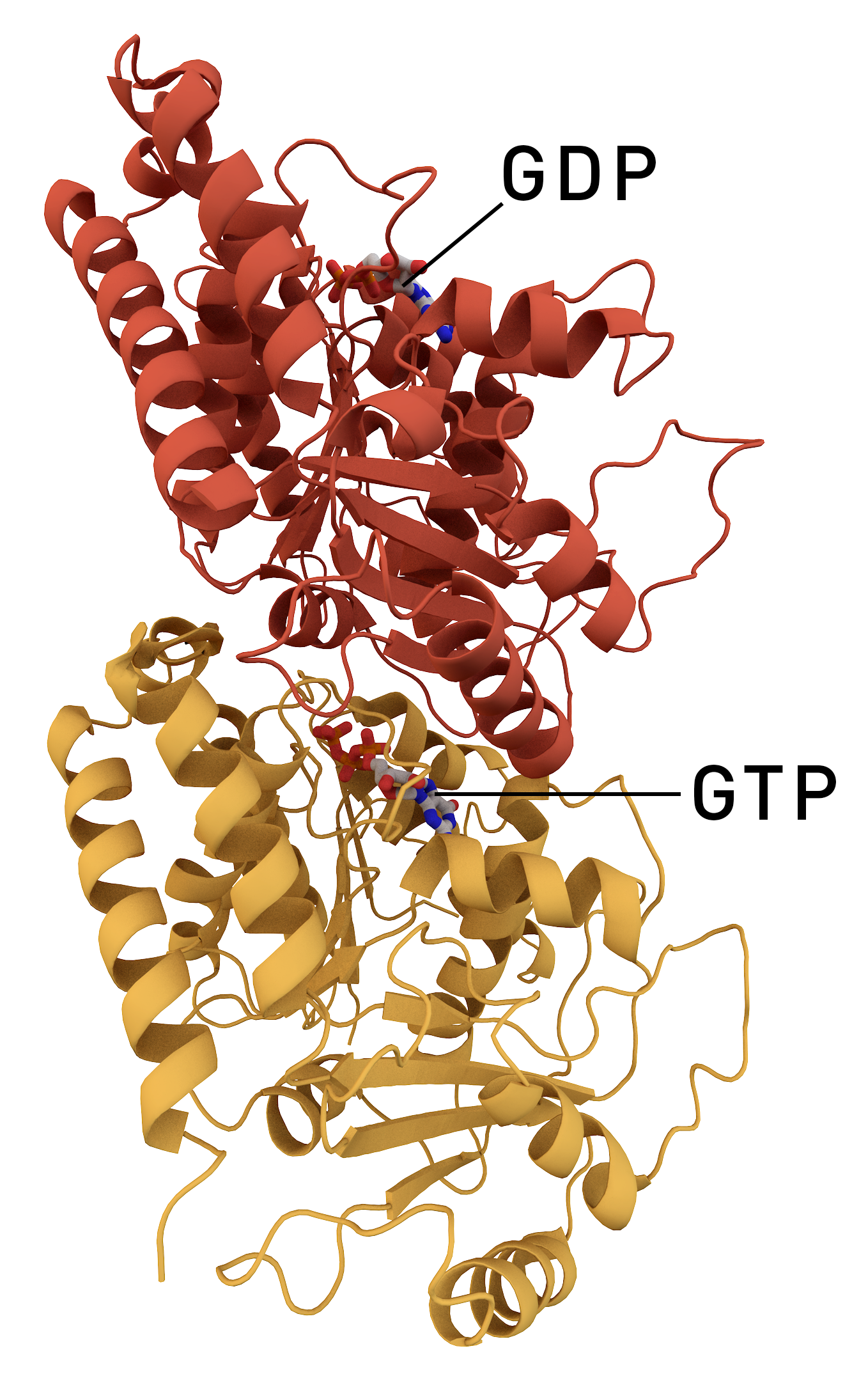
plate I · structural rendering — duotone applied in display; original unmodified
A molecular ribbon rendering of the tubulin αβ heterodimer, generated from Protein Data Bank entry 1JFF, with the bound GTP and GDP nucleotides labeled. This is a structural model derived from diffraction data, not a micrograph. The dimer is the repeating unit of the microtubule lattice and is roughly 8 nm along its long axis — the scale at which the electronic energy diffusion of ORCH-C020 was measured.
Thomas Splettstoesser (www.scistyle.com) · 2015-06-16 · source · CC BY-SA 4.0
Now the limits. 6.6 nanometres is roughly one tubulin dimer, the unit pictured above, and the physics runs in femtoseconds to picoseconds. Orch OR needs milliseconds, across many tubulins.
The superradiance work's striking figure is collective states with radiative lifetimes of 'tens of seconds'. That measures how weakly a state couples to light, not how long it survives jostling by its surroundings. A state can stay dark for seconds and still lose its coherence in femtoseconds. The newest modelling of the same geometry defines its lifetimes within a radiation-only model, with no water, ions or molecular vibrations in it. Its authors write that their results do not imply microtubules must use quantum correlations for neural processing at all.
The optical signal itself is not yet stable. Microtubules scatter ultraviolet light strongly. In the 2026 dataset, the polymerization effect at 280 nanometres ranges from about +6% to about +47%, depending on which of two defensible scattering corrections is used. At 295 nanometres the two corrections disagree on the sign: about −59% on one and about +13% on the other. That is the wavelength that excites tryptophan most selectively, and so where comparison with a tryptophan model means most.
What would settle the central question is a coherence time measured at body temperature. What exists instead is two calculations. Max Tegmark puts microtubule decoherence at 10⁻¹³ to 10⁻²⁰ seconds, against neural timescales of 10⁻³ to 10⁻¹ seconds. Hagan, Hameroff and Tuszyński reply that he modelled the wrong physical state, and get 10⁻⁵ to 10⁻⁴ seconds instead. That is still two to three orders of magnitude short of the roughly 25-millisecond conscious moment the theory names.
This site's survey of the theory's own literature finds its numbers consistent for two decades. It finds no published pass/fail threshold for any direct coherence test. It also finds a change of physical carrier in 2014, from protein shape changes to collective dipoles, so results against the old mechanism no longer bear on the new one.
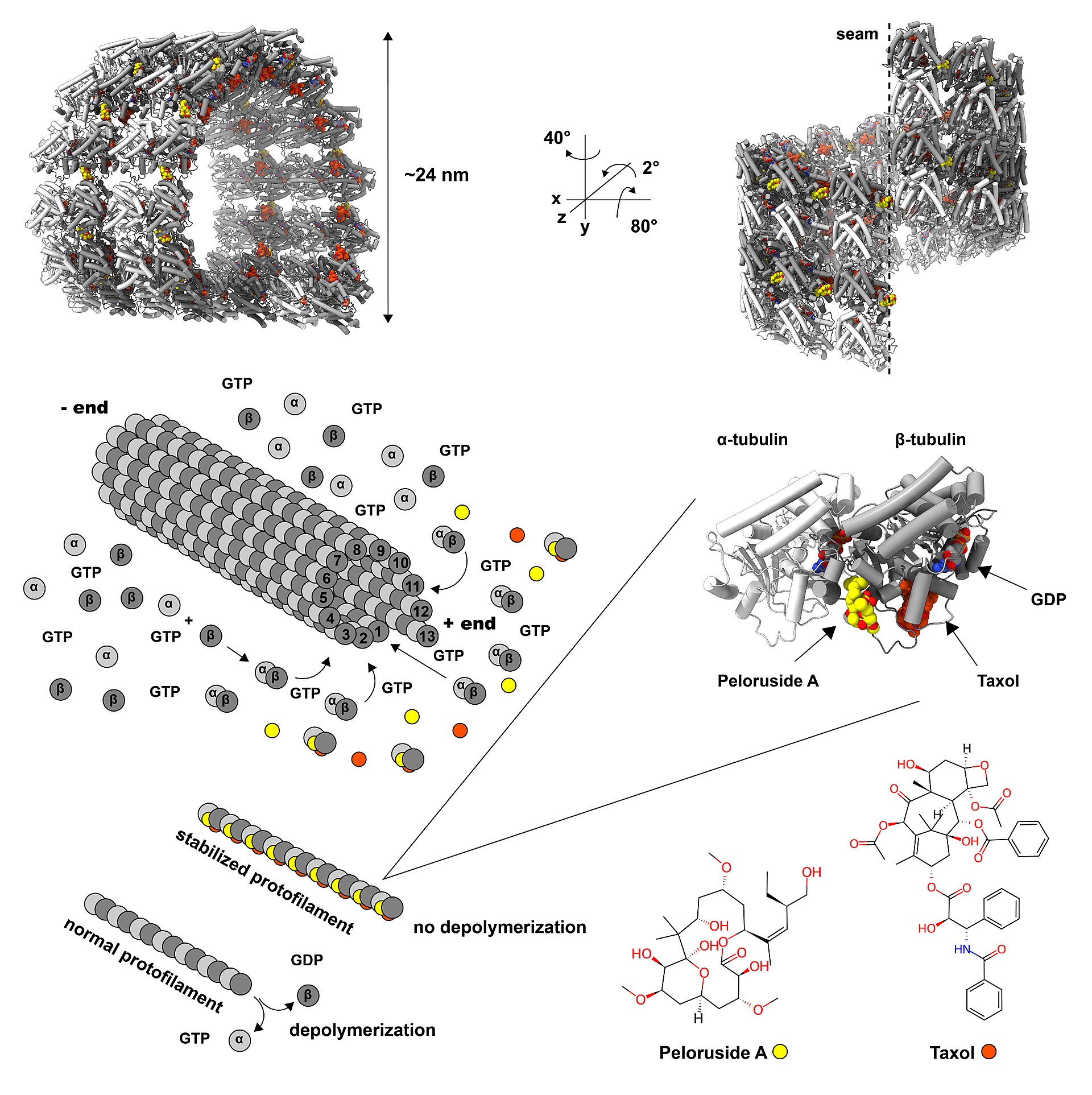
plate II · composite structural figure — duotone applied in display; original unmodified
A composite figure of microtubule architecture and stabilizer binding, built from structural data on the pig (Sus scrofa) microtubule: the approximately 24 nm wall fragment and lattice seam, the 13-protofilament arrangement with dimers adding at the plus end, the taxol and peloruside A binding sites on β-tubulin, and the contrast between a stabilized protofilament that does not depolymerize and a normal one that does. These are renderings and schematics from structural data, not micrographs. Taxol (paclitaxel) is one of the four microtubule-modulating drugs whose effects on anesthetic sensitivity are recorded at ORCH-C024.
This is the part of the case that can be tested now, and it has a real empirical fight in it.
The evidence for starts with the finding that anesthetics bind tubulin and change microtubule photophysicsC011. An anesthesia laboratory at Penn with no stake in the theory finds that an anthracene anesthetic photolabels β-tubulin. The same laboratory finds that microtubule stabilizers raise the dose needed to immobilize tadpoles.
▸ claims behind this paragraph (1)▾ claims behind this paragraph
The drug and the dosing schedule differ, so this does not refute the acute result. It does undo the idea that manipulating microtubule stability changes anesthetic susceptibilityC012 in any consistent direction. The Wellesley group, to its credit, cites the contrary study in its own abstract.
▸ claims behind this paragraph (1)▾ claims behind this paragraph
The sharpest objection comes from inside the Princeton experiment. It also tests picrotoxin, a convulsant and pharmacologically the opposite of an anesthetic, and reports a comparable effect on the same assay. If a convulsant and two anesthetics all move the signal, the assay may be measuring how easily small oily molecules perturb microtubule photophysics, not anything specific to anesthesia.
A test that would decide this is well defined. It needs eight or more agents, including non-anesthetics matched for solubility, free drug concentrations measured, and the predicted correlation registered in advance. It has not been run.
This site's own re-analysis of the four published groups finds the shape of the pattern striking. One mass unit across the spin boundary changes potency by about 30 points; two mass units within a spin pair change it by a few. A smooth effect of mass cannot produce a step like that.
The same re-analysis finds the result thinner than its citation record suggests:
the headline xenon-alone values are calculated from mixtures with isoflurane, not measured directly;
the error bars are of unstated type;
the data cannot statistically separate spin from mass;
in eight years nobody has repeated the experiment.
Spin also points at some spin-sensitive chemistry, not at microtubules. Researchers proposing radical-pair chemistry, in which the spins of paired electrons steer a reaction, have taken up those same four numbers. The same group models the idea that a magnetically sensitive radical pair modulates how fast microtubules assembleC044. That is a parameter fit, not a measurement. But it offers a mechanism for chemically opposite microtubule drugs acting alike. Any radical-pair account implies a cheap test nobody has run: does the xenon isotope effect change with magnetic field?
▸ claims behind this paragraph (1)▾ claims behind this paragraph
The philosopher Kelvin McQueen presses an escape: Penrose's criterion is a lifetime rule, not a random-noise equation, and predicts no radiation. That is correct, and it is why this claim is unresolved rather than refuted. But the escape is getting costly, for three reasons.
Warren S. Warren, a leading NMR methodologist, replies that the data show only that living tissue is complex and imprecisely characterized by MRI. The authors answer with numbers. The classical mechanism he proposes, they calculate, could reach at most 0.4% of the initial magnetization, or 0.13% once relaxation is included, far below what they observe. That answers one classical explanation, but in the authors' own words and with formulas derived for chemical solutions. Nobody else has run the sequence.
Even fully validated, the result would implicate no microtubule: the known quantum systems in the measurement are the spins of protons in water.
The Penrose-side reply is that these are results inside existing frameworks, not the invention of new ones. A co-author of DeepMind's AlphaProof argues much the same in a position paper: the systems deduce, but cannot make the jump to new premises. The case editor's own essay concedes that Penrose's testable examples have mostly gone against him. It defends 'the escalator, not the steps', and leaves open whether that is depth or unfalsifiability.
This bears on why the theory was proposed, not on whether it is true. Refute the Gödel argument and every microtubule claim stands where it was. Vindicate it and microtubules gain no special claim to be what does the non-computing.
The live accounts, side by side
Orch OR. Predicts coherence at 37 °C lasting tens of milliseconds, anesthetic suppression of it that scales with clinical potency, and collapse lifetimes that scale as ℏ/E_G.
Interesting condensed matter, nothing more. Predicts coherence lost within femtoseconds to picoseconds, optical effects moved by any small oily molecule (convulsants included), and no potency correlation.
Classical multi-target pharmacology. Predicts that receptor genetics keeps explaining the drugs one by one, and that microtubule drugs act through transport, metabolism and cell health.
Spin chemistry without microtubules. Predicts that the xenon isotope effect changes with magnetic field, and that isotope or redox manipulations shift microtubule assembly.
Non-classical brain, other site. Predicts that the MRI signal replicates in other hands and survives tests on calibrated phantoms, with no dependence on microtubules.
Collapse physics on its own. Predicts that ℏ/E_G scaling shows up, or fails to, in levitated-particle or condensate experiments, whatever the brain does.
Its limits are the proponents' opening. The same mutation barely affects volatile anesthetics, which its authors conclude act through a broader set of targets. The hypnotic effect is reduced, not abolished. A review by senior anesthesia researchers reports that two decades of work found no channel, and no combination of channels, sufficient for immobility under inhaled agents. So the stronger claim that anesthesia and cognition are *fully* classicalC004 is unresolved.
▸ claims behind this paragraph (1)▾ claims behind this paragraph
The proponents' best argument sits here. Proponent quantum-chemical modelling reportedly predicts several volatile agents' potencies from how they bind to tubulin. In effect it reproduces the Meyer–Overton correlation, anesthesiology's oldest rule, which links a drug's potency to its solubility in oil. A proponent commentary asserts that no other candidate target has a published model that does the sameC057. That assertion has no survey behind it, and the modelling has never been tested prospectively. But no rival model is on the table either.
▸ claims behind this paragraph (1)▾ claims behind this paragraph
The conventional account also gives no principled story of why any of this activity is experienced. Orch OR attempts one, but attempting an explanation is not evidence for it.
What would settle it
A coherence measurement in microtubules at 37 °C, against a pass/fail threshold proponents publish in advance. A clean null near the requirement would close the biological half. Tens of milliseconds would be a landmark in biophysics.
A stable optical signal. Fix the scattering ambiguity first. Then run an anesthetic potency series that includes non-anesthetic and convulsant controls. A slope that tracks clinical potency would be hard to explain conventionally.
A tubulin knock-in mouse that cannot bind anesthetic but still builds normal microtubules, with receptor function checked unchanged. This is the only design that would give the microtubule idea causal evidence of the receptor account's quality.
A preregistered multicentre epothilone replication, with acute and chronic dosing side by side and brain drug levels measured.
A direct test of ℏ/E_G scaling in mesoscopic superpositions, plus the desk calculation of whether the one dynamics known to give Penrose's rate is already excluded.
A magnetic-field test of the xenon isotope effect. If the effect shifts with the field, the anomaly belongs to spin chemistry, not microtubules.
None of these requires believing the theory first, and almost none has been run.
the argument ladder
evidence for a lower rung does not automatically climb
Attribution
Was it actually done? The claims the thesis stands or falls on.
The strongest records on each side, structurally symmetric. Every record separates what the source states from what we infer. Browse the full ledger (70 records) →
strongest supporting
▲Supports· strongORCH-E015
A single GABA_A β3 point mutation abolishes intravenous anesthetic action in vivo
what the source states
The abstract reports that mice carrying the β3(N265M) point mutation, which renders GABA_A receptors containing the β3 subunit insensitive to etomidate and propofol, showed abolished immobilizing action of both drugs and a profound reduction in their hypnotic effect (duration of loss of righting reflex). The same mutation only slightly reduced the effects of the volatile anesthetics enflurane and halothane. The authors conclude that the volatile agents "act via a broader spectrum of molecular targets."
what we infer
The steelman anchor, and the reason the conventional account is assessed as well supported: this is target-level causal evidence of a kind no microtubule study in this case approaches — change one residue, lose the drug effect. Any serious treatment of Orch OR has to reckon with the fact that its main rival has this and it does not. The record is filed as supporting ORCH-C003 and undermining the strong anesthesia claim, but with an honest boundary: the result is about intravenous agents, and the authors' own conclusion about volatiles acting through a broader target spectrum is the specific opening through which a microtubule contribution to volatile anesthesia could still enter. Orch OR proponents are entitled to that opening; they are not entitled to ignore the rest.
limitations
Establishes the mechanism for etomidate and propofol; does not transfer to volatile agents, which are the agents most Orch OR experiments use.
Shows a target is necessary for these drugs' action, not that consciousness is exhausted by receptor pharmacology.
Cautionary precedent from the same literature: TREK-1 knockout anesthetic resistance was initially reported and later not reproduced, so genetic anesthetic-target findings are not automatically durable.
Majorana Demonstrator: no spontaneous collapse radiation in 37.5 kg-y of enriched germanium
what the source states
The collaboration reports that, although white-noise collapse models predict a 1/E X-ray signature, they find "no evidence of such radiation in the 19-100 keV range" in a 37.5 kg-y enriched-germanium exposure collected between 2015 and 2019, with a best-fit signal of 6.3 ± 398.8 counts.
what we infer
An independent underground collaboration reproduces the null in the same channel Gran Sasso searched, so ORCH-C031 no longer rests on a single experiment.
limitations
Constrains only the white-noise formulation; the authors state coloured-noise extensions with a cutoff near 10^11–10^12 Hz evade X-ray bounds.
The DP interpretation is a secondary re-expression of a CSL-oriented search.
A second underground null adds weight to the exclusion of the parameter-free DP model
what the source states
The collaboration closes by stating that it improved the lower limit on the Diósi–Penrose collapse model by almost an order of magnitude, "adding significance to the exclusion of the parameter-free version of the model".
what we infer
Direction here is toward the physics conjunct and toward the Gran Sasso finding's generalization: an independent group reaches the same verdict about the parameter-free version, so the squeeze on ORCH-C030 is no longer single-experiment.
limitations
Same radiation channel as SRC-DONADI-2021, so not an independent test of the mechanism, only of the measurement.
Does not address Penrose's characteristic-lifetime formulation, which predicts no radiation.
Second reader (claude-sonnet-5, 2026-09-11, run 2026-09-11-verify-orch-or-120610, verify-v6) found the passage bears in different directions on the claims the record named; this record carries "supports" toward ORCH-C031, the rest went to a record of its own at intake: The quoted conclusion is accurate and correctly located, and the record properly flags the shared radiation channel with the 2021 underground test as a non-independence issue. But labeling this as 'undermines' is backwards: a second, independent (mostly) underground null result tightening the DP bound and reinforcing exclusion of the parameter-free model actually supports ORCH-C031, which states exactly that outcome. For ORCH-C030, which concerns the general characteristic-lifetime collapse formulation rather than the parameter-free DP model specifically, the passage is only background context, not a direct bearing on that claim's truth.
Independent laboratory: chronic epothilone D and vinblastine both INCREASE isoflurane sensitivity
what the source states
The abstract reports that "compared with saline treatment, epothilone D and vinblastine induced a leftward (more sensitive) shift of LORR response curves (95% confidence intervals for EC50: epothilone D, 0.75[0.73, 0.77] vs. saline, 0.97[0.96, 0.98]; vinblastine, 0.74[0.73, 0.75] vs. saline, 0.98[0.97, 0.99])," while paclitaxel produced a small rightward shift (1.05[1.03, 1.06] vs. saline 0.98[0.97, 0.99]) and the opioid control morphine produced a larger rightward shift (1.16[1.15, 1.17]). Mice received the microtubule-modulating drugs for more than two weeks. The study was randomized and blinded.
what we infer
The most methodologically complete animal study in the case, and it runs against the theory in the form the theory is usually stated. Two features make it more informative than a single contrary data point. First, it measured full concentration–response curves rather than latency at one concentration, which is the better-specified quantity. Second, it included a destabilizer — and vinblastine shifted sensitivity in the same direction as the stabilizer epothilone D, which no account based on microtubule stability predicts, and which suggests the operative variable may be general cellular disruption. This does not refute the acute epothilone-B result (different compound, different regimen), but it does refute the generalization that stabilizing microtubules protects consciousness from anesthetics.
limitations
Chronic dosing (>2 weeks) versus the single acute injection of the Wellesley studies; chronic modulation invites compensatory remodeling.
Epothilone D rather than epothilone B — and Emerson et al. found epothilone D producing resistance in tadpoles, so the compound's direction is not consistent across preparations either.
Authors acknowledge saline was an imperfect vehicle control for poorly soluble compounds.
LORR rather than MAC; isoflurane only; outbred CD1 mice.
Epothilone D altered blood pH and CO₂, offering a physiological confound.
Gran Sasso null result excludes the parameter-free Diósi–Penrose model
what the source states
The abstract reports a dedicated search for the spontaneous radiation predicted by gravity-related dynamical collapse, performed with an ultra-low-background germanium detector at the Gran Sasso underground laboratory, and states: "Our result sets a lower bound on the effective size of the mass density of nuclei, which is about three orders of magnitude larger than previous bounds. This rules out the natural parameter-free version of the Diósi–Penrose model."
what we infer
Methodologically the strongest experiment anywhere in this case, conducted with the model's own co-originator among the authors, and it came out negative. It substantially damages the physics conjunct ORCH-C001 requires. The scope of the exclusion is precisely stated in the authors' own words and should not be inflated: it kills the natural parameter-free stochastic completion, not every conceivable gravity- related collapse theory, and specifically not Penrose's original heuristic ℏ/E_G criterion, which makes no radiation prediction. That qualification is real (see ORCH-E019) and is also exactly the kind of escape that costs a theory its testability.
limitations
Tests a specific stochastic master equation; the map from Penrose's geometric argument to that equation is not unique.
Constrains a parameter range rather than closing the question — non-Markovian and non-local variants evading the radiation prediction have been proposed.
Does not test the ℏ/E_G lifetime scaling itself, which remains unmeasured.
Picrotoxin, a convulsant, produced a comparable effect on the same assay
what the source states
The deep-research report states that the same study found picrotoxin — a GABA_A antagonist and convulsant, pharmacologically the opposite of an anesthetic — reducing tryptophan quenching comparably to the anesthetics tested. This detail is from the paper body rather than the abstract and was not directly verified by this import; it is recorded because it is the single most important qualification on ORCH-E002 and omitting it would misrepresent the experiment.
what we infer
If a convulsant and two anesthetics all suppress the assay, then what is being measured is the perturbability of microtubule photophysics by small hydrophobic molecules, not something specific to anesthesia. This is the sharpest available objection to the anesthesia arm and it comes from inside the theory's own flagship experiment rather than from critics — which is to the authors' credit for reporting it. It does not show the anesthetic effect is spurious; it shows the experiment as performed cannot distinguish an anesthesia-specific mechanism from general pharmacological perturbation. Only a potency series with proper controls can.
limitations
Detail not directly verified against the paper by this import; carried as reported by the deep-research report.
A single comparison compound, not a systematic specificity panel — the absence of specificity is not itself established, only unaddressed.
steelmanned — the account the featured hypothesis must beat
Classical neural computation: cognition lives in membrane potentials, synapses and network dynamics, and consciousness is an organizational property of that activity, not a quantum event. For anesthesia, the account is multi-target pharmacology, with causal evidence Orch OR lacks. One point mutation in the GABA_A receptor β3 subunit abolishes the immobilizing action of etomidate and propofol and sharply reduces their hypnotic effect, while volatile agents act on a broader set of targets. On this account the microtubule findings are ordinary physics and cell biology. An ordered aromatic lattice has collective photophysics whether or not anything computes with it. Small hydrophobic molecules, convulsants included, perturb it. Microtubule drugs shift anesthetic sensitivity through transport, metabolism and cell health, which is the natural reading of a stabilizer and a destabilizer acting alike. Its acknowledged gaps are that it offers no account of why any of this is experienced, and no sufficient molecular target for inhaled agents.
What would change our mind
The case does not end in a verdict; it ends in the studies that would move it, in the order this edition judges they would move it most. A result in either direction counts.
ORCH-R001Small grant · Lab
Measure a coherence witness in physiological microtubules at 37 °C
The measurement the field has been arguing about for twenty-five years without making. Use 2D electronic spectroscopy or photon-echo methods to quantify a defined density-matrix observable — dephasing time, coherence length — in polymerized microtubules under physiological temperature and ionic strength. Run the comparison series that makes the number interpretable: purified tubulin, polymerized microtubules, microtubules with physiological MAPs bound, crowded cytosol-like solution, and if feasible isolated axons. Include isotope substitution, a temperature series, and denatured-protein and disorder controls to separate electronic from vibrational coherence. Publish the target threshold before collecting data.
expected information gain
Decisive either way, and the only entry here that is. Every argument on this rung currently runs on two calculations that disagree by seven to eight orders of magnitude, neither anchored to a measurement. A clean null at physiological conditions would come close to settling the biological half of Orch OR negatively; a positive result at the required timescale would be a landmark in biophysics regardless of what anyone concludes about consciousness. This is the highest-value experiment in the case and it needs an ultrafast spectroscopy group, not a consciousness researcher.
Publish, in advance, a 310 K thermal-bath dephasing prediction for the same 1JFF tryptophan geometry
Ask the group that already has the machinery to extend its radiative-loss Lindblad treatment (recorded at ORCH-E072 and ORCH-E073, SRC-GASSAB-2026) to include solvent, ionic and vibrational baths at 310 K, and to publish, before any spectroscopy is run, the predicted dephasing time, coherence length and participating degrees of freedom, together with the value of a named density-matrix witness that would count as pass and the value that would count as fail. This is the pass/fail threshold the case's own audit found missing from the corpus (ORCH-E035, ORCH-E036), and it is the prior question to the expensive experiment at ORCH-R001: without it, any measured number can be absorbed either way.
expected information gain
Converts the case's central absence from an unmeasured quantity into a scorable one, by fixing the acceptance criterion in advance rather than after the measurement.
Close the scattering ambiguity in the microtubule quantum-yield observable before any potency series
Re-measure the tubulin-dimer versus taxol-stabilized-microtubule quantum yield in cuvette and integrating-sphere geometries, with independent turbidity measurement, inner-filter controls, matched buffers and a measured polymer fraction, at both 280 and 295 nm excitation. The target is to replace the bounded estimate recorded at ORCH-E075 with a single value and to fix the sign at 295 nm (ORCH-E076 through ORCH-E079), and to repeat the non-anesthetic additive control reported in SRC-GASSAB-2026A alongside a convulsant and a hydrophobic nonimmobilizer. Until this is closed, an anesthetic potency series against this observable (ORCH-R002, ORCH-R009) risks measuring the scattering correction rather than the physics.
expected information gain
Makes the collective-optics observable metrologically stable enough that a preregistered anesthetic potency correlation against it could count as pass or fail.
Anesthetic potency series against a microtubule optical observable, with the controls that matter
Extend the Kalra protocol from two agents to a prospective series of at least eight, spanning volatile agents, intravenous agents, and xenon, with the controls whose absence currently sinks the specificity argument: nonimmobilizers (F6, F8), the convulsant picrotoxin, and hydrophobic non-anesthetics matched for lipid solubility. Measure free aqueous concentration rather than nominal dose. Preregister the predicted correlation between clinical potency and suppression of the observable — Craddock et al. 2017 already stated it, so the prediction exists in the literature and can be tested prospectively rather than fitted after.
expected information gain
Directly resolves the objection that currently does the most damage to the anesthesia arm: in the flagship experiment, picrotoxin — a convulsant — affected the assay comparably to the anesthetics. If potency correlation appears across a proper series with nonimmobilizers behaving as they should, the microtubule anesthesia hypothesis becomes serious science. If nonimmobilizers and hydrophobic non-anesthetics suppress the signal just as well, the assay is measuring general pharmacological perturbability and this line closes.
▸ 9 more studies on the agenda▾ the rest of the agenda
ORCH-R009Small grant · Lab
A Meyer–Overton test for a microtubule optical observable
The case's existing anesthetic-potency work (ORCH-R002) asks whether a microtubule observable responds to anesthetics. This asks the sharper question the historical correlation makes available: does the response scale with clinical potency? Take a chemically diverse anesthetic panel spanning orders of magnitude in MAC — including at least one agent that does not act at GABA-A — and measure a quantum-optical or coherence observable of microtubule preparations across a dose range for each agent, in a controlled-atmosphere chamber with the gas concentration monitored directly. Plot the concentration that half-dampens the observable against each agent's clinical potency. A slope tracking 1/MAC across chemically unrelated agents would be a Meyer–Overton correlation for a microtubule observable — the same signature that made the original correlation persuasive, now on the structure the theory nominates. A flat or scattered relationship would show the observable responds to anesthetics without tracking what makes them anesthetics, which is the weaker and more likely outcome.
expected information gain
Converts "anesthetics affect microtubules" — already shown, and compatible with many mundane mechanisms — into a quantitative potency relationship that classical accounts do not predict. Cheaper than the genetic designs the same question has attracted, and informative in either direction; a null is publishable and closes a line the field keeps re-opening. Proposed by proponents; specifying the panel, the observable, and the correlation criterion in advance is what would make either outcome binding.
Do for tubulin what Jurd et al. did for the GABA_A β3 subunit. Use the Emerson et al. photolabeling data to define the anesthetic binding pocket on β-tubulin, then engineer a knock-in that abolishes anesthetic binding while preserving polymerization dynamics, axonal transport, and viability. Test whether behavioral anesthetic sensitivity and the anesthetic-induced photophysical change move together. Include the essential negative control: verify baseline GABA_A responses are unchanged, so any effect cannot be attributed to receptor pharmacology.
expected information gain
The only design in this agenda that could give the microtubule hypothesis causal evidence of the same quality the conventional account already has — which is precisely the asymmetry that currently decides the anesthesia comparison. Co-segregation of anesthetic resistance with loss of the optical effect, at unchanged receptor function, would be very hard to explain conventionally. Unchanged anesthesia despite abolished tubulin binding would substantially refute the strong claim. Expensive and slow, but this is the experiment that would end the argument.
Preregistered multicenter replication of the epothilone anesthesia experiments
Resolve the flat contradiction between the Wellesley epothilone-B results and the Massachusetts General epothilone-D and vinblastine results. Test epothilone B and D head-to-head, acute and chronic regimens, in the same laboratories under one protocol: randomized counterbalanced vehicle/drug crossover, both sexes, full LORR concentration–response curves plus MAC rather than latency at a single concentration, measured brain drug concentration, and blood-gas monitoring given the documented pH and CO₂ changes. Preregister a prediction about which manipulations should raise and which should lower potency.
expected information gain
Two independent laboratories currently report microtubule stabilization moving anesthetic sensitivity in opposite directions, and a destabilizer moving it the same way as a stabilizer. Until that is sorted out, no inference from this literature is safe in either direction. The preregistered directional prediction is the load-bearing part: it forces the hypothesis to commit in advance, which is what would convert this line from a set of accommodatable results into a test.
Desk audit: is the dynamics that reproduces ħ/E_Δ already excluded by the bounded channels?
From the published literature alone, compute whether the least-decoherence semiclassical construction recorded at ORCH-C066 to ORCH-C068 — which reproduces the conjectured rate with the prefactor fixed — predicts spontaneous radiation and momentum diffusion at levels reached by the Gran Sasso search (ORCH-C031), the independent germanium search (ORCH-C047; its Diósi–Penrose reading at ORCH-E049), and the LISA Pathfinder acceleration-noise bound (ORCH-C046); and whether its regularization scale can be pushed above the bounded values without altering the rate. If it is already excluded, the physics conjunct is refuted in every dynamics so far proposed for it and the escape at ORCH-E019 buys nothing; if it survives, the surviving parameter window should be stated numerically, which is what a decisive mesoscopic test (ORCH-R007) would then have to reach.
expected information gain
Prices the under-specification escape precisely: either every proposed dynamics for the Penrose rate is bounded, or a stated surviving window becomes the target for the next experiment.
Test the ℏ/E_G collapse scaling in mesoscopic superpositions
Test Penrose's collapse criterion directly rather than testing a stochastic completion of it. Using levitated nanoparticles, nanomechanical resonators, or the Bose–Einstein condensate scheme of Howl, Penrose & Fuentes, vary mass and separation to determine whether collapse lifetime scales as ℏ/E_G, with environmental decoherence independently characterized. The point is to measure the relation the theory actually asserts — which the Gran Sasso experiment, for all its quality, did not.
expected information gain
Tests one of the two conjuncts of the headline thesis on a track with no biology in it, and would be pursued by quantum-gravity groups for their own reasons — the cleanest separation of concerns available in this case. It would also close the escape route that currently keeps ORCH-C030 unresolved: Penrose OR survives Gran Sasso by not being the model that was tested, and this measures the criterion itself. Scaling is the acknowledged obstacle; the required regime is beyond current capabilities.
Xenon isotope anesthetic potency measured under a controlled external magnetic field
Randomized, blinded loss-of-righting-reflex dose–response in mice for spin-0 and spin-bearing xenon isotopes, run inside a controllable-field enclosure with arms at geomagnetic field, at a field an order of magnitude higher, and at a field about two orders above geomagnetic (i.e. above the upper limit of the field range over which the published radical-pair fit holds (SRC-SMITH-2021)), with field strength logged and the predicted isotope ordering preregistered for each arm. Cheapest decisive discriminator in the case: a field dependence of the isotope effect would support the radical-pair mechanism proposed in SRC-SMITH-2021 and is orthogonal to Orch OR, since no microtubule coherence is required; no field dependence at fields well above the model's stated agreement range would falsify the published fit and return the xenon anomaly to unexplained, further reducing what ORCH-C025 can do for ORCH-C002. My searches did not locate such an in vivo experiment; that is an unresolved retrieval question rather than a finding of absence.
expected information gain
Separates spin-chemistry quantum biology from both classical pharmacology and the microtubule attribution on the one datum that currently embarrasses the classical account.
Independent replication of the Bandyopadhyay resonance measurements
Have a laboratory outside the Bandyopadhyay lineage attempt the triplet-of-triplet resonance measurements on tubulin, microtubules, and neuronal preparations, with published protocols, raw data, and blinded analysis. This is a replication study rather than a new experiment, and it is overdue: the group's distinctive results have stood unreplicated for over a decade, including the 2013 report of 100-microsecond coherence in single microtubules at warm temperature.
expected information gain
Resolves the field's largest replication gap at modest cost. A successful replication would establish an unusual scale-free physical property of neural structures worth investigating on its own terms; a failure would remove a frequently-cited pillar from the proponent case. The comparison the case editor's own primer draws is the right one: the photosynthetic coherence results of 2007 were replicated many times over and founded a field. Thirteen years without replication is itself informative.
Validate the zero-quantum-coherence brain protocol against known ground truth
Before interpreting consciousness correlations, establish what the Kerskens protocol actually witnesses. Run it on engineered phantoms with known coupling structure, then ex vivo tissue, then living brain, testing specifically whether the classical intermolecular multiple-quantum- coherence mechanism Warren proposes can reproduce the reported signals. Have an independent group implement the pulse sequence and signal processing from the published description. Only then test whether the signal depends on microtubule integrity — which is the step that would connect this line to Orch OR at all, since the original experiment does not.
expected information gain
Highest-variance item on the agenda. Validated non-classical function in a living human brain would be among the most important results in neuroscience, independent of Orch OR; a demonstration that classical multi-compartment effects reproduce the signal would close a line that is currently generating strong public claims on contested evidence. Either outcome is worth having, and the ordering matters — phantom validation first, consciousness correlation last.
Zinc-isotope and ROS-modulation test of the radical-pair route to microtubule density
Blinded in vitro and cell-culture comparison of microtubule density and polymerization kinetics under matched chemical concentrations of nuclear-spin-bearing 67Zn versus zero-spin zinc isotopes, crossed with pharmacological modulation of reactive-oxygen-species removal and with field-shielded versus geomagnetic conditions. An isotope difference at matched chemistry, and a field dependence that tracks it, would support the mechanism at ORCH-C044 and its zinc-isotope prediction (SRC-ZADEHHAGHIGHI-2022) and give the 'same-direction stabilizer and destabilizer' result at ORCH-C024 a redox-mediated reading with its own predictions; a null on both would leave general cellular disruption as the better account of ORCH-C024 and would remove this rival from the anesthesia arm.
expected information gain
Tests whether the operative variable behind microtubule-drug effects on anesthetic sensitivity is polymer stability, generic disruption, or spin-dependent redox chemistry.
▸ 2 settled — answered, superseded or retired▾ settled — kept as the record of what was asked
ORCH-R008Publication prize · Desk
answered · 2026-09-30 · set by 2026-09-30-edition-orch-or-093603
Desk study: extract a falsifiable quantitative specification from the Orch OR literature
Study ORCH-S001 collected the corpus. ORCH-E035 shows the theory's parameter values are consistent across two decades, that no pass/fail threshold for any direct coherence test is published, and that the carrier changed in 2014. ORCH-E036 shows no unconditional proponent estimate reaches 25 ms. The remaining step, a proponent-endorsed threshold fixed in advance, is carried by the open item ORCH-R014.
Largely done. The corpus has now been tabulated: it commits to consistent parameter values across two decades — 500 ms with ~10^9 tubulins in 1996, 25 ms with 2 x 10^10 in 1998 and 2014, the same tau x N arithmetic throughout — and commits nowhere to a coherence length, an entanglement structure, a predicted anesthetic potency correlation coefficient, or a pass/fail threshold for any direct coherence measurement; the 1996 conformational-qubit carrier was retired in the 2014 revision, so the two formulations do not make the same demands. What is left is the part a literature audit cannot supply: a threshold — required coherence time, coherence length, participating degrees of freedom — endorsed by proponents and fixed in advance of the measurements in ORCH-R001, ORCH-R002 and ORCH-R009.
expected information gain
Addresses the defect that makes every other item on this agenda harder to interpret: without a published threshold, no measurement can count as pass or fail, and each new photophysics result gets absorbed rather than scored. The audit has now documented that the theory does not publish such a threshold, which was the most useful finding available at desk cost; the remaining value lies in getting proponents to commit to one prospectively, without which each new measurement will continue to be absorbed rather than scored.
answered · 2026-09-30 · set by 2026-09-30-edition-orch-or-093603
Spin or mass? A two-covariate re-analysis of the published xenon-isotope anesthetic-potency data
Study ORCH-S002 ran the pre-registered two-covariate re-analysis. ORCH-E037: the frozen identification rule tripped (condition number 302.4, driven by the narrow mass range rather than spin–mass collinearity), so no spin coefficient is evidential. ORCH-E038: a spin step describes the four means far better than a linear mass term, descriptively only. ORCH-E039 and ORCH-E040: the result is unreplicated, its headline values are calculated, and its dispersions are of unstated type. The dataset cannot support the inferential test; a new experiment (ORCH-R011) is what remains.
The xenon isotope result is one of the few anesthesia findings that is quantum-specific on its face: isotopes with nonzero nuclear spin (129Xe, I=1/2; 131Xe, I=3/2) are reported as less potent than spin-zero isotopes (132Xe, 134Xe), with polarizability held nearly constant. But in the tested set, spin-bearing isotopes are also the lightest, so spin is collinear with mass number, and mass plausibly affects diffusion, solubility, and uptake kinetics. This desk study tabulates every published per-isotope potency estimate (endpoint, n, dispersion, isotopic purity, delivery mixture, blinding, cohort identity) and fits potency on spin-presence and mass number, with collinearity diagnostics and leave-one-out checks. It tabulates only numbers already in the public record; no new animals, no new assays. The point is to determine whether the existing dataset can identify a spin coefficient at all, or whether it is arithmetically incapable of separating the two hypotheses.
expected information gain
Either outcome moves the ledger. If a spin term is separately identified — nonzero with mass in the model, mass null or wrong-signed, condition number and VIF within pre-committed bounds — then ORCH-C025 stands as a quantum-specific anesthesia observation that classical multi-target pharmacology (ORCH-C004) must accommodate, and the burden shifts to producing a mass-matched null. If the design matrix is rank-deficient in practice (spin and mass collinear beyond the pre-set VIF threshold), then ORCH-C025's inference is not supported by its own numbers regardless of how the original p-values read, and the item should be re-scoped to 'awaiting a mass-matched isotope pair' (e.g., a spin-zero isotope lighter than 129, or a spin-bearing isotope heavier than 132). A third outcome — that the published record does not report per-isotope dispersions or group sizes at all — would itself be a finding about the auditability of the result.
Trust comes partly from showing changed minds. Each entry is an edition that changed a verdict, with the word before and the word after — a reversal included.
Aletheia records every change to a case: what changed, why, and who made it — including the AI's role. The latest:
Research agenda: ORCH-R008 open → answered (Study ORCH-S001 collected the corpus. ORCH-E035 shows the theory's parameter values are consistent across two decades, that no pass/fail…
Annotation of the 2026-09-11 intake entry (actor 'aletheia verify (claude-sonnet-5 second reader; drafter claude-fable-5-1)'): the drafter named there is the model asked; the model that…
Corrections applied from the atomic-statement rule (draft-v8), applied to the two statements that landed before it: ORCH-C057.statement — "No candidate molecular target for inhalational…