← All comparisons
Sources partly checked · Bodies & gestures
Bodies with visible ribs
Karahantepe’s stone figure and the moai kavakava repertoire.
2 groups · 2 registered records · reviewed 2026-09-19
Motif families: Ribs & lean bodies
Neolithic Anatolia
Anatolian ribbed figures
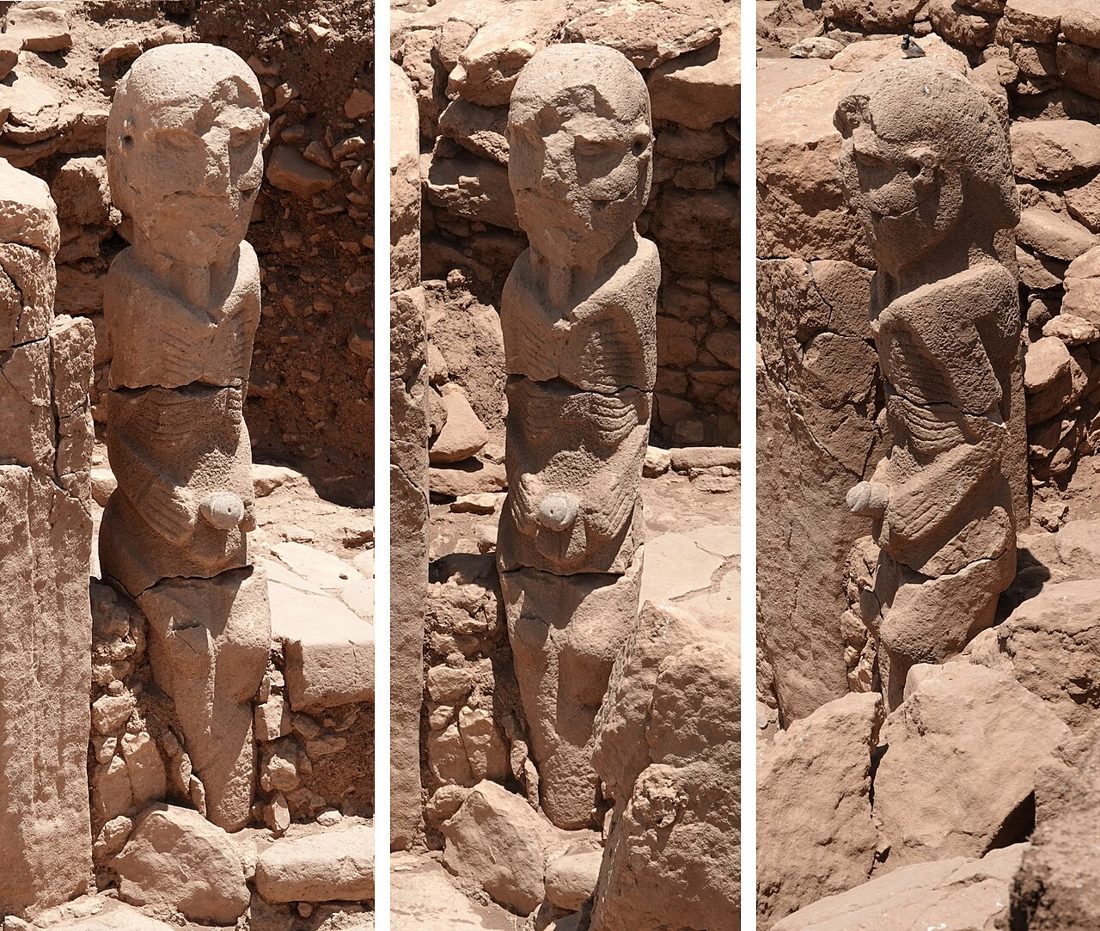
The large Karahantepe statue.
Why these examples belong together
One statue shown in three photographs; no frequency claim.
object · KarahantepeKarahantepe ribbed figure
The official discovery account describes a seated figure. The montage contains three views of one statue.
Dates, sources & image record
- Date unresolvedunresolved · Neolithic attribution is established in the discovery context; this review has not tied the individual carving to a dated stratum.
photographic montage · Marco Restano. CC BY-SA 4.0. Image record
Existing source image; displayed uncropped. No generated reconstruction.
2023 Karahantepe and Göbeklitepe discoveries · Karahan Tepe’s figure and the moai kavakava
Rapanui traditions
Rapanui moai kavakava
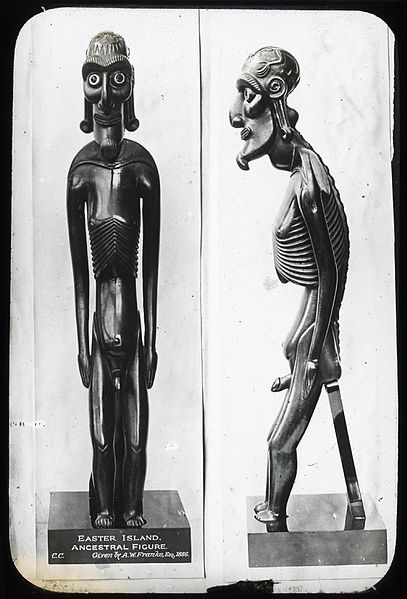
Small wooden figures with pronounced ribs.
Why these examples belong together
One historical example pictured; a separate museum record supplies type context, not its exact identity.
object · Rapa NuiMoai kavakava · historic photograph
A separate museum record establishes the wooden figure type. Its date must not be silently assigned to this photograph.
Dates, sources & image record
- Date unresolvedunresolved · The exact photographed sculpture’s collection identity and date remain unresolved. Oc,G.T.1730 is an image identifier, not a secure collection year.
historical photograph · British Museum photographic collection; reproduction in Lee Paqui’s article. Public domain historical photograph; original record linked. Image record
Reproduced image downloaded unchanged from https://grahamhancock.com/wp-content/uploads/2024/08/paquil1_html_m669eb558.jpg . Two views, one object; the individual sculpture identity is unresolved.
Historic front and side views · Oc,G.T.1730 · Moai kavakava · Oc,+.2595 · Karahan Tepe’s figure and the moai kavakava
The proposed connection
What makes it a question?
The highlighted ribs, prominent facial features and bodily posture make a more specific comparison than generic standing statues.
Paqui explicitly proposes this comparison. Her physiological and shared-ancestry explanations require evidence beyond sculpted anatomy.
Karahan Tepe’s figure and the moai kavakava
Look closely
What appears to correspond
- Both selected examples emphasize ribs and the human body.
Keep in the frame
What differs or remains uncertain
- The stone statue is monumental; the wooden figures are small and portable.
- The official discovery account calls the Karahantepe figure seated.
- The circulating historical photograph’s “1730” identifier should not become a collection date.
Transmission check
No route established in this review
No transmission sequence for this specific comparison has been established in the sources reviewed. That is not proof that contact was impossible.
What would move this forward
- Identify the exact photographed wooden figure.
- Compare local variants and funerary interpretations before inferring shared meaning.
Follow the evidence
Sources & scope
Provisional editorial record; no independent specialist sign-off. Status describes review depth, not the probability of a historical connection.
- claim · Lee Paqui; hosted by Graham Hancock
Guest article, 19 October 2024. Proposes ribbed-figure and bird-with-rounded-object parallels. Its medical and ancestral interpretations are not established by the photographs.
- excavation · Türkiye Ministry of Culture and Tourism
30 September 2023: 2.3 m human statue with emphasized ribs and spine, described as seated; the article’s “standing” label needs care.
- museum · British Museum
A documented example of the type, late eighteenth to mid-nineteenth century. Not an established identification of the figure in the catalogue’s historical photograph.
- image-record · British Museum photographic collection / Wikimedia Commons
The linked image identifier contains 1730; it is not a demonstrated collection year. Individual sculpture identity and age remain to be tied to a collection record.